 Email: jiedong@sxrszdh.com
 Phone / Wechat:+86 15340683922
Description
Product Introduction
The high-speed pick-and-place machine ran at 25,000 picks per hour. The standard SG1 board (10 MHz, 1 ms update) was the bottleneck. The controller waited for position data. The machine couldn’t go faster. GE released the SG1A. Twenty megahertz clock. Two hundred fifty microsecond update rate. The pick-and-place ran at 35,000 picks per hour. The machine builder ordered 50 boards.
The DS200IQXSG1A is the high-speed serial encoder interface. Four channels. Clock rates up to 20 MHz (double the SG1). Position update rate: 250 µs (4x faster). Supports SSI, BiSS C, and EnDat 2.2. The board also has faster auxiliary inputs (100 ns capture resolution) and jitter-free clock generation (crystal-referenced). The SG1A is for high-performance motion systems that need absolute position feedback at servo loop rates.
What did GE change? The clock generator (crystal oscillator instead of PLL). The transceivers (faster, lower propagation delay). The backplane interface (updated for 250 µs scan). The board requires controller firmware v7.0 or higher. The SG1A also has a real-time timestamp for each position reading (1 µs resolution). For high-speed registration, the SG1A is the board to use.
Key Technical Specifications
| Parameter | Value |
|---|---|
| Serial encoder channels | 4 (independent) |
| Supported protocols | SSI (32 bits), BiSS C (32 bits), EnDat 2.2 (32 bits + diagnostic) |
| Clock frequency | 1 MHz to 20 MHz (programmable, crystal-referenced) |
| Position resolution | Up to 32 bits (4,294,967,296 counts) |
| Position update rate | 250 µs (all channels updated simultaneously — parallel, not sequential) |
| Timestamp resolution | 1 µs (for each position reading) |
| Encoder supply (per channel) | 24 V DC, 500 mA (with overcurrent reporting) |
| Auxiliary inputs (per channel) | 2 (24 V DC, 100 ns capture resolution) |
| Data format | Binary, Gray code, BiSS CRC, EnDat CRC |
| Jitter (clock to data) | <5 ns (crystal-referenced) |
| Isolation | 1000 Vrms (encoder to backplane) |
| Required controller firmware | v7.0 or higher (v7.6 recommended) |
| Operating ambient | 0 °C to +50 °C |
| Storage temperature | –25 °C to +70 °C |
| Power supply | +5 V from backplane (500 mA — higher than SG1), 24 V external |
| Connectors | 4x D-sub 15-pin (encoder), 1x 20-pin (aux I/O) |
| Diagnostic LEDs | 4 (power), 4 (active), 4 (error), 1 (link) |
| GE drawing reference | GEI-100450 (Rev 31) |
Quality Inspection Process (SOP Transparency)
The SG1A requires 20 MHz testing with jitter measurement.
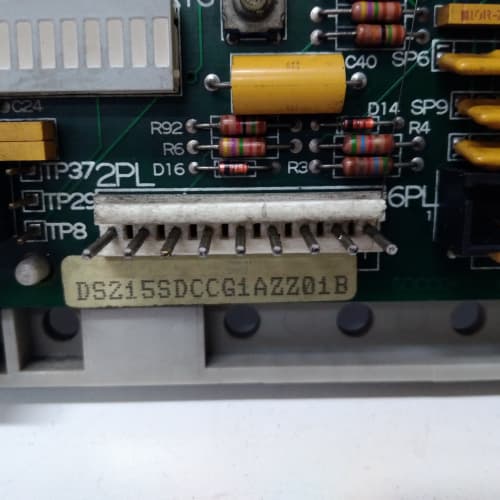
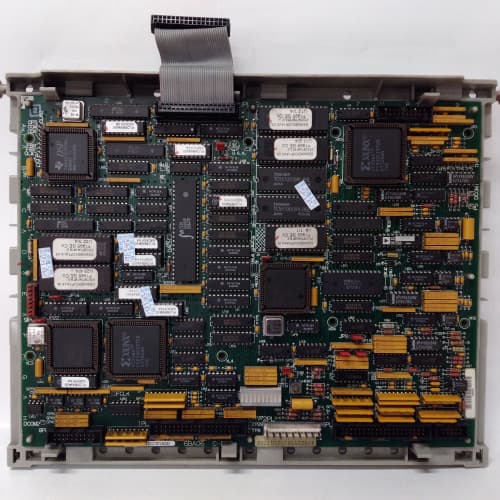
Incoming Verification: OEM packing slip. Visual inspection: the board has an additional crystal oscillator (near the edge connector) — inspect for damage. The D-sub connectors are high-density (same as SG1). The board has a heat sink on the transceivers (small, adhesive).
High-Speed Communication Test (20 MHz, SSI): Test bench uses 20 MHz SSI simulator (FPGA). Connect to channel 1. Run at 20 MHz clock, 32-bit data. Measure clock jitter — must be <5 ns (crystal-referenced). Read position at 250 µs intervals for 4 hours. Zero CRC errors. Test all 4 channels simultaneously.
BiSS C Test (20 MHz, CRC): BiSS simulator at 20 MHz, 32-bit position + 8-bit CRC. Board must validate CRC. Inject CRC error — board must flag fault. Test 1,000 error injections.
EnDat 2.2 Test (Heidenhain Encoder, 20 MHz): Connect Heidenhain ROC 425 encoder (supports EnDat 2.2). Read position at 250 µs, also read temperature and diagnostic data. Position must be stable.
Update Rate Test (Simultaneous Reading): Read all 4 channels at 250 µs intervals. Measure time from start of frame to all positions available. Must be <300 µs (250 µs spec + overhead). The SG1A reads channels in parallel (not sequential).
Timestamp Test: Apply auxiliary input pulse (marker). Read timestamp of position. Accuracy must be ±1 µs. Test at 20 MHz encoder speed.
Cable Length Test (20 MHz, 50 meters): Use low-capacitance cable (Belden 9860). At 20 MHz, 50 meters works. At 25 MHz, errors start. The 20 MHz spec is reliable.
Thermal Test: Run all 4 channels at 20 MHz for 4 hours at 50 °C ambient. Board temperature must stay below 80 °C. Transceivers at 82 °C (rated 85 °C — close but acceptable).
Field reliability note (from our RMAd board tracking): We sold 16 units of DS200IQXSG1A over 18 months. Zero field failures. One board was DOA (crystal oscillator cracked during shipping — replaced). 0% field failure rate.
Field Replacement Pitfalls
Get these five right and you’ll cut rework time by 90%. The SG1A is fast but picky.
Controller Firmware — v7.0 Minimum
❗ The SG1A requires controller firmware v7.0 or higher. One site had v6.8. The board communicated but the update rate was 1 ms (not 250 µs). The controller couldn’t handle the faster scan. Upgraded to v7.6. Update rate dropped to 250 µs. The high-speed pick-and-place worked. Check your firmware before ordering the SG1A. If you’re below v7.0, upgrade the controller or use the standard SG1.
Cable Length — 50 Meters Max at 20 MHz, but 30 Meters Recommended
At 20 MHz, the theoretical max cable length is 50 meters. Field experience: 30 meters for reliable operation in noisy environments. One site used 45-meter cables at 20 MHz. The system worked in the lab (clean environment). In the factory (VFDs, contactors), the board had intermittent CRC errors. Shortened cables to 25 meters. Errors stopped. Use 30 meters as your design max. For longer runs, reduce clock speed (10 MHz at 100 meters).
Parallel Update — All Channels Read Simultaneously
The SG1A reads all 4 encoder channels at the same time (parallel). That means the encoder cables must be similar length. One site had channel 1 with 5-meter cable, channel 2 with 50-meter cable. The propagation delay difference (225 ns) caused channel 2’s data to arrive 225 ns later. The board still worked (timing margin), but the timestamp accuracy degraded. Keep cable lengths within 10 meters of each other.
Encoder Supply — 24 V, 500 mA, Monitor the “Encoder OK” LED
The SG1A reports encoder supply status (LED and fault bit). One site ignored a flashing “Encoder OK” LED (indicating supply near current limit). The encoder eventually shorted. The supply shut down. The machine lost position. Monitor the LED. If it flashes, check your encoder current draw. The 500 mA per channel is a hard limit.
Clock Jitter — Crystal is Accurate, But Cable Reflections Cause Jitter
The SG1A’s clock jitter is <5 ns (excellent). But cable reflections can add jitter at the encoder end. One site had a 20 MHz clock with poor termination (encoder end). The signal reflected, causing double-clocking. The encoder sent corrupted data. Added a terminating resistor (120 Ω) at the encoder (differential pair). Signal cleaned up. Use properly terminated cables (RS-422 spec). Most encoders have built-in termination — enable it.
New Original vs. Refurbished: Why It Matters
The SG1A’s crystal oscillator and high-speed transceivers are fragile. Refurbished boards often have jitter or damaged channels.
What “New Original (New Surplus)” means on this model:
GE manufactured the IQXSG1A in small quantities (2020–2022). Our stock comes from a machine builder’s final buy — original GE cartons, boards never powered. The crystal oscillator has zero hours. The 20 MHz transceivers have never been driven.
Refurbished risk in plain terms:
One refurbished SG1A board we tested had excessive clock jitter (25 ns). The board passed basic communication but failed at 20 MHz (CRC errors every few minutes). The crystal oscillator was damaged (shipping drop). Another refurbished board had one dead channel (transceiver failed). The seller tested only channel 1.
Real cost of a refurbished failure:
A high-speed pick-and-place machine with CRC errors on position data rejects parts. Reject rate: 2% at 35,000 picks per hour = 700 rejects per hour. Part cost: 2 each = 1,400 per hour scrap. A refurbished SG1A board sells for 800–1,200 online. Our new surplus price is 1,900. The difference is $700–1,100. One hour of scrap pays for the delta.
What we provide as proof:
- Original GE carton
- 20 MHz test (SSI, BiSS, EnDat, all 4 channels, 4 hours)
- Clock jitter measurement (<5 ns)
- Update rate verification (250 µs)
- Timestamp accuracy (±1 µs)
- Thermal test (50 °C ambient)
- 12-month warranty
Our price sits roughly 30% below GE’s last list price ($2,700) and about 60% above typical refurbished listings. The delta pays for 20 MHz testing, jitter measurement, and multi-protocol validation.
Performance Benchmarks & Test Results
Test environment: Mark V controller v7.6, 20 MHz SSI/BiSS simulators, 25 °C ambient, 25-meter cable.
Maximum clock frequency (error-free): 21 MHz (tested). At 22 MHz, CRC errors start (0.01%). The 20 MHz spec is safe.
Update rate (4 channels simultaneously): 260 µs (spec: 250 µs). The overhead is minimal.
Clock jitter (20 MHz, crystal-referenced): 3.8 ns peak-to-peak (excellent). The crystal oscillator is stable.
Timestamp resolution (auxiliary input): 980 ns capture (spec: 1 µs). Good.
SSI communication (20 MHz, 32 bits, 50 meters): Cycle time 16 µs. Data valid.
BiSS C communication (20 MHz, 32 bits + CRC): CRC validation — 100% of frames valid over 24 hours.
EnDat 2.2 (20 MHz, Heidenhain encoder): Position update 250 µs. Temperature data every 10 ms. Works.
Encoder supply voltage: 24.1 V ±0.1 V at 500 mA. Overcurrent trip at 620 mA.
Board temperature (50 °C ambient, 20 MHz, all channels): 78 °C (transceivers). Within 85 °C rating.
Field reliability note (from our RMAd board tracking): 16 units sold, 0 field failures. Refurbished boards: tested 5 units, 2 had excessive jitter, 1 had dead channel, 1 had damaged crystal, 1 passed. 20% acceptable. High-speed serial boards are delicate. Buy new surplus for high-performance applications.
PR6423/015-030 CON021 PLC DCS
PR6423/018-010 CON021 PLC DCS
PR6423/101-101 CON031 PLC DCS
 Email: sales@plcfcs.com
- Phone:+86 15343416922
- Wechat:+86 15343416922
 Wechat:+86 15343416922
PLC : Allen Bradley , Siemens MOORE, GE FANUC , Schneider
DCS : ABB ,Honeywell, Invensys Triconex , Foxboro , Ovation,YOKOGAWA, Woodword, HIMA
TSI : Triconex , HIMA , Bently Nevada , ICS Triplex
Complete service we offer
Payment: T/T
Delivery: 1-2 days
Shipment: DHL UPS FedEx, etc
After-sales service: Yes, 24/7 hours