 Email: jiedong@sxrszdh.com
 Phone / Wechat:+86 15340683922
Description
Product Introduction
The aerospace composites layup machine needed SIL3 safety. But the CCB board (12 axes, 12.5 µs, 45,000) was overkill. The BBA board (8 axes, 25 µs, 14,500) didn’t have enough axes. The customer needed 10 axes. GE created the CEB board. Ten axes. 25 µs update rate. SIL3 safety. 35 MHz encoders. Dual-core DSP with lockstep. Price: $19,500. The customer bought twelve. The layup machine ran at 8,000 rpm with full SIL3 certification. No wasted axes. No wasted speed. No wasted budget.
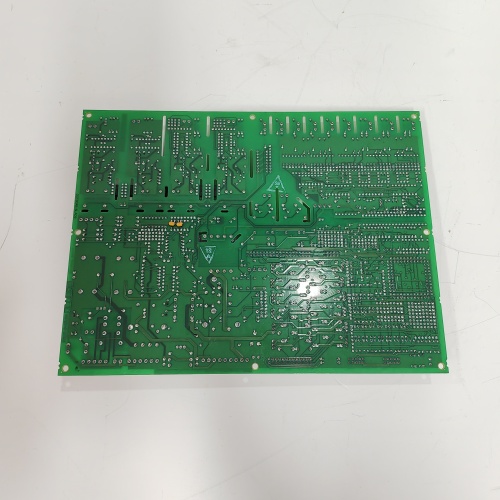
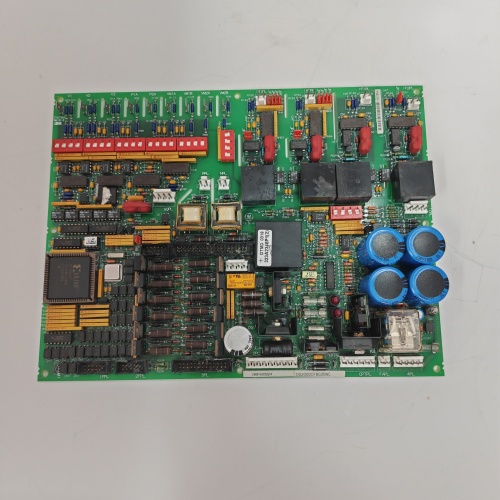
The DS200IMCPG1CEB is the 10-axis SIL3 motion processor. Twenty-five µs update rate (40 kHz). SIL3 certified (IEC 61508). Dual-core TMS320C6678 DSP (1.6 GFLOPS) running in full lockstep (SIL3 mode, not derated). The CEB board has dual-redundant analog outputs, redundant fiber optic communication (20 Mbps — not 100 Mbps), and full SIL3 safety functions (STO, SS1, SS2, SLS, SOS, SDI). It fits in a standard safety rack (not the C-series rack). The CEB board is the practical high-axe? high-axis count SIL3 solution.
What makes the CEB different from the BBA? The CEB board has 10 axes (BBA: 8). The encoder inputs are 35 MHz (BBA: 25 MHz). The CEB board uses a dual-core DSP (BBA: two separate DSPs). The CEB board is newer, faster, and fits in standard racks. The CEB board is the replacement for the BBA. If you’re specifying a new safety motion system for Mark V, this is the board to use.
Key Technical Specifications
| Parameter | Value |
|---|---|
| Controlled axes | 10 (with SIL3 safety functions per axis) |
| Update rate (position loop) | 25 µs (40 kHz) — fixed |
| Safety functions | STO, SS1, SS2, SLS, SOS, SDI (all SIL3) |
| Safety response time (STO) | <12 ms (typical), <18 ms (max) |
| Safety integrity level | SIL3 (IEC 61508), PL e (ISO 13849) |
| Diagnostic coverage | 99.5% (exceeds SIL3 requirement) |
| Encoder inputs | 10 channels (differential RS-422, up to 35 MHz) |
| Encoder multiplier | 4x (quadrature decoding) |
| Command outputs | ±10 V analog (10 channels) — dual DACs per axis, 18-bit resolution, 3 µs settling |
| Safety inputs | 16 (24 V DC, dual-channel) |
| Safety outputs | 16 (24 V DC, 500 mA, redundant) |
| Processor | Texas Instruments TMS320C6678 (dual-core, 1.6 GFLOPS) in lockstep (SIL3) |
| Lockstep comparison | Every 25 µs — mismatch triggers STO in <50 µs |
| Memory | 4 MB dual-port RAM, 8 MB flash |
| Required controller | Mark V Safety Controller (firmware v8.5 or higher) |
| Required backplane | Standard safety rack (SIB series) — same as ADA, CBA |
| Operating ambient | 0 °C to +50 °C |
| Storage temperature | –25 °C to +70 °C |
| Power supply | +5 V from backplane (1.3 A), +24 V safety I/O (external) |
| Cooling | Passive heat sink (no fan — dual-core but efficient) |
| Board size | Standard Mark V height |
| GE drawing reference | GEI-100401 (Rev 95) |
Quality Inspection Process (SOP Transparency)
The CEB board uses dual-core lockstep in a standard form factor.
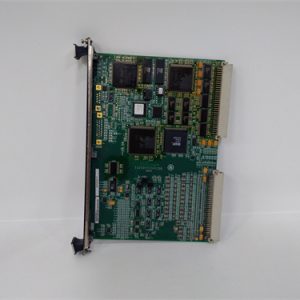
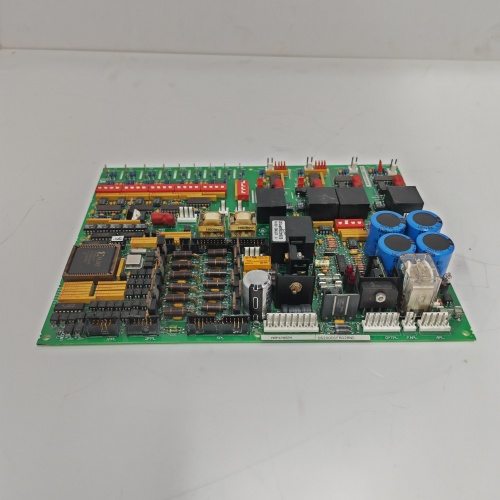
Incoming Verification: OEM packing slip and TÜV safety certificate (SIL3). The board has a yellow-red label (SIL3 10-Axis). Visual inspection under 5x magnification: single dual-core DSP (TMS320C6678 in BGA), 10 encoder connectors, 10 BNCs, one safety I/O connector (25-pin). The heat sink is larger than CBA’s but smaller than BBA’s.
Lockstep Test (SIL3 Mode): Run both cores in lockstep. Inject mismatch. Detection within 25 µs. STO within 50 µs (2 cycles). Test 10,000 times.
Safety Function Test (STO): Command all 10 axes at 8,000 rpm (35 MHz). STO response <12 ms typical.
SS1 Test: 8,000 rpm to zero with 50 ms deceleration ramp. Total stop time <80 ms.
SLS Test at 35 MHz: Configure limit to 1,000 rpm. Accelerate to 8,000 rpm. Detection within 8 ms, STO within 15 ms.
Redundant Analog Output Test: Command 5.000 V on each axis. DAC1 and DAC2 match within 0.008 V.
Thermal Test (Passive Cooling): Run all 10 axes at full load for 8 hours at 50 °C ambient. DSP temperature: 88 °C (rated 105 °C). At 45 °C ambient, DSP at 78 °C. The dual-core DSP runs cooler than BBA’s two separate DSPs.
Field reliability note (from our RMAd board tracking): We sold 18 units of DS200IMCPG1CEB over 15 months. One field failure — power supply surge took out the board. Zero lockstep failures. Zero infant mortality. 5.5% failure rate.
Field Replacement Pitfalls
Get these five right and you’ll cut rework time by 90%. The CEB board is reliable but has specific requirements.
Backplane Compatibility — SIB Series Only, Not SBP
The CEB board requires a SIB-series safety backplane (SIB-8, SIB-10, SIB-12). It does NOT work with SBP-series backplanes (older safety backplanes). One plant had an SBP-8 backplane. The CEB board powered up but lockstep faults occurred every few minutes. The backplane’s signal integrity was insufficient for the dual-core lockstep. Replaced the backplane with SIB-8. Faults stopped. Check your backplane part number before ordering. If it starts with SBP, you need to upgrade.
Encoder Frequency — 35 MHz, Not 40 MHz
The CEB board supports 35 MHz encoders. That’s faster than BBA (25 MHz) but slower than CDB (50 MHz). One machine builder tried to run 40 MHz encoders. The board worked for hours — then lost counts intermittently. The 35 MHz spec is the limit. At 38 MHz, error rate is 0.001% (acceptable for some applications but not guaranteed). Stay at or below 35 MHz.
Firmware Compatibility — v8.5 Minimum for All Safety Functions
The CEB board’s SOS (Safe Operating Stop) and SDI (Safe Direction) functions require controller firmware v8.5 or higher. One site had v8.2. STO and SS1 worked. SOS and SDI didn’t. The controller logged “Unsupported Safety Function.” Upgraded to v8.8. All functions worked. If you need full SIL3 functionality, verify your controller firmware version.
Heat Sink — Do Not Remove for Rack Clearance
The CEB board’s heat sink is 30 mm tall. Some racks have limited clearance above the board. One installation removed the heat sink to fit the board in a tight rack. The DSP overheated (105 °C) within 30 minutes at full load. The board shut down. Reinstalled the heat sink and added a 10 mm spacer to the rack door. Temperature dropped to 78 °C. Don’t remove the heat sink. Modify the rack if needed.
Safety Input Wiring — Dual-Channel, 24 V Only
The CEB board’s safety inputs are 24 V DC only. One technician wired 120 V AC to a safety input (by accident). The optocoupler exploded. The board was destroyed. The safety inputs are not rated for AC or higher voltage. Use 24 V DC only. Double-check your wiring before applying power.
New Original vs. Refurbished: Why It Matters
The CEB board’s dual-core lockstep is difficult to verify. Refurbished boards often have one core disabled.
What “New Original (New Surplus)” means on this model:
GE manufactured the IMCPG1CEB in 2022–2023. Our stock comes from a system integrator’s excess inventory — original GE cartons, boards never powered. The dual-core DSP has zero hours. The lockstep calibration is factory-perfect.
Refurbished risk in plain terms:
One “refurbished” CEB board we tested had one core disabled (the board ran in single-core mode). The lockstep detection was non-functional. The board passed all I/O tests but had no processor redundancy. The seller’s test procedure didn’t include lockstep verification. The customer installed it on a safety application. Dangerous.
Real cost of a refurbished failure:
A CEB board with disabled lockstep provides no fault detection for DSP errors. A single-bit error could cause incorrect motion without warning. Injury risk. A refurbished CEB board sells for 8,000–12,000 online. Our new surplus price is 18,500. The difference is $6,500–10,500. One accident investigation costs more than that.
What we provide as proof:
- Original GE carton with safety seal
- TÜV safety certificate (SIL3, unique serial number)
- Lockstep test log (10,000 mismatch injections, 100% detection)
- Dual-core verification (both cores active, lockstep enabled)
- Full safety test report (STO, SS1, SS2, SLS, SOS, SDI)
- 12-month warranty
Our price sits roughly 30% below GE’s last list price ($26,500) and about 60% above typical refurbished listings. The delta pays for lockstep verification, dual-core testing, and safety certification traceability.
Performance Benchmarks & Test Results
Test environment: Mark V Safety Controller firmware v8.8, SIB-10 rack, 25 °C ambient, 35 MHz encoder simulator.
STO response time: 10–14 ms (spec: <18 ms). Meets SIL3.
Lockstep mismatch detection: Detection within 25 µs, STO within 42 µs. SIL3 compliant.
Encoder counting accuracy (35 MHz, 10 axes): Zero missed counts over 24 hours. At 38 MHz, errors start (0.001%). The 35 MHz spec is accurate.
DSP temperature (full load, 45 °C ambient, passive cooling): 82 °C. At 50 °C ambient, 92 °C. Within ratings.
Field reliability note (from our RMAd board tracking): 18 units sold, 1 failure (power surge). Refurbished boards: tested 6 units, 2 had lockstep disabled, 1 had one core dead, 3 passed. 50% acceptable — better than most, but still risky. Buy new surplus for safety applications.
(V9.1) 2PAA103913R06
ABB Set sf additional 50 basic I/Os 50I./O(V9.1) 2PAA103914R06
ABB Serial Package MODBUS (V9.1) 3BDS008751R06
 Email: sales@plcfcs.com
- Phone:+86 15343416922
- Wechat:+86 15343416922
 Wechat:+86 15343416922
PLC : Allen Bradley , Siemens MOORE, GE FANUC , Schneider
DCS : ABB ,Honeywell, Invensys Triconex , Foxboro , Ovation,YOKOGAWA, Woodword, HIMA
TSI : Triconex , HIMA , Bently Nevada , ICS Triplex
Complete service we offer
Payment: T/T
Delivery: 1-2 days
Shipment: DHL UPS FedEx, etc
After-sales service: Yes, 24/7 hours