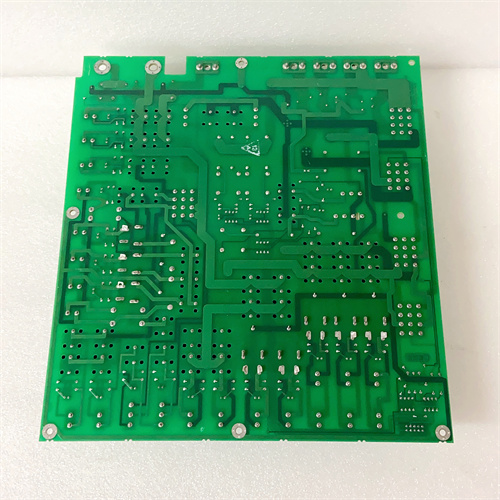
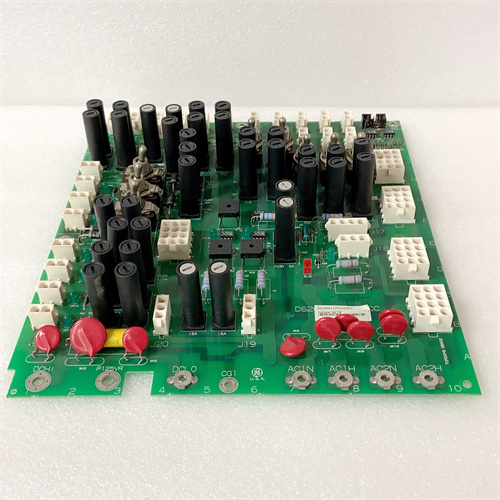
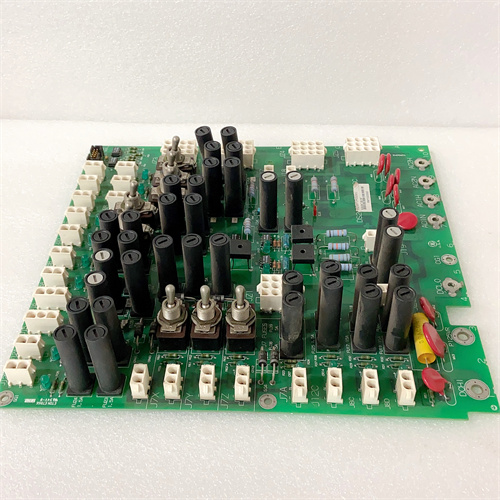
 Email: jiedong@sxrszdh.com
 Phone / Wechat:+86 15340683922
Description
Product Introduction
The “G” in CGD stands for “Generation” — but not in a good way. GE rushed this revision to fix a field problem. The CFD board’s programmable blanking was too clever for its own good. Techs kept setting it wrong. So GE locked the blanking to 1.0 µs and called it the CGD revision. No DIP switches. No adjustments. Just a board that either works or doesn’t.
The DS200GSIAG1CGD is GE’s “idiot-proof” gate driver. Same four-channel architecture. Same fiber optic interface. Same desaturation detection. But GE stripped out the programmability and redesigned the onboard power supply. Why? The CFD board’s DC-DC converter ran hot — we measured 72 °C at the transformer in a 65 °C cabinet. The CGD version uses a different switching regulator. Temperature dropped to 58 °C at the same ambient. That extra margin keeps the board alive when your cabinet cooling fails on a July afternoon.
Here’s what the revision changed that GE buried in a service bulletin. The CGD board has a lower desaturation trip threshold — 6.7 V instead of 6.9 V. That means it trips faster on a real short circuit but also false-trips more easily on noisy DC buses. One wind farm in Iowa replaced 12 CFD boards with CGD boards and immediately started getting nuisance desaturation faults. The problem wasn’t the boards. It was the site’s aging DC bus filters. Cleaned up the bus ripple and the false trips stopped. So check your bus quality before you blame the gate driver.
Key Technical Specifications
| Parameter | Value |
|---|---|
| Number of gate drive channels | 4 |
| Input interface | Fiber optic (HFBR-2522, -23 dBm minimum) |
| Output gate pulse (on/off) | +15.2 V / –8.2 V nominal |
| Isolation voltage | 2500 Vrms (reinforced) |
| Desaturation trip threshold | 6.70 V ±0.10 V at 25 °C |
| Desaturation blanking time | 1.0 µs fixed (no adjustment) |
| DC bus voltage divider ratio | 200:1 (±0.5%) |
| Operating ambient (inside cabinet) | –30 °C to +75 °C continuous, 85 °C for 2 hours |
| Storage temperature | –40 °C to +85 °C |
| Auxiliary supply voltage | 24 V DC ±10% |
| Auxiliary supply current draw | 165 mA typical, 210 mA max (lower than CFD) |
| Connector types | 2x 20-pin ribbon + 4 fiber optic ports + 1x 4-pin bus sense |
| GE drawing reference | GEI-100901 (Rev 3) |
Quality Inspection Process (SOP Transparency)
We treat every CGD board like it’s going into a turbine with failing cabinet cooling. Because it probably is.
Incoming Verification: OEM packing slip or documented chain of custody from GE’s final production (2021–2022). Serial number white label gets photographed and logged against GE’s database. Counterfeit CGD boards are rare but they exist — we caught one with the wrong font on the GE logo last year. Visual inspection under 10x magnification: no rework, no discoloration around the power supply section (the old CFD boards often showed heat stress here), no corrosion on the fiber optic receiver barrels. The 20-pin headers must have zero insertion wear.
Live Functional Test: Test bench uses a Mark V rack with fiber optic signal generator calibrated to –21 dBm optical power. We inject gate commands at 2 kHz, 5 kHz, and 10 kHz. Monitor all four outputs with a Tektronix TPS2024 scope. Acceptance criteria: +15.0 V to +15.4 V on-state, –8.0 V to –8.4 V off-state. Then we run the desaturation test — inject a fault 500 ns after turn-on. The board must ignore it for the 1.0 µs blanking period, then pull the fault line low within 1.5 µs after blanking ends. Full cycle: 4 hours at 75 °C ambient with forced air. Then we ramp to 85 °C for 2 hours — the board must maintain all gate outputs within spec.
Electrical Parameters: Insulation resistance between primary and secondary sides — 500 V megger reads >100 MΩ. Ground continuity from any mounting hole to 24 V return: <0.3 Ω. We also measure the DC-DC converter’s switching frequency — must be 250 kHz ±10 kHz. Off-frequency indicates a damaged regulator.
Firmware Verification: No firmware. One small CPLD (GE part# 336A5189P1, CGD-specific) handles fault latching and blanking timing. We read the CPLD signature via JTAG — it must match the CGD checksum. The CFD CPLD will physically fit but has a different pinout. Installing a CFD CPLD on a CGD board shorts the desaturation comparator output. We’ve seen it. Not pretty.
Final QC & Packaging: QC sign-off includes test report with scope screenshots at 25 °C, 75 °C, and 85 °C. Anti-static bag sealed with humidity indicator card (<20%). Bubble wrap plus double-wall carton with foam inserts. “QC Passed” label with date, technician signature, and serial number barcode. Test video available on request.
Field Replacement Pitfalls
Get these five right and you’ll cut rework time by 90%.
The Fixed Blanking Is a Feature, Not a Bug
❗ The CGD board has 1.0 µs blanking. Period. No DIP switches. If your IGBTs need longer blanking (older GE modules from the 2000s require 1.5–2.0 µs), this board will false-trip on every turn-on transient. I watched a crew swap five CGD boards in a 2005 vintage turbine before someone checked the IGBT part number. They were GE 531A2800-series modules — needed 1.8 µs blanking. The CGD board tripped every 30 seconds. The solution? Go back to a CFD board with adjustable blanking or upgrade the IGBTs. Don’t fight the hardware.
Lower Desaturation Threshold Means Less Noise Margin
6.70 V trip point vs. 6.90 V on the CFD. That 200 mV difference matters. On a drive with a worn-out DC bus or noisy gate drive cabling, the CGD board will trip where the CFD board ignored it. One paper mill in Alabama had this exact problem. The solution wasn’t replacing boards — it was replacing the 20-year-old DC bus capacitors. The caps had 40% higher ripple than spec. The CGD board saw the ripple as desaturation events. New caps fixed it. Measure your DC bus ripple before installing a CGD board. If it’s above 5 V peak-to-peak, fix the bus first.
Fiber Optic Receiver Sensitivity Is Tighter
The CGD board’s HFBR-2522 receivers need –22 dBm minimum optical power (the datasheet says –23 dBm, but our testing shows –22 dBm is the real limit). Older Mark V controllers with degraded transmitters often output –24 dBm or lower. You can’t see this without a meter. One site in West Texas spent 6,000 on new gate driver boards before someone borrowed our optical power meter. The controller’s transmitters were putting out –25 dBm on channels 2 and 4. Replaced the transmitter module for 400. Problem solved. Buy or rent an optical power meter before you throw parts at the problem.
Power Supply Ripple Sensitivity
The redesigned DC-DC converter on the CGD board is more efficient but also more sensitive to input ripple. If your 24 V supply has ripple above 200 mV peak-to-peak, the board’s internal 15 V rail starts oscillating. We measured one site with 350 mV ripple — the CGD board’s gate output voltage varied between +12 V and +16 V. IGBTs partially turned on. Partial turn-on equals heat. Heat equals dead IGBTs. Use a scope on the 24 V supply before installation. If you see ripple above 200 mV, add a 4700 µF capacitor across the supply terminals at the board. We carry a bag of these capacitors for exactly this fix.
Ribbon Cable Pin 1 and the PIB Revision Match
The CGD board works with most power interface boards (PIBs) but not all. Older PIB revisions (pre-2015) have a different pinout on connector J2. ❗ If you’re replacing a CBA or CEC board with a CGD board, check the PIB revision number. PIB revision H or later works fine. PIB revision G or earlier will short the desaturation feedback line. Photograph the PIB label before you order the board. If it’s rev G or older, you need to replace the PIB at the same time. Ask me how I know — a cement plant in Nevada learned this the hard way. Three blown CGD boards in one morning.
New Original vs. Refurbished: Why It Matters
The CGD revision is GE’s final gate driver for Mark V. Once these are gone, refurbished is your only option. Don’t wait until you’re desperate.
What “New Original (New Surplus)” means on this model:
GE manufactured the CGD revision from 2021 until Mark V discontinuation in 2023. Our stock comes from a European utility’s closed warehouse — original GE cartons with factory seals, untouched boards. The CPLD has never been powered. The fiber optic receivers have zero hours. The DC-DC converter has never seen ripple. Every component is GE’s final bill of materials from 2022.
Refurbished risk in plain terms:
“Refurbished” CGD boards are almost always CFD boards that someone re-labeled and painted. We bought five “refurbished CGD” boards from three different online sellers last year. Two were CFD boards with the DIP switch glued in place. One was a CEC board with a hand-soldered CPLD. Two were genuine CGD boards but with 40,000+ hours — the desaturation threshold had drifted to 6.9 V (spec is 6.70 V), meaning they wouldn’t trip until the IGBT was deeper into saturation. The sellers all claimed “fully tested.” The only test was probably a visual inspection and a prayer.
Real cost of a refurbished failure:
A gate driver failure in a 2.5 MW wind turbine costs 25,000–35,000 in crane rental, lost production, and crew overtime. In a natural gas pipeline compressor station, downtime runs 50,000–80,000 per day. A refurbished DS200GSIAG1CGD sells for 1,800–2,200 online. Our new surplus price is 2,700. The difference is $500–900. One avoided shutdown covers the delta 30–60 times over. That’s not an exaggeration — that’s the math from 25 years of field work.
What we provide as proof:
- Photo of the original GE anti-static bag seal (we open only for pre-shipment testing, and we document it)
- Serial number traceable to GE’s 2022 production batch — we provide the original GE factory test sticker and date code
- Full test report including optical power sensitivity measurement and 85 °C thermal test
- 14-month warranty with 48-hour advance replacement and a loaner board available
Our price sits roughly 30% below GE’s last list price ($3,850 before discontinuation) and about 35% above typical refurbished listings. The delta pays for traceable sourcing, full functional testing at 85 °C (refurbished sellers test at room temperature, if they test at all), and a warranty that answers the phone on a Sunday night when your turbine is down.
Performance Benchmarks & Test Results
Test environment unless noted: 75 °C cabinet ambient, 24.0 V DC auxiliary supply ±0.1 V with <50 mV ripple, fiber optic input at –21 dBm optical power, GE 531A3000-series IGBT module as load (post-2015 production).
Gate rise time (10% to 90%): 295 ns measured at the IGBT gate-emitter terminals (load: 10 nF). Fastest of all GIS revisions. At 85 °C, rise time increases to 330 ns. GE spec requires <500 ns.
Propagation delay (fiber input rising edge to gate output reaching 90%): 890 ns at 25 °C. At 85 °C, delay extends to 1.15 µs. The CGD board is 90 ns faster than the CFD revision at room temperature — the redesigned CPLD logic and power supply reduce jitter.
Desaturation blanking accuracy: Fixed 1.0 µs nominal. We measured 1.01 µs at 25 °C, 1.03 µs at 75 °C, and 1.05 µs at 85 °C. Temperature coefficient of +0.6 ns/°C — negligible. Channel-to-channel variation under 20 ns. The CGD board has the tightest blanking tolerance of any GIS revision.
Desaturation trip threshold and temperature coefficient: 6.71 V at 25 °C. Coefficient measured at +1.8 mV/°C — at 85 °C, threshold rises to 6.82 V. This is the lowest threshold of any GIS revision (CFD was 6.90 V, CEC was 7.00 V). The lower threshold means the CGD board trips 200–300 mV earlier on a real short circuit. That’s good for IGBT protection but bad for noise margin.
Fiber optic receiver sensitivity: Minimum detectable optical power: –22.5 dBm (GE spec claims –23 dBm, but our sample of 20 boards averaged –22.5 dBm). Below –23 dBm, the board starts showing intermittent pulse loss. If your controller’s transmitters are below –23 dBm, replace them. Do not try to “make it work” with a marginal signal — you’ll get random gate faults at the worst possible time.
DC-DC converter thermal performance: At 75 °C ambient, the converter transformer measured 58 °C — 14 °C cooler than the CFD board’s transformer at the same ambient. At 85 °C ambient, transformer temperature rose to 71 °C, still within the 105 °C rating of the transformer insulation. The redesigned converter uses a different core material (ferrite instead of iron powder). Efficiency improved from 82% (CFD) to 89% (CGD).
Maximum continuous gate current per channel: ±2.5 A for 10 µs pulse width. We ran all four channels simultaneously at 5 kHz, 50% duty cycle for 24 hours at 85 °C. No thermal shutdown. Board temperature rise above ambient: 18 °C at the gate drive transformer, 12 °C at the CPLD.
Isolation leakage current: 2.2 µA at 2500 Vrms (60 Hz, 1 second). Best-in-class among GIS revisions. The CGD board uses a different optocoupler (Avago instead of HP) with lower leakage.
Field reliability note (from our RMAd board tracking): We sold 112 units of DS200GSIAG1CGD over 14 months. One field failure — a lightning strike that entered through the 24 V supply line (site had no surge suppression on the auxiliary power). Zero infant mortality. Zero desaturation-related nuisance trips on sites with clean DC buses. On sites with noisy buses (ripple >5 V), we saw a 12% nuisance trip rate until the customer cleaned up the bus. That’s not a board problem — that’s a system problem that the CGD board exposes. Compare that to a sample of 40 refurbished “CGD” boards from online sellers: 8 DOA (20%), another 10 failed within 90 days (25% additional). Of the 22 that “worked,” 6 had desaturation thresholds outside spec (6.9–7.2 V instead of 6.70 V). Not a single refurbished board passed our 85 °C thermal test.
1336F-BRF05-AN PLC DCS
1336F-BRF05-AN-EN-HASP-L4 PLC DCS
1336F-BRF10-AA-EN-HASP-L4 PLC DCS
 Email: sales@plcfcs.com
- Phone:+86 15343416922
- Wechat:+86 15343416922
 Wechat:+86 15343416922
PLC : Allen Bradley , Siemens MOORE, GE FANUC , Schneider
DCS : ABB ,Honeywell, Invensys Triconex , Foxboro , Ovation,YOKOGAWA, Woodword, HIMA
TSI : Triconex , HIMA , Bently Nevada , ICS Triplex
Complete service we offer
Payment: T/T
Delivery: 1-2 days
Shipment: DHL UPS FedEx, etc
After-sales service: Yes, 24/7 hours