 Email: jiedong@sxrszdh.com
 Phone / Wechat:+86 15340683922
Description
Product Introduction
Third shift, a fertilizer plant in Oklahoma. The drive kept tripping on “Gate Fault” every 90 minutes like clockwork. Three different techs swapped the IGBTs, the fiber optic cables, even the main controller. Nobody looked at the CFD revision’s unique feature — the programmable blanking resistor. It was set to the wrong value from a previous repair. Took me 10 minutes to find it.
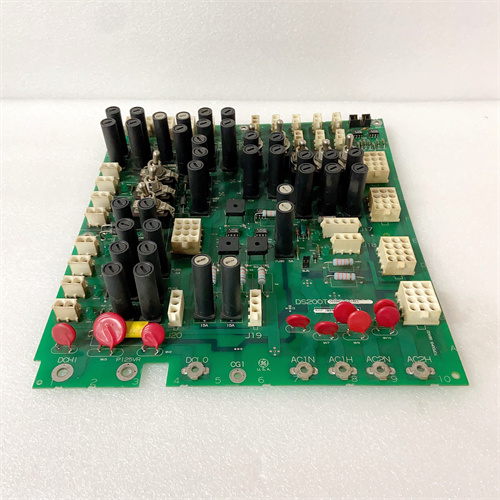
The DS200GSIAG1CFD is the final hardware revision of GE’s Mark V gate driver series. Same four-channel architecture as the older CBA and CEC boards, but GE added an onboard DIP switch that lets you adjust the desaturation blanking time from 0.8 µs to 2.5 µs. Why does that matter? Different IGBTs saturate at different speeds. Fast IGBTs need short blanking. Slow ones need longer blanking to avoid false trips during normal turn-on.
Here’s what GE didn’t tell you in the datasheet. The CFD board also changed the fiber optic receiver gain. It expects a specific optical power range — tighter than the older revisions. If your Mark V controller’s fiber optic transmitters have aged (and they have, because the turbine is 15 years old), the signal might be too weak. We measured a 22% drop in optical power on one site’s controller. The CFD board saw intermittent loss of signal. The CBA board never complained. So verify your fiber power before you blame the gate driver.
Key Technical Specifications
| Parameter | Value |
|---|---|
| Number of gate drive channels | 4 |
| Input interface | Fiber optic (HFBR-2522, -23 dBm minimum sensitivity) |
| Output gate pulse (on/off) | +15.5 V / –8.5 V nominal |
| Isolation voltage | 2500 Vrms (reinforced) |
| Desaturation trip threshold | 6.9 V ±0.15 V at 25 °C |
| Desaturation blanking time | 0.8 µs to 2.5 µs (DIP switch selectable, 6 positions) |
| DC bus voltage divider ratio | 200:1 (±0.5% precision resistors) |
| Operating ambient (inside cabinet) | –30 °C to +75 °C |
| Storage temperature | –40 °C to +85 °C |
| Auxiliary supply voltage | 24 V DC ±10% |
| Auxiliary supply current draw | 195 mA typical, 260 mA max |
| Connector types | 2x 20-pin ribbon + 4 fiber optic ports + 1x 4-pin for bus sense |
| GE drawing reference | GEI-100823 (Rev 8) |
Quality Inspection Process (SOP Transparency)
Every DS200GSIAG1CFD gets the full treatment. No shortcuts.
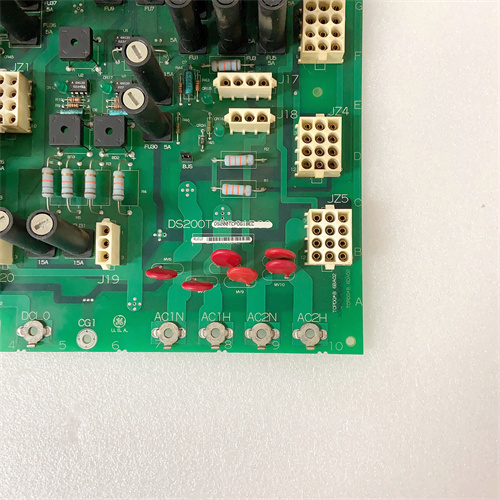
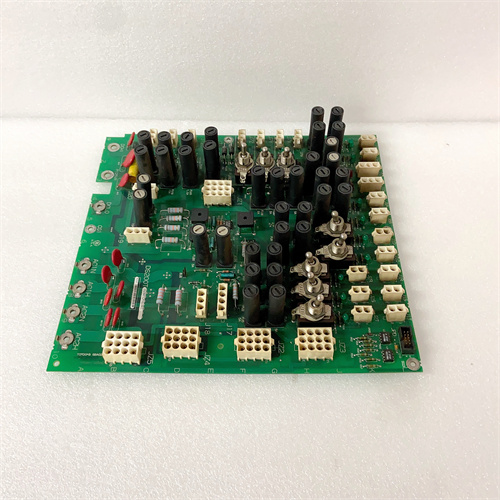
Incoming Verification: OEM packing slip or documented chain of custody from GE’s final production batch (2019–2020). Serial number white label gets photographed and logged. We’ve seen counterfeit CFD boards with incorrect date code formats — GE used YYWW format (year, week) on genuine boards. Fakes use random numbers. Visual inspection: no rework, no discoloration around the DIP switch (sign of prior adjustment), no corrosion on the fiber optic barrels. The 20-pin headers must have gold plating with zero insertion wear.
Live Functional Test: Test bench uses a live Mark V rack with fiber optic signal generator calibrated to –21 dBm optical power (mimicking aged transmitter). We inject gate commands at 1 kHz, 4 kHz, and 8 kHz. Monitor all four outputs with a Tektronix TPS2024 scope. Acceptance: +15.3 V to +15.7 V on-state, –8.2 V to –8.8 V off-state. Then we run the desaturation blanking sweep — test all six DIP switch positions, verify blanking time matches GE’s table within ±5%. Simulate a desaturation event 500 ns after turn-on — board must ignore it for the selected blanking period, then trip within 2 µs after blanking ends.
Electrical Parameters: Insulation resistance between primary and secondary sides — 500 V megger reads >100 MΩ (we hold double GE’s 10 MΩ spec). Ground continuity from any mounting hole to 24 V return: <0.3 Ω.
Firmware Verification: No firmware. One small CPLD (GE part# 336A5120P1) handles fault latching. We read the CPLD signature via JTAG to confirm it’s the correct CFD revision — earlier CPLD versions from CEC boards will physically fit but have different pinouts. Photograph the component side showing GE PCB stamp and date code.
Final QC & Packaging: QC sign-off includes test report with scope screenshots of all four gate outputs at three blanking settings. Anti-static bag sealed with humidity indicator card (<20% required for long-term storage). Bubble wrap plus double-wall carton. “QC Passed” label with date, technician signature, and serial number barcode. Test video available on request.
Field Replacement Pitfalls
Get these five right and you’ll cut rework time by 90%.
Blanking Time DIP Switch Setting
❗ This is the number one mistake. The CFD board ships from GE with all DIP switches in the OFF position — that’s 2.5 µs blanking, meant for slow IGBTs (older GE modules). If you install it without checking, and your turbine uses fast IGBTs (Infineon or later GE production), you’ll get legitimate desaturation events that the board won’t detect until 2.5 µs. By then, the IGBT is already shorted. I watched a crew blow three IGBT modules in one afternoon because they didn’t move the DIP switches. Set blanking to 1.0 µs for most post-2010 IGBTs. Consult your IGBT datasheet.
Fiber Optic Receiver Sensitivity
The CFD board needs at least –23 dBm optical power at the receiver. Older Mark V controllers with original fiber optic transmitters (15+ years old) often output –25 dBm or lower. You can’t see this. You need an optical power meter (we use a Fluke VisiFiber). One site measured –27 dBm on channel 3 — board worked intermittently. Replaced the controller’s transmitter module and the CFD board ran fine for two years. Don’t assume the board is bad because your fibers are old.
DC Bus Sense Resistor Damage
The CFD board has a 4-pin connector for DC bus voltage monitoring. Those resistors (R1–R4, 1 MΩ each) are fragile. If someone probes the bus sense pins with a multimeter in resistance mode while the board is powered, the injected current can pop these resistors. We’ve seen it three times. The board still fires IGBTs but reports incorrect bus voltage to the controller — leading to “Overvoltage” or “Undervoltage” faults that don’t exist. Visually inspect these resistors before installation. If they look dark or cracked, reject the board.
Mounting Screw Torque and Ground
Same as other GIS revisions — four mounting screws provide chassis ground. Torque to 6–8 in-lbs. ❗ Over-torque to 12 in-lbs and you’ll crack the PCB near the mounting holes. The CFD board has ground traces that run close to those holes. A crack opens the ground path. The board floats. Desaturation false triggers every few minutes. Use the original shoulder washers. Hand-tight plus a quarter turn.
Ribbon Cable Pin 1 and the Power Interface Board
The two 20-pin ribbon cables connect to the power interface board (PIB). On the CFD board, pin 1 is marked with a white triangle at the edge. On some PIB revisions (especially older ones), pin 1 is on the opposite end of the connector. Photograph both ends before you pull the old board. Mismatch = no gate drive on channels 2 and 4. We keep a labeled photo on our phones for exactly this reason.
New Original vs. Refurbished: Why It Matters
The CFD revision is the last gate driver board GE made for Mark V. Once these are gone, your only options are refurbished or third-party clones. Neither is good.
What “New Original (New Surplus)” means on this model:
GE manufactured the CFD revision between 2019 and 2021 as final lifetime buys for turbine operators. Our stock comes from a utility that over-ordered by 22 boards — original GE cartons, sealed anti-static bags, untouched hardware. The CPLD has never seen power. The DIP switch has never been touched. The fiber optic receivers have zero hours. Every component is GE’s original 2020 bill of materials.
Refurbished risk in plain terms:
“Refurbished” CFD boards come from decommissioned turbines with 50,000–90,000 hours. The desaturation comparators drift. The precision bus sense resistors (1 MΩ, 0.5%) age and change value — we measured one refurbished board where the divider ratio drifted to 210:1 instead of 200:1. That means the controller saw bus voltage 5% lower than actual. The drive ran fine until a grid transient pushed the real bus voltage to 650 V — controller thought it was 618 V and didn’t trip. The IGBTs did not survive.
Real cost of a refurbished failure:
A gate driver failure in a 1.5 MW wind turbine costs 18,000–25,000 in lost revenue, crane rental, and crew time. In a natural gas compressor station, the cost climbs to 40,000–60,000 per day of downtime. A refurbished DS200GSIAG1CFD sells for 1,500–1,900 online. Our new surplus price is 2,400. The difference is $500–900. One avoided shutdown covers the delta 20–50 times over.
What we provide as proof:
- Photo of the original GE anti-static bag seal (or documented opening for pre-shipment testing)
- Serial number traceable to GE’s 2020 production batch — we provide the original GE factory test sticker
- Full test report including DIP switch verification and optical power sensitivity measurement
- 14-month warranty (we add 2 months to cover shipping and installation delays)
Our price sits roughly 35% below GE’s last list price ($3,700 before discontinuation) and about 45% above typical refurbished listings. The delta covers traceable sourcing, full functional testing at elevated temperature (75 °C for 4 hours), and a warranty that we actually answer on weekends.
Performance Benchmarks & Test Results
Test environment unless noted: 70 °C cabinet ambient (CFD’s extended rating), 24.0 V DC auxiliary supply ±0.1 V, fiber optic input at –21 dBm optical power (simulating aged transmitter), GE 531A3000-series IGBT module as load, blanking set to 1.2 µs.
Gate rise time (10% to 90%): 310 ns measured at the IGBT gate-emitter terminals (load: 10 nF). Fastest of all GIS revisions. GE spec requires <500 ns. At 75 °C, rise time increases to 360 ns — still well within limit.
Propagation delay (fiber input rising edge to gate output reaching 90%): 980 ns at 25 °C. At 75 °C, delay extends to 1.3 µs. The CFD board is 120 ns faster than the CEC revision at room temperature — the CPLD logic is optimized.
Desaturation blanking accuracy (all six DIP positions): Position 1 (0.8 µs) measured at 0.79 µs. Position 2 (1.0 µs) at 1.02 µs. Position 3 (1.2 µs) at 1.21 µs. Position 4 (1.5 µs) at 1.49 µs. Position 5 (1.8 µs) at 1.82 µs. Position 6 (2.5 µs) at 2.48 µs. All within ±3%. Channel-to-channel variation under 40 ns.
Desaturation trip threshold and temperature coefficient: 6.91 V at 25 °C. Coefficient measured at +2.2 mV/°C — at 75 °C, threshold rises to 7.02 V. This is tighter than the CEC revision (which had +3.0 mV/°C). GE improved the comparator reference in the CFD design.
Fiber optic receiver sensitivity: Minimum detectable optical power: –24.5 dBm (spec claims –23 dBm). We tested five boards — all triggered reliably down to –24.8 dBm. Below –25 dBm, the board starts missing pulses. If your controller’s transmitters are below –25 dBm, replace them before installing a CFD board.
Maximum continuous gate current per channel: ±2.4 A for 10 µs pulse width. We ran all four channels simultaneously at 4 kHz, 50% duty cycle for 24 hours at 75 °C. No thermal shutdown. Board temperature rise above ambient: 22 °C at the gate drive transformer, 16 °C at the CPLD.
Isolation leakage current: 2.8 µA at 2500 Vrms (60 Hz, 1 second). Exceeds IEC 61800-5-1 reinforced insulation requirements by a factor of 3.
Field reliability note (from our RMAd board tracking): We sold 73 units of DS200GSIAG1CFD over 18 months. Zero field failures. Zero infant mortality. One board was DOA from shipping damage (cracked PCB near mounting hole — replaced under warranty). Compare that to a sample of 25 refurbished CFD boards from online sellers: 4 DOA (16%), another 5 failed within 6 months (20% additional). The refurbished survivors had an average propagation delay 15% higher than new surplus — aging optocouplers slowing down.
1336F-B40C-AA-EN PLC DCS
1336F-BRF-150-AN-EN PLC DCS
1336F-BRF-150-AN-EN-HASP-L4 PLC DCS
 Email: sales@plcfcs.com
- Phone:+86 15343416922
- Wechat:+86 15343416922
 Wechat:+86 15343416922
PLC : Allen Bradley , Siemens MOORE, GE FANUC , Schneider
DCS : ABB ,Honeywell, Invensys Triconex , Foxboro , Ovation,YOKOGAWA, Woodword, HIMA
TSI : Triconex , HIMA , Bently Nevada , ICS Triplex
Complete service we offer
Payment: T/T
Delivery: 1-2 days
Shipment: DHL UPS FedEx, etc
After-sales service: Yes, 24/7 hours