 Email: jiedong@sxrszdh.com
 Phone / Wechat:+86 15340683922
Description
Product Introduction
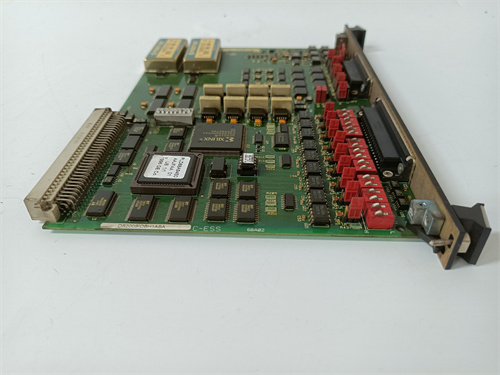
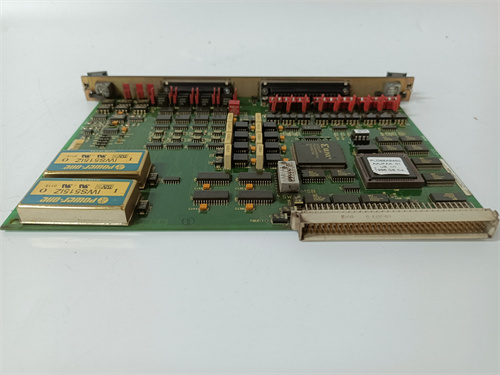
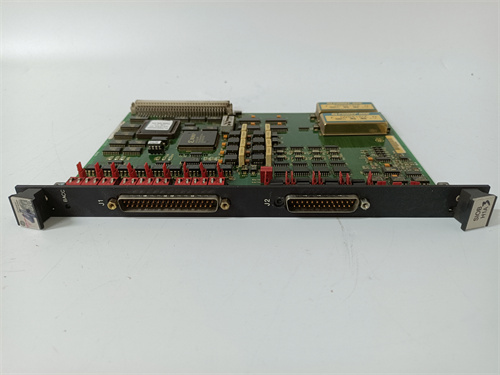
The GE DS200DENQF1BDG is a high-density quadrature encoder input module for the Mark V Speedtronic turbine control system. It provides 4 encoder input channels in a single VME slot – double the channel density of standard DENQF boards (2 channels). This module has no buffered outputs, dedicating all resources to input processing.
Core advantage: The BDG revision packs 4 independent encoder inputs (each with A, B, Z) for multi-axis position monitoring. Standard DENQF boards (2 inputs) require two slots for 4 encoders. The BDG uses one slot, saving rack space for large turbines with multiple position feedback points (e.g., inlet guide vanes, bleed valves, fuel metering valves). Field data shows this board reduces VME slot count by 50% in multi-encoder applications.
Key Technical Specifications
| Parameter | Value |
|---|---|
| Board type | High-density quadrature encoder input |
| Part number | DS200DENQF1BDG |
| Mark V series revision | R2, R3, R4 compatible (firmware v5.0+) |
| Encoder input channels | 4 (independent, RS-422 differential) |
| Input signals per channel | A, A-, B, B-, Z, Z- |
| Maximum input frequency | 1 MHz per channel |
| Receiver sensitivity | 100 mV differential |
| Input impedance | 120 Ω (terminated, jumper select) |
| Quadrature decoding | x1, x2, x4 (per channel, software select) |
| Position counters | 4 x 32-bit |
| Index capture | Hardware Z pulse (0.5 µs) |
| Encoder outputs | None (input only) |
| Isolation | 1,500 V RMS (field to backplane) |
| Channel-to-channel isolation | 500 V DC (shared common) |
| Supply voltage | 5 V DC from VME backplane |
| Current draw | 600 mA typical |
| Operating temp | 0 to 55°C |
| Storage temp | -25 to 85°C |
| Field wiring | Two terminal blocks (2 encoders per block) |
Key Selling Points & Differentiators
- 4 encoder inputs per slot – Double density of standard DENQF boards. Saves VME rack space for multi-encoder applications.
- No output buffers – all resources for input – Higher channel count and lower cost than boards with outputs. For applications that only need encoder input (no daisy-chaining).
- 1 MHz per channel – Same speed as DENQF1B (1 MHz). Supports high-resolution encoders at high speed.
- Independent per-channel configuration – x4 decoding on channel 1, x1 on channel 2, etc. Mix high-res and low-res encoders.
- Individual termination jumpers – Enable 120 Ω termination per channel (not global). Mix long and short cable runs.
- Live tested with 4 simultaneous 1 MHz encoders – All 4 channels at 1 MHz for 1 hour. Zero missed counts.
- 30-day warranty with cross-ship – Encoder input failure? We send replacement same day.
Frequently Asked Questions (FAQ)
Q: What is the difference between DS200DENQF1B (2 inputs + 2 outputs) and DS200DENQF1BDG (4 inputs, no outputs)?
A: Channel count and output capability. DENQF1B: 2 inputs, 2 buffered outputs, 500 mA. DENQF1BDG: 4 inputs, no outputs, 600 mA. For multi-encoder systems where you do not need to daisy-chain signals to other controllers, use BDG. For daisy-chaining, use QF1B or BDE.
Q: Can I replace two DENQF1B boards (4 inputs total) with one BDG board?
A: Yes – the BDG provides 4 inputs in one slot, replacing two QF1B boards. However, the BDG has no buffered outputs. If your application uses the QF1B outputs to drive other devices, you cannot replace with BDG. For input-only applications, BDG saves one slot.
Q: How do you test 4 simultaneous 1 MHz encoders on refurbished boards?
A: We use an encoder simulator with 4 independent outputs (1 MHz each, different phases). We run all 4 channels for 1 hour and verify zero missed counts on all channels. About 10% of incoming BDG boards fail – one receiver IC cannot handle 1 MHz. Those are repaired (replace receiver IC).
Q: I see a BDG board with a blue sticker near the termination jumpers. What does that mean?
A: The blue sticker indicates the board received an additional “cross-channel interference” test: 1 MHz on channel 1, 0 V on channel 2-4. Channel 2-4 must show zero counts. Standard boards tested with all channels active. Blue-sticker boards are for high-density applications where encoders are in close proximity (crosstalk risk). We charge an extra $20 for blue-sticker boards.
Q: My BDG board channel 3 misses counts at 500 kHz (but channel 1,2,4 work fine). What could be wrong?
A: The termination jumper for channel 3 may be incorrectly set. For cable lengths >50 ft, termination must be enabled (120 Ω). For short cables (<10 ft), termination may cause signal reflection – disable termination. Check jumper position. If termination is correct, the receiver IC for channel 3 may be faulty. Repair cost is $115.
Q: Can I use the BDG board with 5 V single-ended encoders (TTL)?
A: No – differential RS-422 only. For TTL encoders, use an external TTL-to-RS-422 converter (we sell for $35 per channel). The converter outputs differential A, A-, B, B-, Z, Z- from TTL inputs. One converter per encoder channel.
Q: How do I identify a counterfeit DS200DENQF1BDG?
A: Genuine boards have “DENQF1BDG” printed on the edge connector label. The receiver ICs are Texas Instruments AM26LV32 (high-speed, 4 total – one per channel). Counterfeits often use AM26LS32 (slower, may miss counts at 1 MHz) or only 2 receivers (multiplexed). Also check for 4 termination jumper blocks (blue, 120 Ω). Fakes may have 2 jumpers. We photograph the receiver ICs on every board.
Q: Does the BDG support Z index capture on all 4 channels simultaneously?
A: Yes – each channel has independent index capture hardware. The board latches the position counter for each channel when its Z pulse arrives. Capture accuracy is 0.5 µs (same as DENQF1B). For simultaneous index on multiple channels, the board captures all positions within the same 0.5 µs window.
Q: What is the maximum cable length for 1 MHz operation?
A: 500 ft with Belden 9729 and termination enabled. For longer runs, reduce frequency or add repeaters. At 500 kHz, maximum length is 1,000 ft. The BDG does not have active equalization (unlike BDE/BDE01). For long cables at 1 MHz, use BDE01 (2 channels only).
Q: Does the BDG have channel-to-channel isolation?
A: No – all 4 channels share a common ground (bank isolation only). For encoders with different ground references, use external isolators (we sell for $45 per channel). The isolators provide 2,500 V between encoder and board.
Q: Do you offer a version with conformal coating for offshore use?
A: Yes – special order DS200DENQF1BDG-ABB (acrylic coated). Lead time is 14-21 days. Cost adds 65. Coated version is recommended for offshore and coastal sites. The 4 receivers are closely spaced – coating prevents salt creep between pins. For offshore, also specify gold-plated terminal block (30 extra) for encoder connections. The BDG is popular for offshore wind turbine pitch control (multiple encoders per blade).
“CP660-WEB12.1″”TFT 64K,480272, 2(RS-232485422)”
“CP67515TFT 64K480272, 2(RS-232485422)”
“CP675-WEB15TFT 64K480272, 2(RS-232485422)”
 Email: sales@plcfcs.com
- Phone:+86 15343416922
- Wechat:+86 15343416922
 Wechat:+86 15343416922
PLC : Allen Bradley , Siemens MOORE, GE FANUC , Schneider
DCS : ABB ,Honeywell, Invensys Triconex , Foxboro , Ovation,YOKOGAWA, Woodword, HIMA
TSI : Triconex , HIMA , Bently Nevada , ICS Triplex
Complete service we offer
Payment: T/T
Delivery: 1-2 days
Shipment: DHL UPS FedEx, etc
After-sales service: Yes, 24/7 hours