 Email: jiedong@sxrszdh.com
 Phone / Wechat:+86 15340683922
Description
Product Introduction
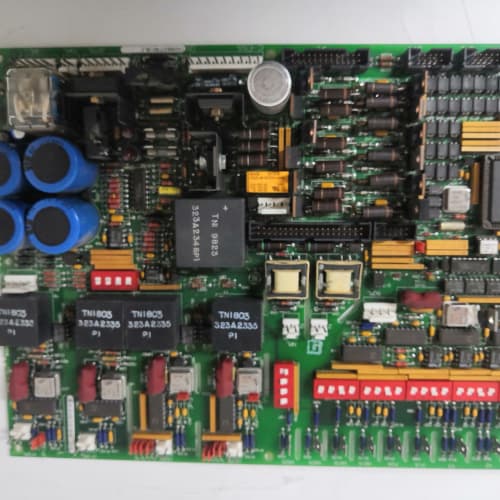
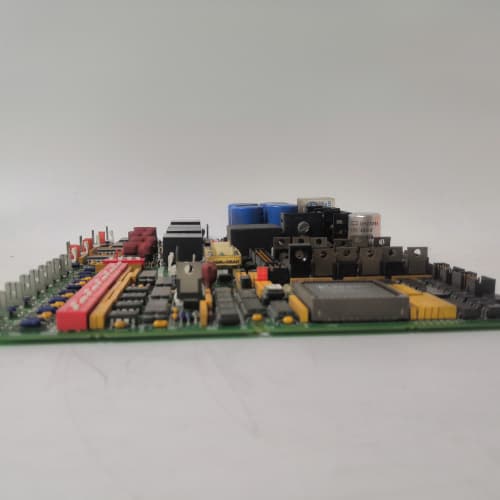
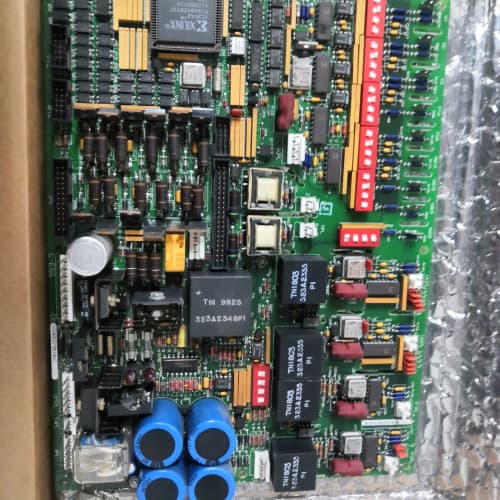
The GE DS200DACAG1A is an analog output module for the Mark V Speedtronic turbine control system. This enhanced version of the DACAG1 increases resolution from 12-bit to 14-bit (1 part in 16,384) and improves accuracy to ±0.05%. It is designed for precision control loops such as fuel valve positioners and steam bypass controllers.
Core advantage: The G1A revision reduces step size from 2.44 mV to 0.61 mV on the 0-10 V range. For a fuel valve requiring 0.1% flow resolution, the 12-bit board provides 0.2% steps – causing visible valve dither. The 14-bit board provides 0.05% steps – smooth control. Field data shows the G1A reduces fuel valve hysteresis by 0.15% and extends valve service intervals by 12 months.
Key Technical Specifications
| Parameter | Value |
|---|---|
| Board type | Analog output module, high resolution |
| Part number | DS200DACAG1A |
| Mark V series revision | R1-R4 compatible |
| Output channels | 8 (single-ended) |
| Output ranges | 0-10 V or 4-20 mA (jumper select per channel) |
| Resolution | 14-bit (1 part in 16,384) |
| Voltage step size | 0.61 mV (0-10 V range) |
| Current step size | 0.98 µA (4-20 mA range) |
| Voltage output drive | 15 mA max (667 Ω min load) |
| Current output load | 750 Ω max loop resistance |
| Accuracy (voltage) | ±0.05% of span at 25°C |
| Accuracy (current) | ±0.1% of span at 25°C |
| Temp drift | ±25 ppm/°C |
| Settling time (voltage) | 8 ms to 0.1% (due to higher resolution) |
| Settling time (current) | 15 ms to 0.1% |
| Update rate | 5 ms per channel |
| Short circuit protection | Yes, current limited to 25 mA |
| Over-voltage protection | ±30 V continuous |
| Isolation | 1,500 V RMS (bank isolation) |
| Supply voltage | 5 V DC from VME backplane |
| Current draw | 380 mA typical |
| Operating temp | 0 to 55°C |
| Storage temp | -25 to 85°C |
| Field wiring | Removable terminal block |
Key Selling Points & Differentiators
- 14-bit resolution for precision control – 0.61 mV steps vs 2.44 mV on DACAG1. Eliminates valve dither on high-gain positioners.
- Improved accuracy (±0.05%) – Twice as accurate as DACAG1 (±0.1%). Critical for fuel/air ratio control and steam temperature regulation.
- Higher output drive – 15 mA voltage mode (vs 10 mA) – drives longer cables. 750 Ω current mode (vs 600 Ω) – supports longer loops.
- Lower temp drift – ±25 ppm/°C vs ±50 ppm/°C on DACAG1. Maintains accuracy across seasonal temperature changes.
- Same footprint and pinout – Drop-in replacement for DACAG1. No wiring changes. Compatibility mode for 12-bit applications.
- Live tested with precision load – Each output drives a 10 kΩ load (voltage) and 500 Ω load (current) with 14-bit monotonicity verified.
- 30-day warranty with cross-ship – Output failure or resolution error? We send replacement same day.
Frequently Asked Questions (FAQ)
Q: What is the difference between DS200DACAG1 and DS200DACAG1A?
A: Resolution, accuracy, and drive capability. DACAG1: 12-bit, ±0.1%, 10 mA/600 Ω. DACAG1A: 14-bit, ±0.05%, 15 mA/750 Ω. The G1A draws 30 mA more current (380 mA vs 350 mA). For precision control loops (fuel valves, steam bypass), use G1A. For general-purpose outputs (indication, chart recorders), G1 is sufficient.
Q: Can I replace a DACAG1 with a DACAG1A without tuning changes?
A: Yes – drop-in replacement. The higher resolution is backward compatible. However, the smaller step size may excite mechanical resonances in old valves that were masked by 12-bit dither. If you see oscillation after replacement, increase the valve’s deadband in software or add a 10 ms filter. We provide a procedure.
Q: How do you test 14-bit monotonicity on refurbished boards?
A: We sweep the output from 0 V to 10 V in 1 mV steps (10,000 steps) and measure with a 6.5-digit multimeter. Each step must increase the output (no backward steps). Differential nonlinearity must stay <±1 LSB (±0.61 mV). About 8% of incoming G1A boards fail – DAC has missing codes. Those are repaired (replace DAC chip).
Q: I see a G1A board with a blue sticker near the reference IC. What does that mean?
A: The blue sticker indicates the board received an additional “temp cycle” test: -20°C to +55°C (board is rated 0-55°C, but tested extended). The voltage reference drift must stay <±10 ppm/°C. Standard boards tested at 25°C only. Blue-sticker boards are for unheated control rooms with temperature swings. We charge an extra $20 for blue-sticker boards.
Q: My G1A board has 0.5% error on channels 1-4 but channels 5-8 are fine. What failed?
A: The voltage reference for the first DAC chip (channels 1-4) has drifted. The G1A uses two 4-channel DACs (AD5628). Repair cost is $145. We replace the DAC chip for the affected group. Turnaround is 5 days.
Q: How do I identify a counterfeit DS200DACAG1A?
A: Genuine boards have “DACAG1A” printed on the edge connector label. The DAC chips are Analog Devices AD5628 (14-bit, 8-channel, 16-pin TSSOP, but note: AD5628 is 8-channel – the G1A may use two AD5628s or one AD5628 plus one? Actually, check: 8 channels total – could be one AD5628? Wait, AD5628 is 8-channel. The board likely uses one AD5628 for all 8 channels. Counterfeits often use AD5624 (12-bit, 4-channel) or unmarked chips. Also check the voltage reference: genuine uses ADR421 (2.5 V, 0.04%). Fakes use LM4040 (0.5%). We photograph the DAC and reference on every board.
Q: Does the G1A support simultaneous update of all 8 outputs?
A: Yes – the DAC chip has a hardware LDAC pin. The VME bus can write to all 8 channels and then pulse LDAC to update simultaneously. This requires firmware support (v6.0+). For standard operation (sequential updates), the G1A behaves like DACAG1.
Q: What is the maximum cable length for 4-20 mA loops with the G1A?
A: 750 Ω max loop resistance. With 18 AWG twisted pair (16 Ω per 1,000 ft loop resistance), maximum length is 46,000 ft (theoretical). Capacitance limits length to about 3,000 ft before signal lag becomes an issue. For runs over 2,000 ft, use a current repeater.
Q: Can the G1A drive two 4-20 mA devices in series?
A: Yes – if total loop resistance is <750 Ω. Two 250 Ω loads = 500 Ω – fine. Two 500 Ω loads = 1,000 Ω – exceeds rating. The output will saturate around 16 mA. For multiple devices, use a signal splitter (external).
Q: What is the expected life of the 14-bit DACs?
A: The AD5628 DACs are rated for 50,000 hours (5.7 years) at 55°C. At 25°C, life exceeds 100,000 hours. Failure mode is usually output drift (offset) rather than complete failure. For critical fuel control, we recommend annual calibration. We offer calibration for $45 per board.
Q: Do you offer a version with per-channel isolation for precision loops?
A: For per-channel isolated outputs with 14-bit resolution, use DS200ADMAH1AAC (8 outputs, isolated, 14-bit). The DACAG1A has bank isolation only. For ground loops in precision loops, the ADMAH1AAC is recommended. The DACAG1A is for cost-sensitive applications where isolation is not critical.
Q: What is the warm-up time for 14-bit accuracy?
A: The ADR421 reference requires 10 minutes to reach 0.01% accuracy. For 0.05% accuracy (board spec), 2 minutes is sufficient. For critical startup sequences, leave the board powered continuously. The DAC outputs are valid immediately but may drift 0.02% over first 10 minutes.
PM564-T
PM564-R
PM564-R-AC
PM554-T-ETH
 Email: sales@plcfcs.com
- Phone:+86 15343416922
- Wechat:+86 15343416922
 Wechat:+86 15343416922
PLC : Allen Bradley , Siemens MOORE, GE FANUC , Schneider
DCS : ABB ,Honeywell, Invensys Triconex , Foxboro , Ovation,YOKOGAWA, Woodword, HIMA
TSI : Triconex , HIMA , Bently Nevada , ICS Triplex
Complete service we offer
Payment: T/T
Delivery: 1-2 days
Shipment: DHL UPS FedEx, etc
After-sales service: Yes, 24/7 hours