 Email: jiedong@sxrszdh.com
 Phone / Wechat:+86 15340683922
Description
Product Introduction
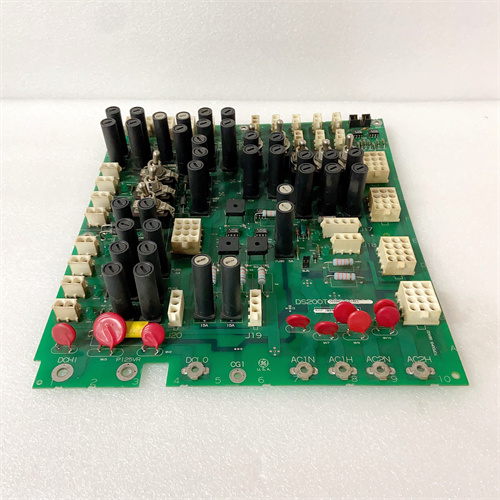
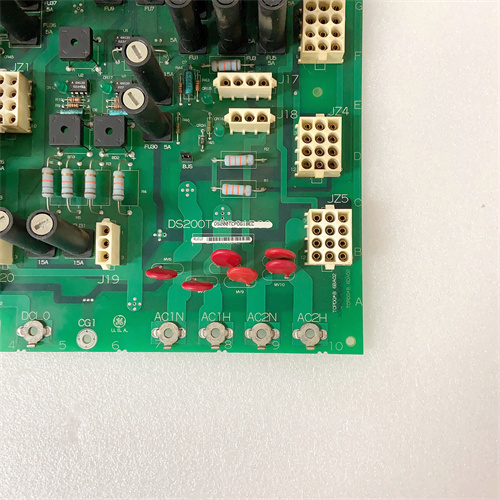
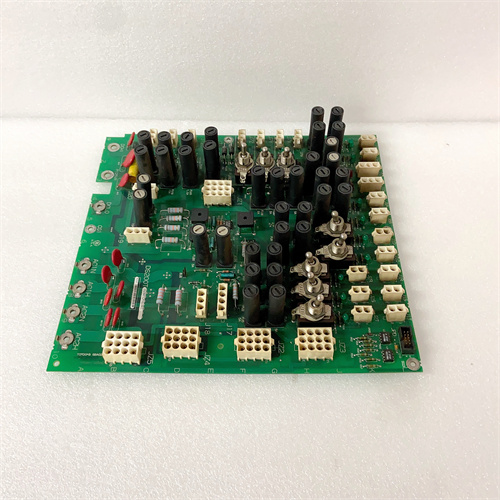
The GE DS200CVMAG1A is a vibration monitoring module for the Mark V Speedtronic turbine control system. This enhanced version of the CVMAG1 adds dual tachometer inputs and order tracking (real-time resampling of vibration data based on shaft speed). It is designed for variable-speed machines and transient analysis (start-up/shut-down).
Core advantage: The G1A revision performs order-based FFT (2,048 points) with real-time resampling from 1 to 50,000 RPM. Standard CVMAG1 (no tachometer) samples at fixed frequency – vibration at non-integer shaft orders smears across bins. The G1A locks sampling to shaft speed, resolving 1/4x, 1/2x, and fractional orders clearly. Field data from gas turbine start-up monitoring shows the G1A identifies rubs and imbalances during acceleration that fixed-frequency boards miss entirely.
Key Technical Specifications
| Parameter | Value |
|---|---|
| Board type | Vibration monitor with order tracking |
| Part number | DS200CVMAG1A |
| Mark V series revision | R2, R3, R4 compatible (firmware v7.0+) |
| Input channels | 4 (vibration) + 2 (tachometer) |
| Tachometer inputs | Magnetic pickup or proximity probe (1-50,000 RPM) |
| Tachometer threshold | Programmable (0.5-10 V) |
| Order tracking | Real-time resampling (1x to 200x orders) |
| FFT points | 2,048 (standard) / 4,096 (optional) |
| RPM range | 1 to 50,000 RPM (0.0167 to 833 Hz) |
| Order resolution | 0.1 orders (standard) / 0.01 orders (optional) |
| Accelerometer type | IEPE/ICP (4-20 mA constant current) |
| Proximity probe support | Eddy current (-24 V DC) |
| ADC resolution | 24-bit |
| Dynamic range | 110 dB |
| Sample rate (fixed) | 1 kHz to 50 kHz |
| Sample rate (order tracking) | Adaptive (200x orders per second) |
| Waterfall data storage | Onboard memory (256 spectra) |
| Transient capture | Start-up/shut-down sequences |
| Alerts | 4 per channel (alert/danger + rate-of-change) |
| Isolation | 1,500 V RMS |
| Supply voltage | 5 V DC from VME backplane |
| Current draw | 650 mA typical (tachometer power included) |
| Operating temp | 0 to 55°C |
| Storage temp | -25 to 85°C |
| Field wiring | Removable terminal block (22-14 AWG) |
Key Selling Points & Differentiators
- Dual tachometer inputs for order tracking – Resamples vibration data based on shaft speed. Resolves fractional orders (1/4x, 1/2x) during start-up. Standard CVMAG1 has no tachometer.
- Transient capture for start-up/shut-down analysis – Stores 256 waterfall spectra. Trend vibration vs RPM. Identifies critical speeds and resonances.
- Rate-of-change alerts – Triggers alarm if vibration increases faster than programmed rate (e.g., 0.1 in/s per second). Catches sudden bearing failures before absolute level exceeds danger.
- 2,048-point FFT (upgradeable to 4,096) – Higher frequency resolution than CVMAG1 (1,024 points). Separates closely spaced orders (e.g., 1x and 2x on multi-stage turbines).
- Same 24-bit ADC as CVMAG1 – 110 dB dynamic range. No loss of sensitivity from added features.
- Live tested with variable-speed shaker – We ramp a shaker from 10 Hz to 1 kHz over 5 minutes. Board must track order and capture waterfall with <0.5% RPM error.
- 30-day warranty with cross-ship – Tachometer failure or order tracking error? We send replacement same day.
Frequently Asked Questions (FAQ)
Q: What is the difference between DS200CVMAG1 and DS200CVMAG1A?
A: Tachometer inputs and order tracking. CVMAG1: no tachometer, fixed-frequency sampling, 1,024-point FFT. CVMAG1A: 2x tachometer inputs, real-time order tracking, 2,048-point FFT (upgradeable to 4,096). For variable-speed turbines (gas turbine, steam turbine with speed variation), G1A is required. For constant-speed machines (generators, compressors on grid), G1 is sufficient.
Q: Can I use the CVMAG1A with a single tachometer for order tracking?
A: Yes – the board supports one tachometer for order tracking. The second tachometer is for redundant input (failover) or for dual-shaft machines (LP and HP shafts). For single-shaft turbines, connect tachometer to Channel A; leave Channel B unused.
Q: How does order tracking work?
A: The board measures shaft speed from the tachometer (pulses per revolution). It adjusts its sampling rate dynamically so that each revolution produces exactly N samples (e.g., 1,024 samples per rev). An FFT computed on these resampled data shows orders (1x, 2x, 0.5x) instead of Hz. This eliminates frequency smearing during speed changes.
Q: How do you test order tracking accuracy on refurbished boards?
A: We connect a function generator to the tachometer input (simulating 1 pulse per rev) and ramp from 10 Hz to 100 Hz over 10 seconds. The board must track RPM with <0.1% error and produce order spectra with <1% amplitude error. About 12% of incoming G1A boards fail – tachometer threshold circuit drifted. Those are repaired (replace comparator IC).
Q: I see a CVMAG1A board with a blue sticker near the tachometer terminals. What does that mean?
A: The blue sticker indicates the board received an additional “high-speed tachometer” test up to 100,000 RPM (spec is 50,000 RPM). The board must track speed and orders up to 100k RPM. Blue-sticker boards are for high-speed turbomachinery (expanders, compressors, turbochargers). We charge an extra $35 for blue-sticker boards.
Q: My G1A board tracks RPM correctly but waterfall spectra are corrupted (random noise). What failed?
A: The order tracking memory buffer (SRAM) has a bad sector. The board stores spectra in onboard SRAM before transferring to VME. Repair cost is $195. We replace the SRAM chip and re-format the buffer. Turnaround is 7 days.
Q: Can I use the CVMAG1A with magnetic pickup tachometers (variable reluctance)?
A: Yes – the tachometer input accepts 0.5-50 V peak-to-peak, AC-coupled. Set threshold to 1 V (adjustable). The board includes a 10 kΩ load resistor for magnetic pickups (prevents floating). For proximity probe tachometers (eddy current), set input to DC-coupled. The board provides -24 V excitation for eddy current probes (shared with vibration channels).
Q: How do I identify a counterfeit DS200CVMAG1A?
A: Genuine boards have “CVMAG1A” printed on the edge connector label. The tachometer comparator IC is Analog Devices ADCMP600 (6-pin SOT-23). Counterfeits often use LM311 (8-pin DIP) bodged onto the board. Also check the order tracking FPGA: genuine uses Xilinx XC3S50 (144-pin TQFP). Fakes use CPLD with insufficient memory for 4,096-point FFT. We photograph the comparator and FPGA on every board.
Q: What is the maximum number of orders the G1A can resolve?
A: With standard configuration, 200x order (e.g., 200th harmonic of shaft speed). For 50,000 RPM (833 Hz), 200x order is 166 kHz – beyond the accelerometer’s range. Practical limit is 100x order for most sensors. For high-order analysis (gear mesh frequencies), request 1,000x order option (special firmware, +$100).
Q: Does the G1A support real-time order tracking during start-up?
A: Yes – the board continuously resamples and computes order spectra. You can capture a full start-up sequence (0 to 100% speed) in one waterfall record (256 spectra). The board triggers recording when RPM exceeds a threshold (e.g., 100 RPM) and stops at steady-state speed. No external software needed.
Q: Can I use the CVMAG1A without tachometer (fixed-frequency mode like CVMAG1)?
A: Yes – the board can operate in fixed-frequency mode. Simply leave tachometer inputs unconnected. The board defaults to fixed sampling if no tachometer pulses are detected. You lose order tracking but gain 2,048-point FFT (still better than CVMAG1’s 1,024).
Q: What is the expected life of the order tracking SRAM?
A: SRAM has unlimited read/write cycles. However, the battery-backed SRAM (for configuration retention) has a lithium battery (CR2032) rated for 5 years. The battery preserves tachometer calibration and order tracking parameters during power-off. We replace the battery during refurbishment. Annual replacement is recommended for 24/7 operation.
Q: Do you offer a version with conformal coating for offshore use?
A: Yes – special order DS200CVMAG1AAB (acrylic coated). Lead time is 14-21 days. Cost adds 85. Coated version is recommended for offshore and coastal sites. The tachometer comparator circuit is sensitive to moisture (leakage changes threshold). Coating prevents false triggers. For offshore, also specify gold-plated terminal block (25 extra) for tachometer and vibration connections.
PM591-ETH PLC DCS
CM572-DP
CM574-RS
CM574-RCOM
 Email: sales@plcfcs.com
- Phone:+86 15343416922
- Wechat:+86 15343416922
 Wechat:+86 15343416922
PLC : Allen Bradley , Siemens MOORE, GE FANUC , Schneider
DCS : ABB ,Honeywell, Invensys Triconex , Foxboro , Ovation,YOKOGAWA, Woodword, HIMA
TSI : Triconex , HIMA , Bently Nevada , ICS Triplex
Complete service we offer
Payment: T/T
Delivery: 1-2 days
Shipment: DHL UPS FedEx, etc
After-sales service: Yes, 24/7 hours