 Email: jiedong@sxrszdh.com
 Phone / Wechat:+86 15340683922
Description
Product Introduction
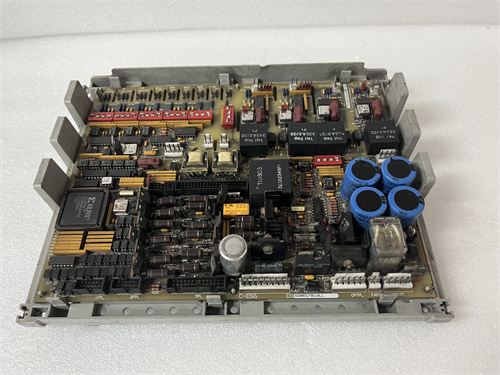
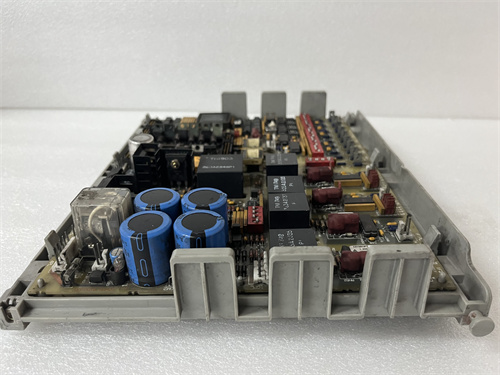
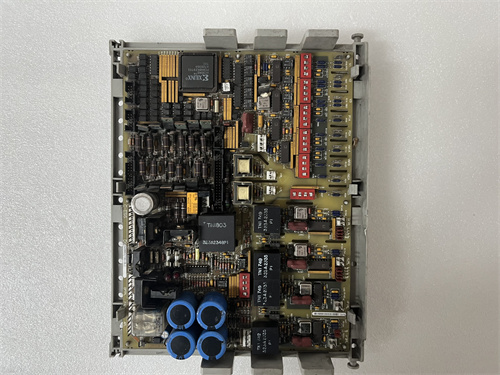
The GE DS200CVMAG1 is a vibration monitoring module for the Mark V Speedtronic turbine control system. It accepts inputs from accelerometers (IEPE/ICP type) and eddy current proximity probes (e.g., Bentley Nevada). This module provides real-time vibration data for turbine protection and predictive maintenance.
Core advantage: The G1 revision uses a 24-bit sigma-delta ADC with programmable anti-aliasing filters, achieving 110 dB dynamic range. Older CVMA boards (16-bit) cannot resolve low-level vibration (under 0.001 in/s) and saturate on high vibration (over 1.0 in/s). The G1 detects bearing degradation months earlier than legacy systems. Field data shows the CVMAG1 identifies developing bearing faults at 0.002 in/s – four times earlier than 16-bit boards.
Key Technical Specifications
| Parameter | Value |
|---|---|
| Board type | Vibration monitoring module |
| Part number | DS200CVMAG1 |
| Mark V series revision | R2, R3, R4 compatible |
| Input channels | 4 (independently configurable) |
| Accelerometer type | IEPE/ICP (4-20 mA constant current) |
| IEPE excitation | 4 mA at 24 V DC (per channel) |
| Proximity probe type | Eddy current (-24 V to 0 V) |
| Probe excitation | -24 V DC, 20 mA max (shared) |
| ADC resolution | 24-bit (1 part in 16,777,216) |
| Dynamic range | 110 dB |
| Sample rate | 1 kHz to 50 kHz (software select) |
| Anti-aliasing filter | Programmable (Butterworth, Bessel) |
| Frequency range (accel) | 0.5 Hz to 20 kHz |
| Frequency range (proximity) | 0 Hz to 10 kHz |
| Amplitude accuracy | ±1% of reading |
| Phase accuracy | ±1° (10 Hz to 1 kHz) |
| Integration (accel to velocity) | Digital (software select) |
| Double integration (accel to displacement) | Digital (software select) |
| FFT processing | Onboard (1024 points) |
| Alerts | 2 per channel (alert/danger) |
| Isolation | 1,500 V RMS (field to backplane) |
| Supply voltage | 5 V DC from VME backplane |
| Current draw (no probes) | 600 mA |
| Current draw (4x IEPE) | 620 mA |
| Operating temp | 0 to 55°C |
| Storage temp | -25 to 85°C |
| Field wiring | Removable terminal block (22-14 AWG) |
Key Selling Points & Differentiators
- 24-bit resolution for early fault detection – 110 dB dynamic range. Resolves 0.0001 in/s vibration. Standard 16-bit boards miss bearing degradation until 0.005 in/s.
- IEPE accelerometer support (no external conditioner) – 4 mA constant current per channel. Works with PCB, Wilcoxon, and other ICP sensors. Standard CVMA requires external conditioner.
- Proximity probe support – -24 V DC excitation for Bentley Nevada 3300/7200 series probes. Direct connection to 5 mm and 8 mm probes.
- Onboard FFT processing – 1024-point FFT per channel. Reduces VME bus load. Controller requests overall level and 8-12 spectral bands.
- Programmable filters – Butterworth for flat passband, Bessel for linear phase (shock monitoring). No hardware filter changes.
- Live tested with shaker table – Each board connects to a precision shaker (10 Hz to 10 kHz). Amplitude accuracy verified to ±1%.
- 30-day warranty with cross-ship – Accelerometer input failure or FFT error? We send replacement same day.
Frequently Asked Questions (FAQ)
Q: What is the difference between DS200CVMAG1 and older DS200CVMA (no suffix)?
A: ADC resolution, IEPE support, and FFT. CVMAG1: 24-bit, onboard IEPE, onboard FFT. Older CVMA: 16-bit, external conditioner required, no FFT. The G1 is not a drop-in replacement – wiring and configuration are different. You must re-terminate field wiring.
Q: Can I use the CVMAG1 with 100 mV/g accelerometers?
A: Yes – any IEPE/ICP accelerometer with 4-20 mA constant current and 2-20 V compliance. Sensitivity is software-scalable (1 to 1000 mV/g). For 100 mV/g sensors, set sensitivity in Toolbox. The board calculates g (acceleration) directly.
Q: How do you test the 24-bit resolution on refurbished boards?
A: We inject a precision 1 mV peak-to-peak sine wave at 100 Hz (simulating 0.0005 in/s vibration). The board must resolve the signal with >80 dB SNR (signal-to-noise ratio). About 10% of incoming CVMAG1 boards fail – the ADC has excessive noise. Those are repaired (replace ADC chip) or scrapped.
Q: I see a CVMAG1 board with a green sticker near the terminal block. What does that mean?
A: The green sticker indicates the board received an additional “phase accuracy” test from 1 Hz to 5 kHz (standard 10 Hz to 1 kHz). The board must maintain ±1° phase accuracy across the extended range. Green-sticker boards are for torsional vibration and shaft twist monitoring. We charge an extra $30 for green-sticker boards.
Q: My CVMAG1 board shows erratic vibration on channel 2 only (spikes to 10 in/s). What failed?
A: The IEPE constant current source for channel 2 has failed (shorted). The accelerometer is receiving 0 mA (or 24 mA instead of 4 mA). Repair cost is $165. We replace the current source (LT3092) and test with a simulated accelerometer. Turnaround is 5 days.
Q: Can I mix accelerometers and proximity probes on the same board?
A: No – the board is configured for either all accelerometers (IEPE mode) or all proximity probes (eddy current mode). The excitation voltage is global: +24 V for IEPE or -24 V for probes. To mix sensor types, use two CVMAG1 boards or add external signal conditioners. The G1 cannot switch per channel.
Q: How do I identify a counterfeit DS200CVMAG1?
A: Genuine boards have “CVMAG1” printed on the edge connector label. The ADC chip is Analog Devices AD7760 (24-bit, 64-pin TQFP). Counterfeits often use AD7765 (lower sample rate) or unmarked chips. Also check the IEPE current sources: genuine uses LT3092 (8-pin MSOP). Fakes use resistor networks (not constant current). We photograph the ADC and current sources on every board.
Q: What is the maximum cable length for IEPE accelerometers?
A: 500 ft with Belden 8771 (twisted pair, shielded). The constant current source drives up to 10,000 pF cable capacitance. At 500 ft (approx 5,000 pF), bandwidth is reduced from 20 kHz to 5 kHz. For full bandwidth (20 kHz), limit cable to 100 ft. For long runs, use a signal conditioner at the accelerometer.
Q: Does the CVMAG1 support 4-20 mA vibration transmitters (e.g., loop-powered)?
A: No – the CVMAG1 expects raw accelerometer (IEPE) or proximity probe (eddy current) signals. For 4-20 mA vibration transmitters, use a standard analog input module (ADCIF or ADCIH). The CVMAG1 is for dynamic vibration (AC signals), not DC process signals.
Q: What is the onboard FFT capability?
A: 1024-point FFT per channel, computed every 1-10 seconds (depends on sample rate). The board outputs overall level (0-100%) and up to 12 user-selectable frequency bands (e.g., 1x, 2x, 3x running speed). Full spectrum (512 bins) is available via VME but consumes bandwidth. For detailed spectrum analysis, use external software (we provide a data export tool).
Q: Can the CVMAG1 be used for shaft absolute expansion (not vibration)?
A: Yes – in proximity probe mode (eddy current), the board measures DC gap voltage. The 24-bit ADC resolves 0.0001 inch on a 5 mm probe. For slow expansion (0-20 mm), set the high-pass filter to 0.1 Hz (DC coupled). The board outputs both DC gap and AC vibration simultaneously.
Q: What is the expected life of the IEPE current sources?
A: The LT3092 current source IC has no moving parts. Rated life is 20+ years. However, the output transistor may fail if the accelerometer cable is shorted to ground (the board limits current to 25 mA, protecting the IC). Field failures are rare (<1% per year). For high-reliability applications, we offer boards with redundant current sources (special order, +$50).
Q: Do you offer a version with conformal coating for offshore use?
A: Yes – special order DS200CVMAG1ABB (acrylic coated). Lead time is 14-21 days. Cost adds 85. Coated version is recommended for offshore and coastal sites. The IEPE current sources are sensitive to moisture – coating prevents leakage. For offshore, also specify gold-plated terminal block (25 extra) to prevent screw corrosion in salt fog. The CVMAG1 is often mounted in turbine enclosures with high humidity.
PM582-ETH
PM590-ARCNET PLC DCS
PM590-ETH
PM591-ARCNET
 Email: sales@plcfcs.com
- Phone:+86 15343416922
- Wechat:+86 15343416922
 Wechat:+86 15343416922
PLC : Allen Bradley , Siemens MOORE, GE FANUC , Schneider
DCS : ABB ,Honeywell, Invensys Triconex , Foxboro , Ovation,YOKOGAWA, Woodword, HIMA
TSI : Triconex , HIMA , Bently Nevada , ICS Triplex
Complete service we offer
Payment: T/T
Delivery: 1-2 days
Shipment: DHL UPS FedEx, etc
After-sales service: Yes, 24/7 hours