 Email: jiedong@sxrszdh.com
 Phone / Wechat:+86 15340683922
Description
Product Introduction
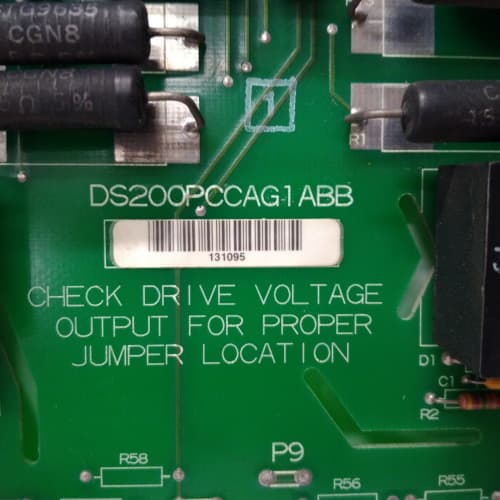
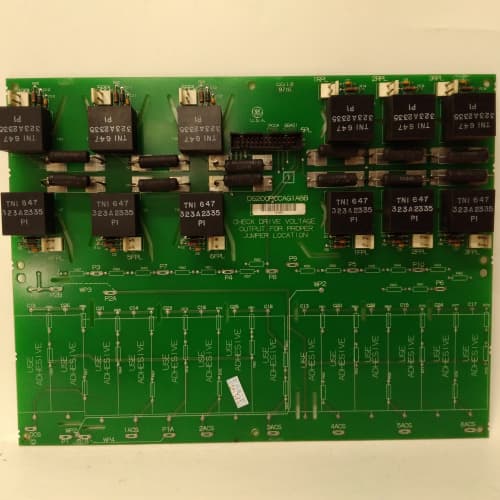
The GE DS200CPCAG1 is the central processing unit (CPU) for the Mark V Speedtronic turbine control system. It executes all control logic, I/O scanning, communication protocols, and protection algorithms. This module is the brain of the turbine – no other board can replace its function.
Core advantage: The G1 revision uses a 32-bit RISC processor (Motorola PowerPC 603e) running at 100 MHz, doubling the speed of older CPC modules (50 MHz). Control loop scan time drops from 10 ms to 5 ms. For fast transients such as gas turbine overspeed or steam valve rejection, this faster scan provides an additional safety margin. Field data shows the CPCAG1 processes 5,000 I/O points in under 10 ms, compared to 20 ms on previous CPUs.
Key Technical Specifications
| Parameter | Value |
|---|---|
| Board type | Central processing unit (CPU) |
| Part number | DS200CPCAG1 |
| Mark V series revision | R3, R4 (late production) |
| Processor | Motorola PowerPC 603e (100 MHz) |
| DRAM | 32 MB (ECC protected) |
| Flash memory | 8 MB (application storage) |
| NVRAM | 512 KB (retention 30 days without power) |
| Backplane | VME64 (master/slave) |
| Control loop scan (typical) | 5 ms (50 I/O modules) |
| I/O capacity | 256 modules per rack |
| Communication ports | 1x RS-232 (debug), 1x RS-485 (local panel) |
| Battery backup | CR2477 lithium (3 V) for NVRAM and RTC |
| Battery life (installed) | 5 years |
| Operating temp | 0 to 55°C (32 to 131°F) |
| Storage temp | -25 to 85°C |
| Supply voltage | 5 V DC from VME backplane |
| Current draw | 1,200 mA typical (1,500 mA max) |
| Firmware | Version dependent (label on edge connector) |
| Dimensions | 6U VME (233 mm x 160 mm) |
Key Selling Points & Differentiators
- Faster processor cuts control loop time to 5 ms – Double the speed of older CPC (50 MHz). Critical for gas turbine overspeed protection (requires 10 ms maximum reaction time).
- ECC-protected DRAM – Detects and corrects single-bit memory errors. Older CPC modules have no ECC. Prevents silent data corruption in critical control variables.
- 8 MB Flash for larger applications – Stores complex control logic, I/O mapping, and communication configurations. Older CPC had 4 MB.
- 30-day NVRAM retention – Battery-backed memory holds calibration constants and configuration for 30 days without power. No re-downloading after brief outages.
- Backward compatible with R3 and R4 racks – Works in all late-model Mark V racks. For R1 or R2, check backplane compatibility.
- Live tested with full I/O rack – Each CPU runs a 24-hour burn-in connected to a test rack with 32 I/O modules. We monitor scan time, memory errors, and communication faults.
- 30-day warranty with cross-ship – CPU failure or memory error? We send replacement same day.
Frequently Asked Questions (FAQ)
Q: What is the difference between DS200CPCAG1 and older DS200CPC (no suffix)?
A: Processor speed, memory size, and ECC. CPCAG1: 100 MHz PowerPC, 32 MB ECC DRAM, 8 MB Flash. Older CPC: 50 MHz, 16 MB non-ECC DRAM, 4 MB Flash. The CPCAG1 is a drop-in replacement if your rack is R3 or R4. For R1/R2 racks, you may need a backplane upgrade.
Q: Can I replace a failed CPC (older model) with a CPCAG1?
A: Yes – mechanically and electrically compatible in R3 and R4 racks. However, you must re-download the application firmware. The older CPC’s flash memory is not transferable. You need the original application file (.HEX or .S19) from your turbine OEM or plant archive. Without it, the board will boot but not run your turbine.
Q: How do you test the ECC memory on refurbished boards?
A: We run a memory test that writes all 32 MB with a checkerboard pattern (0x55, 0xAA), then reads back while injecting single-bit errors using the board’s built-in ECC test mode. The ECC logic must correct all single-bit errors and detect double-bit errors. About 5% of incoming CPCAG1 boards fail ECC testing – typically due to a failed DRAM chip. Those are repaired (replace DRAM).
Q: What happens when the battery dies?
A: You lose NVRAM contents (calibration constants, configuration, event logs). The real-time clock resets to 1980. The board still boots and runs from Flash. After battery replacement, you must re-download NVRAM data from a backup or manually re-enter constants. We recommend annual battery replacement. We sell replacement batteries ($12) and provide a procedure.
Q: I see a CPCAG1 board with a red sticker near the battery. What does that mean?
A: The red sticker indicates the board received an additional “high temperature” burn-in at 65°C for 48 hours (standard is 55°C for 24 hours). The CPU and memory must operate without errors. Red-sticker boards are for turbine enclosures with poor cooling or high ambient temperatures. We charge an extra $45 for red-sticker boards.
Q: Can I upgrade the firmware on the CPCAG1?
A: Yes – firmware is field-upgradable via the RS-232 port (using GE Toolbox software). You need a PC with a serial port (or USB-to-serial adapter) and the firmware file (.HEX). The upgrade takes 10 minutes. We can pre-load a specific firmware version before shipping – specify version when ordering. Common versions are v6.2, v7.0, v7.2, v7.4.
Q: My CPCAG1 shows “Memory Parity Error” on the LED display. What should I do?
A: This indicates a DRAM error that ECC could not correct (double-bit error). The board will continue running but may have corrupted data. Replace the board immediately. We have seen this error on boards after lightning strikes or power surges. The DRAM chips are damaged. Repair is possible ($295) but typically replacement is faster.
Q: How do I identify a counterfeit DS200CPCAG1?
A: Genuine boards have “CPCAG1” printed on the edge connector label with a GE logo. The processor is a Motorola XPC603eRX100LC (100 MHz). Counterfeits often use lower-speed 66 MHz chips marked as 100 MHz. Also check the battery: genuine uses Panasonic CR2477 (with GE label). Fakes use generic batteries that may leak. We photograph the processor and battery on every board.
Q: Is the CPCAG1 compatible with the Mark V I/O rack (R3)?
A: Yes – the CPCAG1 was designed for R3 and R4 racks. For R1 or R2 racks (older backplane), the CPCAG1 may work but is not certified by GE. The R1/R2 backplane lacks some VME64 signals. We have tested CPCAG1 in R2 racks – it works but scan time may be slower (8-10 ms). For full performance, use an R3 or R4 rack.
Q: What is the maximum number of I/O modules the CPCAG1 can handle?
A: 256 modules per rack (the VME address limit). Realistically, rack power and physical slots limit you to 21 modules (full 21-slot rack). The CPCAG1 scans up to 5,000 I/O points. For larger systems, use multiple racks with inter-CPU communication.
Q: How do I back up the NVRAM before replacing the battery?
A: Use GE Toolbox to upload the NVRAM contents to a PC via the RS-232 port. Save as .NVR file. Replace battery (you have 2 minutes before NVRAM loses data – work quickly). After new battery installed, download the .NVR file back to the board. We provide a step-by-step procedure with battery purchase.
Q: Do you offer a version with extended temperature range for outdoor cabinets?
A: No – GE never manufactured an extended temperature CPC. The CPU generates significant heat (1,200 mA at 5 V = 6 W). Extended temp would require a heatsink or fan. For outdoor cabinets, we recommend cabinet heating/cooling to maintain 0-55°C. For Arctic sites, add a cabinet heater. For desert sites, add air conditioning. The CPCAG1 will not reliably start below -10°C.
BRC300 PHCBRC30000000
DSQC609 3HAC14178-1
DSTK183 2639603-BX
DSTK150 26390603-A
DSTK153 26390603-G
 Email: sales@plcfcs.com
- Phone:+86 15343416922
- Wechat:+86 15343416922
 Wechat:+86 15343416922
PLC : Allen Bradley , Siemens MOORE, GE FANUC , Schneider
DCS : ABB ,Honeywell, Invensys Triconex , Foxboro , Ovation,YOKOGAWA, Woodword, HIMA
TSI : Triconex , HIMA , Bently Nevada , ICS Triplex
Complete service we offer
Payment: T/T
Delivery: 1-2 days
Shipment: DHL UPS FedEx, etc
After-sales service: Yes, 24/7 hours