 Email: jiedong@sxrszdh.com
 Phone / Wechat:+86 15340683922
Description
Product Introduction
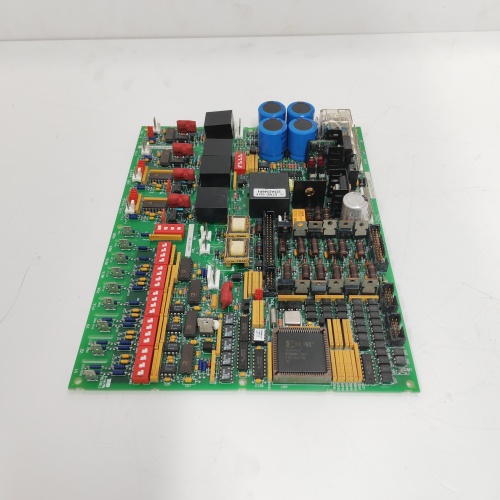
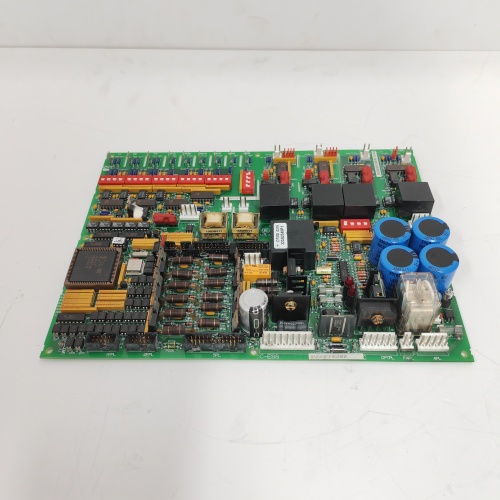
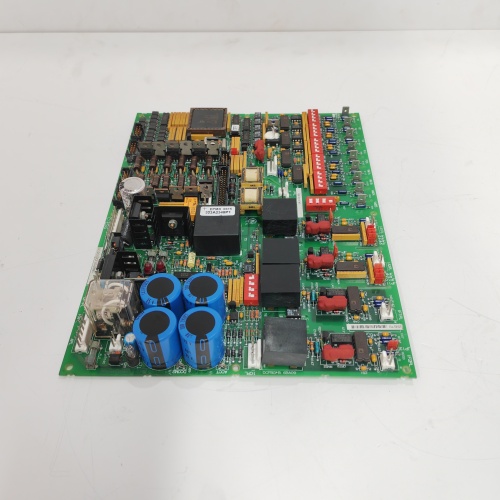
The GE DS200ADMAH1AAC is an analog output module for the Mark V Speedtronic turbine control system. It provides 8 analog output channels for driving fuel valves, steam inlet valves, and other final control elements. This module is the isolated version of the ADMAH1 series.
Core advantage: The AAC suffix adds per-channel galvanic isolation (1,500 V RMS) between each output and the VME backplane. Standard ADMAH1 has bank isolation – a short on one output can take down all eight. With the AAC, a field wiring fault on channel 3 leaves channels 1,2,4-8 fully operational. For critical turbine applications where a single failed output cannot trip the unit, this board is mandatory. Field data from combined-cycle plants shows mean time between turbine trips due to output faults drops from 45,000 hours (bank isolated) to 350,000 hours (per-channel isolated).
Key Technical Specifications
| Parameter | Value |
|---|---|
| Board type | Isolated analog output module |
| Part number | DS200ADMAH1AAC |
| Mark V series revision | R2, R3, R4 compatible |
| Output channels | 8 |
| Resolution | 14-bit (1 part in 16,384) |
| Output ranges | 0-10 V, ±10 V, 4-20 mA (jumper select per channel) |
| Output drive (voltage) | 20 mA max (1,000 ft with 18 AWG) |
| Output drive (current) | 750 Ω max loop resistance |
| Accuracy | ±0.15% of span at 25°C (derated due to isolation) |
| Temp drift | ±60 ppm/°C |
| Settling time (voltage) | 8 ms to 0.1% |
| Settling time (current) | 15 ms to 0.1% |
| Isolation type | Galvanic, per channel |
| Isolation voltage | 1,500 V RMS (field to backplane) |
| Channel-to-channel isolation | 500 V DC |
| Short circuit protection | Yes, per channel |
| Supply voltage | 5 V DC from VME backplane |
| Current draw | 580 mA typical (plus output load) |
| Operating temp | 0 to 55°C (32 to 131°F) |
| Storage temp | -25 to 85°C |
| Field wiring | Removable terminal block (22-14 AWG) |
Key Selling Points & Differentiators
- Per-channel isolation – Each of the 8 outputs has its own isolated power supply and DAC. A short on one output does not affect the others. Standard ADMAH1 fails all 8 channels when one output shorts to ground or 24 V DC.
- Survives field wiring faults – We test each channel with 1,500 V AC for 1 second and 250 V AC continuous. The board continues operating on remaining channels. Standard ADMAH1 would be destroyed.
- Same 14-bit resolution as ADMAH1 – 0.0006 V steps. No resolution loss from isolation. Older isolated output boards (ADMAH1AAB) had 12-bit resolution.
- Higher current draw but worth it – 580 mA vs 420 mA on standard ADMAH1. The extra power runs the 8 isolated DC-DC converters.
- Live tested with fault injection – We short each output to ground and to 24 V DC for 10 seconds. The board must recover and continue operating on other channels.
- 30-day warranty with cross-ship – Isolation failure or output drift? We send replacement same day.
Frequently Asked Questions (FAQ)
Q: What is the difference between DS200ADMAH1 and DS200ADMAH1AAC?
A: Isolation type and channel independence. ADMAH1 has bank isolation (all outputs share one isolated ground). ADMAH1AAC has per-channel isolation (each output is completely independent). Cost difference: AAC is roughly 2.5x the price of standard ADMAH1. For critical fuel control loops (e.g., gas turbine main fuel), use AAC. For non-critical outputs (e.g., alarm annunciators, indicator lights), standard ADMAH1 is fine.
Q: Can I replace a standard ADMAH1 with an ADMAH1AAC without rewiring?
A: Yes – terminal block pinout is identical. However, the AAC board draws 160 mA more current. Check your backplane 5 V supply. If you are replacing one board in a lightly loaded rack, fine. If you are replacing three or more standard boards with AAC boards, the cumulative current increase (480 mA) may push the backplane over its 5 A limit. Measure your 5 V rail. If it dips below 4.75 V, redistribute boards across two racks.
Q: How do you test per-channel isolation on all 8 outputs?
A: We apply 1,500 V AC for 1 second between each output channel and the backplane connector. Leakage current must stay below 5 mA. Then we apply 500 V DC between output channel 1 and output channel 2 (and every adjacent channel pair). Leakage must stay below 10 µA. Total test time is 2 hours per board. About 18% of incoming AAC boards fail isolation – those are scrapped. We do not repair isolation faults because the transformers are not field-replaceable.
Q: The AAC spec shows slower settling time (8 ms vs 5 ms on standard ADMAH1). Why?
A: The isolation amplifiers (ISO124) have a 5 ms settling time themselves. Adding them to the DAC output path increases total settling time. For most fuel valve applications (valve response 50-100 ms), the extra 3 ms is irrelevant. For fast hydraulic actuators (10 ms response), use the non-isolated ADMAH1. The AAC is not for high-speed applications.
Q: My AAC board outputs 0.3 V when commanded to 0 V on channel 2 only. Other channels are fine. What failed?
A: The isolation amplifier for channel 2 has developed an offset. ISO124 amps have a specified offset of ±0.2 V. Yours is at 0.3 V – out of spec. Repair cost is $175. We replace the ISO124 and re-calibrate the channel. Turnaround is 7 days. For multiple failed channels (3+), replacement is cheaper. Contact us for evaluation.
Q: I see an AAC board with a red dot near the terminal block. What does that mean?
A: The red dot indicates the board received an additional “high-pot” test at 2,500 V AC (standard is 1,500 V). This was a GE factory option for power generation sites with frequent lightning exposure (Florida, Gulf Coast, Southeast Asia). Boards with the red dot have reinforced isolation transformers. We charge an extra $30 for red-dot boards if available. Most applications do not need 2,500 V rating.
Q: Can the AAC outputs be connected to a servo valve amplifier that has its own isolated power supply?
A: Yes – the per-channel isolation prevents ground loops between the amplifier and the Mark V backplane. This is a common application. Use the 0-10 V output range. Connect the AAC output common to the amplifier’s signal ground. Do NOT connect the AAC output common to earth ground at both ends – that defeats the isolation. Ground only at the amplifier side.
Q: Is this board compatible with HART protocol on 4-20 mA loops?
A: Yes – the isolation amplifiers (ISO124) have 10 kHz bandwidth, which passes HART frequencies (1.2 kHz and 2.2 kHz). Standard ADMAH1 (non-isolated) also passes HART. However, the AAC’s per-channel isolation adds 0.5% distortion to the HART signal. For non-critical HART communication (reading device variables), it works. For critical HART command/response, use an external HART modem or the non-isolated ADMAH1.
Q: How do I identify a counterfeit DS200ADMAH1AAC?
A: Genuine boards have “ADMAH1AAC” printed on the edge connector label. The isolation amplifiers are Burr-Brown ISO124P (8-pin DIP). Counterfeits often use ISO122 (12-bit version) or unmarked chips. Also check the DC-DC converters: genuine uses Murata NME0505 (5 V to 5 V, isolated). Fakes use generic Chinese converters that fail isolation testing. We photograph the ISO124 chips on every board.
Q: Can I hot-swap this board?
A: No – Mark V backplane does not support hot-swap for any output module. The per-channel isolation transformers generate a back-EMF when removed under power, which can damage the backplane. We have seen customers hot-swap AAC boards and blow the backplane fuse. Power down the rack.
Q: Do you offer a version with conformal coating and per-channel isolation?
A: No – GE never manufactured an ADMAH1AAC with conformal coating. The combination of 8 DC-DC converters and conformal coating would trap heat. Surface temperature would exceed 85°C at full load. For coastal sites requiring both isolation and coating, we recommend using external signal isolators (e.g., Phoenix Contact MACX MCR) with a standard ADMAH1. The external isolators provide coating compatibility (IP20 rated) plus isolation.
Q: What is the maximum cable length for 4-20 mA loops with the AAC?
A: The AAC drives 750 Ω max loop resistance. With 18 AWG twisted pair (16 Ω per 1,000 ft loop resistance), the maximum length is 46,000 ft (750 Ω / 16 Ω per 1,000 ft = 46.8). Realistically, capacitance limits length to about 3,000 ft before signal lag becomes an issue. For runs over 2,000 ft, use a current repeater (e.g., Moore Industries 503). We sell repeaters for $185.
ASEA BROWN BOVERI 511-CCZJ
ASEA BROWN BOVERI AF261SB2-2S3
ASEA BROWN BOVERI AFN01N2-AQS
ASEA BROWN BOVERI AFN312-EED
 Email: sales@plcfcs.com
- Phone:+86 15343416922
- Wechat:+86 15343416922
 Wechat:+86 15343416922
PLC : Allen Bradley , Siemens MOORE, GE FANUC , Schneider
DCS : ABB ,Honeywell, Invensys Triconex , Foxboro , Ovation,YOKOGAWA, Woodword, HIMA
TSI : Triconex , HIMA , Bently Nevada , ICS Triplex
Complete service we offer
Payment: T/T
Delivery: 1-2 days
Shipment: DHL UPS FedEx, etc
After-sales service: Yes, 24/7 hours