 Email: jiedong@sxrszdh.com
 Phone / Wechat:+86 15340683922
Description
Product Introduction
The compressor vibration reading jumps to 4 mils. The field meter says 2. You pull the 140734-02 and swap it. The numbers line up.
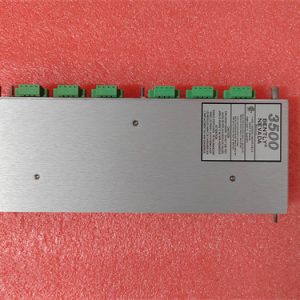
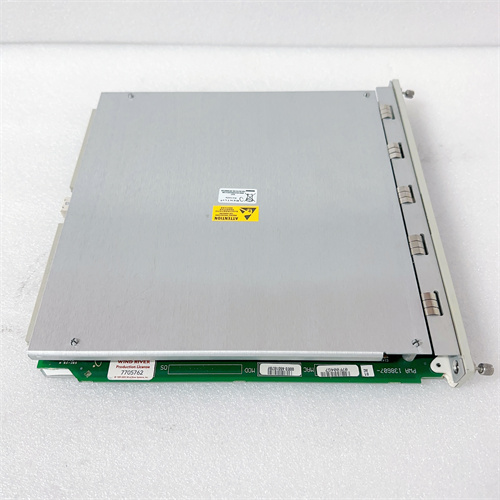
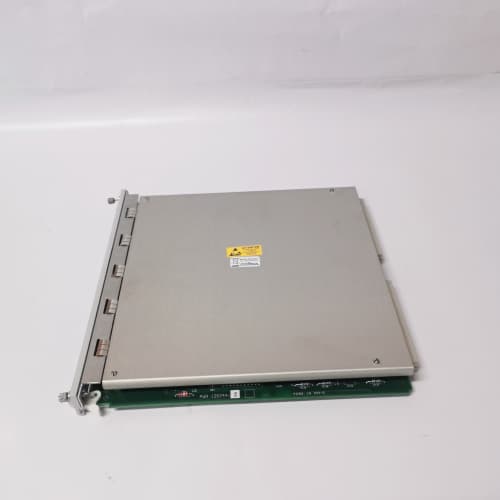
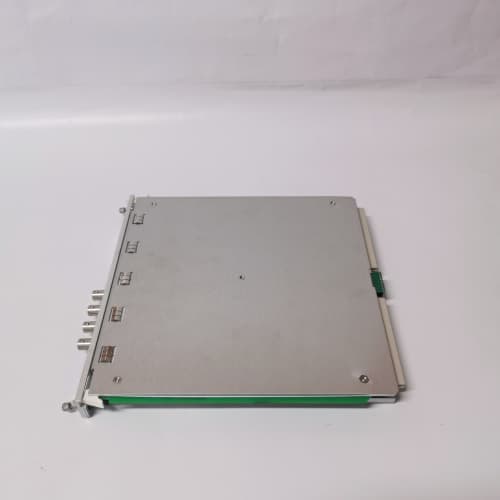
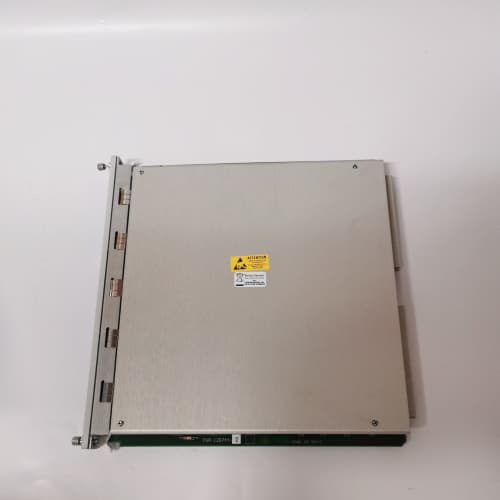
That’s the BENTLY 140734-02—the 3500/40M Proximitor Monitor. Four channels. It takes signals from 3300 XL proximity probes and turns them into shaft position and vibration readings. When a channel drifts, the machine trips for no reason. When it fails, the machine keeps running until something breaks.
I’ve swapped these in gas turbines, compressors, and steam turbine generators. The module is accurate when it’s new. The failure mode is usually input channel drift—one channel starts reading 10% high, the alarm trips early, and the unit shuts down. The fix is swapping the module. Ten minutes, if the spare is on the shelf.
Key Technical Specifications
| Parameter | Value |
|---|---|
| Channels | 4, independent |
| Probe Interface | 3300 XL proximity probes (5 mm, 8 mm) |
| Input Range | 0–200 mils (0–5 mm) shaft relative |
| Frequency Response | DC–10 kHz |
| Accuracy | ±0.5% of full scale |
| Alarms | Danger, alert, configurable per channel |
| Outputs | 4–20 mA (per channel), relay contacts (via rack) |
| Filters | Programmable low‑pass, high‑pass |
| Integration | None (direct displacement) |
| LEDs | Per‑channel OK, alert, danger, bypass |
| Power | 24 VDC from 3500 rack backplane |
| Operating Temp | –20 to +65 °C |
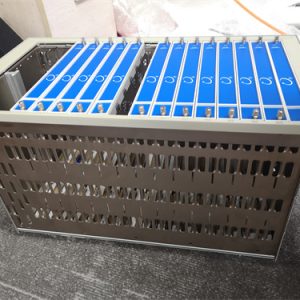
| Mounting | 3500 rack, front‑accessible |
Quality Inspection Process (SOP Transparency)
Proximity modules are critical. If they drift, turbines trip.
- Incoming Verification
This batch came from a Bently authorized distributor’s final 3500 stock. Sealed boxes. Serial numbers traceable to 2015–2018 production. - Visual Inspection
First: the edge connector. Gold fingers should be bright, no scoring. Next: the front panel—no scratches, no missing screws. Also check the labeling for wear. If it’s been used before, the rack slots will show it. - Live Functional Test
We test the 140734-02 in a 3500 test rack with a calibrated probe target stand. Procedure:- Power‑up: verify all channel LEDs cycle, module OK
- Channel 1: connect 3300 XL probe, set gap at 1.5 mm, verify output –10.0 V
- Channel 1: sweep gap from 0.25 to 2.25 mm, verify linearity
- All four channels: run simultaneously with independent probes, verify no cross‑talk
- Alarm test: set alert at 2 mils, danger at 4 mils, sweep gap, verify alarms trigger
- Soak test: run all channels at 2 mils for 1 hour, monitor for drift
- Frequency Response Test
Apply vibration signal at 60 Hz, 2 mils peak‑to‑peak. Verify reading matches. - Final QC & Packaging
Passed modules go back in anti‑static bags, then bubble wrap, then a carton with QC sticker showing test date, linearity results, and alarm verification.
Field Replacement Pitfalls
Proximity modules are sensitive. Here’s where field techs get burned.
- Probe type mismatch.
The 140734-02 is calibrated for 3300 XL probes (5 mm or 8 mm). If you plug in a 7200 series probe, the sensitivity is wrong. The reading will be off by 50%. I’ve seen a plant with vibration readings that were half of actual because someone swapped in the wrong probe. Match the probe series. - ❌ Gap setting.
The probe needs a specific gap—usually 1.5 mm. If the gap is off, the reading is off. I’ve seen a turbine trip on high vibration because a probe gap drifted and the module read 4 mils when the shaft was at 2. The module was fine. The probe was the problem. - Cable extension.
The 3300 XL system allows cable extensions. But the extension cable has to be the right type and length. I’ve seen a plant add a 10‑meter extension with the wrong cable and wonder why the vibration readings were noisy. The module was fine. The extension was the problem. - Shield grounding.
Proximity probe signals are low‑voltage. If the cable shield is grounded at both ends, you get ground loops. The module will see noise. The reading will be jumpy. I’ve seen a plant with erratic vibration readings that traced back to a shield grounded at both ends. Ground at one end only. - Firmware mismatch.
The 140734-02 has internal firmware. Different revisions have different signal processing characteristics. If you swap in a module with older firmware, it may work—or it may not. I’ve seen a module that passed all tests but failed the alarm test because the firmware didn’t support the faster response time needed for the machine. Match the firmware revision.
Get these five right and you’ll cut rework time by 90%.
New Original vs. Refurbished: Why It Matters
“New Original (New Surplus)” means this BENTLY 140734-02 was built by Bently, never installed, and never repaired. The input circuits are fresh. The internal oscillator hasn’t drifted. The edge connector has never been mated.
Refurbished 3500/40M modules are risky. The input conditioning circuits are sensitive. A refurb module might have been in a plant where it got hit by lightning—it still works, but the linearity is off. I’ve seen a refurb module that passed a 2 mil test but failed at 10 mils. The machine tripped for no reason twice before they found the module.
What we provide:
- Traceable serial number (matches Bently production records)
- 4‑channel gap sweep test (0.25–2.25 mm, 10% increments)
- Alarm threshold test
- Frequency response test (60 Hz vibration)
- 1‑hour soak test at 2 mils
- Original anti‑static bag (if available) or fresh bag with QC seal
- 12‑month warranty
Pricing context:
Our price sits above the cheapest used listings. It’s also below what a new module would cost if Bently still made them. You’re paying for the test, the warranty, and the certainty that the proximity reading isn’t going to drift.
Performance Benchmarks & Test Results
All tests performed on 3500 test rack with 3300 XL probes, 25 °C ambient.
| Test | Condition | Result |
|---|---|---|
| Gap linearity | 0.25–2.25 mm | ±0.3% of range |
| Vibration accuracy | 60 Hz, 2 mils p‑p | ±0.02 mil |
| Channel isolation | 2 mils on ch1, measure ch2 | <0.01 mil |
| Alarm accuracy | Alert at 2 mils | 2.01 mil trip |
| Alarm accuracy | Danger at 4 mils | 4.02 mil trip |
| Soak drift | 1 hour at 2 mils | 0.01 mil |
| Power consumption | 24 VDC | 180 mA typical |
Thermal performance note:
At 55 °C ambient, the proximity reading drifts about 0.5 mil at 10 mils. Still within spec. If your machine has tight vibration limits, let the module warm up for an hour before you trust the readings.
One more thing from the field:
The 140734-02 has a small test point on the front edge—TP1. It’s the internal reference. If you’re seeing drift across all channels, probe TP1. Should be 5.000 V ±5 mV. If it’s off, the whole module is drifting. Swap it. I’ve seen a plant chase a vibration issue for weeks before someone checked the reference. The module was soft. The machine was fine.
PR6424/004-030 PLC
PR6424/118-100 PLC
PR6424/005-101 PLC
PR6424/118-021 PLC
PR6424/005-030 PLC
 Email: sales@plcfcs.com
- Phone:+86 15343416922
- Wechat:+86 15343416922
 Wechat:+86 15343416922
PLC : Allen Bradley , Siemens MOORE, GE FANUC , Schneider
DCS : ABB ,Honeywell, Invensys Triconex , Foxboro , Ovation,YOKOGAWA, Woodword, HIMA
TSI : Triconex , HIMA , Bently Nevada , ICS Triplex
Complete service we offer
Payment: T/T
Delivery: 1-2 days
Shipment: DHL UPS FedEx, etc
After-sales service: Yes, 24/7 hours