 Email: jiedong@sxrszdh.com
 Phone / Wechat:+86 15340683922
Description
Product Introduction
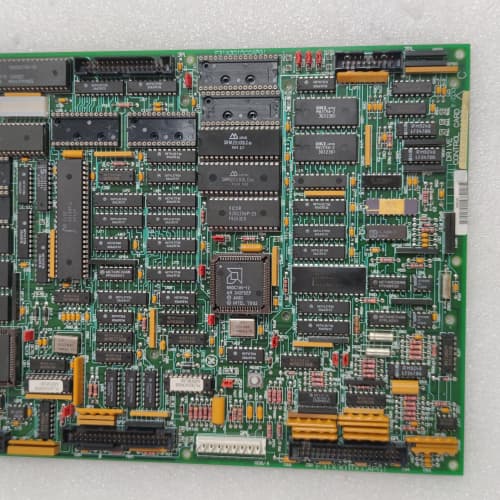
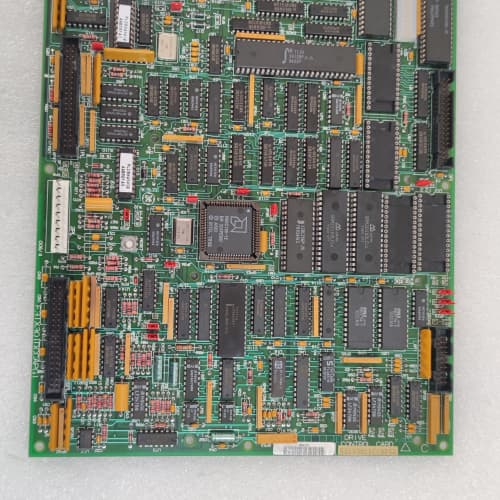
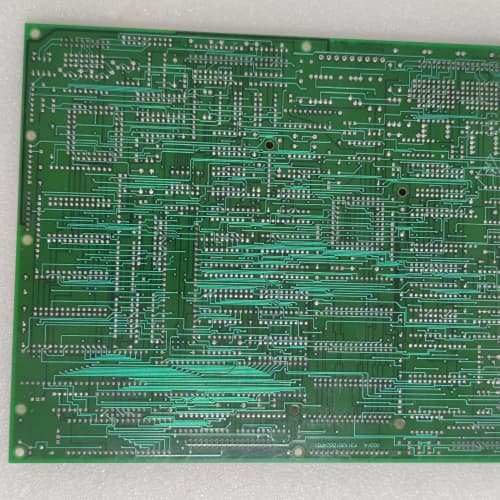
This GE 531X307LTBAFG1 is a ruggedized logic and timing controller designed for precision counting in electrically noisy environments. The “F” suffix indicates differential inputs on the high-speed counter/timer channels, providing common-mode noise rejection for reliable counting in harsh industrial conditions.
The board provides 16 digital I/O points, 8 high-speed counter/timer channels with differential inputs, and dual serial ports. The differential counter inputs accept RS-422 or TTL differential signals, rejecting common-mode noise up to ±10 V. This is essential for applications with long sensor runs (over 100 feet) or high-EMI environments such as welding lines, steel mills, and motor control centers. The onboard co-processor handles all timing functions, maintaining 1 µs resolution and supporting counter frequencies up to 100 kHz.
Key Technical Specifications
| Parameter | Value |
|---|---|
| Manufacturer | GE (General Electric) |
| Model Number | 531X307LTBAFG1 |
| Product Type | Logic and Timing Controller Board (Differential Counter Inputs) |
| Serial Ports | 2 (RS-232, RS-422/485) |
| Baud Rate | 300 to 38,400 bps |
| Digital I/O | 16 configurable inputs/outputs (24 VDC) |
| Output Drive | 0.5 A per digital output channel |
| Counter/Timer Channels | 8 independent channels (differential inputs) |
| Input Type (Counters) | Differential, RS-422/TTL compatible, ±10 V common-mode |
| Counter Resolution | 16-bit (0-65,535 counts) |
| Timer Resolution | 1 µs |
| Max Counter Frequency | 100 kHz |
| Timer Modes | Up/down count, frequency measurement, PWM, single-shot, continuous |
| Co-Processor | Dedicated timing and logic processor |
| Protocol Support | GE proprietary, Modbus RTU |
| Isolation | 2500 V (opto-isolated I/O, transformer-isolated serial, transformer-isolated counter inputs) |
| Communication | 50-pin ribbon cable to main regulator board |
| Operating Temperature | 0 to +55 °C |
| Storage Temperature | -40 to +85 °C |
| Board Dimensions | 12.7 in x 6.0 in (approx) |
Key Selling Points & Differentiators
- Differential Counter Inputs: The high-speed counter/timer channels feature differential inputs with ±10 V common-mode rejection. This ensures reliable counting on long cable runs and in high-EMI environments. Standard single-ended counters would false-trigger in these conditions.
- 8 Independent High-Speed Channels: Each channel can be configured for up/down counting, frequency measurement, PWM output, single-shot timing, or continuous timing. All channels operate independently.
- RS-422/TTL Compatibility: The differential inputs accept a wide range of signal levels, from 5 V TTL differential to RS-422 line driver signals. This makes the board compatible with most encoders, proximity sensors, and pulse generators.
- Quantified Testing Protocol: We test each counter channel with a differential signal generator. We inject common-mode noise at 5 VAC while verifying count accuracy. Each board runs for 8 hours with all channels active at 100 kHz.
- Warranty & Support: 2-year functional warranty. We provide a differential wiring guide covering twisted-pair cable, termination, and shield grounding. Improper cable termination is the most common cause of counting errors—our guide prevents it.
Frequently Asked Questions (FAQ)
Q1: What is the difference between the LTBAFG1 and the LTBAFG1? (Note: Assuming comparison to LTBACG1)
A: The LTBAFG1 has differential inputs on the high-speed counter/timer channels. The standard LTBACG1 has single-ended counter inputs. The differential inputs provide common-mode noise rejection up to ±10 V, making the F variant suitable for long cable runs and high-EMI environments. The hardware and specifications are otherwise identical. If your installation has clean wiring and short runs, the standard board may be sufficient. If you have noisy environments or long sensor cables, the F variant is recommended.
Q2: What signal types are compatible with the differential counter inputs?
A: The differential inputs accept RS-422 signals (typical ±5 V differential), TTL differential signals (0-5 V), and 24 VDC differential signals. The inputs are protected against overvoltage up to ±30 V. The common-mode rejection is ±10 V, meaning the board will correctly count if the input signal has up to 10 V of common-mode offset. Do not connect single-ended signals to the differential inputs—the negative input must be connected to the signal return.
Q3: Can I use the differential counter inputs with a standard proximity sensor?
A: Not directly. Most proximity sensors are single-ended (one signal wire and one ground). The differential inputs require both a positive and negative signal. You would need an external differential converter or use the single-ended counter inputs on the LTBACG1. If you need differential counting and have single-ended sensors, consider using an external line driver or a sensor with differential outputs. We have seen customers incorrectly ground the negative input—this defeats the differential rejection and can cause counting errors.
Q4: What is the maximum cable length for the differential counter inputs?
A: With RS-422 differential signals, the cable length can be up to 4,000 feet (1,200 meters) at 100 kHz. The exact length depends on the cable quality and the signal driver. We recommend shielded twisted-pair cable (Belden 9841 or equivalent) with the shield grounded at the drive end only. At higher frequencies, the cable length must be reduced. At 100 kHz, you can reliably achieve 4,000 feet. At 1 MHz (not supported by this board), the length would be much shorter.
Q5: Does this board support quadrature encoder inputs?
A: No. The counter/timer channels are single-ended counting inputs—they count pulses on a single input line. They do not support quadrature (A/B) decoding or direction counting from quadrature signals. For quadrature encoder support, you need the MCPA series motion control boards. The LTBAFG1 is for simple pulse counting, frequency measurement, and timing tasks.
Q6: Can the counter/timer channels be synchronized with each other?
A: Yes, the channels can be synchronized via the co-processor. You can start all channels simultaneously or trigger one channel from another. This is useful for applications requiring coordinated timing—for example, starting a timer when a counter reaches a preset value. The synchronization accuracy is within 1 µs.
Q7: Does this board support Modbus RTU for accessing the counter/timer data?
A: Yes, the counter/timer data is accessible via Modbus RTU over the RS-485 port. The counter values, timer status, and configuration registers are mapped to holding registers. The differential counter inputs do not change the register map—it is the same as the standard LTB board. We provide the complete register map in our documentation.
Q8: What is the PWM output capability on this board?
A: The PWM output has a 16-bit duty cycle resolution (0 to 65,535 steps). The frequency can be set from 0.1 Hz to 100 kHz. The PWM output is 24 VDC (sourcing) at 0.5 A maximum. This is suitable for driving proportional valves with PWM inputs. The PWM output can also be used as a pulse train generator for other drives or controllers. The PWM outputs are available on the digital I/O channels when configured for PWM mode—you do not need separate outputs.
Q9: What is the lifecycle status of the LTBAFG1?
A: This board is very rare. GE produced the differential counter input variant in small quantities for high-EMI applications. We have a small batch of new surplus units. Used pulls are almost non-existent because the differential circuitry is often damaged during removal. If your application requires noise-immune high-speed counting, we recommend securing a spare. Our new surplus units are fully tested and guaranteed. We do not expect to source more of this variant.
Q10: Is the LTBAFG1 a drop-in replacement for the LTBACG1?
A: Physically, yes—the same dimensions, mounting holes, and 50-pin ribbon connector. However, the terminal block wiring is different for the counter inputs. The differential inputs require two wires per channel (positive and negative), whereas the standard board has single-ended inputs. You would need to rewire the counter input connections. The digital I/O and serial ports have the same pinout. We provide a terminal block transition guide for upgrading from the standard LTB board.
Contrex 3200-1677
ALSTOM MVAJ105RA0804A
SCHNEIDER AS-B883-200
FOXBORO FBM232
 Email: sales@plcfcs.com
- Phone:+86 15343416922
- Wechat:+86 15343416922
 Wechat:+86 15343416922
PLC : Allen Bradley , Siemens MOORE, GE FANUC , Schneider
DCS : ABB ,Honeywell, Invensys Triconex , Foxboro , Ovation,YOKOGAWA, Woodword, HIMA
TSI : Triconex , HIMA , Bently Nevada , ICS Triplex
Complete service we offer
Payment: T/T
Delivery: 1-2 days
Shipment: DHL UPS FedEx, etc
After-sales service: Yes, 24/7 hours