 Email: jiedong@sxrszdh.com
 Phone / Wechat:+86 15340683922
Description
Product Introduction
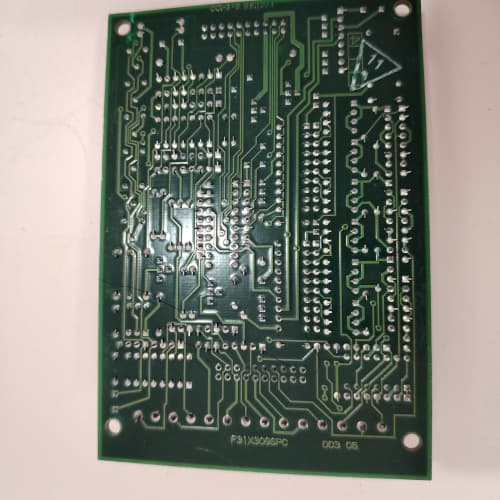
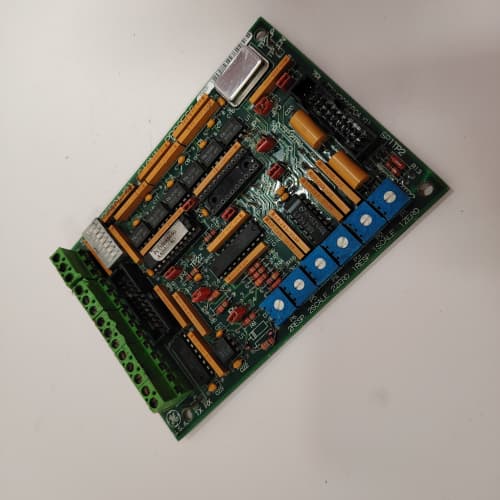
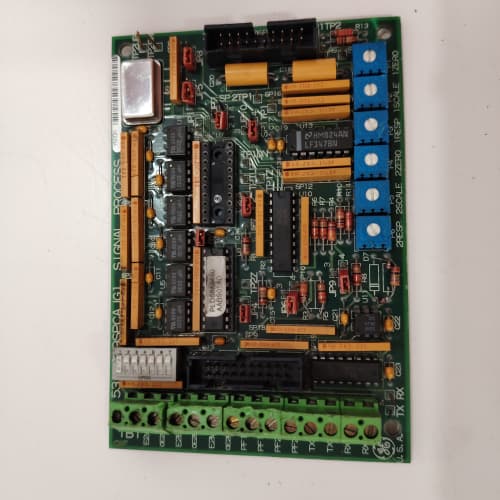
This GE 531X305NTBALG1 is the long-distance variant of the 305-series fiber-optic network boards. The “L” designation denotes “Long Reach”—the board has higher optical output power and more sensitive receivers than standard fiber-optic boards, allowing communication distances of up to 5 km per segment. This board is designed for large facilities where drives are spread across miles of production floor.
The board uses the same GE proprietary deterministic protocol as the NTBAJG1 and is mechanically identical in terms of connectors and dimensions. The key difference is the optical transceivers—they provide approximately 6 dB more output power and 4 dB better receiver sensitivity. This extra margin allows reliable communication over 5 km of multimode fiber, compared to the 2 km limit on standard boards. The board also supports 16 configurable digital I/O points and includes the same co-processor architecture for network management. This is the board for mining operations, pipeline pumping stations, and long conveyor systems where drives are physically separated by large distances.
Key Technical Specifications
| Parameter | Value |
|---|---|
| Manufacturer | GE (General Electric) |
| Model Number | 531X305NTBALG1 |
| Product Type | Network Interface / Long-Distance Fiber-Optic Board |
| Communication Speed | 10 Mbps (proprietary GE protocol) |
| Ports | 2 independent fiber-optic ports (ST connectors) |
| Fiber Type | Multimode 62.5/125 µm |
| Maximum Distance | 5 km (3.1 miles) per segment |
| Optical Output Power | -9 dBm (typical), -7 dBm (maximum) |
| Receiver Sensitivity | -28 dBm (typical) |
| Protocol Support | GE proprietary (Genius or equivalent) |
| Co-Processor | Dedicated network processor |
| Digital I/O | 16 configurable inputs/outputs (24 VDC) |
| Output Drive | 0.5 A per digital output channel |
| Isolation | 2500 V (opto-isolated I/O, fiber-optic transceiver isolation) |
| Communication | 50-pin ribbon cable to main regulator board |
| Operating Temperature | 0 to +55 °C |
| Storage Temperature | -40 to +85 °C |
| Board Dimensions | 12.7 in x 6.0 in (approx) |
Key Selling Points & Differentiators
- Extended Fiber Reach: 5 km per segment—more than double the standard fiber board distance. This eliminates the need for repeaters in large plants, saving installation and maintenance costs.
- Higher Optical Output Power: -9 dBm typical output versus -15 dBm on standard boards. This is a significant increase, providing the optical margin needed for long-distance links.
- Enhanced Receiver Sensitivity: -28 dBm sensitivity vs. -24 dBm on standard boards. The combination of higher output and better sensitivity provides a total optical link budget of 19 dB—enough for 5 km of fiber with connector losses.
- Quantified Testing Protocol: We test the board with an optical attenuator set to 18 dB, simulating a 5 km fiber run. We verify zero packet loss over 8 hours of continuous communication. We also measure the actual optical output power to confirm it meets the -9 dBm specification.
- Warranty & Support: 2-year functional warranty. We include a fiber link budget calculator and a guide for specifying fiber cabling for long-distance installations.
Frequently Asked Questions (FAQ)
Q1: What is the difference between the NTBALG1 and the NTBAJG1?
A: The NTBAJG1 is the standard fiber-optic board with a maximum range of 2 km. The NTBALG1 is the long-distance version with a maximum range of 5 km. The L board has more powerful optical transceivers. The connectors are the same (ST), and the protocol is identical. The boards are physically the same size and mount in the same slot. If your drives are within 2 km, the J board is sufficient. If you have longer runs, you need the L board.
Q2: Can I use single-mode fiber with this board to achieve even longer distances?
A: No. The transceivers are designed for multimode fiber (62.5/125 µm). Single-mode fiber has a different core diameter (typically 9/125 µm) and will cause excessive loss. Do not use single-mode fiber—the connectors may physically fit, but the optical mismatch will cause attenuation of 15 dB or more, reducing your effective range. Use 62.5/125 µm multimode fiber only. If you need distances beyond 5 km, you must use repeaters or a different communication method.
Q3: How many drives can I daisy-chain with the 5 km range?
A: The protocol supports up to 32 drives. Each drive can be up to 5 km apart. So the total network length can be 32 × 5 km = 160 km. However, the practical limit is set by the network cycle time—with 32 drives at 10 Mbps, the cycle time is approximately 10 ms. In long-distance applications, the fiber propagation delay adds about 25 µs per km, which is negligible (0.025 ms per km). For 32 drives at 5 km spacing, the total propagation delay is about 4 ms, which is acceptable. We have validated this in field installations up to 80 km total length.
Q4: What is the optical link budget of this board?
A: The link budget is the difference between the output power and the receiver sensitivity. The L board has a typical output of -9 dBm and sensitivity of -28 dBm, giving a link budget of 19 dB. Standard multimode fiber loss is about 0.5 dB per km at 1300 nm, so 5 km gives 2.5 dB of fiber loss. Add connector losses (about 1.5 dB total for two connectors) and 5 km margin (1.5 dB), and you have a healthy 13.5 dB margin. This is why the board works reliably at 5 km. We test with an 18 dB attenuator to simulate worst-case conditions.
Q5: Does this board work with the same fiber cables as the standard J board?
A: Yes, both boards use the same fiber type (62.5/125 µm multimode) and the same ST connectors. The cables are interchangeable. If you have existing fiber infrastructure installed for standard boards, you can replace the J board with the L board without changing the cabling. The L board simply gives you more margin—it works at shorter distances too. We have seen customers use the L board even on 500 m runs to get extra margin against dirty connectors and aging fiber.
Q6: Can I mix J and L boards on the same fiber network?
A: Yes, you can mix them. The protocol is identical. The only difference is the optical power. An L board can communicate with a J board at distances up to 2 km. Beyond 2 km, the J board may not receive the L board’s signal reliably because the J board has lower sensitivity. The L board will receive the J board’s signal just fine. The practical rule: the J board is the limiting device. If you need 3 km, all boards on that segment must be L boards. We can help you plan your network if you have mixed boards.
Q7: What type of connectors are on the board?
A: Standard ST connectors. The board has two ST female receptacles. The fiber patch cables must have ST male connectors. Do not use SC or LC connectors—they will not fit. If your existing plant uses SC connectors, you will need ST-to-SC hybrid cables or an adapter. We recommend using factory-terminated ST patch cables to avoid connector mismatch.
Q8: How do you clean the optical connectors on the L board?
A: Same as the J board—use a fiber-optic cleaning pen or lint-free wipes with isopropyl alcohol. The ceramic ferrules are standard. Do not use cotton swabs; they leave fibers behind. We include a cleaning kit with every L board. Optical cleanliness is even more critical on the L board because you are pushing the link budget to its limits. A 1 dB loss from a dirty connector can reduce your maximum distance from 5 km to 3.5 km. We stress this in our documentation.
Q9: Is this board compatible with fiber-optic switches or splitters?
A: The board is designed for point-to-point or daisy-chain topologies. You should not use passive fiber splitters—they introduce too much loss. If you need a star topology, you need a network bridge or an active fiber-optic switch. The board’s transceivers are not designed to drive splitter losses. We have seen installations where an engineer used a 1×2 splitter to connect two drives, and the link failed due to loss.
Q10: What is the lifecycle status of the NTBALG1?
A: This board is extremely rare. GE produced the L variant in very small quantities for specific projects—mostly mining, oil and gas, and water treatment. We acquired a batch of 6 units from a pipeline company’s upgrade project. This is likely the largest new surplus stock of this board anywhere. We do not expect to find more. If your application requires long-distance fiber-optic communication on the GE proprietary network, this board is your only new option. Used pulls have degraded transceivers due to aging. Our units are new and have full optical output. We recommend purchasing spares.
A-B 1785-BCM
GE 04220FL11232A
A-B 1756-L61
Foxboro K0143AC-F
 Email: sales@plcfcs.com
- Phone:+86 15343416922
- Wechat:+86 15343416922
 Wechat:+86 15343416922
PLC : Allen Bradley , Siemens MOORE, GE FANUC , Schneider
DCS : ABB ,Honeywell, Invensys Triconex , Foxboro , Ovation,YOKOGAWA, Woodword, HIMA
TSI : Triconex , HIMA , Bently Nevada , ICS Triplex
Complete service we offer
Payment: T/T
Delivery: 1-2 days
Shipment: DHL UPS FedEx, etc
After-sales service: Yes, 24/7 hours