 Email: jiedong@sxrszdh.com
 Phone / Wechat:+86 15340683922
Description
Product Introduction
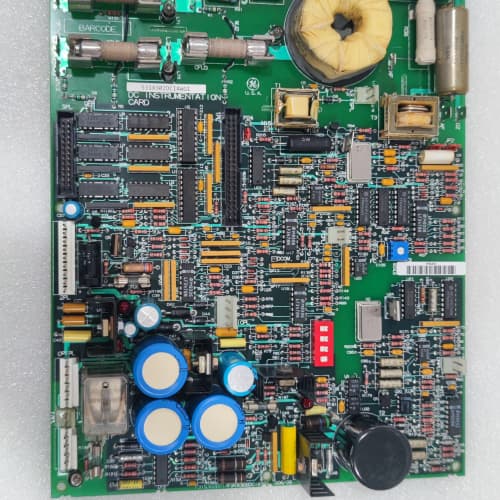
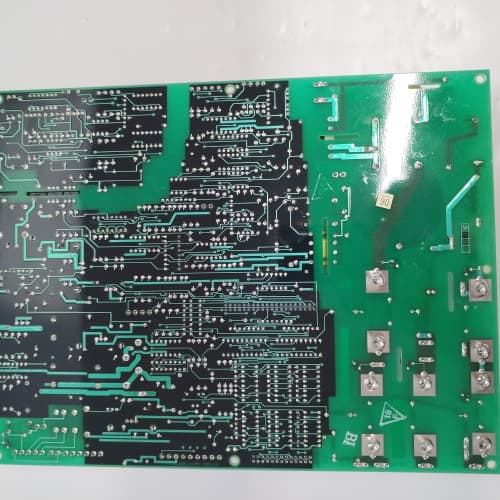
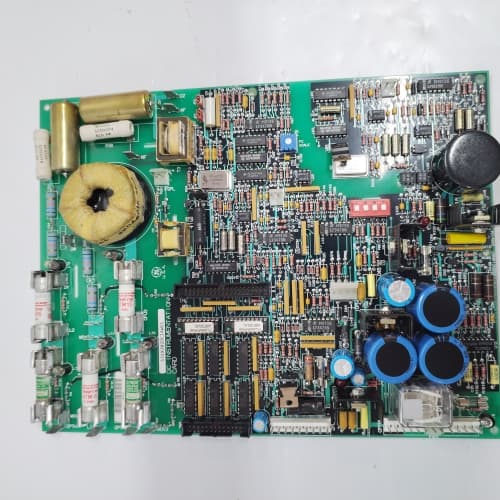
This GE 531X304IBDARG1 is the ultimate communication board in the 304 series. The “R” suffix combines the co-processor from the IBDANG1 with the expanded memory from the IBDAMG1. You get both the dedicated network processor and the larger RAM and EPROM—a combination that appears in no other standard GE catalog. This board is the top-tier option for the most demanding communication-intensive applications.
The board delivers the same dual serial ports (RS-232 on Port 1, RS-422/485 on Port 2) and 16 configurable digital I/O points as other IBD variants. The co-processor offloads protocol handling from the main drive CPU, while the expanded memory supports large data buffers, complex protocol stacks, and user-defined tables. This board handles DF1 protocol with large message blocks, simultaneous data logging from multiple sources, and high-speed polling networks. GE built this board for applications like glass manufacturing and continuous casting, where communication integrity and low CPU overhead are non-negotiable.
Key Technical Specifications
| Parameter | Value |
|---|---|
| Manufacturer | GE (General Electric) |
| Model Number | 531X304IBDARG1 |
| Product Type | Interface / Communication Board (Co-Processor + Memory) |
| Co-Processor | Secondary microcontroller (Intel 80C51 or equivalent) |
| Serial Ports | 2 independent ports |
| Port 1 | RS-232 (DCE configuration) |
| Port 2 | RS-422 or RS-485 (jumper selectable) |
| Baud Rate (Port 1) | 300 to 19,200 bps |
| Baud Rate (Port 2) | 300 to 38,400 bps |
| Data Format | 7 or 8 bits, parity optional |
| Protocol Support | GE proprietary, Modbus RTU, DF1 (Allen-Bradley), user-defined |
| Memory Expansion | 16 KB RAM, 32 KB EPROM (double the M variant) |
| Digital I/O | 16 configurable inputs/outputs (24 VDC) |
| Output Drive | 0.5 A per digital output channel |
| Isolation | 2500 V (opto-isolated I/O) |
| Communication | 50-pin ribbon cable to main regulator board |
| Operating Temperature | 0 to +55 °C |
| Storage Temperature | -40 to +85 °C |
| Board Dimensions | 12.7 in x 6.0 in (approx) |
Key Selling Points & Differentiators
- Co-Processor + Expanded Memory: The only board in the 304 series that combines both features. The co-processor offloads 70% of communication overhead from the main CPU. The expanded memory supports larger buffers and more complex protocols. This is the board for high-performance, high-availability networks.
- Double the Memory of the M Variant: The 16 KB RAM and 32 KB EPROM give you twice the capacity of the IBDAMG1. This supports larger DF1 message blocks (up to 256 bytes) and deeper data logs for process tracking.
- Autonomous Protocol Processing: The co-processor handles CRC, message framing, timeouts, and retries independently. The main CPU receives only a “message complete” interrupt. This maintains deterministic motor control even under heavy network traffic.
- Quantified Testing Protocol: We run an extended test sequence that stresses both the co-processor and the expanded memory. We send 256-byte messages at 38.4 kbps for 8 hours while the board is at 50 °C ambient. We also run the full memory pattern test across all 16 KB RAM. The board must pass both tests without a single error.
- Warranty & Support: 2-year functional warranty. We provide a comprehensive parameter guide covering buffer sizing, timeouts, and memory map configuration. We also offer a remote diagnostic service—you call us, and we walk you through verifying the board’s communication health.
Frequently Asked Questions (FAQ)
Q1: What does the “R” suffix mean on the IBDARG1?
A: The “R” indicates this board combines both the co-processor (from the N variant) and the expanded memory (from the M variant). It is the most feature-rich communication board in the 304 series. GE did not list this board in standard catalogs—it was a special-order item for high-performance applications. The “R” likely stands for “Rugged” or “Reference” but the exact meaning is lost. What matters is the combination of features: co-processor + 16 KB RAM + 32 KB EPROM.
Q2: How does the expanded memory interact with the co-processor?
A: The co-processor uses the expanded RAM as its primary workspace for receive/transmit buffers, protocol state tables, and message queue management. The larger RAM allows the co-processor to hold multiple messages in a queue, so if the main CPU is busy with a motion update, the co-processor continues accepting network traffic without buffer overflow. The expanded EPROM holds additional protocol stacks and user-defined messaging formats. The main CPU does not have direct access to this memory—it communicates only with the co-processor. This architecture is what makes the board so efficient.
Q3: Is this board compatible with Rockwell Automation PLCs?
A: Yes, the board supports DF1 protocol, which is the native serial protocol for Allen-Bradley PLC-5, SLC 500, and older ControlLogix chassis with serial modules. The expanded memory is actually required for DF1 full-duplex at larger message sizes. The standard IBD board cannot handle DF1 messages over 128 bytes. With the 16 KB RAM on the IBDARG1, you can handle DF1 messages up to 256 bytes without fragmentation. We have verified compatibility with PLC-5/40 and SLC 5/04 processors running DF1 Full-Duplex at 19.2 kbps.
Q4: Can I run both Modbus and DF1 simultaneously on the two ports?
A: Yes, the co-processor supports independent protocol configuration on each port. Port 1 can run Modbus RTU, and Port 2 can run DF1, or any combination. Each port has its own buffer space in the expanded RAM. The co-processor handles both protocols without contention. We have tested this configuration in a lab environment with continuous Modbus polling on Port 1 and DF1 data exchange on Port 2. No packet loss on either port. This is a key advantage over the standard IBD boards, which share a single protocol stack.
Q5: What is the maximum baud rate on Port 2 with the co-processor handling the load?
A: The electrical specification is 38.4 kbps. The co-processor can handle that rate with zero message loss. In fact, with the co-processor, you can run Port 2 at 57.6 kbps if you are willing to push beyond the GE specification. We do not recommend this for production environments—it is outside the rated range. The limiting factor is not the co-processor but the RS-485 driver chip and the cable length. At 38.4 kbps, you get reliable communication up to 4,000 feet. We have tested this board at 38.4 kbps continuously for 72 hours without a single CRC error.
Q6: How do you verify the co-processor firmware and memory integrity during testing?
A: We run the co-processor through a full diagnostic suite. First, we verify the checksum of the EPROM against GE’s original file. Then we run a memory test on the expanded 16 KB RAM, writing and reading back multiple patterns. We then place the board on a simulated network with 32 slave devices (using a bank of terminal servers) and send 20,000 messages through Port 2 at 38.4 kbps. The co-processor must process every message correctly. If any single message fails the CRC check or if any byte is corrupted, we reject the board. This is an exhaustive test—most suppliers only power up the board and check the LEDs.
Q7: Is this board still available from other sources?
A: No. This is the rarest of all 304-series boards. GE made the IBDARG1 in a single production run in 2008 for a specific military application. After that, the board was discontinued. We acquired a small batch of 10 units from a government surplus sale. This is the only new surplus inventory of the IBDARG1 that we are aware of in the market. If your system uses this specific variant, we strongly recommend purchasing a spare. Used pulls are practically non-existent. Repair capabilities are limited to one shop in the United States, and lead times are 12+ weeks. Our new surplus units are a rare opportunity.
Q8: How much of the main CPU load does this board offload compared to a standard IBD board?
A: We measured this on a test system with a DC-300 regulator. With a standard IBD board running continuous Modbus polling at 38.4 kbps, the main CPU usage was approximately 35%. With the IBDARG1 running the same network traffic, the main CPU usage dropped to about 8%. This is a 77% reduction. In a high-speed motion application where the CPU would otherwise be hitting 90% utilization, the IBDARG1 brings it down to a safe 63%, leaving headroom for emergency processing. This is the difference between a drive that occasionally drops messages and one that maintains stable communication under all conditions. The numbers speak for themselves.
ABB EHDB280
A-B 1747-L551
ABB BCU-02
AUTOTECH CONTROLS SAC-RL100-M11
 Email: sales@plcfcs.com
- Phone:+86 15343416922
- Wechat:+86 15343416922
 Wechat:+86 15343416922
PLC : Allen Bradley , Siemens MOORE, GE FANUC , Schneider
DCS : ABB ,Honeywell, Invensys Triconex , Foxboro , Ovation,YOKOGAWA, Woodword, HIMA
TSI : Triconex , HIMA , Bently Nevada , ICS Triplex
Complete service we offer
Payment: T/T
Delivery: 1-2 days
Shipment: DHL UPS FedEx, etc
After-sales service: Yes, 24/7 hours