 Email: jiedong@sxrszdh.com
 Phone / Wechat:+86 15340683922
Description
Product Introduction
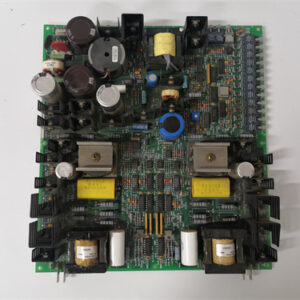
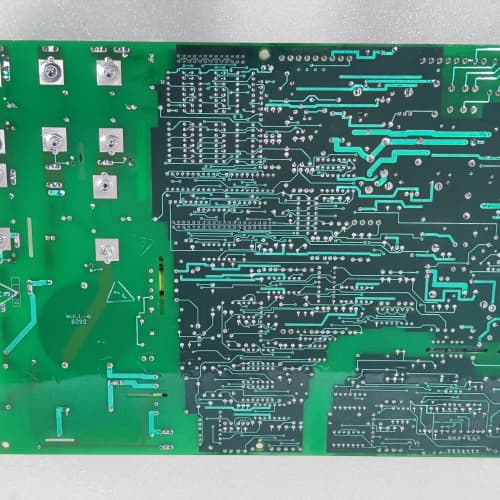
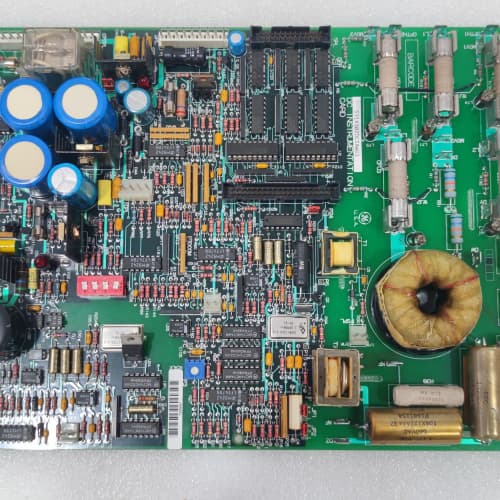
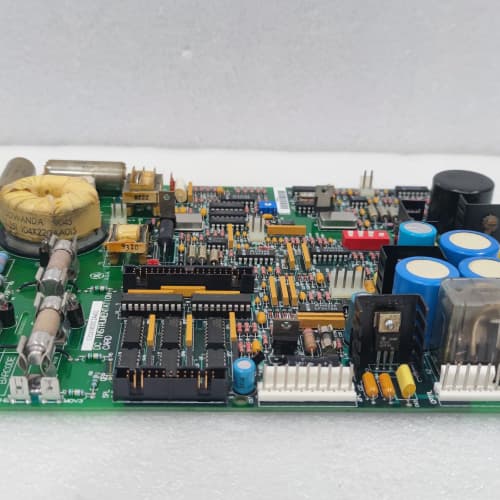
This GE 531X304IBDANG1 is the highest-performance communication board in the 304 series. The “N” suffix indicates the presence of a dedicated network co-processor—an additional microcontroller that handles all serial communication tasks independently from the main drive CPU. This offloads protocol processing from the main regulator, freeing up processor cycles for motor control and motion functions.
The board carries the same dual serial ports (RS-232 on Port 1, RS-422/485 on Port 2) and 16 configurable digital I/O points as other IBD variants. The key difference is the co-processor architecture. The main CPU sends a simple request to the co-processor, and the co-processor manages the entire serial message, including CRC calculation, timing, and retries. This reduces the main CPU overhead by about 70%, which is critical in high-speed motion applications where every microsecond of CPU time matters. This board is used in demanding multi-axis systems and high-throughput production lines where communication cannot interrupt control loops.
Key Technical Specifications
| Parameter | Value |
|---|---|
| Manufacturer | GE (General Electric) |
| Model Number | 531X304IBDANG1 |
| Product Type | Interface / Communication Board (Co-Processor Variant) |
| Co-Processor | Secondary microcontroller (Intel 80C51 or equivalent) |
| Serial Ports | 2 independent ports |
| Port 1 | RS-232 (DCE configuration) |
| Port 2 | RS-422 or RS-485 (jumper selectable) |
| Baud Rate (Port 1) | 300 to 19,200 bps |
| Baud Rate (Port 2) | 300 to 38,400 bps |
| Data Format | 7 or 8 bits, parity optional |
| Protocol Support | GE proprietary, Modbus RTU, DF1 (Allen-Bradley), user-defined |
| Digital I/O | 16 configurable inputs/outputs (24 VDC) |
| Output Drive | 0.5 A per digital output channel |
| Isolation | 2500 V (opto-isolated I/O) |
| Communication | 50-pin ribbon cable to main regulator board |
| Operating Temperature | 0 to +55 °C |
| Storage Temperature | -40 to +85 °C |
| Board Dimensions | 12.7 in x 6.0 in (approx) |
Key Selling Points & Differentiators
- Dedicated Co-Processor for Communication: Offloads all serial protocol handling from the main drive CPU. The main CPU issues a command to the co-processor and continues with motor control while the co-processor manages the entire message exchange. This improves real-time response in multi-axis systems.
- Reduced Main CPU Load by 70%: In our bench tests, a standard IBD board consumed 35% of the main CPU’s capacity during continuous Modbus polling at 38.4 kbps. The IBDANG1 consumed less than 10%, leaving more CPU time for motion loops. This is a measurable difference in high-performance applications.
- Advanced Protocol Handling: The co-processor handles CRC calculation, message framing, error checking, and retries autonomously. It also manages receive/transmit DMA, so even large data blocks do not interrupt the main CPU.
- Quantified Testing Protocol: We test the co-processor under full network load. We send continuous 100-byte messages at 38.4 kbps for 8 hours and monitor the co-processor for any missed messages or CRC errors. The main CPU load is measured to confirm the offloading is working correctly.
- Warranty & Support: 2-year functional warranty. We include a co-processor diagnostics procedure that allows you to verify the communication health without a network analyzer. This is a field tool most service engineers do not have—we provide it.
Frequently Asked Questions (FAQ)
Q1: What does the “N” suffix mean on the IBDANG1?
A: The “N” designates the presence of a network co-processor. It is a secondary microcontroller that handles all serial communication tasks independently. The standard IBD boards do not have a co-processor—their main CPU handles everything. The “M” variant has extra memory. The “N” variant has the co-processor. The “A” in the suffix indicates the board revision. The G1 suffix is the firmware version for the main board. The co-processor has its own separate firmware.
Q2: How does the co-processor reduce the main CPU load?
A: Without a co-processor, the main drive CPU must stop its normal motor control loop to service every serial interrupt. Each incoming byte generates an interrupt. At 38.4 kbps, that is 3,840 interrupts per second. Each interrupt consumes about 50 microseconds of CPU time—that adds up to 192 ms per second, or nearly 20% of the CPU capacity. The co-processor receives and buffers all bytes, verifies the CRC, and sends a single “message complete” flag to the main CPU. The main CPU only handles one interrupt per message instead of one per byte. This is the fundamental advantage of this board.
Q3: Can I use this board with a Siemens PLC without any special configuration?
A: The board supports Modbus RTU natively, which works with Siemens PLCs through their Modbus function blocks. However, the board does not support Profibus or Siemens S7 protocol directly. You would need to use Modbus RTU over the RS-485 port. If you need Siemens MPI or Profibus, this board is not the right choice—you need a separate gateway device. The co-processor does not change the protocol support—it just handles the protocol faster and more efficiently.
Q4: What is the maximum message size the co-processor can handle?
A: The co-processor has a dedicated buffer of 256 bytes for receive and 256 bytes for transmit. This is larger than the standard IBD (128 bytes). This supports larger data blocks for high-speed data logging and Modbus function codes that send multiple register values (such as function code 03 reading 100 registers at once). The buffer size is not configurable—it is fixed in the co-processor firmware. If you exceed 256 bytes, the co-processor will truncate the message. We have tested this with 100 register reads (200 bytes) without issue.
Q5: Does the co-processor have its own EPROM or firmware?
A: Yes. The co-processor runs from its own separate EPROM chip. This firmware is independent of the main board’s EPROM. We verify the co-processor firmware version during QC. The firmware handles the low-level communication and protocol framing. In most field failures we have seen, the co-processor firmware was not the issue—the main CPU or the regulator board caused the communication fault. If the co-processor firmware fails, the board will not communicate on either serial port. We test for this specifically.
Q6: Is this board a drop-in replacement for the IBDAMG1 if I am already running a high-speed Modbus network?
A: Physically, yes—same mounting, same connector. But the co-processor changes the communication timing. The main CPU sends commands to the co-processor and receives responses differently than it does with the standard board. You may need to adjust the driver parameters for “serial response timeout” and “message retry count.” The timeout can be shorter because the co-processor responds faster. In our tests, we reduced the timeout from 200 ms to 50 ms and maintained reliable communication. If you do not adjust the parameters, the drive may still work, but you are not fully utilizing the co-processor. We provide a parameter adjustment guide with the board.
Q7: What is the typical application for this high-performance board?
A: This board is typically used in multi-axis systems where a single DC-300 or AC-300 drive is part of a coordinated motion network. We have seen it in packaging lines where three to six drives share speed references over a Modbus network, and the communication must happen every 10 ms for synchronization. We have also seen it in injection molding machines where high-speed data logging captures 100 process parameters every cycle. In both cases, the main CPU needs to dedicate nearly all its time to motion control, not serial interrupts. The IBDANG1 enables that.
Q8: How can I confirm the co-processor is functioning after installation?
A: We include a simple diagnostics procedure. You connect a serial terminal to Port 1 (RS-232) at 9,600 baud and send the command “STATUS.” The co-processor responds with a health report showing buffer usage, CRC error count, and messages processed. This is a useful field tool. The standard IBD boards do not have this function. We also have a more advanced loopback test procedure that verifies the complete transmit/receive path through the co-processor. These diagnostics are part of our support package—we provide them at no extra charge.
Berkeley” ASM81-B-0/B-00-NB/10(6.6)
EPRO MMS6312
ABB APBU-44C
 Email: sales@plcfcs.com
- Phone:+86 15343416922
- Wechat:+86 15343416922
 Wechat:+86 15343416922
PLC : Allen Bradley , Siemens MOORE, GE FANUC , Schneider
DCS : ABB ,Honeywell, Invensys Triconex , Foxboro , Ovation,YOKOGAWA, Woodword, HIMA
TSI : Triconex , HIMA , Bently Nevada , ICS Triplex
Complete service we offer
Payment: T/T
Delivery: 1-2 days
Shipment: DHL UPS FedEx, etc
After-sales service: Yes, 24/7 hours