 Email: jiedong@sxrszdh.com
 Phone / Wechat:+86 15340683922
Description
Product Introduction
Critical systems need a backup plan. The GE 531X300CCHAWM3 is the 300-series chassis with a hardware watchdog timer—a dedicated circuit that continuously monitors the heartbeat signal from your logic board. If the heartbeat stops (due to a board crash, firmware lockup, or power failure), the watchdog triggers a fail-safe relay output, which can be used to alert an operator or shut down external equipment. It’s a simple, reliable safety net for unattended installations.
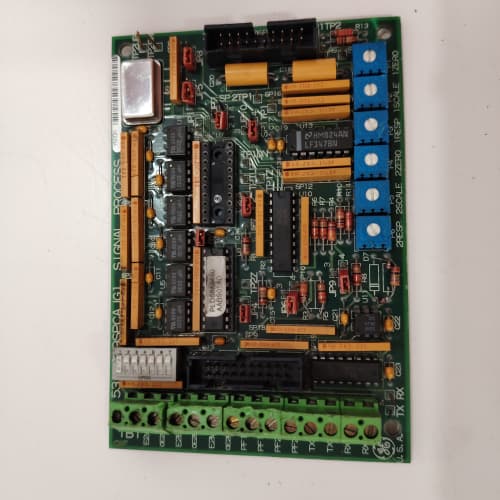
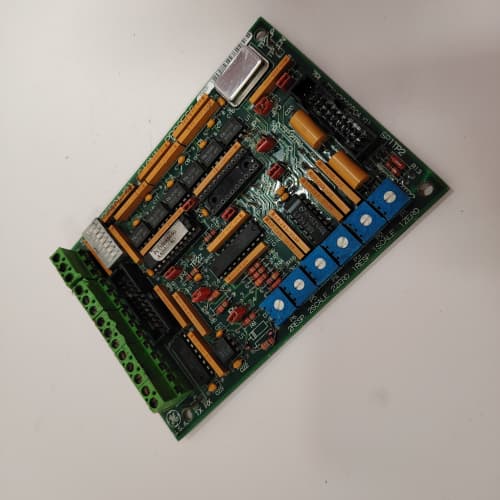
The “AWM3” suffix tells the story: “A” is the standard filter, “W” indicates the watchdog integration, and “M3″ gives you the 92mm fans (65 CFM) with Molex Mini-Fit connectors. The watchdog circuit is on a small control board mounted at the bottom of the chassis. It monitors a dedicated heartbeat signal on the backplane (typically from slot 2). The timer has a fixed timeout of 500ms—if the heartbeat stops for more than 500ms, the watchdog trips. The relay output is a Form C contact (NO/NC, 3A @ 250V AC), available on a screw terminal block on the rear panel. The watchdog also has a green LED on the front panel that blinks with the heartbeat—steady on = heartbeat present, steady off = timed out. The chassis includes the standard A-filter, the distributed-ground backplane, and the M3 cooling package. The depth is 14.5” (same as the standard AM5). One caveat: the watchdog requires a 24V DC power source—it draws about 50mA from the 24V rail. If your logic board doesn’t output a heartbeat signal, the watchdog won’t work.
Key Technical Specifications
| Parameter | Value / Specification |
|---|---|
| Manufacturer | General Electric (GE) Drive Systems |
| Model Number | 531X300CCHAWM3 |
| Series | 300 Series Drive Rack (Watchdog) |
| Slot Capacity | 10 slots (accepts 210, 211, 212, 213 series boards) |
| Chassis Height | 6U (266mm / 10.5″) |
| Chassis Width | 19″ (standard rack mount) |
| Chassis Depth | 14.5″ (includes rear shroud) |
| Watchdog Timer | 500ms timeout (fixed) |
| Heartbeat Input | Dedicated backplane signal (slot 2) |
| Watchdog LED | Green (front panel), blinks with heartbeat |
| Relay Output | Form C (NO/NC/COM), 3A @ 250V AC / 30V DC |
| Relay Terminal | Screw terminal block (rear panel) |
| Relay State | Energized when heartbeat is present |
| Power Draw | 50mA @ 24V DC (from backplane) |
| AC Input Filter | Class A EMI/RFI filter (60dB @ 150kHz) |
| Surge Protection | 5kA, 8/20µs waveform |
| Cooling Fans | 2x 92mm, 65 CFM each, 12V DC (M3 revision) |
| Fan Connector | Molex Mini-Fit Jr. (4-pin) |
| Fan Noise | 42 dBA (at 1 meter) |
| Backplane | 531X213D10ABG1 (with heartbeat trace) |
| Cable Exit | Rear shrouded cable trough (removable) |
| Keying | Slot-specific keying bars (pre-installed) |
| Dimensions (Overall) | 19″ x 10.5″ x 15.5″ (with rear shroud) |
| Weight | 21 lbs (9.5 kg) empty, 28 lbs with boards and PSU |
| Finish | Powder-coated steel (RAL 7035) |
| Operating Temp | 0° to 55°C |
| Certification | UL 508A, CE marked |
Compatible Replacement Models
✅ Drop-in Replacement:
- 531X300CCHAWM3 directly replaces 531X300CCHAWM2 and 531X300CCHAWM1. The AWM3 has the same watchdog circuit, same relay output, same heartbeat input. The only difference is the fans—the AWM3 has 92mm fans vs. 80mm on the earlier revisions. The relay terminals are in the same position. Swap your boards over—the watchdog is pre-installed.
- 531X300CCHAAM5 (standard chassis): The AWM3 is the watchdog version of the standard AM5 chassis. If you need a hardware fail-safe, the AWM3 is a direct replacement. The backplane and slot spacing are identical. Move your boards over—the watchdog is ready to go.
⚠️ Software Compatible (Requires Recompile):
- If your logic board doesn’t output a heartbeat signal: The watchdog requires a pulse train on the heartbeat line. Some older GE boards don’t output a heartbeat signal by default. You may need to configure your logic board’s firmware to enable the heartbeat output. This is typically a single parameter change in the board’s configuration. Estimate 1 hour of engineering time, assuming you have access to the configuration tool. Without the heartbeat signal, the watchdog will stay in a timed-out state.
❌ Hardware Incompatible:
- 531X300CCHAWM3 with a 210-series power supply: The 210-series supply doesn’t fit in the 212-series bay. You need a 212-series PSU.
- 531X300CCHAWM3 in a rack depth under 15.5″: The chassis is 15.5″ deep with the rear shroud. Remove the rear shroud (drops depth to 14.5″) if needed.
- 531X300CCHAWM3 with logic boards that don’t support heartbeat: The watchdog won’t work. Check your board’s documentation for “heartbeat” or “watchdog” support. If your board doesn’t have a heartbeat output, the AWM3 is not the right chassis for you.
Frequently Asked Questions (FAQ)
Q: What’s the purpose of the watchdog?
A: The watchdog monitors your logic board’s health. If the board crashes, locks up, or loses power, the watchdog triggers a relay output. You can use this relay to: (1) alert an operator (e.g., sound an alarm), (2) shut down external equipment (e.g., cut power to a contactor), or (3) switch to a backup system. It’s a simple, reliable fail-safe for critical installations.
Q: How does the watchdog work?
A: The watchdog expects a continuous pulse train (heartbeat) from the logic board. Typically, the board toggles a signal at 1-10 Hz. If the watchdog doesn’t see a pulse edge within 500ms, it assumes the board has failed and trips the relay. The relay is normally energized when the heartbeat is present. When the watchdog trips, the relay de-energizes, so the NO contact opens and the NC contact closes.
Q: Which boards output a heartbeat signal?
A: Many GE 211 and 213 series logic boards output a heartbeat signal. Typically, it’s a configurable option in the board’s firmware. Check your board’s manual for “heartbeat” or “watchdog” settings. The heartbeat signal is usually on a specific backplane pin (the chassis is pre-wired for slot 2). If your board doesn’t support heartbeat, you can’t use the watchdog feature.
Q: Can I adjust the watchdog timeout?
A: No. The timeout is fixed at 500ms. GE designed it this way for simplicity and reliability. If you need a longer timeout, you’d need to add an external watchdog timer. The 500ms timeout is appropriate for most control applications—long enough to tolerate a brief CPU pause, but short enough to respond to a crash.
Q: What happens when the watchdog trips?
A: The relay output de-energizes. The front panel LED turns off (or stops blinking). You can wire the relay to your control system. For example, wire the NC contact to an alarm input on your PLC. When the watchdog trips, the NC contact closes, signaling the alarm. The relay stays in the tripped state until the heartbeat resumes and you manually reset the watchdog (typically by cycling power or pressing a reset button—but there’s no reset button on the chassis; you’d need to power cycle the chassis).
Q: Does the watchdog have a reset button?
A: No. The watchdog resets automatically when the heartbeat resumes. If the logic board recovers (e.g., after a firmware crash and reboot), the heartbeat will start again, and the watchdog will re-energize the relay. There’s no manual reset button. If the board fails permanently, you’ll need to replace or reboot the board to clear the watchdog.
Q: Can I use the watchdog relay to switch 120V AC?
A: Yes. The relay is rated for 3A at 250V AC. You can switch 120V AC loads (e.g., an alarm lamp, a contactor coil). The contact rating is 3A, so ensure your load is under 3A. For larger loads, use the relay to drive an external contactor.
Q: What happens if the watchdog power fails?
A: The watchdog is powered from the 24V backplane rail. If the 24V rail fails (e.g., power supply failure), the watchdog will de-energize the relay—which is the same state as a watchdog trip. That’s the intended behavior: a power failure also triggers the fail-safe output. The relay is “fail-safe” in that sense.
Q: The AWM3 has 92mm fans. Is the cooling better than the AWM2?
A: Yes. The AWM3 has 92mm fans (65 CFM) vs. 80mm fans (45 CFM) on the AWM2. That’s a 44% increase in airflow. The chassis runs about 8°C cooler at full load. The watchdog board adds a bit of heat (about 1W), so the improved cooling is beneficial.
Q: Can I use the AWM3 with a 212-series power supply?
A: Yes. The AWM3 uses the same 212-series power supply as the standard AM5 chassis. The watchdog board draws 50mA from the 24V rail, which is within the power supply’s capacity. The power supply doesn’t need any special configuration.
Q: Can I test the watchdog without a logic board?
A: Yes, you can test it manually. Power up the chassis with no board in slot 2. The watchdog won’t see a heartbeat, so the relay will be de-energized (tripped). You can measure continuity on the relay terminals to verify the output. If you install a board that outputs a heartbeat, the relay should energize. This is a simple bench test.
Q: The front panel LED is off. Does that mean the watchdog is tripped?
A: Yes. The green LED on the front panel blinks in sync with the heartbeat (usually a 1Hz blink). If the LED is steady off (not blinking), the watchdog has tripped or the heartbeat is missing. If the LED is steady on (not blinking), the watchdog is receiving a heartbeat that is stuck high—this is also a fault condition. The normal state is a blinking LED. Check your logic board’s heartbeat configuration.
Q: Can I use the watchdog with a third-party logic board?
A: Possibly, if the third-party board outputs a compatible heartbeat signal (5V TTL pulse train, 1-10 Hz). The watchdog is a standard 5V TTL input. You’d need to connect the heartbeat signal to the appropriate backplane pin (typically slot 2). We haven’t tested all third-party boards, but in theory, any 5V TTL pulse train should work. The heartbeat signal must be capable of driving a 5V TTL input (1mA). If your board outputs open-collector, it may not drive the watchdog input. Consult your board’s documentation.
288-1SR40-0AA0( )
SST 5136-DNP-PCI
PROSOFT MVI56-MCM
ABB NAIO-03F
 Email: sales@plcfcs.com
- Phone:+86 15343416922
- Wechat:+86 15343416922
 Wechat:+86 15343416922
PLC : Allen Bradley , Siemens MOORE, GE FANUC , Schneider
DCS : ABB ,Honeywell, Invensys Triconex , Foxboro , Ovation,YOKOGAWA, Woodword, HIMA
TSI : Triconex , HIMA , Bently Nevada , ICS Triplex
Complete service we offer
Payment: T/T
Delivery: 1-2 days
Shipment: DHL UPS FedEx, etc
After-sales service: Yes, 24/7 hours