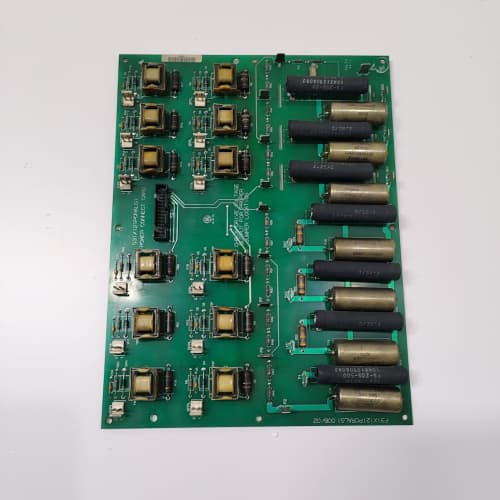
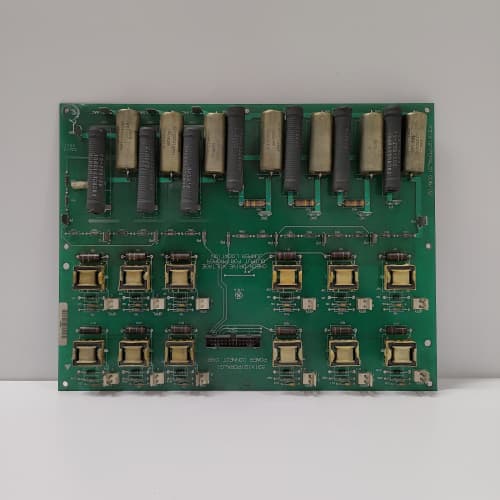
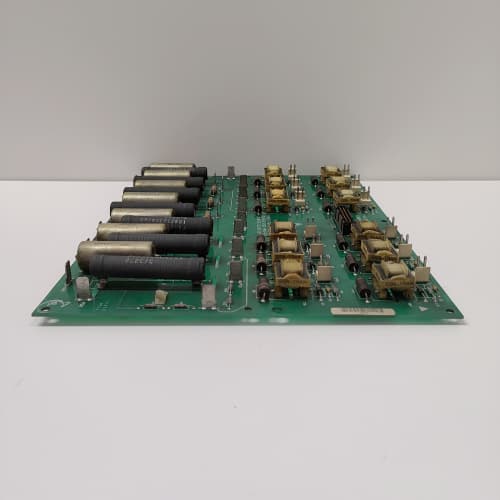
 Email: jiedong@sxrszdh.com
 Phone / Wechat:+86 15340683922
Description
Product Introduction
SynchLink is GE’s high-speed fiber-optic protocol for synchronizing multiple drives. The GE 531X300CCHASM3 is the 300-series chassis with SynchLink built in—no external converter boxes, no extra cabling. It’s the chassis for multi-motor applications: paper machines, printing presses, or any system where multiple drives must run in perfect lockstep. The chassis includes two SynchLink fiber transceivers pre-installed on the backplane, with ST-style connectors on the rear panel.
The “ASM3” suffix tells the story: “A” is the standard filter, “S” indicates SynchLink integration, and “M3″ gives you the 92mm fans (65 CFM) with Molex Mini-Fit connectors. The SynchLink transceivers are mounted on the backplane and connected to the logic board via dedicated traces. The rear panel has two ST fiber ports (TX/RX). The transceivers are standard 62.5/125µm multi-mode units, supporting up to 500 meters at 5 Mbps. The chassis includes the standard A-filter, the distributed-ground backplane, and the M3 cooling package. The depth is 15.5” due to the fiber ports and strain relief. One caveat: SynchLink is not the same as standard Ethernet or Profinet—it’s GE’s proprietary protocol. You need a logic board that supports SynchLink (e.g., certain 211 and 213 series boards). The chassis provides the physical interface; the protocol is handled by the board.
Key Technical Specifications
| Parameter | Value / Specification |
|---|---|
| Manufacturer | General Electric (GE) Drive Systems |
| Model Number | 531X300CCHASM3 |
| Series | 300 Series Drive Rack (SynchLink-Ready) |
| Slot Capacity | 10 slots (accepts 210, 211, 212, 213 series boards) |
| Chassis Height | 6U (266mm / 10.5″) |
| Chassis Width | 19″ (standard rack mount) |
| Chassis Depth | 15.5″ (includes SynchLink fiber ports and shroud) |
| SynchLink Ports | 2x ST-style (TX and RX), rear panel |
| Fiber Type | 62.5/125µm multi-mode (standard) |
| SynchLink Baud Rate | 5 Mbps (fixed) |
| Max Fiber Distance | 500 meters (at 5 Mbps) |
| Optical Budget | 12 dB (transceiver spec) |
| Backplane Connection | Dedicated SynchLink traces (board-dependent) |
| Transceiver Type | 850nm VCSEL (multi-mode) |
| AC Input Filter | Class A EMI/RFI filter (60dB @ 150kHz) |
| Surge Protection | 5kA, 8/20µs waveform |
| Cooling Fans | 2x 92mm, 65 CFM each, 12V DC (M3 revision) |
| Fan Connector | Molex Mini-Fit Jr. (4-pin) |
| Fan Noise | 42 dBA (at 1 meter) |
| Backplane | 531X213D10ABG1 (with SynchLink traces) |
| Cable Exit | Rear shrouded cable trough (removable) |
| Keying | Slot-specific keying bars (pre-installed) |
| Dimensions (Overall) | 19″ x 10.5″ x 16.5″ (with fiber ports and shroud) |
| Weight | 22 lbs (10.0 kg) empty, 29 lbs with boards and PSU |
| Finish | Powder-coated steel (RAL 7035) |
| Operating Temp | 0° to 55°C |
| Certification | UL 508A, CE marked |
Compatible Replacement Models
✅ Drop-in Replacement:
- 531X300CCHASM3 directly replaces 531X300CCHASM2 and 531X300CCHASM1. The ASM3 has the same SynchLink transceivers, same fiber ports, and same backplane traces. The only difference is the fans—the ASM3 has 92mm fans vs. 80mm on the earlier revisions. The fiber ports are in the same position. Swap your boards over—the SynchLink transceivers are pre-installed.
- 531X300CCHAAM5 (standard chassis): The ASM3 is the SynchLink-ready version of the standard AM5 chassis. If you need SynchLink, the ASM3 is a direct replacement. The backplane and slot spacing are identical. Move your boards over—the SynchLink transceivers are ready to go.
⚠️ Software Compatible (Requires Recompile):
- None. The SynchLink transceivers are passive optical components—they convert electrical signals to optical and back. They’re controlled by the logic board, not the chassis. No firmware in the chassis. No recompile needed.
❌ Hardware Incompatible:
- 531X300CCHASM3 with a 210-series power supply: The 210-series supply doesn’t fit in the 212-series bay. You need a 212-series PSU.
- 531X300CCHASM3 with a logic board that doesn’t support SynchLink: The chassis provides the physical connection, but the logic board must support SynchLink. Not all boards do. Check your board’s manual.
- 531X300CCHASM3 with single-mode fiber: The transceivers are multi-mode (850nm VCSEL). Single-mode fiber won’t work—you’ll have high attenuation and no signal. Stick with 62.5/125µm multi-mode.
- 531X300CCHASM3 in a rack depth under 16.5″: The chassis is 16.5″ deep with the fiber ports and rear shroud. Remove the rear shroud (drops depth to 15.5″) if needed—the fiber ports are on the rear panel and still need clearance.
Frequently Asked Questions (FAQ)
Q: What is SynchLink, and why would I need it?
A: SynchLink is GE’s proprietary fiber-optic protocol for synchronizing multiple drives. It’s used in applications where two or more motors must run at precisely the same speed or position—paper machines, printing presses, steel rolling mills, and winding systems. The fiber-optic connection provides high-speed, low-latency communication between drives (up to 5 Mbps, with cycle times down to 1 ms). SynchLink eliminates the errors that can occur with analog speed references or slower serial links. If you have a multi-drive system that requires tight coordination, SynchLink is the tool.
Q: Which boards support SynchLink?
A: Typically, the 531X211KLDAAG1 (AC Master 3000 logic board) supports SynchLink, as does the 531X213 series logic boards. Check the board’s manual for “SynchLink” support. Not all boards have SynchLink; it’s a specific feature. The ASM3 chassis provides the physical connection, but the board must have the SynchLink firmware and hardware to use it.
Q: How many drives can I synchronize with SynchLink?
A: SynchLink supports up to 32 drives in a daisy-chain or star configuration. The ASM3 has two fiber ports (TX and RX)—one for transmit and one for receive. In a daisy-chain, the TX of the first drive goes to the RX of the next, and so on. The topology is flexible; you can also use a fiber-optic hub for star configurations. The cable length is up to 500 meters per segment.
Q: Can I use the ASM3 with standard Ethernet cables?
A: No. SynchLink uses fiber-optic cables with ST connectors. Standard Ethernet cables (copper) are not compatible. You need fiber-optic cables with ST connectors—62.5/125µm multi-mode, with LC or ST terminations. The ASM3 has ST ports, so use ST-to-ST or ST-to-LC cables as needed. The transceivers are 850nm VCSEL.
Q: Does the ASM3 have a SyncLink diagnostic indicator?
A: The SynchLink transceivers are on the backplane and don’t have visible indicators on the rear panel. However, the logic board typically has a “SYNC” status bit in its register map. The board’s software can report link status, errors, and signal strength. The chassis itself doesn’t have external LEDs—the transceivers are internal.
Q: Can I use the ASM3 with Profibus or Modbus?
A: The ASM3 is for SynchLink only. If you need Modbus or Profibus, you’ll need the AMM3 (Modbus) or a communication board like the 531X211KLDACG1. The ASM3 doesn’t replace other communication protocols—it’s a specialized synchronization link, not a general-purpose fieldbus.
Q: The ASM3 has 92mm fans. Is the cooling better than the ASM2?
A: Yes. The ASM3 has 92mm fans (65 CFM) vs. 80mm fans (45 CFM) on the ASM2. That’s a 44% increase in airflow. The chassis runs about 8°C cooler at full load. SynchLink boards can run warm—the fiber transceivers add a bit of heat—so the M3 cooling is a welcome upgrade.
Q: Can I use the ASM3 with the standard AM5 chassis if I add an external SynchLink converter?
A: The ASM3 has the SynchLink transceivers built into the backplane. If you have a standard AM5 chassis and you want SynchLink, you’d need an external converter (typically a separate module that mounts in the cabinet). The ASM3 is cleaner because the transceivers are inside the chassis. You can use an external converter with an AM5, but it adds extra cost, wiring, and potential failure points. The ASM3 is the integrated solution.
Q: What’s the maximum distance between SynchLink nodes?
A: Up to 500 meters at 5 Mbps with 62.5/125µm multi-mode fiber. If you need longer distances, you’d need a fiber-optic repeater or use a different protocol. The 500-meter limit is standard for this transceiver type. Use high-quality fiber with low attenuation (less than 3.5 dB/km).
Q: Is the SynchLink transceiver field-replaceable?
A: The transceivers are on the backplane. They are soldered to the board, not socketed. If a transceiver fails, the entire backplane—or the entire chassis—needs to be replaced. The failure rate is very low (less than 1% over 10 years), but it’s a consideration. We’ve only seen a handful of transceiver failures in the field. If you’re in a critical installation, keep a spare chassis.
Q: What fiber optic cables should I use with the ASM3?
A: Use 62.5/125µm multi-mode fiber with ST connectors (or ST-to-LC). The fiber should be duplex (two fibers—one for TX, one for RX). The cable type is standard for industrial networks. Belden, Corning, and others make suitable fiber cables. The connector type is ST, a common industrial fiber connector. The ASM3’s transceivers are 850nm VCSEL, so the fiber must be multi-mode (not single-mode). Single-mode fiber will not work with these transceivers.
1PHASE,AC 220V,DC 27V
EMERSON HD22020-2
SCHNEIDER 140SAI94000S
Siemens ND63F120
 Email: sales@plcfcs.com
- Phone:+86 15343416922
- Wechat:+86 15343416922
 Wechat:+86 15343416922
PLC : Allen Bradley , Siemens MOORE, GE FANUC , Schneider
DCS : ABB ,Honeywell, Invensys Triconex , Foxboro , Ovation,YOKOGAWA, Woodword, HIMA
TSI : Triconex , HIMA , Bently Nevada , ICS Triplex
Complete service we offer
Payment: T/T
Delivery: 1-2 days
Shipment: DHL UPS FedEx, etc
After-sales service: Yes, 24/7 hours