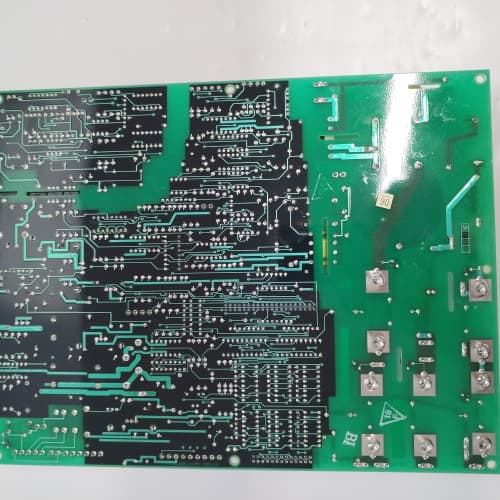
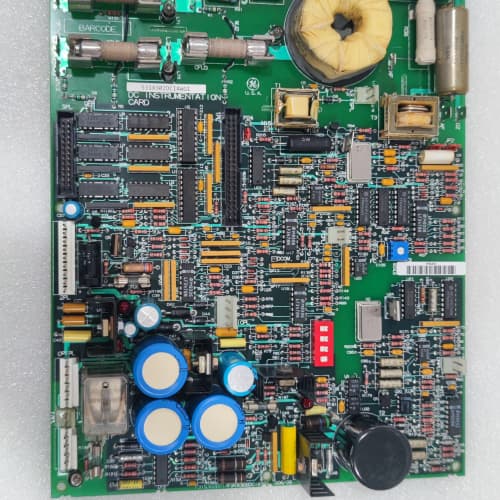
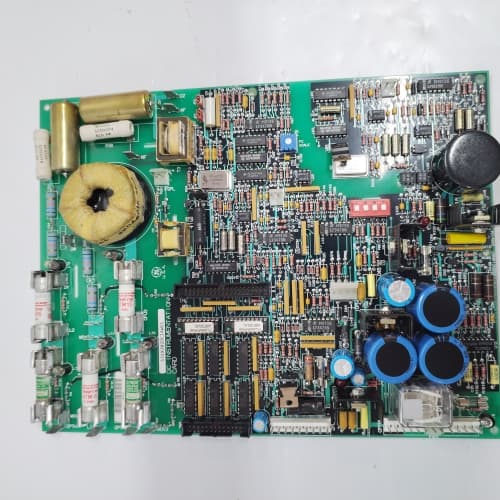
 Email: jiedong@sxrszdh.com
 Phone / Wechat:+86 15340683922
Description
Product Introduction
Some drive installations need a lot of field wiring. The GE 531X300CCHAJM2 is the 300-series chassis with an integrated junction box—a dedicated compartment at the bottom of the chassis that houses a terminal strip and cable entry glands. It saves you from having to mount a separate terminal box in the cabinet and run wires from your field devices (limit switches, pressure transmitters, contactors) through the chassis to your I/O boards. The junction box is pre-wired to the backplane’s I/O headers, so you land your field wires on the terminal strip, and the signals are automatically routed to the appropriate slots.
The “AJM2” suffix tells the story: “A” is the standard filter, “J” indicates the junction box integration, and “M2″ is the revision with the 80mm fans and a larger terminal strip (36 positions instead of 24). The junction box is a sheet-metal compartment on the front of the chassis, below the board slots. It has a hinged door with a key lock, and it’s sized to accommodate up to 36 field wires (22-14 AWG). The terminal strip is rated for 10A, 300V. The junction box is pre-wired to the backplane’s I/O headers (slots 2-6, typically). The chassis also includes a cable entry plate at the bottom with knockouts for conduit fittings. The M2 revision uses 80mm fans (45 CFM), which is sufficient for most applications. The depth increases to 15.5” due to the junction box. One caveat: the junction box is not isolated from the board compartment—it shares the same internal air space, so any moisture or dust that enters the junction box could eventually make its way to your boards. Keep the junction box door closed and sealed.
Key Technical Specifications
| Parameter | Value / Specification |
|---|---|
| Manufacturer | General Electric (GE) Drive Systems |
| Model Number | 531X300CCHAJM2 |
| Series | 300 Series Drive Rack (Junction Box) |
| Slot Capacity | 10 slots (accepts 210, 211, 212, 213 series boards) |
| Chassis Height | 6U (266mm / 10.5″) |
| Chassis Width | 19″ (standard rack mount) |
| Chassis Depth | 15.5″ (includes junction box and rear shroud) |
| Junction Box Type | Integrated compartment (front, below board slots) |
| Terminal Strip | 36 positions (22-14 AWG, 10A, 300V) |
| Terminal Marking | Pre-printed labels (CH1-CH36) |
| Cable Entry | Bottom plate with 4x knockouts (3/4″ trade size) |
| Door Type | Hinged with key lock (included) |
| Junction Box to Backplane | Pre-wired (slots 2-6 I/O headers) |
| AC Input Filter | Class A EMI/RFI filter (60dB @ 150kHz) |
| Surge Protection | 5kA, 8/20µs waveform |
| Cooling Fans | 2x 80mm, 45 CFM each, 12V DC |
| Fan Connector | .093″ connector |
| Fan Noise | 40 dBA (at 1 meter) |
| Backplane | 531X213D10ABG1 (standard) |
| Cable Exit | Rear shrouded cable trough (removable) |
| Keying | Slot-specific keying bars (pre-installed) |
| Dimensions (Overall) | 19″ x 10.5″ x 16.5″ (with junction box and rear shroud) |
| Weight | 25 lbs (11.3 kg) empty, 32 lbs with boards and PSU |
| Finish | Powder-coated steel (RAL 7035) |
| Operating Temp | 0° to 50°C |
| Certification | UL 508A, CE marked |
Compatible Replacement Models
✅ Drop-in Replacement:
- 531X300CCHAJM2 directly replaces 531X300CCHAJM1 and 531X300CCHAJM0. The AJM2 has the same junction box dimensions, same pre-wiring, and same backplane. The only difference is the terminal strip size—the JM0 had 24 positions; the JM2 has 36. If you have the smaller terminal strip, you can still use the AJM2—you’ll just have more available positions. The pre-wiring from the terminal strip to the backplane is identical.
- 531X300CCHAAM5 (standard chassis): The AJM2 is the junction-box version of the standard chassis. If you need field wiring termination, the AJM2 is a direct replacement. The backplane and slot spacing are identical. Move your boards over—the junction box is pre-wired to the I/O headers.
⚠️ Software Compatible (Requires Recompile):
- None. The junction box is purely a passive wiring interface. The terminal strip connections are hard-wired to the backplane pins—no active electronics. No firmware, no configuration. No recompile needed.
❌ Hardware Incompatible:
- 531X300CCHAJM2 with a 210-series power supply: The 210-series supply doesn’t fit in the 212-series bay. You need a 212-series PSU.
- 531X300CCHAJM2 in a rack depth under 16.5″: The chassis is 16.5″ deep with the junction box and rear shroud. This is the deepest of all 300-series variants. If your cabinet is shallower than 16.5″, this chassis won’t fit. The junction box is not removable without significant modification.
- 531X300CCHAJM2 with field wiring that exceeds the terminal strip rating: The terminal strip is rated for 10A, 300V. If you’re switching higher currents or voltages, you’ll need external relays or contactors. The junction box is for signal wiring, not power.
Frequently Asked Questions (FAQ)
Q: What’s the purpose of the junction box?
A: It gives you a convenient, organized place to land field wiring from your sensors, switches, and actuators. Instead of running wires directly to the I/O boards (which can be messy and strain the connectors), you land them on the terminal strip in the junction box. The chassis is pre-wired from the terminal strip to the backplane’s I/O headers, so the signals reach the boards without additional internal wiring. It’s a clean, serviceable solution.
Q: Which slots does the junction box connect to?
A: The junction box is pre-wired to the I/O headers on slots 2 through 6. Specifically, terminals 1-8 connect to slot 2, 9-16 to slot 3, 17-24 to slot 4, 25-30 to slot 5, and 31-36 to slot 6. The wiring is labeled on the terminal strip and on the backplane. If you have boards in slots 7-10, you’ll need to run separate wiring—the junction box doesn’t connect to those slots. The pre-wiring is fixed; you can’t change the assignment.
Q: Can I use the junction box with 24V DC or 120V AC signals?
A: Yes, the terminal strip is rated for 300V, so it can handle both 24V DC and 120V AC signals. However, you should separate AC and DC wiring—use separate conduit entries or maintain physical separation inside the junction box. The terminal strip doesn’t have barriers, so mixing AC and DC on adjacent terminals could cause electrical noise coupling. We recommend using separate compartments or wire ducts.
Q: The junction box has a door with a key lock. Does it come with keys?
A: Yes. The AJM2 includes two keys. The lock is a standard cam lock. If you lose the keys, you can replace the lock with a standard 19mm cam lock (available at hardware stores). The lock is for basic security—keeping curious operators out. It’s not a high-security lock.
Q: The chassis is 16.5″ deep. Is that with or without the junction box?
A: The 16.5″ depth includes the junction box and the rear shroud. The junction box extends about 2″ from the front of the chassis, and the rear shroud adds another 1″. If you remove the rear shroud (four screws), the depth drops to 15.5″—but the junction box still extends forward. The minimum depth is 15.5″ if you remove the rear shroud.
Q: Can I remove the junction box if I don’t need it?
A: You can, but the junction box is an integral part of the chassis—it’s not a bolt-on accessory. Removing it would leave a large opening on the front of the chassis, which would allow dust and debris to enter. If you don’t need the junction box, we recommend buying the standard AM5 chassis instead. The AJM2 is specifically for field wiring applications.
Q: The junction box has 4 knockouts. What size conduit fits?
A: The knockouts are 3/4″ trade size (standard for 1/2″ conduit fittings). You can also use 1/2″ conduit with a reducing bushing. The knockouts are on the bottom plate of the junction box. We recommend using liquid-tight conduit fittings for a good seal.
Q: Does the junction box have a grounding terminal?
A: Yes. There’s a ground lug inside the junction box (M6 stud). Connect your field wiring ground to this lug. The lug is bonded to the chassis ground. This is required for safety and for EMI performance. Don’t skip the ground connection.
Q: The AJM2 has 80mm fans. Is that enough with the junction box?
A: Yes. The junction box is on the front of the chassis, and the fans are on the side. The airflow path isn’t blocked by the junction box—it’s below the fan level. The 80mm fans move 45 CFM each, which is sufficient for most applications. If you have a fully loaded rack in a hot cabinet, you might consider upgrading to the AJM5 (with 92mm fans) if such a variant existed. (GE never made an AJM5—the AJM2 is the only junction-box variant.)
Q: Can I use the junction box to terminate power wiring for the boards?
A: No. The junction box is for signal wiring only (10A, 300V max). The power supply for the boards is handled by the 212-series PSU in slot 1. Do not attempt to connect AC power or high-current DC to the terminal strip—it’s not rated for that.
Q: The terminal strip has 36 positions. Is that enough for my application?
A: That depends on your I/O count. A typical drive installation might have 8 digital inputs, 8 digital outputs, 4 analog inputs, and 4 analog outputs—that’s 24 terminals. The AJM2’s 36 positions give you some room for expansion. If you need more than 36 terminals, you’ll need an external terminal box. The AJM2 is designed for moderate I/O applications.
WESTINGHOUSE 1C31189G01
ABB FI830F
ABB LXN1604-6 3BHL000986P7000
SST 5136-DNP-PCI
 Email: sales@plcfcs.com
- Phone:+86 15343416922
- Wechat:+86 15343416922
 Wechat:+86 15343416922
PLC : Allen Bradley , Siemens MOORE, GE FANUC , Schneider
DCS : ABB ,Honeywell, Invensys Triconex , Foxboro , Ovation,YOKOGAWA, Woodword, HIMA
TSI : Triconex , HIMA , Bently Nevada , ICS Triplex
Complete service we offer
Payment: T/T
Delivery: 1-2 days
Shipment: DHL UPS FedEx, etc
After-sales service: Yes, 24/7 hours