 Email: jiedong@sxrszdh.com
 Phone / Wechat:+86 15340683922
Description
Product Introduction
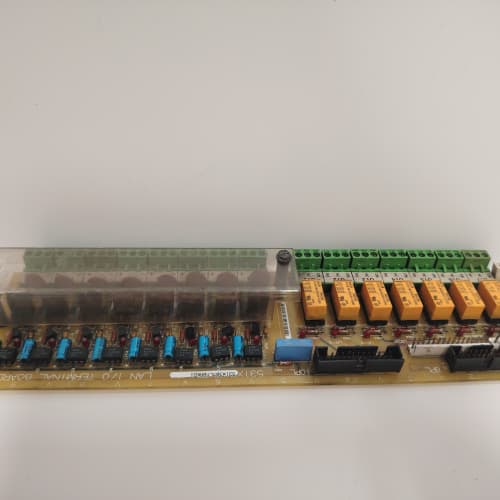
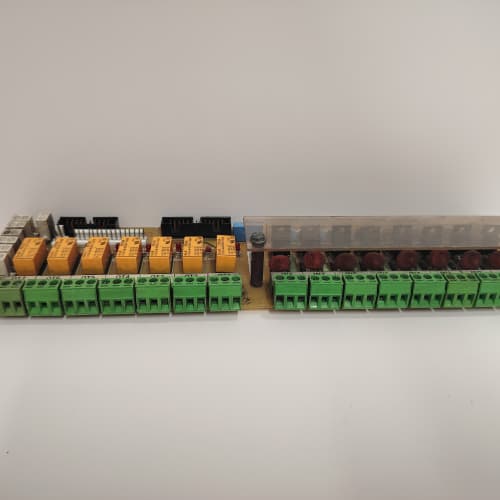
Most plants feed their drive racks with AC power. But some use DC—from a battery bank, a DC bus, or a centralized rectifier. The GE 531X300CCHADM1 is the chassis for those installations. Instead of the standard AC input filter, this variant includes a DC input module with a built-in EMI filter and a distribution panel that routes the DC power to the backplane. It’s a rare bird—GE only made a few thousand of these.
The “ADM1” suffix tells the story: “A” means it includes the standard filter, “D” indicates DC input, and “M1” is the revision with the 92mm fans and the updated fan connectors. The DC input module accepts 24V, 48V, or 125V DC (selectable via jumpers) and filters out the switching noise from your plant DC bus. That’s important because DC bus power—especially from shared rectifiers—can carry high-frequency ripple that confuses your logic boards. The filter provides about 60dB attenuation at 150kHz, which keeps that noise out of your 5V and 24V rails. The DC input module also includes reverse-polarity protection (a Schottky diode) and a slow-blow fuse. The caveat: the DC input module is not hot-swappable. If you need to service it, you must power down the entire chassis. Also, the module generates about 15W of heat, which adds to the thermal load. The M1 fans handle it easily, but if you’re in a hot cabinet, factor that in.
Key Technical Specifications
| Parameter | Value / Specification |
|---|---|
| Manufacturer | General Electric (GE) Drive Systems |
| Model Number | 531X300CCHADM1 |
| Series | 300 Series Drive Rack |
| Slot Capacity | 10 slots (accepts 210, 211, 212, 213 series boards) |
| Chassis Height | 6U (266mm / 10.5″) |
| Chassis Width | 19″ (standard rack mount) |
| Chassis Depth | 13.5″ (includes rear shroud and DC module) |
| DC Input Module | 24V, 48V, or 125V DC (jumper-selectable) |
| DC Input Range | ±20% of nominal (19-30V, 38-58V, 100-150V) |
| DC Input Filter | EMI filter, 60dB @ 150kHz |
| Reverse Polarity | Schottky diode protection (1.5V drop) |
| Input Fuse | 10A slow-blow (field replaceable) |
| DC Outputs | 5V @ 15A, ±15V @ 3A, 24V @ 5A (same as 212 PSU) |
| DC-DC Converter | 250W isolated converter (on DC module) |
| Power Dissipation | 15W (DC module only) |
| Cooling Fans | 2x 92mm, 65 CFM each, 12V DC (M1 revision) |
| Fan Connector | Molex Mini-Fit Jr. (4-pin) |
| Cable Exit | Rear shrouded cable trough (removable cover) |
| Keying | Slot-specific keying bars (pre-installed) |
| Dimensions (Overall) | 19″ x 10.5″ x 14.5″ (with rear shroud) |
| Weight | 20 lbs (9.1 kg) empty, 27 lbs with boards |
| Finish | Powder-coated steel (RAL 7035) |
| Operating Temp | 0° to 50°C (derate above 40°C) |
| Certification | UL 508A, CE marked |
Compatible Replacement Models
✅ Drop-in Replacement:
- 531X300CCHADM1 directly replaces 531X300CCHADM0. The M0 and M1 are functionally identical—both have the DC input module and the same filter. The M1 upgraded the fans to 92mm and changed the fan connector. Swap your boards over, and you’re good to go. The DC input module is pre-wired to the backplane, so no additional wiring is needed.
- 531X300CCHAAM5 (AC input version): The ADM1 and AAM5 share the same chassis dimensions and backplane. The only difference is the input module—AC on the AAM5, DC on the ADM1. If your plant has DC power, the ADM1 is the right choice. If you have AC, you’ll need the AAM5 or ABM5. No firmware changes are needed for either—the output voltages to the boards are the same.
⚠️ Software Compatible (Requires Recompile):
- None. The chassis is a passive mechanical assembly with a DC-DC converter module. The converter doesn’t have a communication bus. No firmware, no configuration. It’s a dumb power supply. No recompile needed.
❌ Hardware Incompatible:
- 531X300CCHADM1 with a 210-series power supply: The DC module is a different form factor than the AC power supply. It’s designed to mount in the same bay as the 212-series PSU, but with a different bracket. A 210-series PSU won’t fit.
- 531X300CCHADM1 with a DC input voltage outside the selected range: If you set the jumpers for 24V but feed it 125V, the DC-DC converter will self-destruct. The protection diode will short, and the fuse will blow, but the module might still be damaged. Check the jumpers before you apply power.
- 531X300CCHADM1 in a rack depth under 14.5″: The chassis is 14.5″ deep with the rear shroud. If your cabinet is shallow, you’ll need to remove the rear shroud (drops depth to 13.5″)—but the DC module adds about 1″ to the internal depth, so the overall depth remains 14.5″. No workaround for this—measure before ordering.
Frequently Asked Questions (FAQ)
Q: Can I use this chassis with a standard AC power supply instead of the DC input module?
A: No. The ADM1 is designed specifically for DC input. The bay where the AC power supply would go is occupied by the DC input module. You can’t swap it for an AC PSU—the mounting holes are different, and the wiring is pre-terminated for DC. If you have AC power, you need the AAM5 or ABM5 chassis.
Q: What’s the advantage of using a DC input chassis over an AC input one?
A: Two main advantages. First, if your plant has a centralized battery bank (for UPS purposes), you can power your drive rack directly from the batteries without an AC inverter in between—that reduces the number of failure points. Second, if you have a DC bus system (common in large facilities with multiple drives), you can tie the chassis directly to that bus. It’s about simplifying the power path and improving reliability. The DC-DC converter is also slightly more efficient (83% vs. 78% for the AC PSU), so you save a bit of power.
Q: The DC input module has jumpers for 24V, 48V, and 125V. How do I know which one to use?
A: It depends on your plant’s DC bus voltage. Standard battery banks are often 24V or 125V (common in utilities and substations). Industrial DC buses can be 48V or 125V. Measure your DC voltage at the input terminals before you power up. Then set the jumpers on the DC module to match. The module won’t start if the voltage is outside the ±20% tolerance. If you’re unsure, start with the 125V setting (it’s the most common for large plants) and test with a multimeter.
Q: Does the DC input module provide isolation?
A: Yes. The DC-DC converter is fully isolated to 2500V RMS between the input and output. That means your logic boards are isolated from your plant DC bus ground. This is important because DC buses can have ground faults that would otherwise damage your electronics. The isolation is verified by the UL listing.
Q: I’m feeding the chassis from a battery bank. Do I need an external fuse?
A: The DC module has an internal 10A fuse, but we recommend an external DC-rated fuse or circuit breaker as close to the battery as possible. The internal fuse protects the chassis; the external one protects the wiring. Use a slow-blow fuse rated for DC—not an AC fuse. DC arcs don’t self-extinguish, so AC-rated fuses are dangerous. A typical recommendation is a 15A DC fuse (Bussmann type AGC or equivalent). If you have a battery bank, you already know this.
Q: The DC module runs warm. Is that normal?
A: Yes. The DC-DC converter dissipates about 15W at full load. The chassis temperature will be about 5°C warmer than an AC-input chassis. The M1 fans handle the extra heat, but if your cabinet is already near the thermal limit, you might need to add a fan. We’ve measured the heat sink temperature at 55°C with a 25°C ambient and a fully loaded rack—that’s within spec. If you’re above 40°C ambient, the module can reach 65°C, which is still acceptable but close to the limit. Improve cabinet ventilation if you’re in a hot plant.
Q: Can I use the ADM1 chassis with boards that require 5V only, and skip the 24V rail?
A: Yes. The DC module outputs all three rails (5V, ±15V, 24V) simultaneously. You can’t turn off individual rails. If your boards don’t use 24V, it just sits unused—but it’s still powered up. The 24V rail is always on as long as the DC input is present. There’s no way to disable it. That’s just how the converter works.
Q: How do I replace the fuse on the DC module?
A: The fuse is a 10A slow-blow, 250V DC rated, 5x20mm cartridge fuse. It’s in a holder on the front of the DC module. Turn off the DC input, wait for the capacitors to discharge (about 30 seconds), then twist the fuse holder open. Replace it with the same type. Do not use a fast-blow fuse—it will blow on startup due to the inrush current. We stock spare fuses if you need them.
Q: What’s the difference between the ADM1 and the ADM0 in terms of DC input?
A: The DC input module is identical. The only difference is the fans: the ADM1 has 92mm fans (65 CFM), while the ADM0 has 80mm fans (45 CFM). If you have an ADM0 and it’s overheating, swapping to an ADM1 chassis will drop the temperature by about 8°C. The DC module itself is the same part across both revisions.
Q: Can I feed the DC module from a solar array?
A: You can, but you’ll need a charge controller or regulator between the panels and the chassis. The DC input needs to stay within ±20% of the selected voltage. Solar panels have variable output; if the voltage drops below the tolerance, the chassis will power-cycle, which is bad for the boards. We recommend a battery buffer (charge the batteries from solar, then feed the chassis from the batteries). That’s a common setup in remote installations.
HONEYWELL CC-PDOB01
REXROTH HCS02.1E-W0054-A-03-NNNN
GE IC660BBA104K
 Email: sales@plcfcs.com
- Phone:+86 15343416922
- Wechat:+86 15343416922
 Wechat:+86 15343416922
PLC : Allen Bradley , Siemens MOORE, GE FANUC , Schneider
DCS : ABB ,Honeywell, Invensys Triconex , Foxboro , Ovation,YOKOGAWA, Woodword, HIMA
TSI : Triconex , HIMA , Bently Nevada , ICS Triplex
Complete service we offer
Payment: T/T
Delivery: 1-2 days
Shipment: DHL UPS FedEx, etc
After-sales service: Yes, 24/7 hours