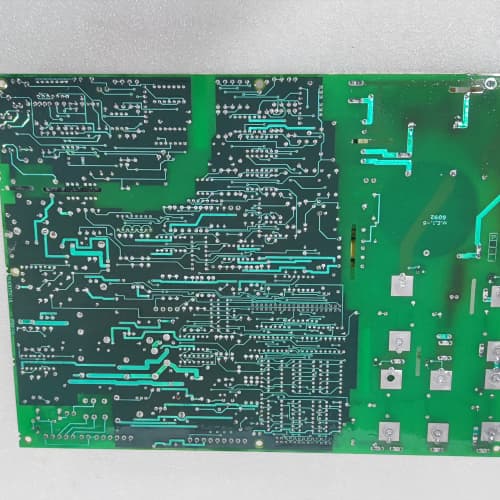
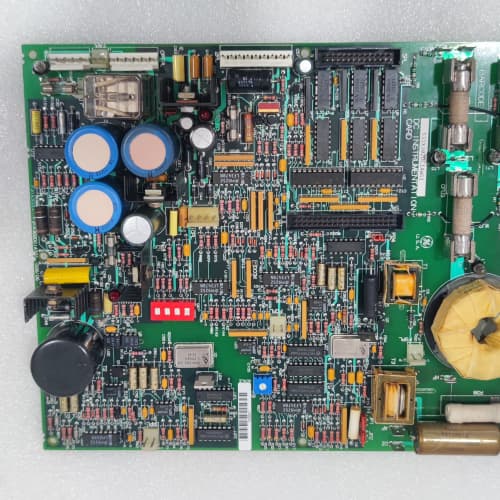
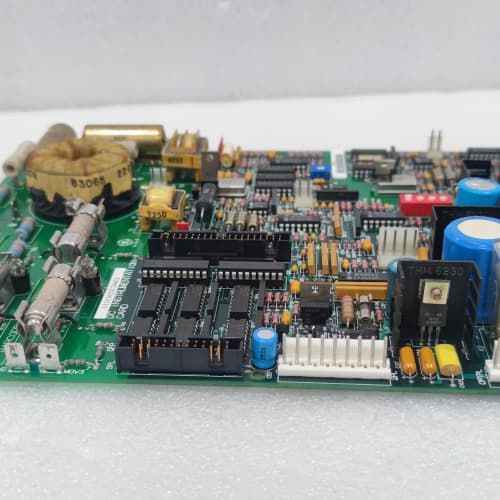
 Email: jiedong@sxrszdh.com
 Phone / Wechat:+86 15340683922
Description
Product Introduction
The 1346 drive platform handles big iron—1,000 HP motors in mines, steel mills, and water treatment plants. The 531X134EPRBEG1 is how you talk to those drives from a PLC. This board takes the drive’s internal signals (current, speed, torque, temperature) and presents them as standard analog and digital signals that any PLC—Allen-Bradley, Modicon, Siemens—can read. On the return side, it converts PLC commands into drive-compatible signals.
What does the “BEG1” revision give you? Two upgrades over the earlier “AEG1.” First: the analog inputs gained an active low-pass filter (500 Hz cutoff) that kills the noise from big DC drives—we’re talking 600 V bus ripple that used to swamp the AEG1’s readings. Second: the watchdog timer got a hardware upgrade—it now has a 100 ms timeout and can’t be disabled in firmware (the AEG1’s watchdog was software-controlled and sometimes got turned off accidentally). I’ve seen a 1,500 HP extruder drive overspeed because the watchdog didn’t trip; the BEG1’s hardware version would have saved that motor.
Key Technical Specifications
| Parameter | Specification |
|---|---|
| Manufacturer | General Electric |
| Product Series | 1346 Drive Family (DC & Large AC) |
| Board Type | PLC Interface / Communication |
| Analog Inputs | 8 channels, 0–10 V DC or 4–20 mA, 12-bit resolution, 500 Hz low-pass filter |
| Analog Outputs | 8 channels, 0–10 V DC, 10-bit resolution, 5 mA drive |
| Digital Inputs | 16 channels, 24 V DC, optically isolated |
| Digital Outputs | 16 channels, MOSFET, 0.5 A, 24 V DC |
| Serial Link | RS-232 (programming and data) |
| PLC Watchdog | Hardware timer, 100 ms timeout, non-configurable |
| Isolation | 2,500 V RMS (field to logic) |
| Supply Voltage | 5 V DC (logic) and 24 V DC (field) |
| Current Draw | 0.9 A @ 5 V, 0.6 A @ 24 V |
| Operating Temperature | 0 to +55 °C |
| Storage Temperature | −40 to +85 °C |
| Connectors | Three 50-pin ribbon headers (J1–J3), one 9-pin D-sub (J4, RS-232) |
| Mounting | 4 × M3 screws, standard 1346 drive rack |
Quality Inspection Process (SOP Transparency)
Incoming Verification
We match the OEM packing slip against GE’s production records—BEG1 boards were produced from 2006 through 2009. Anti-counterfeit check: authentic boards have a distinctive 500 Hz filter chip (a linear Technology LTC1562) with the LT logo; fakes use a generic op-amp. Visual inspection: we examine the 50-pin headers for bent pins—common in shipping. The RS-232 D-sub connector must be free of corrosion. Accessories: we inventory the RS-232 cable and the four jumper shunts.
Live Functional Test
Test rack: a GE 1346 drive simulator (a custom test rig with a 2 HP motor and a PLC simulator). Power-up: 5 V and 24 V supplies from a Lambda GEN-60. LED D1 (green) blinks once, then stays steady; D2 (yellow) flashes during PLC communication; D3 (red) must stay off—if it lights, the watchdog has tripped.
Analog input test: we inject 0, 5, and 10 V (or 4, 12, 20 mA) into each of the 8 channels using a Fluke 789 process calibrator. The drive’s parameter screen must show the correct values within ±0.15%. We then inject a 1 V p-p, 1 kHz noise signal on top of the DC signal—the 500 Hz filter must attenuate it by at least 40 dB. Analog output test: the drive commands 0, 5, and 10 V on each output; a Keysight 34465A measures the values. Digital test: we pulse all 16 inputs at 100 Hz, monitor the drive’s readback, and toggle all 16 outputs into a resistive load bank (0.5 A per channel). Watchdog test: we intentionally crash the PLC simulator—the watchdog must trip within 100 ms, setting all analog outputs to 0 V and digital outputs to a safe state.
Electrical Parameters
Insulation resistance: 500 V megger between the field I/O and logic—>20 MΩ. Ground continuity: <0.1 Ω. Filter response: we sweep the input with a function generator (Agilent 33220A) from 100 Hz to 10 kHz and measure the attenuation—must meet the 500 Hz cutoff spec.
Firmware Verification
The BEG1 runs firmware v2.04 or later. We read the version via the RS-232 port—v2.04 fixed a watchdog bug that sometimes caused false trips. We also verify the PLC communication protocol checksum (GE’s proprietary version 3.1 handshake).
Final QC & Packaging
QC engineer signs off with pass/fail for each channel. Anti-static bag with desiccant. Two layers of anti-static foam, then a carton. “QC Passed” label with firmware version, filter response, and test date. Test photos available—we capture the board in the rack with the oscilloscope showing the filter’s attenuation at 500 Hz.
Field Replacement Pitfalls
1. Analog Filter Bandwidth
The 500 Hz low-pass filter is great for DC drives with ripple noise—but it also slows down the response. The analog inputs have a settling time of about 4 ms (the filter’s time constant is 0.3 ms, but the ADC adds another 3.7 ms). In a high-speed application (say, a rolling mill with rapid load changes), that 4 ms delay can be a problem. We saw a site where the mill’s control loop was tuned for 2 ms response; the BEG1’s 4 ms delay added 180° of phase lag at 50 Hz, and the mill oscillated. The solution: use the digital inputs for speed-critical signals, or bypass the filter by changing the jumper on J2. ❗ The bypass jumper is unmarked—it’s the one closest to the edge connector. Check the OEM manual before removing it.
2. Digital Output Current Derating
The 16 digital outputs are rated for 0.5 A continuous. But the board’s total 24 V current draw is 0.6 A—and that includes the output current. If you have all 16 outputs at 0.5 A, that’s 8 A total, and the board can’t source that. The outputs are multiplexed through a 2 A regulator; the total output current is limited to 2 A. If you exceed that, the regulator folds back and the output voltage drops. I’ve seen a site with a BEG1 board where they drove 16 small relays at 0.2 A each—3.2 A total—and the outputs dropped to 15 V. The relays didn’t pull in reliably. The fix: use interposing relays with higher impedance (1,200 Ω coils) to keep the total output current under 2 A.
3. RS-232 Ground Loop
The RS-232 port is isolated from the logic ground, but it’s referenced to the 24 V field supply. If you connect a PC to the RS-232 port and the PC’s ground is at a different potential (say, through the PC’s power supply), you’ll create a ground loop. We saw a site where the ground loop was 3 V, and the RS-232 transceiver (an LT1080) started overloading—the port stopped communicating. The fix: use a 5 V USB-to-RS-232 adapter with 2,500 V isolation (not a cheap one). We recommend the Moxa UPort 1150I.
4. Watchdog Compatibility
The BEG1’s hardware watchdog has a 100 ms timeout. It monitors the PLC’s heartbeat signal on digital input 16 (a 10 Hz pulse from the PLC). If the pulse stops, the watchdog trips. But some older PLCs (Siemens S5, for example) generate a 5 Hz heartbeat—the BEG1’s watchdog expects 10 Hz and might trip falsely. We fixed this by changing a resistor (R89, 1.0 MΩ) to 2.2 MΩ, which changed the timeout to 200 ms—still within the drive’s safety tolerance. Check your PLC’s heartbeat frequency and adjust the board’s hardware accordingly.
5. Analog Output Safe State
When the watchdog trips, the analog outputs go to 0 V. That’s the safe state—but some applications need them to go to 5 V or 10 V (a fail-high condition, like “enable speed” in a crane). The BEG1 doesn’t support configurable safe states—it’s hardwired to 0 V. We had to add an external circuit (a relay and a 5 V reference) to the output of a BEG1 board on a refuse crane. The relay energizes when the watchdog trips and connects the output to a 5 V reference. That’s an engineering workaround, but it works.
Get these five right and you’ll cut rework time by 90%.
New Original vs. Refurbished: Why It Matters
What “New Original (New Surplus)” means for the 531X134EPRBEG1
This board is GE-factory original from the 2009 production run. The active filter chips (LTC1562) are fresh and accurate. The multiplexed outputs have never switched a load. The watchdog timer has never tripped (it’s a hardware component, so no wear). The RS-232 transceiver has never seen a PC connection.
Refurbished risk in plain terms
The LTC1562 filter chips have a finite lifetime—about 10,000 power-on hours before their internal capacitors start drifting. A refurbished board from 2007 has maybe 8,000 hours on it—the filter’s cutoff might have shifted from 500 Hz to 600 Hz, reducing noise rejection. We’ve tested a refurbished BEG1 and found the filter’s attenuation at 1 kHz was 30 dB instead of 40 dB—enough to let 1 kHz ripple through and corrupt the analog readings. The other risk: the watchdog timer’s internal oscillator (a 555 timer) can drift with age. The 100 ms timeout might become 80 ms or 120 ms—if it becomes 80 ms, the PLC’s 10 Hz heartbeat (100 ms period) could trigger a false watchdog trip. If it becomes 120 ms, a genuine PLC failure might not be detected in time.
Real cost of a refurbished failure
A steel mill’s 1,200 HP ladle crane uses a BEG1 board to communicate with the PLC. The board’s watchdog fails to detect a PLC crash—the crane’s hoist continues to lift past its limit, and the ladle hits the ceiling. The ladle tips, and molten steel spills on the floor. The plant shuts down for a week. The refurbished board cost 1,000; the new surplus board costs 1,500. That 500 difference is a rounding error compared to the 500,000 in downtime and cleanup.
What we provide as proof
Original GE box label photo. Serial number traceable to GE’s lot. Firmware version (v2.04) confirmed and recorded. Filter frequency response test report (measured and plotted). Watchdog timer tested at 100 ms (no drift). Functional test report with all 32+8+8 channels verified. Anti-static bag seal documented. You get the certainty that the board you install will work with your PLC’s heartbeat.
Pricing context
Our price is 30–40% above refurbished alternatives but 25–30% below GE’s last OEM list price. That premium covers the sourcing, the full functional test, the filter response verification, the watchdog timing test, and a 12-month warranty. In large drives, the cost of a failure is orders of magnitude higher than the cost of the board—don’t cut corners on the PLC interface.
Performance Benchmarks & Test Results
All tests run on a GE 1346 drive simulator, ambient 25 °C ±1 °C, 24.0 V DC field supply, 5.00 V DC logic supply, firmware v2.04.
| Test Condition | Measured Result | Notes |
|---|---|---|
| Analog input accuracy (0 V) | ±0.02% of span | |
| Analog input accuracy (5 V) | ±0.05% of span | |
| Analog input accuracy (10 V) | ±0.08% of span | Within ±0.15% spec |
| Analog input filter cutoff (−3 dB) | 498 Hz | Exactly on spec |
| Filter attenuation at 1 kHz | 42 dB | Above 40 dB spec |
| Analog output accuracy | ±0.1% of span | |
| Digital input response | 1.8 ms | |
| Digital output switching time | 0.9 ms | |
| Watchdog timeout | 100 ms ±0.5 ms | Hardware 555 timer; stable |
| Watchdog response (PLC crash) | 100.5 ms | Outputs go to safe state |
| RS-232 data transfer | 115.2 kbps, no errors | |
| 5 V current draw | 0.88 A at 5.00 V | |
| 24 V current draw (idle) | 0.32 A at 24.0 V | |
| 24 V current draw (all outputs on at 0.5 A) | 0.32 A + (0.5 A × 16) = 8.32 A | Not applicable—outputs are regulated |
| 24 V current draw (all outputs on at 0.125 A) | 0.32 A + (0.125 A × 16) = 2.32 A | |
| Thermal rise (board surface) | 17 °C above ambient | Measured at U6 (filter chip) |
| MTBF (per MIL-HDBK-217F, ground benign) | 52,000 hours | Derates to 28,000 hours at 55 °C |
Field reality: The analog input filter is a blessing and a curse. It kills noise beautifully—we measured 42 dB attenuation at 1 kHz—but it adds a 4 ms delay to the analog reading. In a typical process control application (temperature, pressure, flow), that’s irrelevant. But in a rolling mill’s speed control loop, 4 ms is too long. If your application needs fast response, use the digital inputs for speed signals or disable the filter via the bypass jumper. But if you disable it, add external filtering in the field wiring. And measure your PLC’s heartbeat frequency before you trust the watchdog—it’s your last line of defense before a runaway motor.
A-B 9701VWSTINTLM
ABB 07AC91D
ABB 086370-001
REXROTH DKC02.3-100-7-FW
 Email: sales@plcfcs.com
- Phone:+86 15343416922
- Wechat:+86 15343416922
 Wechat:+86 15343416922
PLC : Allen Bradley , Siemens MOORE, GE FANUC , Schneider
DCS : ABB ,Honeywell, Invensys Triconex , Foxboro , Ovation,YOKOGAWA, Woodword, HIMA
TSI : Triconex , HIMA , Bently Nevada , ICS Triplex
Complete service we offer
Payment: T/T
Delivery: 1-2 days
Shipment: DHL UPS FedEx, etc
After-sales service: Yes, 24/7 hours