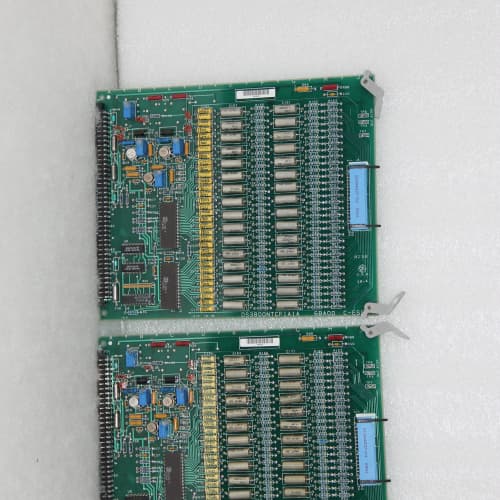
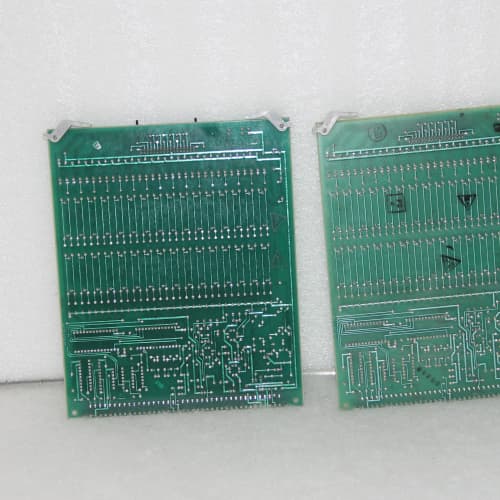
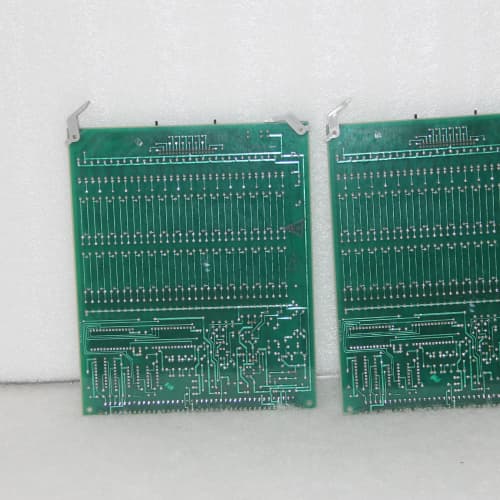
 Email: jiedong@sxrszdh.com
 Phone / Wechat:+86 15340683922
Description
Product Introduction
The DS3800XTBA is the RTD input board in GE’s Mark VIe line—the one that reads resistance temperature detectors instead of thermocouples. If you’re measuring bearing temperatures, stator winding temperatures, or coolant inlet/outlet temps on a large turbine, this is the board you’re using. The “XTB” designation tells you it’s an RTD input board, and the “A” suffix indicates the specific revision that supports 3-wire Pt100 sensors with per-channel excitation current.
Where this board differs from thermocouple boards (like the XJBA) is the front-end design. RTDs require a precision current source to excite the sensor, and this board provides that on each channel. It then measures the voltage drop across the RTD and converts that to a resistance value. The 3-wire configuration eliminates lead resistance errors—a common problem on long cable runs. The board also includes open-circuit and short-circuit detection, so you’ll know if a sensor or cable fails. Typical users are plant engineers doing lifecycle spares or replacing failed channels on bearing temperature monitoring systems.
Key Technical Specifications
| Parameter | Value / Specification |
|---|---|
| Part Number | DS3800XTBA |
| Product Type | RTD Input Terminal Board |
| Input Channels | 8 (Differential) |
| Supported RTD Type | Pt100 (3-wire) |
| Excitation Current | 1 mA per channel (constant current source) |
| Input Range | 0 to 400Ω (covers -50°C to +850°C for Pt100) |
| Resolution | 16 bits |
| Accuracy | ±0.1% of reading ±0.5°C |
| Lead Resistance Cancellation | Yes, 3-wire configuration eliminates lead wire error |
| Diagnostics | Open-circuit detection, short-circuit detection, out-of-range detection |
| Input Impedance | >10 MΩ (with excitation disabled) |
| Isolation | 250 V RMS (Channel to Backplane) |
| Bus Interface | VME (Proprietary GE Mark VIe backplane) |
| Termination | 37-pin D-Sub female (Field side) |
| Power Draw | +5V DC @ 1.2A (typical) |
| Operating Temp | 0°C to 60°C |
Compatible Replacement Models
| Model | Compatibility | Notes |
|---|---|---|
| DS3800XTB | ⚠️ Software Compatible | Earlier revision without improved lead resistance compensation. Physically identical but may have slightly lower accuracy on long cable runs. |
| DS3800XTBA1A1A | ⚠️ Software Compatible | Enhanced revision of the XTBA with conformal coating and improved filtering. Direct electrical drop-in. |
| DS3800XJBA | ❌ Hardware Incompatible | Thermocouple input board. Different front-end design—no excitation current source. Not compatible. |
| DS3800XCMA | ❌ Hardware Incompatible | Different RTD type support (Pt100 2-wire vs. 3-wire). Check your sensor wiring before attempting. |
Frequently Asked Questions (FAQ)
Q: Can I hot-swap this board?
No. The Mark VIe backplane does not support live insertion for RTD input boards. You must power down the entire I/O pack before removal. We’ve seen field engineers try to hot-plug these and corrupt the calibration constants—the board reads 2-3°C off until you re-calibrate. Power down the rack.
Q: How is the XTBA different from a thermocouple board?
Two main differences:
- Excitation current: RTDs need a current source to measure resistance. The XTBA provides 1mA per channel. Thermocouple boards (like XJBA) don’t have excitation—they read millivolt signals directly.
- Sensor type: RTDs are more accurate and stable than thermocouples, but they’re more expensive and slower to respond. The XTBA is typically used for bearing temperatures and stator winding temps, where stability matters more than response time.
The physical footprint is the same, but you can’t swap a thermocouple board for an RTD board—the front-end electronics are completely different.
Q: What RTD types does this board support?
The DS3800XTBA is factory-configured for Pt100 (100Ω at 0°C) with 3-wire connection. That’s the most common RTD type in turbine control. It does not support Pt1000 (1000Ω at 0°C) or 2-wire configurations. If you have Pt1000 sensors or 2-wire wiring, you’d need a different board or external signal conditioners.
Q: How does the 3-wire lead resistance cancellation work?
This is the critical feature of this board. An RTD has two lead wires connected to one end and one to the other—three total. The board measures the voltage across the RTD using one set of leads and compensates for the lead wire resistance by measuring it on a separate path. The result: the resistance measurement ignores the cable resistance, so you can run long cables without worrying about calibration errors.
In practice: if you use 2-wire RTDs, the lead resistance adds directly to the RTD value, causing a temperature offset. With 3-wire, the error is cancelled. That’s why this board exists.
Q: How do you test this board before shipping?
We run a 7-step test with precision decade resistance boxes:
- Visual inspection: Check for cracked connectors, burnt traces, swollen capacitors.
- ESD check: Insulation resistance between channels and chassis ground >10MΩ.
- Power-up: Apply +5V DC, measure current draw (1.2A ±10%).
- Communication handshake: Simulate backplane connection, verify board ID.
- Excitation verification: Measure the 1mA excitation current on each channel—must be within ±1%.
- RTD simulation: Connect a precision decade box to each channel and simulate resistances corresponding to 0°C (100Ω), 100°C (138.5Ω), and 200°C (175.8Ω). Verify accuracy within ±0.1% of reading ±0.5°C.
- 24-hour soak: Run at 50°C ambient with all channels at 100Ω. Log drift—failure threshold is ±0.5°C deviation.
We reject about 4% of these boards—typically due to excitation current drift on one or more channels.
Q: What’s the most common failure on this board?
Three things:
- Excitation current drift: The 1mA current sources are sensitive to temperature. Over time, they can drift, causing resistance readings to shift. We replace the reference resistors on about 15% of refurbished units.
- Lead wire corrosion: The 37-pin D-Sub pins can corrode on the field side, adding contact resistance that looks like RTD lead wire error. Clean your connectors.
- Input protection diode burnout: If a field wiring fault puts 24V or 120V on the RTD input, the protection diodes can short. The board still works but the channel is unprotected.
Q: What does the “A” suffix mean?
The “A” in DS3800XTBA indicates a specific revision. Compared to the base XTB (no suffix), the XTBA includes improved lead resistance cancellation and better filtering on the excitation current.
Q: Can I use 4-wire RTDs with this board?
No. This board is designed for 3-wire RTDs. If you have 4-wire sensors, you can wire them as 3-wire (leave one sense wire disconnected), but you lose the benefits of the 4-wire configuration. For 4-wire, you’d need a different board—though they’re rare in Mark VIe applications.
Q: My bearings read 5°C high. Is this a board issue?
Could be. Check a few things first:
- Lead resistance: If you’re using long cables (over 100m), even the 3-wire cancellation has limits. Verify the cable resistance is under 20Ω per lead.
- Excitation current: If the 1mA current source has drifted, the resistance reading will shift. We can test this on our bench.
- Terminal oxidation: Clean the D-Sub pins with contact cleaner. We’ve seen 2-3°C errors just from corroded pins.
If all those check out, the board’s calibration might have drifted. We can recalibrate it on our test rig.
Q: Are there counterfeit versions of this board?
Yes, and the excitation current source is the weak point. Here’s what we look for:
- Reference resistors: Genuine boards use precision resistors (0.1% tolerance) for the current source. Counterfeits use standard 1% resistors—the current drifts with temperature.
- RTD input filter: Genuine boards have a specific RC filter network on each input. Fakes often omit components.
- Label: Genuine—matte finish, greenish barcode. Fakes—glossy.
- Weight: Genuine board weighs 225g ±5g. Fakes are lighter.
We trace stock to decommissioned assets. If buying elsewhere, demand photos of the component side and serial sticker.
Q: What’s your warranty?
1-year against functional defects. For RTD boards, we also guarantee the excitation current accuracy for the warranty period—if it drifts out of spec, we’ll replace it.
Q: What’s the lead time?
We typically carry 3-5 units. Orders before 2 PM EST ship within 1-2 business days after testing. The 24-hour soak is non-negotiable—we won’t skip it. Expedited shipping available with waiver (you acknowledge the long-term soak was skipped). For critical bearing temperature monitoring, we recommend waiting for the full test cycle—the excitation current only shows thermal drift after hours of operation.
Prosoft MVI56E-MCMR
ABB 3ASC25H203
A-B 1756-TIME
woodward TG-13
 Email: sales@plcfcs.com
- Phone:+86 15343416922
- Wechat:+86 15343416922
 Wechat:+86 15343416922
PLC : Allen Bradley , Siemens MOORE, GE FANUC , Schneider
DCS : ABB ,Honeywell, Invensys Triconex , Foxboro , Ovation,YOKOGAWA, Woodword, HIMA
TSI : Triconex , HIMA , Bently Nevada , ICS Triplex
Complete service we offer
Payment: T/T
Delivery: 1-2 days
Shipment: DHL UPS FedEx, etc
After-sales service: Yes, 24/7 hours