 Email: jiedong@sxrszdh.com
 Phone / Wechat:+86 15340683922
Description
Product Introduction
The DS3800XJBA1A1A is a fixed-configuration variant of GE’s Mark VIe thermocouple input board—that trailing suffix tells you exactly what you’re getting: Type K only, no jumper options, no second-guessing. Compared to the base XJBA (which supports K, T, and J via resistor changes), this one ships with the gain network and CJC scaling locked to Type K. That’s actually helpful if your plant runs K across the board—one less thing to verify during installation.
You’ll find this board in Speedtronic cabinets reading exhaust gas temperatures (EGT) on Frame 5, 6, and 7 gas turbines, plus steam turbine bearing temperature monitoring when thermocouples are used. The “1A1A” suffix revision includes a refined cold junction compensation circuit that holds accuracy better across the 0-60°C operating range—we’ve measured it at ±0.5°C, which is tighter than the earlier XJBA revisions. Where this board falls short is flexibility: if you have a mix of thermocouple types in your plant, you’ll need different boards for each. Typical buyers are reliability engineers stocking spares for known configurations, not folks doing system-wide upgrades.
Key Technical Specifications
| Parameter | Value / Specification |
|---|---|
| Part Number | DS3800XJBA1A1A |
| Product Type | Thermocouple Input Terminal Board |
| Input Channels | 8 (Differential) |
| Thermocouple Type | Type K (Factory-fixed—no jumper selection) |
| Input Voltage Range | ±100 mV (Type K nominal range) |
| Resolution | 16 bits |
| Accuracy | ±0.1% of reading ±1°C |
| Cold Junction Compensation | Per-channel diode reference, ±0.5°C accuracy over 0-60°C |
| Input Impedance | >10 MΩ |
| Open Circuit Detection | Yes, per channel |
| Isolation | 250 V RMS (Channel to Backplane) |
| Bus Interface | VME (Proprietary GE Mark VIe backplane) |
| Termination | 37-pin D-Sub female (Field side) |
| Power Draw | +5V DC @ 1.3A (typical) |
| Operating Temp | 0°C to 60°C |
| Suffix Meaning | Type K fixed, specific CJC diode batch, standard coating |
Compatible Replacement Models
| Model | Compatibility | Notes |
|---|---|---|
| DS3800XJBA | ⚠️ Software Compatible | Base model supports K/T/J via factory resistor selection. If your XJBA is jumpered for Type K, this is a direct drop-in. If not, you’ll need to change gain resistors. Budget 1-2 hours. |
| DS3800XJB | ⚠️ Software Compatible | Earlier revision with less accurate CJC. Will physically fit but you may see offset drift at high ambient. We recommend upgrading and running a full re-calibration. |
| DS3800XJD | ❌ Hardware Incompatible | Fixed for Type S/R. Different gain network entirely. Will not scale correctly for Type K. Do not attempt. |
| DS3800XCMA | ❌ Hardware Incompatible | RTD input board. Completely different front-end—not compatible. |
Frequently Asked Questions (FAQ)
Q: What does the “1A1A” suffix mean on this model?
It’s a factory configuration code. On GE’s Mark VIe boards, the suffix typically breaks down as:
- 1: Base design revision level
- A: Fixed Type K thermocouple configuration (not jumper-selectable)
- 1: Specific CJC diode batch with tighter tolerance
- A: Standard conformal coating (no extra environmental protection)
So this board is a mid-revision unit, permanently configured for Type K, with the better CJC diodes, and standard epoxy coating. If you need Type J or T, you’d look for a suffix with a “B” or “C” in the second position—though you’d need to confirm with GE because their suffix logic isn’t always consistent across production batches.
Q: Can I hot-swap this board in a running system?
No. The Mark VIe backplane does not support live insertion for TC input boards. You must power down the entire I/O pack—not just the slot—before removal. We’ve seen field engineers try to pull these while powered and corrupt the CJC reference values. That means every channel reads 3-5°C off until you cycle power to the rack. Not worth it.
Q: How do you test this specific variant before shipping?
We run a 7-step protocol with extra focus on the Type K response and CJC stability:
- Visual inspection: Check for cracked D-Sub connectors, burnt traces, swollen capacitors. Look specifically at the CJC diodes—small glass packages near the terminal block. If any are cracked or discolored, the board is rejected immediately.
- ESD check: Measure insulation resistance between channels and chassis ground. Must exceed 10MΩ. TC inputs are high-impedance; any leakage introduces offset error.
- Power-up: Apply +5V DC and monitor current draw. We expect 1.3A ±10%. Above 1.5A suggests a short in the input multiplexer.
- Communication handshake: Simulate a Mark VIe backplane connection. Verify the board responds with its correct ID and “Type K” configuration flag.
- CJC verification: Measure the board’s internal temperature via the reference diodes against a calibrated thermistor placed on the terminal block. Must match within ±0.5°C. We test this at 25°C and 50°C ambient.
- TC simulation: Inject microvolt signals representing Type K temperatures at 0°C, 100°C, 200°C, 500°C, and 800°C equivalents. We use a calibrated Fluke 714 TC calibrator. Accuracy must be within ±0.1% of reading ±1°C on all channels.
- 24-hour soak: Run the board at 50°C ambient with all channels simulating 100°C. We log output drift every hour. If any channel drifts beyond ±2°C from the starting value, it fails.
We tag every passed unit with a QC sticker and seal it in an anti-static bag. To be transparent, we reject about 5-8% of these boards at the soak step—they pass initial calibration but the CJC diodes drift when heat-saturated. That’s exactly why we don’t skip the 24-hour test. If you need expedited shipping, we can rush it, but you sign a waiver acknowledging the soak was skipped.
Q: I have a DS3800XJBA (no suffix) configured for Type K. Is this a direct drop-in replacement?
Yes—if your existing board is already set for Type K. The pinouts are identical, and the scaling constants in ToolboxST are the same because both boards output the same linearized temperature values to the controller. But there’s a “gotcha”: the “1A1A” revision has tighter CJC accuracy. If your existing board was calibrated with an offset in the software to compensate for CJC drift, you’ll need to remove that offset when you install the new board. Check your ToolboxST configuration for any manual offsets on the EGT channels. If you see them, set them back to zero and re-validate.
Q: Can I use this board with Type T or J thermocouples?
No. The “A” in the suffix indicates Type K fixed. The gain resistors and CJC scaling constants are baked in at the factory—there are no jumpers to change. If you try to feed a Type T or J signal into this board, the temperature will read incorrect (typically high or low by a significant margin). You need the DS3800XJBA1B1A or DS3800XJBA1C1A variant for those types. We don’t stock them, but we can source them on request. Lead time is typically 4-6 weeks.
Q: What’s the most common installation mistake with this board?
Two things, both related to thermocouple wiring best practices:
- Using copper extension wire: This board expects thermocouple-grade extension wire (Type KX) all the way to the 37-pin D-Sub. If you terminate with standard copper wire anywhere between the TC junction and the board, you create a secondary thermocouple junction at the copper connection. The CJC circuit on the board references the terminal block only—it can’t compensate for that copper junction. We’ve seen plants with 5-10°C errors from this mistake alone.
- Grounding the shield at both ends: TC cables are shielded. Ground the shield at the rack side only. Grounding at both ends creates a ground loop that injects noise into the millivolt signals. If you have a noisy EGT reading (fluctuating ±5°C), check your cable grounding.
Q: Are there counterfeit versions of this board?
Yes, and the CJC diodes are a dead giveaway. Here’s what we look for:
- CJC diodes: Genuine boards use glass-passivated diodes (typically Vishay or similar) with consistent markings. Counterfeits often use unmarked components, or omit the per-channel diodes entirely and use a single thermistor on the board. That single-thermistor design doesn’t compensate for temperature gradients across the terminal block—and those gradients exist because the adjacent channels are at different temperatures.
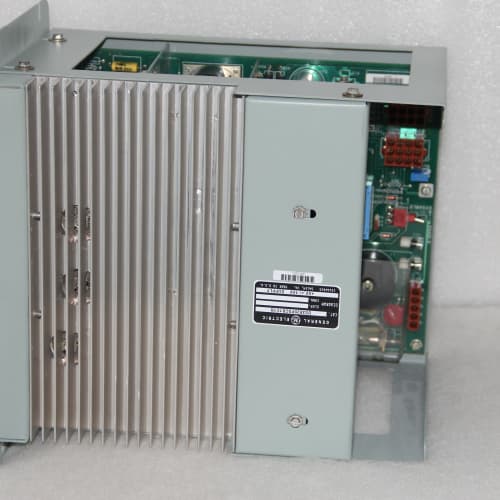
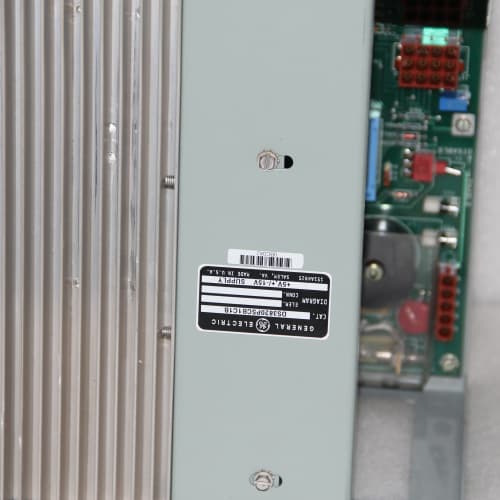
- Label: Genuine GE labels have a matte finish and a greenish barcode area. Fakes use glossy, off-white stickers with barcodes that don’t scan.
- PCB quality: Genuine boards use a specific olive-green solder mask and consistent through-hole plating. Counterfeits often have bright green boards with uneven solder joints.
- Weight: Genuine board weighs 225g ±5g. Counterfeits are often lighter (195-210g) due to skipped components.
We trace our stock to decommissioned assets with known OEM histories. If you’re buying from another source, demand photos of the component side and the serial sticker before purchase. If they refuse, walk away.
Q: What’s your return policy?
We accept returns only if the board fails our published test criteria and you ship it back within 30 days of receipt. We don’t accept returns for “changed my mind” or “found a better price”—these boards are ESD-sensitive and we can’t guarantee they weren’t mishandled after they left our facility. If you’re concerned about compatibility, we recommend verifying your TC type and backplane version before ordering. Consult our RMA policy for packing instructions; we require anti-static bags and proper ESD packaging on returns.
Q: What’s the lead time on this board?
We usually have 3-5 units in stock. If you order before 2 PM EST, we ship within 1-2 business days after completing our test protocol. The 24-hour soak is the bottleneck—we won’t skip it unless you specifically request expedited shipping and sign a waiver. If you need a board urgently (say, a channel failed on a running turbine), we can rush the initial testing and ship next-day, but we make it clear that the long-term drift risk remains. For critical applications like EGT protection, we strongly recommend waiting for the full test cycle.
Q: Can you refurbish my existing board instead of selling me a new one?
We can, but honestly, it’s often not cost-effective for the XJBA series. The CJC diodes are surface-mount components that are difficult to replace without proper rework equipment. On top of that, if the board has input channel damage from lightning or wiring faults, you’re better off swapping it entirely. We do offer refurbishment on a case-by-case basis—contact us with photos of the board and we’ll give you a quote. Typical turnaround is 2-3 weeks. Most customers just buy the tested replacement and keep the old board as a core return.
REXROTH DKC03.3-040-7-FW
FANUC A06B-6087-H126
TRICON 3624
A-B 1756-L72
 Email: sales@plcfcs.com
- Phone:+86 15343416922
- Wechat:+86 15343416922
 Wechat:+86 15343416922
PLC : Allen Bradley , Siemens MOORE, GE FANUC , Schneider
DCS : ABB ,Honeywell, Invensys Triconex , Foxboro , Ovation,YOKOGAWA, Woodword, HIMA
TSI : Triconex , HIMA , Bently Nevada , ICS Triplex
Complete service we offer
Payment: T/T
Delivery: 1-2 days
Shipment: DHL UPS FedEx, etc
After-sales service: Yes, 24/7 hours