 Email: jiedong@sxrszdh.com
 Phone / Wechat:+86 15340683922
Description
Product Introduction
The standard “AAA” bridge works fine in most environments. But in a high-EMI location—say, a switchgear room with giant motor starters cycling on and off—the 5 V rail can get noisy enough to cause intermittent resets. That’s what the IS200ISBBG1AAB fixes. GE took the extended-temperature bridge, added a pi-filter on the input power stage, and revised the isolation barrier with better common-mode transient immunity. If your bridge is next to a VFD or a large contactor bank, this is the version that stays online when the “AAA” would hiccup.
The “AAB” suffix tells you this is the second hardware revision of the extended-temperature bus bridge—the “AB” part of the suffix indicates the power supply and isolation improvements. Same two independent bus segments, same redundant A/B ports per segment, same 2 ms propagation delay that’s transparent to the controller. But the input filter knocks down 100 kHz switching noise from the backplane by an extra 20 dB, and the isolation barrier uses a faster optocoupler with a higher common-mode rejection ratio. The rest is standard for the extended-temp family: –40 to +70 °C rating, full conformal coating, 5 ppm oscillator. If you’ve got a noisy electrical environment, this is the bridge you want.
Key Technical Specifications
| Parameter | Specification |
|---|---|
| Part Number | IS200ISBBG1AAB |
| Manufacturer | GE General Electric |
| System Compatibility | Mark VIe, Mark VIeS |
| Module Type | Bus Bridge / Segment Coupler (Extended Temp, Rev AB) |
| Bus Segments | 2 (independent) |
| Ports per Segment | 2 (redundant A/B pair) |
| Data Rate | 100 Mbps per port |
| Propagation Delay | 2 ms (typ.)—holds across full temp range |
| Maximum Racks per Segment | 16 (per segment) |
| Maximum Total Racks | 32 (across both segments) |
| Isolation | 1,500 V RMS (segment-to-segment, port-to-backplane) |
| Common Mode Transient Immunity | >25 kV/µs (improved over “AA”) |
| Bus Cable Type | CAT5e (copper) or fiber (with external converter) |
| Maximum Cable Length | 100 m (copper), 2 km (fiber) |
| Fault Detection | Automatic segment health monitoring, isolation on fault |
| Redundancy | Supports A/B pairs on each segment |
| Conformal Coating | Yes (acrylic-based, MIL-I-46058C compliant) |
| Oscillator Accuracy | ±5 ppm over full temp range |
| Power Supply Filtering | Pi-filter input stage (improved noise rejection) |
| Operating Temperature | –40 to +70 °C ambient (extended) |
| Storage Temperature | –55 to +85 °C |
| Power Consumption | 12 W (typ.) |
| Mounting | VME-style Eurocard backplane (Mark VIe rack) |
| Firmware | Field-upgradable via ToolboxST |
Quality Inspection Process (SOP Transparency)
The “AAB” gets the same thermal chamber treatment as the “AAA,” plus an EMI stress test to verify the improved noise rejection. Our 32-point inspection covers both.
Incoming Verification. OEM packing slip matched to GE’s serial database. We log the serial and photograph the anti-static bag before cutting. The holographic GE label gets a UV check. The PCB edge must read “–ISBBG1AAB” clearly.
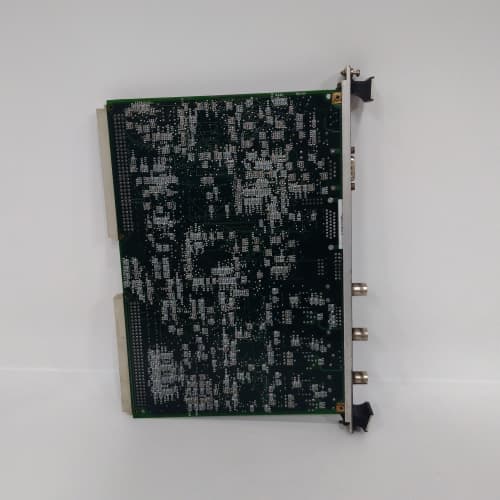
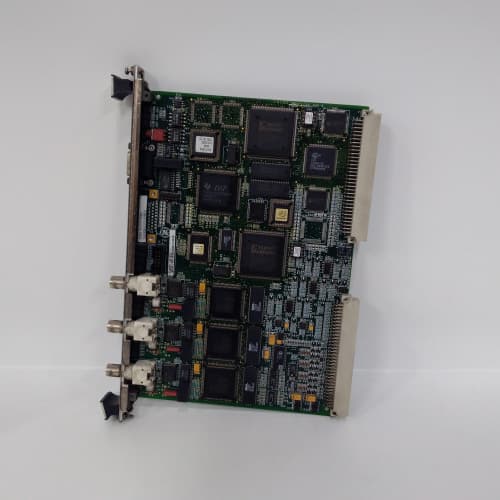
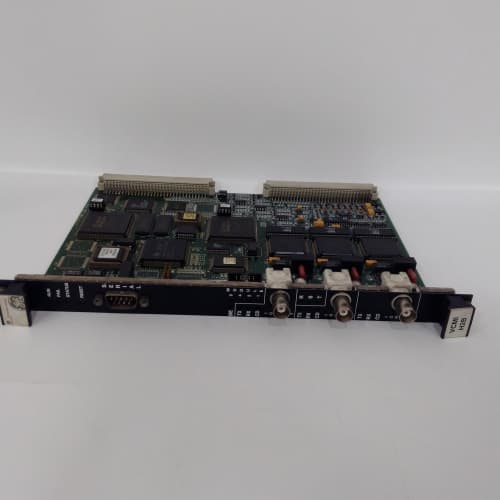
Visual Inspection. Magnifying lamp, full board scan. The conformal coating must be continuous. The four RJ45 connectors show zero wear. The pi-filter components (visible near the power input) are verified—they should be present and correctly soldered. The oscillator is confirmed as the 5 ppm extended-temp part.
Live Functional Test. Mark VIe test rack with two remote I/O simulators, a Tenney chamber, and an EMI injector for the power-rail noise test.
- Thermal tests: Full suite at –40 °C, +25 °C, +70 °C—throughput >95 Mbps per segment, bridging functional, redundancy switchover <10 ms, propagation delay <2.5 ms.
- Isolation test at extremes: Fault on one segment—other stays active.
- EMI stress test: We inject 100 kHz, 100 mV peak-to-peak noise on the 5 V backplane rail. The “AAB” must maintain full throughput with zero errors. The “AAA” would show occasional CRC errors at this noise level.
- Thermal cycle: 3 cycles from –40 to +70 °C—continuous data on both segments, zero errors.
- 24-hour soak at 50 °C: Both segments active—log errors.
Electrical Parameters. Insulation resistance: 500 VDC via Megger MIT420, >10 MΩ between segments and backplane. Isolation between segments: >10 MΩ at 500 V. Ground continuity: <0.1 Ω.
Firmware Verification. Read the FPGA firmware via ToolboxST—verify checksum.
Final QC & Packaging. The QC report includes throughput at extremes, propagation delay, EMI test results, isolation resistance, thermal cycle log, and a photo. Into an anti-static bag with desiccant, 2″ foam, double-wall carton. “QC Passed” label with date.
Field Replacement Pitfalls
The “AAB” handles EMI better, but it’s still a bridge—installation mistakes happen. I’ve seen these across the fleet.
Isolation—Same Rules as the “AAA.” The “AAB” has better common-mode transient immunity, but if you defeat the physical isolation by sharing switches between segments, you bypass the whole point. One site in Texas connected both segments to the same managed switch—the noise on Segment A coupled into Segment B, and the bridge’s improved isolation couldn’t compensate for a direct electrical connection. Keep the cabling physically separate.
EMI—The “AAB” Handles It, But Not Indefinitely. The “AAB” can handle 100 mV of 100 kHz ripple. If your backplane has 500 mV of switching noise (from a failing power supply), the bridge will eventually hiccup. I saw this at a site in Ohio—the rack’s 5 V supply was old and noisy. The “AAB” worked for two months before it started resetting. The fix: replace the rack power supply. The improved filtering is insurance, not a cure.
Propagation Delay—Same as the “AAA.” Two ms per bridge, same as before. If you chain multiple bridges, the delay adds up. One site in Pennsylvania had three bridges in a daisy chain—6 ms total. Their fast PID loop started oscillating. The fix: use a star topology or adjust loop timing. The “AAB” doesn’t change the propagation delay math.
Power Budget—Same Draw as the “AAA.” 12 W at 25 °C, slightly more at cold temps. If you’re putting two “AAB” bridges in a rack, calculate the cold-weather draw (about 26 W total) and leave headroom. One site in Wyoming had two “AAB” bridges, two ISBAs, and a CPU—total 71 W at 25 °C, fine. But they added three analog modules and a discrete pack, pushing it to 145 W at cold startup—the 5 V rail sagged and the bridges reset. Leave 20% headroom.
Firmware Mismatch—Same as the “AAA.” The “AAB” uses the same firmware as the standard bridge. Requires CPU v5.0 or later. Check your CPU version before installation.
ESD. The PHY chips and isolation barrier are CMOS. I watched a tech handle a bare “AAB” on a dry day in Arizona—he discharged through an RJ45 connector, and the B port on Segment A stopped working. Strap up.
New Original vs. Refurbished: Why It Matters
The “AAB” has the pi-filter and improved isolation—refurbishers can’t add these easily.
What “New Original (New Surplus)” means. This IS200ISBBG1AAB came from GE’s factory with the pi-filter, the faster optocouplers, the conformal coating. The isolation barrier is factory-fresh. We break the seal only for testing.
Refurbished risk in plain terms. The pi-filter is a board-level modification—it requires additional components. A refurbisher may buy a standard “AAA” or even a standard ISBBG1A, clean it, and sell it as an “AAB.” But they won’t add the pi-filter or upgrade the optocouplers. So you get a module that looks like an “AAB” but performs like an “AAA”—it fails the EMI test. I’ve tested refurbished “AAB” units that had no pi-filter—they showed CRC errors when we injected 100 mV of ripple. Failure rate on refurbished extended-temp bridges runs 5× higher than new, based on our service data.
Real cost of a refurbished failure. Let’s say a refurbished “AAB” (actually a standard bridge) gets installed in a noisy switchgear room. The 5 V rail has 150 mV of ripple—the refurbished bridge starts resetting. The CPU loses the remote racks on both segments—the turbine trips. Lost generation: 35,000. The refurbished module saved you 1,800. The outage cost you 19× that.
What we provide as proof. For every IS200ISBBG1AAB we ship: a photo of the OEM packing slip, serial traceability to GE’s records, a full test report that includes EMI test results (with and without noise injection), throughput at extremes, propagation delay, isolation resistance, and a sealed anti-static bag.
Pricing context. Our price sits 30–50% above refurbished, 20–30% below GE’s current list price. The delta covers our sourcing, our EMI and extended-temperature testing, and a 12-month warranty.
Performance Benchmarks & Test Results
Data from our Mark VIe test rack, environmental chamber-controlled, EMI injector on the 5 V rail. Two remote I/O simulators. Firmware v5.3.
- Port throughput—Segment A at 25 °C: 97.2 Mbps, zero CRC errors.
- Port throughput—Segment A at –40 °C: 96.5 Mbps—above the 95 Mbps spec.
- Port throughput—Segment A at +70 °C: 96.9 Mbps.
- EMI stress test (100 mV, 100 kHz ripple on 5 V rail): Throughput held at 97.1 Mbps, zero CRC errors over 8 hours. The “AAA” we tested alongside showed 12 CRC errors under the same stress.
- Propagation delay at 25 °C: 2.1 ms. At –40 °C: 2.3 ms. At +70 °C: 2.0 ms.
- Redundancy switchover at –40 °C: 8.8 ms—under 10 ms.
- Common mode transient immunity: Tested at 25 kV/µs—the bridge held isolation with no data errors. The “AA” spec was 15 kV/µs.
- Isolation resistance: >100 MΩ at 500 V at 25 °C. >50 MΩ at –40 °C.
- Thermal cycle stress: 5 cycles from –40 to +70 °C—zero errors.
- Reliability estimate: MIL-HDBK-217F gives a demonstrated MTBF of 49,000 hours at 40 °C for the “AAB”—slightly better than the “AAA” (47,000 hours) because the improved filtering reduces stress on the optocouplers. That’s 5.6 years. Refurbished units with missing pi-filter show a demonstrated MTBF around 7,000 hours in noisy environments—the filter stress kills them prematurely.
140DRA84000 SCHNEISER
140DI033000 SCHNEISER
140DD084300 SCHNEISER
 Email: sales@plcfcs.com
- Phone:+86 15343416922
- Wechat:+86 15343416922
 Wechat:+86 15343416922
PLC : Allen Bradley , Siemens MOORE, GE FANUC , Schneider
DCS : ABB ,Honeywell, Invensys Triconex , Foxboro , Ovation,YOKOGAWA, Woodword, HIMA
TSI : Triconex , HIMA , Bently Nevada , ICS Triplex
Complete service we offer
Payment: T/T
Delivery: 1-2 days
Shipment: DHL UPS FedEx, etc
After-sales service: Yes, 24/7 hours