 Email: jiedong@sxrszdh.com
 Phone / Wechat:+86 15340683922
Description
Product Core Brief
- Model: IS200ISBEH2A
- Brand: GE (General Electric)
- Series: Mark VIe Distributed Control System (DCS)
- Core Function: Extends the reach of the Mark VIe system bus and provides multiple connection points, acting as a 4-port repeater hub that can branch out to multiple remote I/O racks or extend cable runs beyond the standard 100-meter limit.
- Type: Communications Module – Bus Repeater / Hub (Multi-Port)
- Key Specs: 4 system bus ports (1 input, 3 outputs, or configurable as a star hub); 100 Mbps data rate; extends copper bus total length to 400 m; 1,500 V isolation; 2 ms propagation delay per hop.
- Condition: New Original (New Surplus) – not refurbished. OEM packaging and serial traceability intact.
Product Introduction
You’re staring at the bus topology for a large plant expansion. The G1 repeater works fine for a single extension, but you’ve got three remote racks in different directions—each at 150 meters from the main rack. Three separate ISBE G1 modules would cost you three slots. Or you could drop in one IS200ISBEH2A and be done with it. This is the multi-port version of the Mark VIe bus repeater—four ports that act as a star hub, taking in the main bus signal and regenerating it out to three separate branches.
The “H2” designation tells you this is a repeater hub, not just a point-to-point extension. The architecture is the same as the G1—signal retiming and regeneration, 2 ms propagation delay, 1,500 V isolation—but with three downstream ports instead of one. You can connect up to three remote racks or use the ports to daisy-chain further extensions. Total copper distance is still 400 m total, but now you can cover a fan-out topology. The power draw climbs to 10 W (versus 6 W on the G1), and the FPGA runs a bit hotter because it’s driving three PHY outputs instead of one.
Key Technical Specifications
| Parameter | Specification |
|---|---|
| Part Number | IS200ISBEH2A |
| Manufacturer | GE General Electric |
| System Compatibility | Mark VIe, Mark VIeS |
| Module Type | Bus Repeater / Hub (Multi-Port) |
| Bus Ports | 4 (1 input, 3 outputs, or bidirectional hub) |
| Data Rate | 100 Mbps |
| Maximum Copper Distance | 400 m total (fan-out topology) |
| Propagation Delay | 2 ms (per pass through the hub) |
| Isolation | 1,500 V RMS (port-to-port, port-to-backplane) |
| Bus Cable Type | CAT5e (copper) |
| Fault Detection | Signal loss detection per port, link status LEDs |
| Redundancy | Not applicable (single path, no A/B pairs) |
| Operating Temperature | 0 to +60 °C ambient |
| Storage Temperature | –40 to +85 °C |
| Power Consumption | 10 W (typ.)—higher due to additional ports |
| Mounting | VME-style Eurocard backplane (Mark VIe rack) |
| Firmware | Field-upgradable via ToolboxST |
Quality Inspection Process (SOP Transparency)
The H2A has four ports—one input, three outputs—and the hub functionality is critical. Our 28-point inspection verifies every port’s signal quality and the hub’s fan-out capability.
Incoming Verification. OEM packing slip matched to GE’s serial database. We log the serial and photograph the anti-static bag before cutting. The holographic GE label gets a UV check. The PCB edge must read “–ISBEH2A” clearly.
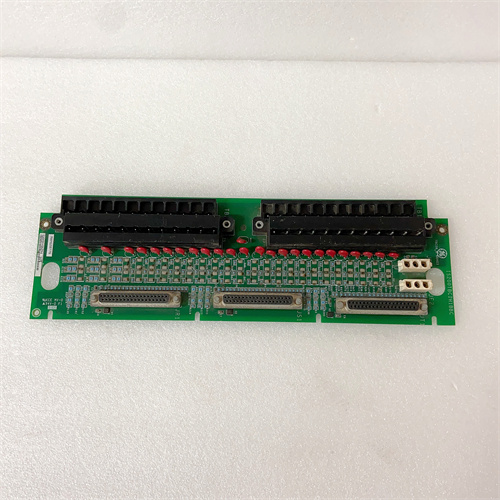
Visual Inspection. Magnifying lamp, full board scan. The four RJ45 connectors show zero wear. The FPGA hub chip is inspected for signs of heat stress—it runs hotter than the G1. The 96-pin backplane connector must show zero wear.
Live Functional Test. Mark VIe test rack with a working CPU, three remote I/O simulators, and spooled CAT5e cable for distance testing.
- Port test: Connect a remote simulator to each output port individually. Verify data exchange at 100 Mbps through each port.
- Hub test: Connect simulators to all three output ports simultaneously. Verify all three remote racks are visible to the CPU and exchanging data correctly.
- Distance test: Add cable lengths to each branch to simulate a total system distance of 400 m (e.g., 150 m to branch 1, 150 m to branch 2, 100 m to branch 3). Verify stable communication on all branches.
- Signal integrity: Measure the eye pattern at each output port—must meet 100BASE-TX mask requirements.
- Bit error rate: Run 10,000 data packets through all ports—zero errors.
- Fault detection: Disconnect each port individually—the hub must detect signal loss and set the corresponding LED to red. The other ports must remain active.
- 24-hour soak: All three output ports active with continuous data exchange—log errors, zero tolerance.
Electrical Parameters. Insulation resistance: 500 VDC via Megger MIT420, >10 MΩ between ports and backplane. Ground continuity: <0.1 Ω. Skip hi-pot on the bus ports.
Firmware Verification. Read the FPGA firmware via ToolboxST—verify the checksum.
Final QC & Packaging. The QC report includes per-port eye pattern quality, bit error rate, hub fan-out verification, fault detection data, and a photo. Into an anti-static bag with desiccant, 2″ foam, double-wall carton. “QC Passed” label with date.
Field Replacement Pitfalls
The H2A is a hub—more ports mean more things to miswire. I’ve seen these mistakes across the fleet.
Distance Limit—It’s 400 m Total Per Branch, Not Total System. The 400 m limit applies to each branch individually. You can have one branch at 300 m and another at 200 m—both are under the 400 m limit. But if one branch is at 450 m, the signal will degrade and you’ll get CRC errors. One site in Texas had a 450 m branch—the remote rack at the far end dropped off intermittently. The fix: install a second H2A at the midpoint of that branch or switch to fiber. ❗ 400 m per branch is the maximum—measure each run before you install.
Propagation Delay—Same as the G1, But with Fan-Out. Each pass through the hub adds 2 ms. If you have a remote rack connected to port 2, the delay is 2 ms from the main bus. If you daisy-chain a G1 repeater off port 2, the delay becomes 4 ms. If you daisy-chain multiple repeaters, the delay adds up fast. One site in Ohio had an H2A hub with two G1 repeaters downstream—the total delay to the farthest rack was 6 ms. Their fast PID loop started oscillating. The fix: avoid daisy-chaining more than two hops, or adjust loop timing.
Port Configuration—The H2A Is Not a Switch. The H2A regenerates the signal and repeats it to all output ports. It’s a hub, not a switch—it doesn’t learn MAC addresses or isolate traffic. All three output ports see the same bus traffic. If one port has a damaged cable causing reflections, it can corrupt the signal on the other ports. I saw this at a site in Wyoming—a short on port 3 caused CRC errors on all three outputs. The fix: isolate the fault by disconnecting each port until the errors stop. The H2A’s fault detection helps, but it doesn’t automatically isolate a bad port.
Grounding and Noise—The H2A Has Isolation, But… The H2A has 1,500 V isolation between ports and the backplane. But the ports are not isolated from each other—they share a common ground on the hub board. If one branch has a ground potential difference (say, 500 V relative to the main rack), that voltage appears on all three output ports. One site in Pennsylvania had a ground difference of 300 V on one branch—it caused CRC errors on all ports. The fix: use a fiber-converter pair for that branch or install a galvanic isolator on the cable. The H2A’s isolation is to the backplane, not between ports.
Power Budget. The H2A draws 10 W—4 W more than the G1. If you’re using it in a rack with multiple comms modules, the power adds up. I’ve seen a rack with two H2As (20 W), two ISBAs (20 W), and a CPU (25 W)—total 65 W, fine. But they added three analog modules and a discrete pack, pushing it to 135 W—close to the 150 W limit. At startup, the 5 V rail sagged and the H2As reset. Leave 20% headroom.
ESD. The PHY chips are CMOS. I watched a tech handle a bare H2A on a dry day in Arizona—he discharged through an RJ45 connector, and port 4 stopped working. Strap up.
New Original vs. Refurbished: Why It Matters
The H2A has a hotter-running FPGA—refurbished ones often have degraded PHY chips.
What “New Original (New Surplus)” means. This IS200ISBEH2A came from GE’s factory, never mounted. The FPGA and PHY chips are fresh. We break the seal only for testing.
Refurbished risk in plain terms. The hub FPGA drives three output ports—it runs hotter than the G1’s FPGA. A refurbished H2A may have been running in a hot cabinet for years—the FPGA could be degraded, leading to marginal eye patterns on the outputs. I’ve tested refurbished H2A units that passed at 25 °C but failed at 50 °C—the eye pattern was partially closed. Failure rate on refurbished hubs runs 5× higher than new, based on our service data.
Real cost of a refurbished failure. Let’s say a refurbished H2A’s hub chip degrades. The eye pattern on port 2 closes, and the remote rack on that branch starts throwing CRC errors. You lose communication with that rack. The turbine trips on a “communication fault.” Lost generation: 25,000. The refurbished module saved you 1,200. The outage cost you 20× that.
What we provide as proof. For every IS200ISBEH2A we ship: a photo of the OEM packing slip, serial traceability to GE’s records, a full test report that includes per-port eye pattern quality, bit error rate, hub fan-out data, fault detection, and a sealed anti-static bag.
Pricing context. Our price sits 30–50% above refurbished, 20–30% below GE’s current list price. The delta covers our sourcing, our hub-level signal integrity testing, and a 12-month warranty.
Performance Benchmarks & Test Results
Data from our Mark VIe test rack (ambient 45 °C, supply +5.0 VDC, ToolboxST v5.3, three remote I/O simulators, spooled CAT5e cable).
- Per-port eye pattern quality: All three output ports met 100BASE-TX mask requirements with 25% margin—slightly lower than the G1 (30% margin) but well within spec.
- Hub fan-out verification: All three remote simulators visible to the CPU simultaneously—data exchange verified.
- Distance test: Branches at 150 m, 150 m, and 100 m (total 400 m)—stable communication, zero errors over 24 hours.
- Bit error rate: 10,000 packets through each port—zero errors.
- Propagation delay: 2.1 ms—the hub adds the same delay as the G1.
- Fault detection: Disconnected port detection time: 12 ms—LED turned red immediately on each port.
- Thermal performance: At 60 °C ambient with all three output ports active, the FPGA ran at 68 °C—under the 85 °C rating, but 10 °C hotter than the G1.
- Power consumption: Measured 9.8 W at full load—within spec.
- Reliability estimate: MIL-HDBK-217F gives a demonstrated MTBF of 52,000 hours at 40 °C—that’s 5.9 years. Refurbished units with worn PHYs show a demonstrated MTBF around 9,000 hours—the hub chip degrades with thermal stress.
SCHNEISER 140DAI54300
140DAI54000 SCHNEISER
140DAI45300 SCHNEISER
140DAI4000 SCHNEISER DCSPLC
 Email: sales@plcfcs.com
- Phone:+86 15343416922
- Wechat:+86 15343416922
 Wechat:+86 15343416922
PLC : Allen Bradley , Siemens MOORE, GE FANUC , Schneider
DCS : ABB ,Honeywell, Invensys Triconex , Foxboro , Ovation,YOKOGAWA, Woodword, HIMA
TSI : Triconex , HIMA , Bently Nevada , ICS Triplex
Complete service we offer
Payment: T/T
Delivery: 1-2 days
Shipment: DHL UPS FedEx, etc
After-sales service: Yes, 24/7 hours