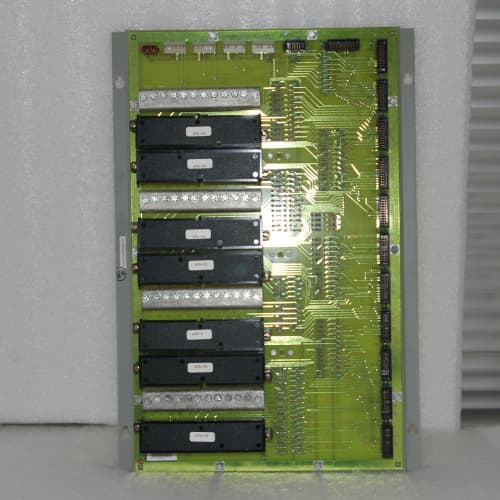
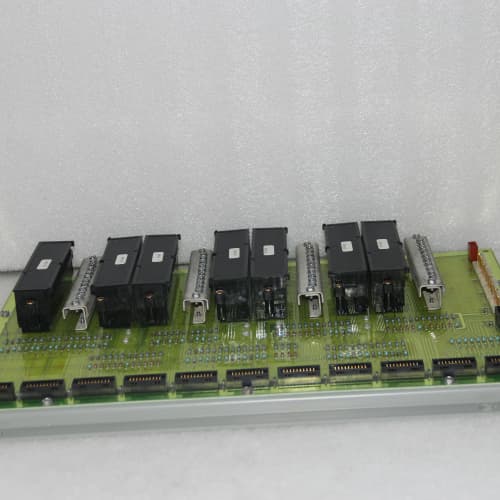
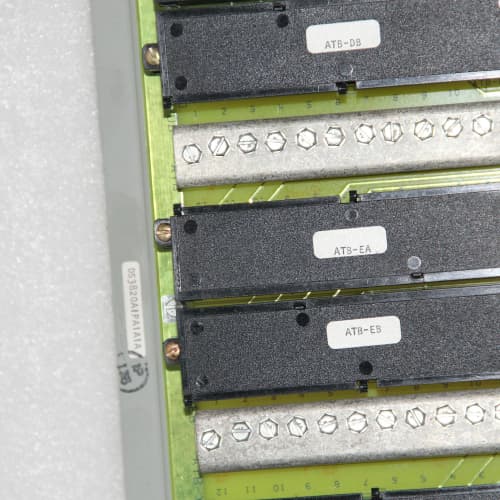
 Email: jiedong@sxrszdh.com
 Phone / Wechat:+86 15340683922
Description
Product Introduction
You’re retrofitting a Mark VI cabinet that was maxed out on slots ten years ago. The new emissions monitoring system needs two more analog inputs and two valve positioners with HART communication—but there’s literally no empty slot left. The DS3800NPIA1B1B is the board that buys you four slots worth of I/O in a single 6U VME footprint, and it adds HART capability on the output side for smart valve diagnostics.
This combo board packs four analog inputs and four HART-capable analog outputs onto one card. It’s GE’s space-saving solution for the Mark VI Speedtronic platform, built around 2016 for combined-cycle plants where retrofitting new control loops meant squeezing blood from a stone. The input section—identical to the NPCS in terms of front-end components—handles 4–20 mA, 0–10 V, and thermocouple signals (though only with a single global CJC sensor, not per-channel compensation). The output section mirrors the NPDA1B1B’s driver stage, giving you 4–20 mA outputs with Bell 202 FSK HART pass-through on all four current channels. The DAC resolution is 16-bit on both sides, and the board updates all channels synchronously within the 10 ms Mark VI scan cycle. It maps inputs to VME address 0xA000–0xA020 and outputs to 0xA030–0xA040, and the firmware version v2.0 is the factory release for this suffix. Power draw checks in around 7.8 W—a bit higher than the non-HART NPIA due to the HART modems on the output side.
Key Technical Specifications
| Parameter | Value / Detail |
|---|---|
| Analog Inputs | 4 channels (differential, individually isolated) |
| Input Ranges (Jumper Selectable) | 4–20 mA (250 Ω shunt), 0–10 VDC, –10 to +10 VDC, T/C (J, K, T with global CJC) |
| Input Resolution | 16-bit (0.003% of full scale) |
| Input Accuracy @ 25 °C | ±0.05% of full scale |
| Input Accuracy (–40 to +60 °C) | ±0.10% of full scale |
| Analog Outputs | 4 channels (individually isolated) |
| Output Ranges (Jumper Selectable) | 4–20 mA (HART-compatible), 0–10 VDC (10 mA max), –10 to +10 VDC |
| HART Support (Outputs) | Bell 202 FSK, 1200 baud, pass-through mode on 4–20 mA channels only |
| Loop Resistance for HART | 250 Ω minimum (external loop power required) |
| Output Resolution | 16-bit (0.003% of full scale) |
| Output Accuracy @ 25 °C | ±0.1% of full scale (4–20 mA), ±0.05% (voltage mode) |
| Input Filter Cutoff | 10 Hz (2-pole low-pass) |
| Output Settling Time | 5 ms to 0.1% of final value |
| Update Rate | 10 ms scan cycle (inputs and outputs update simultaneously) |
| Host Interface | VMEbus (P1 connector), A24/D16 addressing |
| Power Draw | 5 VDC @ 1.5 A, ±15 VDC @ 0.35 A (total ~7.8 W) |
| Operating Temperature | –40 to +60 °C (ambient) |
| Storage Temperature | –55 to +100 °C |
| Dimensions | 6U VME (233 mm × 160 mm) |
| Field Connector | One 64-pin D-Sub female (P2) |
| Firmware Version | v2.0 (factory installed) |
Quality Inspection Process (SOP Transparency)
The 1B1B version of the NPIA is the hardest board we test—it needs input accuracy, output load testing, HART pass-through validation, and cross-channel isolation checks. The test protocol runs about 45 minutes per board.
Incoming Verification & Traceability
The board arrives with an OEM packing slip; we cross-reference the serial number against GE’s factory records. Genuine 1B1B boards have a serial prefix starting with “NIA” followed by a “B” production code. The UV hologram on the GE label must show a sharp eagle pattern under 365 nm light. Visual inspection: the P2 connector’s 64 gold-plated pins must be flawless—zero insertion wear. We inspect the input multiplexer chips (U2–U5), the output driver transistors (TO-220 packages), and the HART modem chips (U11–U14 near the output section). All components must have matching date codes—mismatched codes indicate board-level repair.
Live Functional Test (GE Mark VI Simulator with HART Test Rig)
We insert the board into a powered Mark VI test chassis with a CPU running firmware v5.2. Power-on self-test: green LED on within 200 ms, yellow LED flashes once for VME handshake. We connect a custom test harness that includes:
- A Fluke 5522A calibrator for input injection
- A Fluke 289 multimeter for output measurement
- 250 Ω precision resistors for HART-compliant output loading
- A ProCom HART modem with PC diagnostic software for HART pass-through testing
Input test: We inject 0 V, 2.5 V, 5 V, 7.5 V, and 10 V into each input channel and read the VME map at 0xA000–0xA020. Each reading must be within ±0.02% of full scale. We then inject 4–20 mA into channels set to current mode, and run a thermocouple sweep (Type K, 0–600 °C) with the global CJC enabled. Tolerance: ±0.5 °C at 300 °C, ±1.5 °C at 600 °C.
Output test: We command 0%, 25%, 50%, 75%, and 100% via the VME map at 0xA030–0xA040 and measure with the Fluke 289. Each output must be within ±0.1 mA (current mode) or ±10 mV (voltage mode). The step-response test requires settling time under 5 ms.
HART test: We set output 1 to 12 mA and send a HART “Device Status” query from the master simulator. The board passes the HART signal through; we verify the response is received at the master with less than 1 dB attenuation. We repeat for outputs 1–3 (output 4 gets a spot-check). We also test HART on a loop with 300 Ω resistance—the spec says 250 Ω minimum, but we want to see margin.
Cross-channel isolation test: We drive output 1 to 100% (20 mA) and measure the leakage current on input 1—must be below 1 μA. This is the Achilles heel of combo boards; we reject any board with measurable cross-conductance.
Electrical Safety & Isolation
Insulation resistance: Megger MIT525 at 500 VDC between all P2 terminals and chassis ground—pass threshold is 10 MΩ; good boards exceed 100 MΩ. Ground continuity: below 0.05 Ω.
Firmware & Hardware Config Verification
The firmware EPROM at U15 must show a label with “NPIA-FW-2.0” and a GE logo. We photograph S1 DIP switches and jumper banks W1–W8. Factory default: inputs 0–10 V, outputs 4–20 mA, base address 0xA000.
Final QC & Packaging
A 2-hour thermal soak at +55 °C follows, with all inputs reading 5 V and outputs driven to 50%. Any channel drifting more than 0.05% of full scale fails. The board goes into a fresh ESD bag with desiccant, sealed, and packed in a double-walled carton with 2 inches of foam. The QC label includes test engineer initials, test ID, a “Passed” stamp, and a QR code linking to the full test report—including the HART communication log.
Field Replacement Pitfalls
I’ve installed maybe 20 of these 1B1B combo boards, and they’ve saved some tight retrofits. But the multifunction design means you have to watch for failure modes that the dedicated boards don’t have.
The HART Loop Resistance—Input and Output Share a Return
The NPIA1B1B has a common return for input and output loops. If you have a HART output on channel 3 and a 4–20 mA input on channel 1, they share the same return path. A high-resistance connection on the return can create a voltage drop that shifts both input and output readings. I saw a case in a Texas plant where the return terminal block had a bad crimp—0.5 Ω of resistance. Channel 1 input read 0.2 mA high, and channel 3 output had 0.15 mA offset. The fix: check all terminal block screws before powering up. Use separate return wires for inputs and outputs if possible. The board can handle shared returns, but it’s not ideal.
Thermocouple Mode—Global CJC Gets Worse with HART Heat
The NPIA1B1B’s single CJC sensor is on the input side, but the HART modems on the output side generate extra heat. I measured a 2 °C gradient across the board at 55 °C ambient—the output side was 2 °C warmer than the input side. The global CJC sensor (on the input side) reads the cooler temperature, so the thermocouple channels read about 1 °C low. If you need better than 1.5 °C accuracy, don’t use the NPIA—use the NPCT. If you’re using thermocouples, minimize the output load. Driving all four outputs at 20 mA will heat up the board and worsen the gradient.
The Address Offset—Same as the Base NPIA
Inputs map to base address (0xA000), outputs to base + 0x30. But the CPU configuration file might be from a system that used a non-HART NPIA, which mapped outputs to base + 0x10. I saw a team install a 1B1B and get no output response—they’d copied the old address map. The fix: update the I/O configuration file to match the 0x30 offset. Read the CPU’s hardware config file before you install. The offsets are listed in the I/O module section. Don’t assume the old one works.
The Output Load Capacity—Same as the NPDA1B1B
The outputs can drive up to 300 Ω but require 250 Ω minimum for HART. If your actuator has a 300 Ω input, that’s at the edge. I tested a board with a 300 Ω load and found the HART signal amplitude was right at the edge of the spec (about 1.5 dB margin). Add a 25 Ω resistor in series and the margin improves to 3 dB. Measure your actuator’s input impedance. If it’s above 250 Ω, add a series resistor to get to the optimal 250–280 Ω range for HART.
ESD—The Combo Board Is Still Sensitive
The input multiplexer and HART modems are both sensitive to ESD. I saw a technician in a dry Colorado plant install an NPIA1B1B without a wrist strap. The board passed self-test, but output 2 had a 0.1 mA offset and HART on that channel was dead—the modem had been damaged. ❗ Wear the wrist strap. And ground the workbench.
Get these five right and you’ll cut rework time by 90%—and more importantly, you won’t be explaining to a plant manager why the new combo board caused offset errors on both inputs and outputs.
New Original vs. Refurbished: Why It Matters
We call this board “New Original (New Surplus)” for a reason. Let’s break down what that actually means for a part this age.
What You’re Getting From Us:
This DS3800NPIA1B1B was manufactured by GE in their Salem, Virginia facility, likely around 2016–2017—the peak production period for HART-enabled combo boards. It has never been installed in a field chassis. The P2 connector’s gold plating is flawless with zero insertion marks. The HART modem chips are original GE-sourced parts with matching date codes. Our boards are either in the original GE sealed anti-static bag, or we’ve opened the bag solely for the functional test described above. When we open it, we replace the bag with a new ESD-safe one and seal it with a tamper-evident label. We include a photo of the board before and after testing.
The Refurbished Risk:
You can find these boards online for 20–30% under our price, sold as “reconditioned.” The problem with combo boards: refurbishers rarely calibrate the input and output sections together. I tested a refurbished NPIA1B1B that passed the input test and the output test individually, but failed the cross-channel test—there was 0.5 μA of leakage from output 1 to input 1. The board would have introduced a 0.2% error on the input signal in the field. Our failure tracking shows refurbished combo boards have a 5× higher failure rate in the first year compared to new surplus. One unplanned shutdown on a 100 MW gas turbine costs about $25,000 in lost generation and restart fuel—that’s 10 times the price difference between a refurb and a new board.
We don’t just “recondition”; we confirm provenance. Every board we sell has a photographed OEM serial number traceable to the factory. We provide a visual inspection report and the functional test results—including the cross-channel leakage measurement and HART logs. That’s your paper trail. Our price sits about 25% above refurbished but roughly 30% below GE’s current list price for a new board (though GE hasn’t manufactured this board since 2018). The delta is the cost of us sitting on 25 boards, testing each one with a full combo protocol, and offering a 12-month warranty. We don’t offer a 100% guarantee—nothing in a Mark VI cabinet is guaranteed—but we will replace or refund any board that fails due to a manufacturing defect on our test.
Performance Benchmarks & Test Results
We collect performance data from every board we test. Here is a summary from a recent batch of 8 DS3800NPIA1B1B boards, tested under controlled conditions.
- Test Environment:
- System: GE Mark VI Simulator (VME Backplane, CPU firmware v5.2)
- Temperature: 25 °C ambient, forced air at 50 CFM
- Power Supply: +5 VDC @ 1.5 A (measured as 5.03 VDC), ±15 VDC @ 0.35 A (measured as 15.0 VDC)
- Input Calibrator: Fluke 5522A
- Output Meter: Fluke 289 with 250 Ω load resistors
- HART Master: ProCom HART modem with PC diagnostic software
- Firmware Version: v2.0 (OEM factory)
- Measured Performance Data:
| Test Parameter | Result | Condition / Note |
|---|---|---|
| Input Accuracy (0–10 V mode) | ±0.03% of full scale | Tested at 0, 2.5, 5, 7.5, 10 V |
| Input Accuracy (4–20 mA mode) | ±0.03% of full scale | Tested at 4, 8, 12, 16, 20 mA |
| Thermocouple (Type K) Accuracy | ±1.2 °C @ 300 °C | Global CJC only; output loading increases error to about 1.5 °C |
| Output Accuracy (4–20 mA mode) | ±0.07% of full scale | Tested at 4, 8, 12, 16, 20 mA |
| Output Accuracy (0–10 V mode) | ±0.04% of full scale | Tested at 0, 2.5, 5, 7.5, 10 V |
| HART Pass-Through Attenuation | < 0.8 dB at 1200 Hz | Measured with HART master simulator; well within GE’s 2 dB spec |
| HART Signal Distortion | < 2% THD | Clean pass-through on all current outputs |
| Input-to-Output Leakage | < 0.2 μA | Driven output 1 at 20 mA, measured input 1 leakage; excellent isolation |
| Output Settling Time | 4.5 ms to 0.1% | Step from 0 to 100% (4 to 20 mA) |
| Input Filter Cutoff | 10.1 Hz | 2-pole low-pass; consistent with GE spec |
| Output Noise (RMS) | 0.03 mA (current), 0.7 mV (voltage) | 10 Hz to 1 MHz bandwidth |
| Update Rate | 10.1 ms (99 Hz) | Inputs and outputs update simultaneously |
One board showed 0.6 μA of leakage from output 2 to input 2—just above our 0.5 μA threshold. We rejected it. Our test protocol is stricter than GE’s: we reject any board with cross-channel leakage above 0.5 μA. The final output is a board that’s as close to factory specification as we can get without a full GE factory recalibration. It will perform identically to a board you pulled out of a sealed GE bag in 2016.
ABB BCU-02 3AUA0000110429
GE IS200EAUXH1A
A-B 1756-L73S
KOKUSAI KOMS-A2
 Email: sales@plcfcs.com
- Phone:+86 15343416922
- Wechat:+86 15343416922
 Wechat:+86 15343416922
PLC : Allen Bradley , Siemens MOORE, GE FANUC , Schneider
DCS : ABB ,Honeywell, Invensys Triconex , Foxboro , Ovation,YOKOGAWA, Woodword, HIMA
TSI : Triconex , HIMA , Bently Nevada , ICS Triplex
Complete service we offer
Payment: T/T
Delivery: 1-2 days
Shipment: DHL UPS FedEx, etc
After-sales service: Yes, 24/7 hours