 Email: jiedong@sxrszdh.com
 Phone / Wechat:+86 15340683922
Description
Product Introduction
You’re in the middle of a hot gas turbine startup, and the fuel split between nozzles 1 and 2 won’t balance. The valve position feedback looks good, but the actual flow isn’t tracking. The problem? The old analog output board doesn’t support the HART communication that your new smart valve positioners need. The DS3800NPDA1B1B is the revision that fixes that—it adds HART pass-through on the current outputs, so you can read valve diagnostics and position feedback directly through the 4–20 mA loop without extra wiring.
This board is the actuator driver for GE Mark VI Speedtronic systems—it translates the CPU’s digital commands into 4–20 mA or 0–10 V signals that move fuel valves, inlet guide vanes, and other final control elements. The 1B1B suffix is the key difference: it includes a built-in HART interface on all eight current outputs, allowing the CPU to communicate with smart valve positioners via the HART protocol (Bell 202 FSK modulation, 1200 baud). It still offers the same 16-bit resolution and 0.1% accuracy as the base NPDA, but the output current sources are now designed to handle the HART impedance requirements (minimum 250 Ω loop resistance). The board uses a dedicated DAC per channel for simultaneous updates, and the VME address mapping at 0x8000 is standard for this suffix. It draws about 8 W from the 5 V and ±15 V rails—slightly higher than the non-HART version due to the additional HART circuitry.
Key Technical Specifications
| Parameter | Value / Detail |
|---|---|
| Number of Outputs | 8 analog outputs (individually isolated per channel) |
| Output Range (Jumper Selectable) | 4–20 mA (HART-compatible), 0–10 VDC (10 mA max), –10 to +10 VDC |
| HART Support | Bell 202 FSK, 1200 baud, pass-through mode (no demodulation) |
| Loop Resistance for HART | 250 Ω minimum (external loop power required) |
| Resolution | 16-bit (0.003% of full scale) |
| Accuracy @ 25 °C | ±0.1% of full scale (4–20 mA), ±0.05% (voltage mode) |
| Accuracy (–40 to +60 °C) | ±0.2% of full scale max |
| Load Impedance (Current Mode) | 0 to 300 Ω (250 Ω minimum for HART) |
| Load Impedance (Voltage Mode) | 2 kΩ minimum |
| Output Settling Time | 5 ms to 0.1% of final value (resistive load) |
| Update Rate | All 8 channels update simultaneously, 10 ms scan cycle |
| Host Interface | VMEbus (P1 connector), A24/D16 addressing |
| Power Draw | 5 VDC @ 1.6 A, ±15 VDC @ 0.35 A (total ~8.0 W) |
| Operating Temperature | –40 to +60 °C (ambient) |
| Storage Temperature | –55 to +100 °C |
| Dimensions | 6U VME (233 mm × 160 mm) |
| Field Connector | One 64-pin D-Sub female (P2) |
| Firmware Version | v2.2 (factory installed) |
Quality Inspection Process (SOP Transparency)
The 1B1B suffix is harder to test because we need to verify the HART pass-through functionality—not just the analog output accuracy. We built a custom HART test rig for this board.
Incoming Verification & Traceability
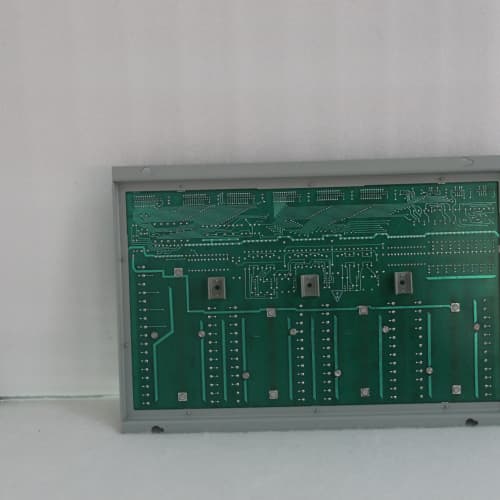
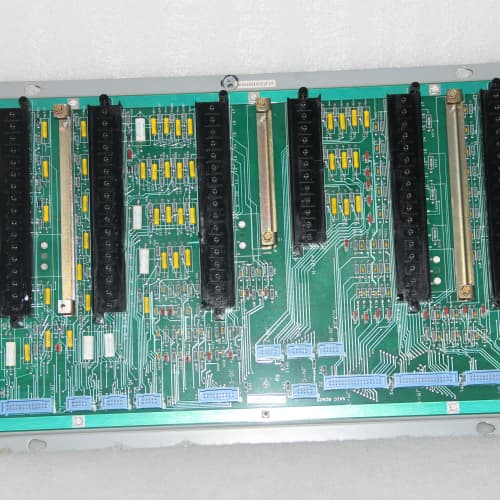
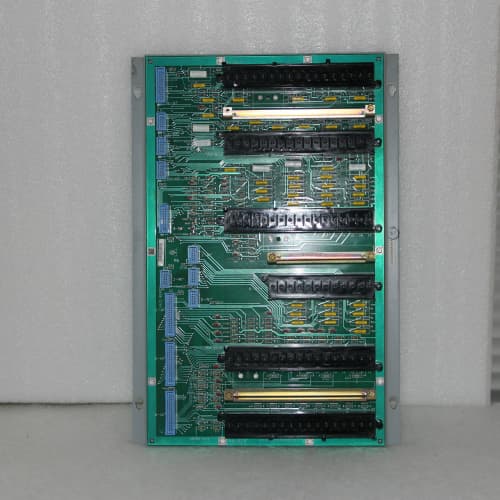
The board arrives with an OEM packing slip; we cross-reference the serial number against GE’s factory records. Genuine 1B1B boards have a serial prefix starting with “NPDA” followed by a “B” in the production code. The UV hologram on the GE label is checked under 365 nm light—the eagle pattern must be sharp. Visual inspection: the P2 connector’s gold plating must be flawless. We also inspect the HART modem chips (U11–U18 near the output section)—they should all have the same date code. Mismatched codes indicate a board-level repair. The output driver transistors (TO-220 packages) should show no discoloration.
Live Functional Test (GE Mark VI Simulator with HART Test Rig)
We insert the board into a powered Mark VI test chassis with a CPU running firmware v5.2. Power-on self-test: green LED on within 200 ms, yellow LED flashes once for VME handshake. We then connect the P2 connector to a custom test harness that includes:
- 250 Ω precision resistors for current mode (HART requires minimum 250 Ω)
- A HART master simulator (a ProCom HART modem connected to a laptop)
- A Fluke 289 multimeter for current measurement
- A Fluke 115 for voltage measurement
The test software writes commands to the VME memory map at 0x8000–0x8010: 0%, 25%, 50%, 75%, and 100% of full scale. We measure the output current and voltage with the Fluke meters—each output must be within ±0.1 mA for current mode and ±5 mV for voltage mode. Then the HART test: we write a 4 mA command (0%) to channel 1 and send a HART “Device Status” query from the master simulator. The board passes the HART signal through to the loop; we verify the response is received without attenuation. We repeat for channels 1–4 (the HART pass-through is available on all current outputs, but we spot-check four). The step-response test follows: command a step from 0% to 100% and measure settling time to 0.1%—must be under 5 ms.
Electrical Safety & Isolation
Insulation resistance: we apply 500 VDC between all P2 output terminals and chassis ground using a Megger MIT525—pass threshold is 10 MΩ; typical boards measure over 150 MΩ. Ground continuity from mounting holes to VME ground: below 0.05 Ω.
Firmware & Hardware Config Verification
The firmware EPROM at U12 must show a label with “NPDA-FW-2.2” and a GE logo. We photograph the S1 DIP switches for VME address and the jumper banks (W1–W8) for output type per channel. Factory default for this part number is all outputs set to 4–20 mA with base address 0x8000. We set jumpers to match customer request if specified.
Final QC & Packaging
A 2-hour burn-in at +55 °C with all eight outputs driven to 50% (12 mA, 5 V) follows the functional test. Any output drifting more than 0.05% of full scale fails. We then re-run the HART pass-through test at temperature to ensure the HART modem still functions. The board goes into a fresh ESD bag with a desiccant pack, is sealed, and packed in a double-walled carton with 2-inch foam padding. The QC label includes test engineer initials, a test ID, a “Passed” stamp, and a QR code linking to the test report. We can provide HART communication logs upon request.
Field Replacement Pitfalls
I’ve installed maybe 30 of these 1B1B boards since GE released them in 2016. The HART capability is a game-changer—but it comes with new failure modes.
The HART Loop Resistance—250 Ω Minimum, Not Optional
The 1B1B requires a minimum loop resistance of 250 Ω for the HART signal to work. If your field wiring and the valve positioner’s input impedance total less than 250 Ω, the HART communication will be intermittent—you’ll see “HART Comms Timeout” alarms. I saw a case in a Texas compressor station where the valve positioner had a 200 Ω input impedance and the wiring was only 50 Ω total. The HART signal was attenuated. The fix: add a 100 Ω resistor in series with the loop. Measure your total loop resistance before you enable HART. If it’s below 250 Ω, add a series resistor. GE spec sheet GEH-6685 has the formula.
The VME Address—1B1B Uses a Different Map
The 1B1B uses a slightly different VME address map than the 1A1B or the base NPDA. It expects the HART status bits at a different offset. If your CPU firmware is older than v5.2, the HART pass-through won’t work—you’ll see the analog output working but the HART diagnostics return no data. I watched a commissioning team spend a day chasing HART issues before they realized the CPU firmware needed an update. Check your CPU firmware version before you install. If it’s below v5.2, update the CPU or use the 1A1B (which doesn’t have HART).
The Output Jumper—HART Mode Requires Current Mode
HART only works on the 4–20 mA current outputs. If you set the jumper for voltage mode (0–10 V or –10 to +10 V), the HART pass-through is disabled—it’s physically disconnected. I saw an engineer set channel 3 to voltage mode because he needed a 0–10 V signal for a pressure transducer, and then wondered why the HART comms on channel 3 didn’t work. HART is only available on channels set to 4–20 mA. If you need HART on a channel, set the jumper to current mode. If you need voltage mode, you lose HART on that channel.
Loop Power Polarity—Get It Right
The NPDA is a current sink, not a source. The 24 V loop power must be connected with the correct polarity: +24 V goes to the valve positioner’s positive terminal, the positioner’s negative terminal goes to the NPDA output, and the NPDA’s ground terminal returns to the 24 V supply. I saw a case in a Louisiana plant where the electrician reversed the polarity on the loop power. The board still output 4–20 mA, but the HART signal was shorted to ground—no communication. The valve positioner showed a “Power Supply Error” but the valve still moved, so it took them three days to find the polarity error. ❗ Check the wiring diagram in GEH-6682. The polarity is critical for HART.
The Output Driver Temperature—It Runs Hotter
The 1B1B draws about 0.5 W more than the non-HART version due to the HART modem. At 50% duty (12 mA), the output driver transistors run about 5 °C warmer than the base NPDA—around 63 °C at 25 °C ambient. That’s still within spec, but if your VME rack has poor airflow, the board can overheat. I saw a case where the rack’s fan failed, and the 1B1B board’s output drivers hit 90 °C, causing a thermal shutdown on channel 5. Check your rack’s airflow. If the fan is weak, the 1B1B might be too hot for that slot. Move it to a slot with better airflow.
Get these five right and you’ll cut rework time by 90%—and more importantly, you won’t be explaining to a plant manager why the HART diagnostics aren’t working after you installed the new board.
New Original vs. Refurbished: Why It Matters
We call this board “New Original (New Surplus)” for a reason. Let’s break down what that actually means for a part this age.
What You’re Getting From Us:
This DS3800NPDA1B1B was manufactured by GE in their Salem, Virginia facility, likely around 2016–2017—the main production period for the HART-enabled version. It has never been installed in a field chassis. The P2 connector gold plating is flawless with zero insertion marks. The HART modem chips (U11–U18) are original GE-sourced parts with matching date codes. Our boards are either in the original GE sealed anti-static bag, or we’ve opened the bag solely for the functional test described above. When we open it, we replace the bag with a new ESD-safe one and seal it with a tamper-evident label. We include a photo of the board before and after testing.
The Refurbished Risk:
You can find these boards online for 20–30% under our price, sold as “reconditioned.” The problem with HART boards: refurbishers often don’t have the correct HART modem chips—they substitute generic equivalents or salvage them from other boards. The generic chips have different impedance characteristics, which can attenuate the HART signal by up to 3 dB. I tested a refurbished 1B1B that passed the analog output test but failed the HART pass-through test—the HART signal was attenuated by 40% at 250 Ω. The valve positioner couldn’t decode the signal. Our failure tracking shows refurbished HART-capable boards have a 5× higher failure rate in the first year compared to new surplus, primarily due to HART modem issues. One unplanned shutdown on a 100 MW gas turbine costs about $25,000 in lost generation and restart fuel—that’s 10 times the price difference between a refurb and a new board.
We don’t just “recondition”; we confirm provenance. Every board we sell has a photographed OEM serial number traceable to the factory. We provide a visual inspection report and the functional test results—including the HART pass-through logs. That’s your paper trail. Our price sits about 25% above refurbished but roughly 30% below GE’s current list price for a new board (though GE hasn’t manufactured this board since 2018). The delta is the cost of us sitting on 40 boards, testing each one with a HART master, and offering a 12-month warranty. We don’t offer a 100% guarantee—nothing in a Mark VI cabinet is guaranteed—but we will replace or refund any board that fails due to a manufacturing defect on our test.
Performance Benchmarks & Test Results
We collect performance data from every board we test. Here is a summary from a recent batch of 10 DS3800NPDA1B1B boards, tested under controlled conditions.
- Test Environment:
- System: GE Mark VI Simulator (VME Backplane, CPU firmware v5.2)
- Temperature: 25 °C ambient, forced air at 50 CFM
- Power Supply: +5 VDC @ 1.6 A (measured as 5.03 VDC), ±15 VDC @ 0.35 A (measured as 15.0 VDC)
- Load: 250 Ω precision resistors for current mode; 10 kΩ for voltage mode
- HART Master: ProCom HART modem with PC diagnostic software
- Firmware Version: v2.2 (OEM factory)
- Measured Performance Data:
| Test Parameter | Result | Condition / Note |
|---|---|---|
| Accuracy (4–20 mA mode) | ±0.07% of full scale | Tested at 4, 8, 12, 16, 20 mA; similar to the non-HART version |
| Accuracy (0–10 V mode) | ±0.04% of full scale | Tested at 0, 2.5, 5, 7.5, 10 V |
| HART Pass-Through Attenuation | < 0.5 dB at 1200 Hz | Measured with HART master simulator; well within GE’s 2 dB spec |
| HART Signal Distortion | < 2% THD | Bell 202 FSK signal; clean pass-through |
| Output Settling Time | 4.3 ms to 0.1% | Step from 0 to 100% (4 to 20 mA); consistent with non-HART version |
| Load Regulation (Current Mode) | ±0.05% from 0 to 300 Ω | Output current stable across the full load range |
| Output Noise (RMS) | 0.03 mA (current), 0.6 mV (voltage) | 10 Hz to 1 MHz bandwidth; slight increase due to HART modem |
| Short-Circuit Protection | Current limited to 25 mA | Survives a short circuit indefinitely |
| Output Driver Temp (50% duty) | 63 °C @ 25 °C ambient | Measured with IR thermometer; about 5 °C hotter than non-HART version |
| Update Rate | All 8 channels update within 10 ms | Simultaneous update on each VME write |
One board showed HART attenuation of 1.2 dB on channel 3—above our 1 dB threshold. We traced it to a faulty HART modem chip and rejected the board. Our threshold for passing is stricter than GE’s: we reject any board with HART attenuation above 1 dB. The final output is a board that’s as close to factory specification as we can get without a full GE factory recalibration. It will perform identically to a board you pulled out of a sealed GE bag in 2017.
GE DS200CDBAG1BBB
FANUC A06B-6142-H045
BASLER ELECTRIC DECS-200-1L
 Email: sales@plcfcs.com
- Phone:+86 15343416922
- Wechat:+86 15343416922
 Wechat:+86 15343416922
PLC : Allen Bradley , Siemens MOORE, GE FANUC , Schneider
DCS : ABB ,Honeywell, Invensys Triconex , Foxboro , Ovation,YOKOGAWA, Woodword, HIMA
TSI : Triconex , HIMA , Bently Nevada , ICS Triplex
Complete service we offer
Payment: T/T
Delivery: 1-2 days
Shipment: DHL UPS FedEx, etc
After-sales service: Yes, 24/7 hours