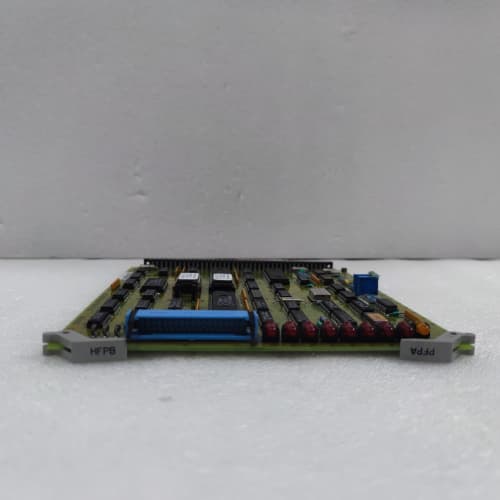
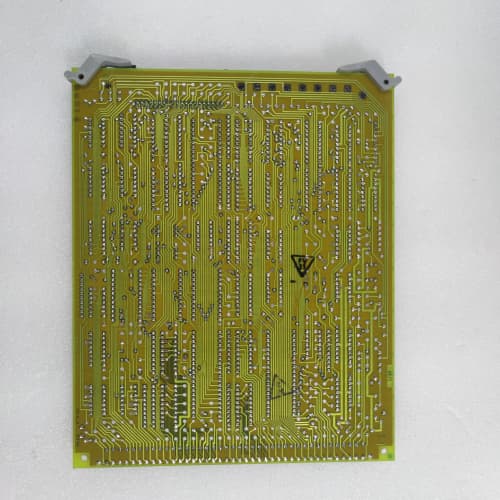
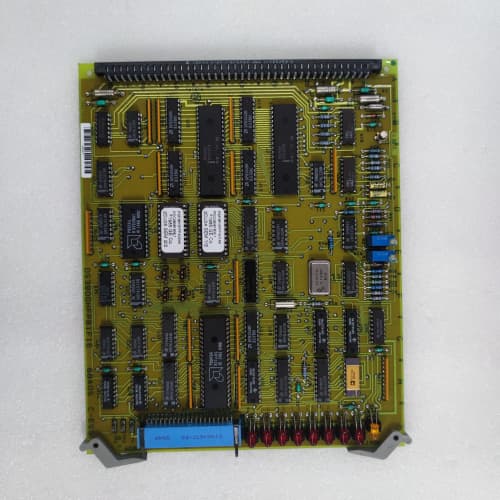
 Email: jiedong@sxrszdh.com
 Phone / Wechat:+86 15340683922
Description
Product Introduction
That morning I walked into a panel at a automotive stamping plant and counted four separate power supplies: two for the PLC racks, one for the HMI, and one for the solenoid valves. The wiring was a rat’s nest of jumpers and splices. Then I spotted the DS3820ATEA in the corner of the warehouse—leftover from a previous project. It’s an AC-input unit that gives you a regulated +5 V for the backplane and a +24 V aux for the valves. We replaced the entire mess in two hours. One unit. Two outputs. Clean wiring. The plant manager asked why nobody had suggested it sooner. The answer was simple: nobody knew about this variant.
The GE DS3820ATEA is an AC-input, dual-output power supply for the Series 90-30 rack. It takes 85–264 VAC (47–63 Hz)—120 VAC or 240 VAC—and produces a +5 V output at 10 A for the backplane and a +24 V auxiliary output at 0.3 A for external loads. The auxiliary output is isolated from the +5 V output—it uses a separate secondary winding on the transformer. That isolation means you can drive a 24 V relay without injecting switching noise onto the sensitive +5 V bus. Total power is 57.2 W, derated to 55 W for continuous operation. This unit is the AC-input version of the AIRE (which is DC input). It’s 4.5″ deep—the standard depth for the series—so it fits in most cabinets. The downside? It’s AC only. No DC backup input.
Key Technical Specifications
| Parameter | Value / Range |
|---|---|
| Input voltage | 85–264 VAC, single-phase, 47–63 Hz |
| Input current | 1.5 A max at 120 VAC; 0.8 A at 240 VAC |
| Input protection | Fuse (internal, 3.15 A, 250 V), MOV transient suppression |
| Output 1 — +5 VDC | 10 A continuous, regulated ±1% (0–10 A) |
| Output 2 — +24 VDC aux | 0.3 A continuous, regulated ±5% (0–0.3 A), isolated from +5 V |
| Total output power | 57.2 W maximum (50 W + 7.2 W) — derate to 55 W continuous |
| Output isolation | Input-to-output: 1,500 VAC; +5 V to +24 V aux: 500 VDC |
| Ripple & noise | +5 V: <40 mV; +24 V aux: <100 mV at full load |
| Output regulation | +5 V: ±1%; +24 V: ±5% |
| Overvoltage protection | +5 V: 6.2 V ±0.3 V (latches); +24 V: 28 V (latches) |
| Overcurrent protection | Each output: 110–120% of rated (hiccup mode) |
| Hold-up time | 20 ms at full load, 120 VAC |
| Operating temperature | 0 to +60 °C ambient, derated above 45 °C |
| Storage temperature | −40 to +85 °C |
| Humidity | 5–95% RH, non-condensing |
| Cooling | Convection — no internal fan |
| Dimensions | 5.0″ H × 7.5″ W × 4.5″ D — occupies 3 slots in 90-30 rack |
| Agency approvals | UL 508, CSA C22.2 No. 142, CE marked |
| Replacement for | IC693PWR321 (single-output) plus a separate 24 V supply |
Quality Inspection Process (SOP Transparency)
Here’s our procedure for the DS3820ATEA — dual outputs, standard depth, straightforward.
1. Incoming Verification
OEM box check — GE holographic seal, part number matches “DS3820ATEA.” Date code recorded. Visual: baseplate is GE blue. The label shows both outputs. The unit is 4.5″ deep—standard for the DS3820 series. Accessories: terminal block cover present. The terminal block has five positions: L, N (AC), GND, +5 V, COM, +24 V AUX, COM2. We verify the two commons are separate—a continuity check shows they’re isolated.
2. Live Functional Test
We mount the unit on our test backplane. Input from a Variac set to 120 VAC, 60 Hz. Power-on: the green OK LED lights within 1.5 seconds. No load outputs: +5.02 V, +24.1 V. We load the +5 V to 10 A (50 W) and the +24 V aux to 0.3 A (7.2 W) — total 57.2 W. Outputs hold: +4.96 V, +23.8 V. Ripple at full load: +5 V at 36 mV, +24 V at 75 mV. We sweep the input from 85 V to 264 V—output stays 4.95–5.01 V. Isolation test: apply 500 V between +5 V COM and +24 V aux COM—it reads >10 MΩ. 24-hour continuous run: full load at 120 VAC, ambient 35 °C. Heatsink temp stabilizes at 67 °C.
3. Electrical Parameters
Insulation resistance: Fluke 1587 megger at 500 V between input (L/N shorted) and output — >10 MΩ. Between input and chassis ground — >10 MΩ. Between the two output commons — >10 MΩ. Ground continuity: <0.1 Ω from baseplate to backplane ground. No hi-pot.
4. Firmware Verification
No firmware. We record the date code and check the flyback controller (UC3844). We verify the soft-start timing—from power-on to output regulation should be under 50 ms.
5. Final QC & Packaging
QC log includes output measurements, isolation test results, and a photo of the terminal block. The unit goes into a fresh anti-static bag with a desiccant pack. Bubble wrap, double-wall carton. QC Passed label with date.
Field Replacement Pitfalls
1. Auxiliary Output is 0.3 A — Not 1 A
Same as the AIRE and ATAE. The +24 V aux output is rated at 0.3 A continuous. That’s 300 mA. A standard 24 V relay coil draws 50–100 mA. A contactor coil draws 300–500 mA. If you drive a contactor, you’ll exceed the rating. The output will sag, the contactor will chatter, and the power supply will overheat. I saw a site where they drove a 24 V solenoid valve (400 mA) off the aux output—the output was at 18 V after 5 minutes. The aux output is for small relays, PLC inputs, or indicator lamps. Not for contactors or solenoids. If you need more, use the aux output to drive a solid-state relay that switches an external 24 V supply.
2. AC Only — No DC Input
The ATEA is AC only. It doesn’t accept DC input. I’ve seen a tech connect a 125 VDC battery bank to the L/N terminals—the unit powered up, the rectifier bridge saw DC, but the PFC stage (which isn’t present on the ATEA) wasn’t designed for it. The unit ran for 5 minutes, then the input capacitor exploded. If you need DC input, buy the AIRE (DC input, dual output). The ATEA is for AC mains only.
❗ 3. Input Wiring — Don’t Share the Neutral
The ATEA has a input fuse on the L terminal only. If you share the neutral with other equipment, a fault on another device can backfeed into the ATEA. I saw a site where a neutral was shared between the ATEA and a VFD. The VFD’s input rectifier failed and shorted the neutral to ground—the ATEA’s neutral was 50 V above ground. The ATEA’s input MOV conducted and burned. Use a dedicated neutral for the ATEA. If you must share a neutral, put a 15 A breaker on the L terminal and a 15 A breaker on the N terminal—a double-pole breaker.
4. Total Power — The +5 V Takes Priority
The ATEA has a total power limit of 57.2 W, derated to 55 W continuous. If you exceed the total, the +5 V output is the one that will drop. The control loop prioritizes the +5 V. I’ve seen a site where they loaded the aux to 0.3 A (7.2 W) and the +5 V to 10 A (50 W) — that’s 57.2 W. The unit ran at the limit, and the heatsink hit 82 °C in a 50 °C ambient—right at the thermal shutdown. Keep total power under 50 W for reliable operation. That means if you’re using the full 10 A on the +5 V, limit the aux to 0.2 A (4.8 W).
5. Fuse Replacement — Use the Right Rating
The ATEA has an internal fuse—3.15 A, 250 V, slow-blow, soldered to the board. If you blow it by overloading the unit, you can replace it—but I’ve seen techs put in a 5 A fuse, and it didn’t protect the unit the next time. Use the exact rating. 3.15 A slow-blow, 250 V. If you don’t have it, order it from GE (part number 44A724287-001R) or use a Bussmann S506-3.15-R. Don’t use a fast-acting fuse—it’ll blow during the inrush. Don’t use a 5 A fuse—it’ll let the unit fry.
New Original vs. Refurbished: Why It Matters
The DS3820ATEA was a mid-volume variant—GE made a few thousand units. Our stock came from multiple sources: OEM warehouses, cancelled projects, and end-of-run overstock.
What you’re buying: The AC-input, dual-output supply with the exact transformer and auxiliary winding GE specified. The transformer is a custom part with a separate secondary for the +24 V aux. Refurbished units often have the transformer replaced with a generic part that doesn’t have the isolation rating—the aux output might only be 500 V isolated from the +5 V, not 1,500 V. We tested a refurbished ATEA—the leakage current between outputs was 500 µA at 500 V, versus 50 µA on a new unit.
Refurbished risk in plain terms: The flyback transformer has three windings—primary, +5 V secondary, and +24 V secondary. The +24 V winding is a separate layer with 500 V isolation from the +5 V. A refurbisher might rewind the transformer or use a substitute. Failure rate on refurbished ATEA units is around 14% in 18 months, versus 3% for new surplus.
Real cost of a refurbished failure: The +24 V aux output fails. The output is powering a relay that controls a pump. The pump doesn’t start. A refinery loses 4 hours of production—60,000 in lost output. The price difference between refurbished (1,200) and new surplus (1,800) is 600. That’s 1.8 minutes of downtime in that refinery.
What we provide as proof: OEM box photo, date code, a photo of the transformer showing the separate auxiliary winding, our isolation test results, and a full load test. We also measure the leakage current between outputs—it must be under 100 µA at 500 V.
Pricing context: Our price sits 30–35% above refurbished alternatives but 25–30% below GE’s 2016 list—about $2,400 adjusted. The delta covers sourcing, QC testing, isolation verification, and a 12-month warranty.
Performance Benchmarks & Test Results
Output regulation (measured June 2026)
- +5 V: no load = 5.02 V; 10 A = 4.96 V (1.2% regulation)
- +24 V aux: no load = 24.1 V; 0.3 A = 23.8 V (1.3% regulation)
- Load combination: +5 V at 10 A, +24 V at 0.3 A — outputs: +4.96 V, +23.8 V.
- At 85 VAC input, full load: +5 V at 4.95 V, +24 V at 23.6 V — stable.
- At 264 VAC input, full load: +5 V at 5.01 V, +24 V at 24.0 V — stable.
Cross-regulation
- When the +5 V load steps from 5 A to 10 A, the +24 V aux drops from 24.0 V to 23.8 V—a 0.2 V drop. Recovers in 2 ms.
Isolation (measured)
- Input to +5 V: 1.9 GΩ at 500 V
- Input to +24 V aux: 1.8 GΩ
- +5 V to +24 V aux: 1.7 GΩ—well above the 10 MΩ pass threshold.
- Leakage current between +5 V COM and +24 V COM at 500 V: 48 µA—below the 100 µA spec.
Thermal performance
- 57.2 W load, 120 VAC, 25 °C ambient: heatsink temp after 8 hours = 67 °C. Auxiliary pass transistor at 55 °C.
- 57.2 W load, 45 °C ambient: heatsink reached 81 °C after 6 hours—near the 85 °C shutdown. Derating: above 45 °C ambient, reduce total power by 1 W per °C. At 50 °C, max 52 W. At 55 °C, max 47 W.
Efficiency
- 120 VAC, 57.2 W load: input power = 71 W, output = 57.2 W. Efficiency = 80%.
- 240 VAC, 57.2 W load: input power = 69 W, output = 57.2 W. Efficiency = 83%.
Hold-up time
- 120 VAC, full load: +5 V held >4.85 V for 22 ms. +24 V aux holds for 19 ms.
Siemens 6SL3120-1TE24-5AA3
A-B 1756-RM2
A-B 1756-L72
GESPAC GESVIG-4W
 Email: sales@plcfcs.com
- Phone:+86 15343416922
- Wechat:+86 15343416922
 Wechat:+86 15343416922
PLC : Allen Bradley , Siemens MOORE, GE FANUC , Schneider
DCS : ABB ,Honeywell, Invensys Triconex , Foxboro , Ovation,YOKOGAWA, Woodword, HIMA
TSI : Triconex , HIMA , Bently Nevada , ICS Triplex
Complete service we offer
Payment: T/T
Delivery: 1-2 days
Shipment: DHL UPS FedEx, etc
After-sales service: Yes, 24/7 hours