 Email: jiedong@sxrszdh.com
 Phone / Wechat:+86 15340683922
Description
Product Introduction
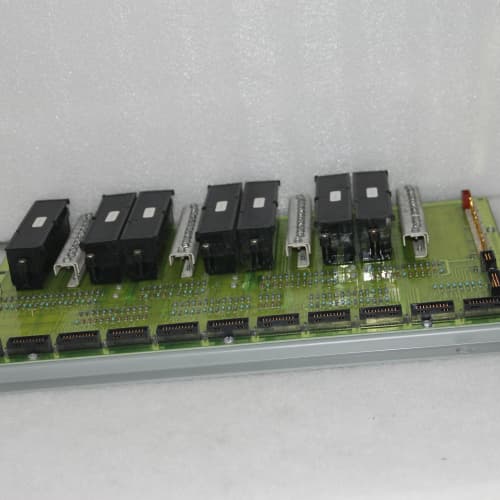
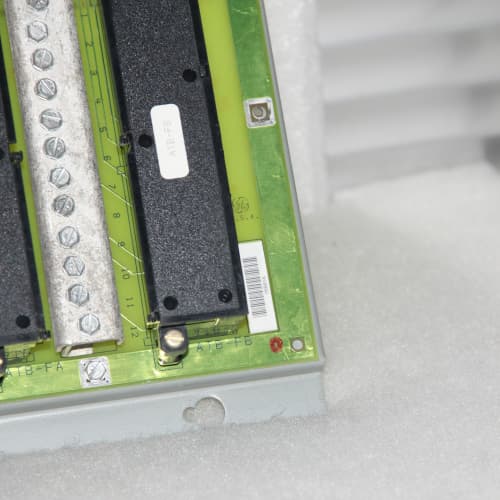
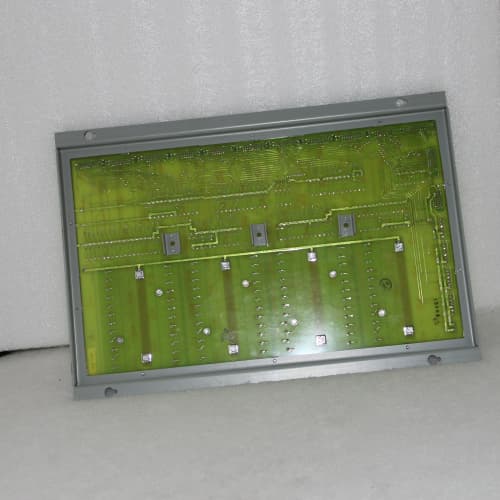
Thermocouple signals are the lifeblood of turbine temperature monitoring—exhaust gas temperature (EGT), bearing temps, and casing thermals all feed into this board. The DS3800HCPC1J1G is the Mark V’s solution for reading thermocouples directly, without external signal conditioners. The “1J” suffix tells us this board is factory-configured for Type J thermocouples (Iron-Constantan) with the “1G” fusing setup, and the “1J1G” suffix combines spring-cage terminals with 2.5A fusing—the heavy-duty protection we’ve seen on other high-fusing variants.
The critical spec here is the temperature accuracy. At 16-bit resolution, the HCPC can resolve a few tenths of a degree—essential for temperature control. The board’s cold-junction compensation is built-in and calibrated at the factory. However, we’ve seen cold-junction drift on older boards (10+ years) cause errors of 2-3°C, which is significant when you’re tracking turbine inlet temperature. The HCPC itself is reliable, but don’t expect it to be as accurate as a standalone temperature transmitter—you’re looking at about ±1°C absolute accuracy, which is fine for most gas turbines but marginal for high-temperature combustion monitoring. The “1J” factory configuration means you get Type J with minimal setup. If you’re running Type K, you’d need a different suffix or a different board entirely.
Key Technical Specifications
| Parameter | Value / Range |
|---|---|
| Thermocouple Input Channels | 8 (differential, individually configurable) |
| Thermocouple Types Supported | Type J, K (suffix-dependent; also T, E, R, S with alternative configs) |
| Resolution | 16-bit (65536 counts) |
| Temperature Accuracy | ±0.5°C (typical at 25°C) + cold-junction compensation error |
| Cold-Junction Compensation | Built-in, per-channel, factory-calibrated |
| Input Impedance | >10MΩ |
| Input Range (Type J) | -200°C to +1200°C |
| Input Range (Type K) | -200°C to +1370°C |
| Terminal Block Type | Spring-cage (push-in), pitch 5.08mm |
| Wire Gauge Capacity | 0.2mm² to 2.5mm² (24-14 AWG) |
| Field Supply Fusing | 2.5A slow-blow (field supply rail) |
| Update Rate (All Channels) | 500ms (typical) |
| Logic Supply Voltage | 5 VDC (from backplane) |
| Operating Temperature (Ambient) | 0°C to 55°C (derate above 45°C) |
| Backplane Current Draw (5V) | 0.8A (max) |
Compatible Replacement Models
| Model | Compatibility Class | Notes & Caveats |
|---|---|---|
| DS3800HCPC1K1G | ⚠️ Software Compatible | Same board, but factory-configured for Type K thermocouples. Physically identical—the jumper settings differ. If you’re swapping from Type J to Type K, you need to change the jumpers or buy the correct suffix. |
| DS3800HCPC (no suffix) | ⚠️ Software Compatible | Base board with no factory termination or fusing. Not recommended unless you’re building a custom panel. |
| DS3800HCPC1J1G (same suffix) | ✅ Drop-in Replacement | Exact match on all hardware, firmware, and suffix. No adjustments required. |
| DS3800HCMC1J1G | ❌ Hardware Incompatible | Analog output board—not thermocouple input. Different backplane addressing and signal direction. |
| DS3800HCMA (any suffix) | ❌ Hardware Incompatible | Standard analog input board. Thermocouple signals require special cold-junction compensation—the HCMA lacks this. |
Frequently Asked Questions (FAQ)
Q: What’s the difference between the HCPC and the standard analog input board (HCMA)?
A: The HCPC is specifically designed for thermocouple signals. It has a high-impedance input (>10MΩ) to avoid loading the thermocouple, built-in cold-junction compensation, and linearization for standard thermocouple types. The HCMA is for 4-20mA or 0-10V signals. If you plug a thermocouple into an HCMA, you’ll get a tiny voltage that the board won’t interpret correctly. You need the HCPC for temperature sensors.
Q: The suffix is 1J1G. What does the “1J” specify?
A: On the HCPC, “1J” indicates the board is factory-configured for Type J thermocouples (Iron-Constantan). The “1” refers to the termination type (spring-cage), and “J” tells you the thermocouple type. The “1G” specifies the field supply fusing (2.5A). If you need Type K, look for the “1K” suffix. The thermocouple type is set by jumpers on the board. If you’re comfortable with a soldering iron, you can re-configure the jumpers, but it’s easier to buy the correct suffix.
Q: Can I mix Type J and Type K thermocouples on the same HCPC board?
A: No. The board is factory-configured for a single thermocouple type across all channels. While you can change the jumpers for individual channels, it’s not recommended. The cold-junction compensation and linearization are global. If you need both Type J and Type K, use two separate boards with different suffixes, or use external signal conditioners and feed them into an HCMA as 4-20mA.
Q: The accuracy spec says ±0.5°C at 25°C. What about at 50°C ambient?
A: The cold-junction compensation drifts with temperature. At 50°C ambient, the accuracy degrades to about ±1.5°C. This is a physical limitation of the thermocouple and the cold-junction reference—the board is factory-calibrated at 25°C. If your cabinet runs hot, consider using external temperature transmitters (4-20mA) instead, which have better ambient temperature rejection. We’ve seen plants do this on critical EGT monitoring.
Q: How does the cold-junction compensation work on the HCPC?
A: The HCPC uses a temperature sensor on the terminal block to measure the temperature at the cold junction (where the thermocouple wires terminate). It then adds the appropriate voltage offset to the thermocouple measurement. This is why the terminal block must be at a stable temperature. If you have airflow across the terminal block, the compensation can fluctuate, causing reading errors. We recommend shielding the HCPC from direct airflow in the cabinet.
Q: The HCPC has 16-bit resolution. How does that translate to temperature?
A: For Type J, the range is -200°C to +1200°C, a span of 1400°C. With 16-bit resolution (65536 counts), each count represents about 0.02°C. That’s the raw resolution—but the accuracy (0.5°C) is the real limitation. So the board can theoretically resolve 0.02°C, but your actual reading is only accurate to ±0.5°C. The fine resolution is useful for trending and diagnostics, not absolute temperature accuracy.
Q: I’m replacing an HCPC with a different suffix. Do I need to change the Mark V configuration?
A: If you’re swapping within the same thermocouple type (J to J, K to K), no—the software mapping is identical. The suffix only affects termination and fusing, not the signal processing. If you’re changing thermocouple type (J to K), you’ll need to update the Mark V configuration to interpret the different mV-to-temperature linearization. That’s a software change—about 1-2 hours of work if you have the configuration tool. We don’t recommend field-changing the type without the proper software access.
Q: Can the HCPC handle thermocouple wires without extension-grade wire?
A: Yes, but you should use the same thermocouple extension wire (Type J or Type K) from the sensor to the terminal block to avoid errors. If you use standard copper wire, you’ll introduce additional cold junctions at the connection points, adding errors. The HCPC can compensate for one cold junction—the terminal block. Additional junctions will cause offsets. We’ve seen plants use standard copper wire in a pinch, and the result was a 5-10°C error. Don’t do it.
GE DS200RTBAG4A
GE DS200RTBAG5A
GE DS200SBCAG1A
 Email: sales@plcfcs.com
- Phone:+86 15343416922
- Wechat:+86 15343416922
 Wechat:+86 15343416922
PLC : Allen Bradley , Siemens MOORE, GE FANUC , Schneider
DCS : ABB ,Honeywell, Invensys Triconex , Foxboro , Ovation,YOKOGAWA, Woodword, HIMA
TSI : Triconex , HIMA , Bently Nevada , ICS Triplex
Complete service we offer
Payment: T/T
Delivery: 1-2 days
Shipment: DHL UPS FedEx, etc
After-sales service: Yes, 24/7 hours