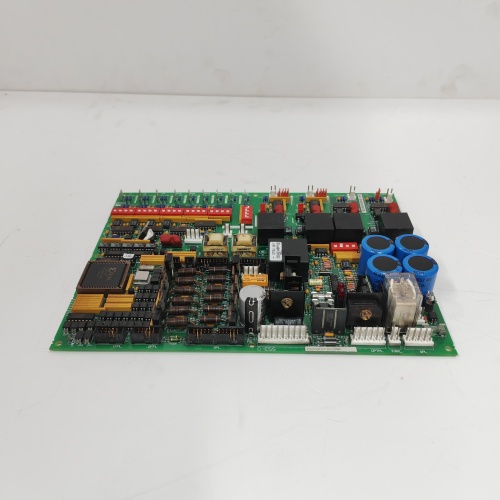
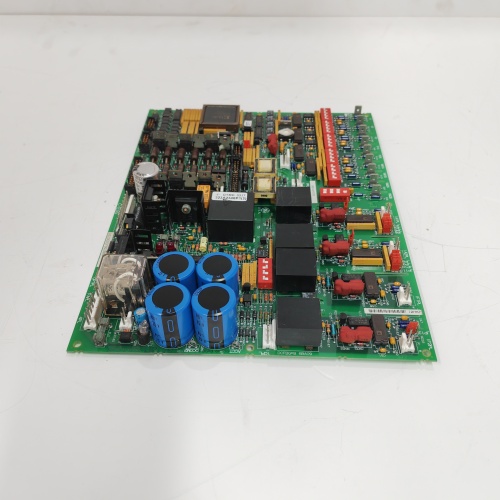
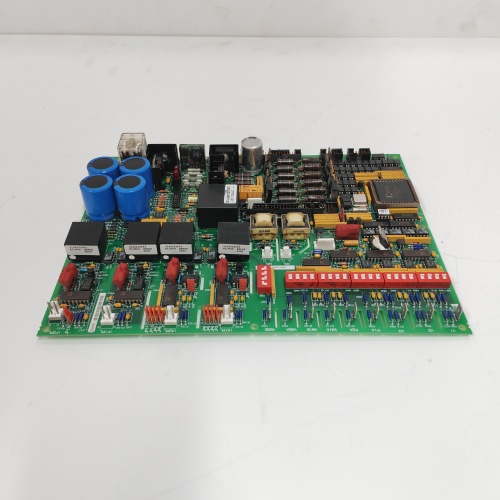
 Email: jiedong@sxrszdh.com
 Phone / Wechat:+86 15340683922
Description
Product Core Brief (10-Second Snapshot)
- Model: DS200TBQCG1
- Brand: General Electric (GE)
- Series: Mark VI / Mark VIe
- Core Function: Terminates ultra-high-current discrete outputs for large solenoids and motor starters.
- Product Type: Ultra-High-Current Output Termination Board
- Key Specs: 4 channels; 20A per channel; 24/48/125 VDC; heavy-duty terminal block.
*(Note: Condition: New Surplus. This is the highest-current board in the TBQ series—verify your connected I/O card supports 20A output drivers).*
Product Introduction (Anti-Template)
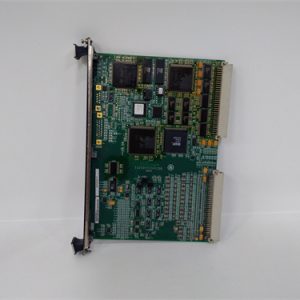
When 10A isn’t enough—and for some turbine applications, it isn’t—you need the DS200TBQCG1. This board is built for the big loads: main hydraulic pump contactors, large motor starters, and the oversized solenoids that control turbine inlet guide vanes on large-frame gas turbines. At 20A continuous per channel, this board handles loads that would melt the traces on any other Mark VI termination board.
The trade-off is channel count—you get four channels instead of eight or sixteen. The terminal block uses wider spacing (12.5mm pitch) and larger screws (accepts 10-12 AWG wire) to handle the current and heat. There are no fuses on this board; protection is handled upstream by the connected I/O card or external panel. Compared to the TBQBG1A (8 channels, 10A), the TBQCG1 gives you half the channels but double the current capacity—a straightforward power-density trade that’s necessary when you’re driving equipment that pulls 15-18A during startup.
Key Technical Specifications
| Parameter | Value / Range |
|---|---|
| Manufacturer | General Electric (GE) |
| Part Number | DS200TBQCG1 |
| Board Type | Ultra-High-Current Output Termination Board |
| Number of Channels | 4 (heavy-duty outputs) |
| Voltage Compatibility | 24, 48, or 125 VDC |
| Current Rating | 20A per channel (continuous) |
| Termination per Channel | 2 independent screw terminals (redundant wiring capability) |
| Fuse Protection | None (external protection via connected I/O card or external panel) |
| Terminal Type | Heavy-duty screw clamp (accepts 10-12 AWG recommended) |
| Terminal Pitch | 12.5mm (extra-wide spacing for high voltage/current) |
| Wire Range | 10-14 AWG (12 AWG recommended) |
| Isolation | None (passive; isolation by connected I/O cards) |
| Mounting | VME rack (fits standard Mark VI backplane) |
| Operating Temp | -20°C to +65°C |
| Dimensions | 6U VME form factor |
| Connectors | 4-channel terminal block (dual terminals per channel); 1 x 96-pin DIN backplane connector |
Compatible Replacement Models
Replacement options depend on your current requirements and whether you need the full 20A capacity.
✅ Drop-in Replacement: There is no exact electrical equivalent in the Mark VI line—the TBQCG1 is unique in its 20A rating. The DS200TBQCG1A (if available) would be a future revision, but as of this writing, the base model is the only version.
⚠️ Software Compatible: The DS200TBQBG1A (8 channels, 10A) fits the rack and is software-compatible, but it cannot handle loads above 10A. If your load is under 10A, you could downgrade to save rack space—but you lose the heavier terminals and wider spacing. If your load exceeds 10A, the TBQBG1A will overheat and fail within hours.
❌ Hardware Incompatible: The DS200TBQAG1A (16 channels, 5A) and DS200TBPXG1A (standard discrete, 2A) use different pinouts and are not designed for high-current loads. Attempting to use them for 20A loads will cause immediate trace damage and fire risk.
❌ Hardware Incompatible: The DS200TBCAG1A (analog) and DS200TBCBG1A (thermocouple) use completely different signal paths and are not suitable for any discrete output application.
Frequently Asked Questions (FAQ)
Why does this board only have 4 channels?
The 20A current rating requires wide copper traces (at least 8mm width), larger terminal blocks, and additional clearance between channels for heat dissipation. Four channels is the maximum that fits in the 6U VME form factor while maintaining safe thermal margins. If GE had tried to put 8 channels on this board, the traces would overheat, the board would warp from thermal stress, and you’d have fires in your rack. Four channels is the practical limit for 20A in this footprint.
What wire gauge should I use with this board?
GE recommends 10-12 AWG for the TBQCG1. The terminal block accepts 10-14 AWG, but at 20A continuous, 12 AWG is the minimum we recommend (it’s rated for about 25A chassis wiring, giving you 20% margin). 10 AWG is safer if your cable run exceeds 15 feet or if the ambient temperature is above 40°C. The terminal screws are larger than on other boards (M4 instead of M3), and the torque spec is higher (1.2 N·m, about 10.6 in-lb). Do not use 14 AWG wire—it will run hot at 20A and the insulation will degrade over time.
What’s the difference between this board and the TBQBG1A?
The TBQBG1A is an 8-channel, 10A board with dual terminals per channel and a 10mm pitch. The TBQCG1 is a 4-channel, 20A board with dual terminals per channel and a 12.5mm pitch. Key differences:
- Channel count: 8 vs. 4
- Current rating: 10A vs. 20A
- Terminal spacing: 10mm vs. 12.5mm
- Wire gauge: 12-16 AWG vs. 10-12 AWG
- Torque spec: 0.8 N·m vs. 1.2 N·m
The TBQCG1 is for the largest loads—motor starters, main hydraulic pumps, and oversized solenoids. If your load is under 10A, you’re better off with the TBQBG1A.
Can I use this board with a Mark VIe controller?
No—same platform limitation as all Mark VI boards. The TBQCG1 uses the older Mark VI backplane pinout. Mark VIe uses a different assignment and typically uses the IS200TBQCG1 for this application. The board physically fits but signals map incorrectly—use the Mark VIe-specific board for new installations.
How do I test this board before installation?
Testing a 20A board requires more robust test equipment:
- Visual inspection: Check for burn marks around the terminal block. Look for discolored traces on the backplane connector. The extra-wide terminal block should be firmly attached with no loose screws.
- Continuity – primary path: Verify each channel’s “A” terminal shows <0.1Ω to the backplane pin. The low resistance is critical for 20A operation. Channel 1A to pin A1, up to channel 4A (pin C4).
- Continuity – redundant path: Verify each channel’s “B” terminal shows <0.1Ω to the same backplane pin.
- Cross-check: Measure resistance between “A” and “B” terminals on the same channel—should be <0.05Ω (essentially a direct short).
- Insulation: Measure between adjacent channels—should be >10MΩ. The 12.5mm pitch provides excellent spacing, but even so, keep the board clean—contamination at 125V DC can arc across even 12.5mm.
- Load test: This is essential. Using an external DC power supply and a load resistor, apply 20A through each channel. Measure voltage drop from terminal to backplane—should be <0.05V at 20A. If the voltage drop is higher, the board has excess resistance (likely a degraded solder joint or damaged trace).
What’s the most common failure on this board?
Two issues specific to the ultra-high-current design:
- Solder joint cracking on the backplane connector. The 20A current generates significant heat in the 96-pin DIN connector pins. Over many thermal cycles (on/off), the solder joints can develop ring cracks—especially on the high-current pins near the center of the connector. Inspect the backplane connector—if you see dull or dark solder joints, plan on reflowing them or replacing the board.
- Terminal block thermal degradation. At 20A, the terminal block can reach 70-80°C in normal operation. Over years, this can harden the plastic and make it brittle. The terminal block on the TBQCG1 is a high-temperature phenolic material, but even so, it’s a wear item. If you see cracks in the terminal block plastic, replace the board immediately.
- Internal trace delamination is rare but possible. The board uses 3oz copper to handle the current, but repeated thermal cycling can cause the copper to delaminate from the fiberglass. The symptom is intermittent connections—the channel works when cold, fails when hot.
If I’m using this board in a SIL-rated application, what’s the recommended maintenance interval?
For SIL-2 and SIL-3 applications (IEC 61508), we recommend:
- Visual inspection: Every 3 months (check terminal screws, look for discoloration)
- Thermal check: Every 6 months (measure terminal block temperature at full load—should be below 80°C at 25°C ambient)
- Torque verification: Every 6 months (re-torque all terminal screws to 1.2 N·m)
- Continuity check: Annually (verify both the ‘A’ and ‘B’ paths are conducting)
- Load test: Every 2 years (verify the board can carry 20A without excessive voltage drop)
These intervals are more frequent than for lower-current boards because of the thermal stress. The TBQCG1 runs hot—that’s the nature of 20A continuous current. If your plant has high ambient temperatures (above 40°C), consider forced-air cooling in the rack or reduce the maintenance interval to quarterly inspections.
What’s the lead time for a replacement TBQCG1?
These are specialized, low-volume boards:
- New surplus: 4-8 weeks. The 20A rating makes them hard to find—expect to pay a premium, often 40-50% above the TBQBG1A.
- Refurbished: 2-4 weeks. Ensure the refurbisher tests at full 20A current, not just continuity. Some only test at 5A and assume the board is fine—it’s not.
- Used/as-is: Available but high risk. The board’s thermal stress means used boards often have degraded terminal blocks or cracked solder joints. Only buy as-is if you have a full test bench.
Is there a direct Mark VIe equivalent?
Yes—the IS200TBQCG1 (Mark VIe version). But as with all cross-platform moves, the backplane pinout is different, and the Mark VIe board may have different thermal management features (some variants use active cooling or temperature sensing). If you’re migrating to Mark VIe, plan to replace all ultra-high-current boards as part of the rack conversion. For existing Mark VI systems, the TBQCG1 is your only option for 20A loads.
What’s the correct torque for the terminal screws?
GE spec for the TBQCG1 is 1.2 N·m (about 10.6 in-lb)—significantly higher than standard termination boards. The larger terminal screws (M4) and heavy-duty brass inserts require this torque to maintain low contact resistance at 20A. Use a torque screwdriver—do not guess. At 1.2 N·m, you’ll feel solid resistance. Do not exceed 1.2 N·m—the thread insert can strip above this torque. The terminal block is field-replaceable if you strip a screw, but it’s a challenging repair—better to torque correctly the first time.
Can I use this board with 125V DC at 20A?
Yes—the TBQCG1 is rated for 125V DC at 20A continuous, but this is the absolute maximum for the board. At these levels:
- Power dissipation in the terminal block is about 2-3W per channel (depending on contact resistance)
- The board will reach 80-85°C at the terminal block in a 25°C ambient environment
- You must use 10 AWG wire to minimize IR heating
- The rack should have good airflow (natural convection may not be sufficient)
- Consider forced-air cooling if ambient temperature exceeds 35°C
We’ve used these boards at 125V DC / 20A in large gas turbine applications without issues, but the thermal management is critical. The ‘C’ series boards (like this one) are designed for this environment, but they run near their limits—regular thermal monitoring is essential. We recommend thermal imaging every 6 months to catch hot spots early.
00-119-966 RDW2
1FK7101-5AY81-1SH3-Z S11 0000-136-892 4.2KW
 Email: sales@plcfcs.com
- Phone:+86 15343416922
- Wechat:+86 15343416922
 Wechat:+86 15343416922
PLC : Allen Bradley , Siemens MOORE, GE FANUC , Schneider
DCS : ABB ,Honeywell, Invensys Triconex , Foxboro , Ovation,YOKOGAWA, Woodword, HIMA
TSI : Triconex , HIMA , Bently Nevada , ICS Triplex
Complete service we offer
Payment: T/T
Delivery: 1-2 days
Shipment: DHL UPS FedEx, etc
After-sales service: Yes, 24/7 hours