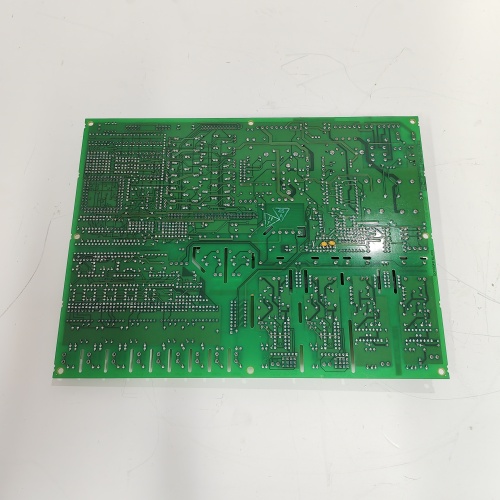
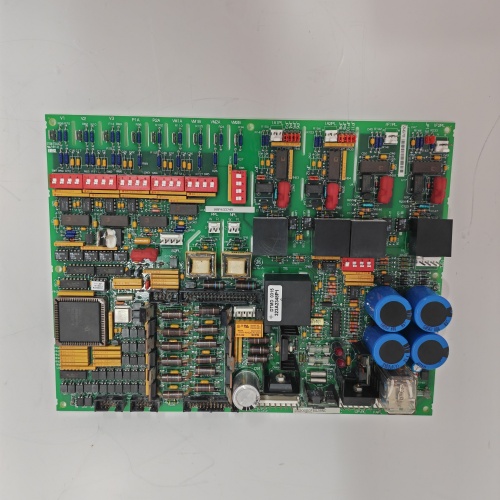
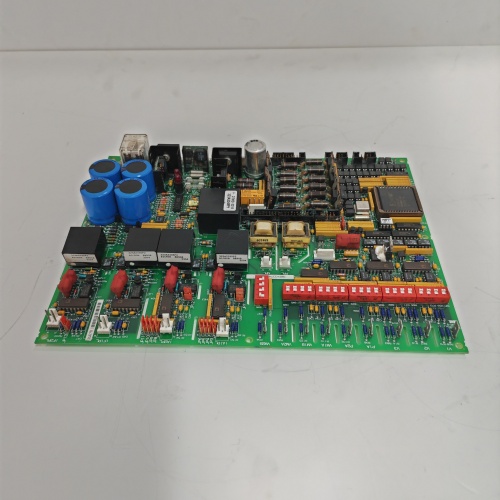
 Email: jiedong@sxrszdh.com
 Phone / Wechat:+86 15340683922
Description
Product Introduction (Anti-Template)
Sometimes you don’t need more channels—you need more redundancy. The DS200TBQBG1A sacrifices channel count (8 instead of 16) to give you dual terminal connections per channel, higher current capability (10A continuous), and wider trace spacing that reduces the risk of shorts in high-vibration environments.
This board is purpose-built for the most critical outputs in a turbine control system: fuel trip solenoids, emergency stop valves, and overspeed protection circuits—the kind of outputs where a single loose wire or terminal failure is not an option. Compared to the TBQAG1A (16 channels, 5A, single termination), the TBQBG1A gives you two separate screw terminals for each output, so you can run redundant wiring to the same load. The 10A capacity handles large solenoids that draw 6-8A during actuation. The ‘B’ in the part number indicates this is the high-current, high-redundancy variant in GE’s TBQ family—a board you don’t see in every panel, but when you need it, you really need it.
Key Technical Specifications
| Parameter | Value / Range |
|---|---|
| Manufacturer | General Electric (GE) |
| Part Number | DS200TBQBG1A |
| Board Type | High-Current Redundant Output Termination Board |
| Number of Channels | 8 (dual termination per channel) |
| Voltage Compatibility | 24, 48, or 125 VDC |
| Current Rating | 10A per channel (continuous) |
| Termination per Channel | 2 independent screw terminals (redundant wiring) |
| Fuse Protection | None (requires external protection or connected I/O card protection) |
| Terminal Type | Screw clamp (accepts 12-16 AWG recommended) |
| Terminal Pitch | 10mm (wide spacing for high voltage/current) |
| Isolation | None (passive; isolation by connected I/O cards) |
| Mounting | VME rack (fits standard Mark VI backplane) |
| Operating Temp | -20°C to +65°C |
| Dimensions | 6U VME form factor |
| Connectors | 16-position terminal block (dual terminals per channel); 1 x 96-pin DIN backplane connector |
Compatible Replacement Models
Replacement options depend on whether you need the 10A capacity and redundant termination.
✅ Drop-in Replacement: The DS200TBQBG1 (no ‘A’ suffix) is a direct drop-in—same pinout, same 8 channels, same 10A rating, same dual terminal layout. The ‘A’ revision added improved labeling and a slightly different trace routing that reduces voltage drop by about 2% at 10A. If you find the non-‘A’ version, it works fine—just be aware that the voltage at the load terminals will be a fraction of a volt lower.
⚠️ Software Compatible: The DS200TBQAG1A (16 channels, 5A, single termination) fits the rack and is software-compatible, but it cannot handle 10A. If you’re driving loads under 5A, you could downgrade—but you lose the redundant termination feature. Not recommended for critical safety applications.
❌ Hardware Incompatible: The DS200TBPXG1A (standard discrete, 2A) and DS200TBPAG1A (mixed-signal) use different pinouts and are not designed for high-current loads. Attempting to use them for high-current solenoid control will damage the boards and potentially the connected I/O card.
❌ Hardware Incompatible: The DS200TBQAG1ABB (16 channels, 5A, fused) has a different backplane pinout and keying—the ‘B’ series boards use a different assignment for the high-current pins. Force it, and you’ll bend pins or short the power supply.
Frequently Asked Questions (FAQ)
What’s the difference between the TBQBG1A and the TBQAG1A?
The TBQAG1A is a 16-channel, 5A, single-termination board with fuses. The TBQBG1A is an 8-channel, 10A, dual-termination board without fuses. Key differences:
- Channel count: 16 vs. 8
- Current rating: 5A vs. 10A
- Terminals: Single vs. dual per channel
- Fuses: Yes vs. No (external protection required for TBQBG1A)
- Pitch: 7.5mm vs. 10mm (wider spacing on the TBQBG1A for high voltage/current)
The TBQBG1A is used for critical applications where losing a single wire or terminal connection is unacceptable—the dual terminals let you run redundant wiring to the load. The TBQAG1A is for general-purpose high-current outputs.
Why doesn’t this board have fuses?
GE designed the TBQBG1A for applications where fuse interruption would be catastrophic—like fuel trip solenoids. If a fuse blows on a fuel trip circuit, you lose the ability to shut down the turbine. Instead, the protective device is located upstream (on the connected I/O card or a separate protection panel), and the termination board is wired directly to the load. The connected I/O card (typically a DS200TCQBG1 or similar) has onboard current limiting and diagnostics that handle overload protection without single-point failure risk. If you absolutely need fuse protection, you’ll need to add external fuse holders in the wiring—but that defeats the redundancy purpose of the board.
How do the dual terminals per channel work?
Each of the 8 output channels has two independent screw terminals (labeled “A” and “B” on the board). Both terminals are connected to the same backplane pin internally. You can wire both terminals to the same load—for example, you run two separate wires from terminal A and terminal B to the two coil terminals of a solenoid. If one wire breaks or one terminal loses contact, the other wire maintains the circuit. This is called “redundant wiring” and is required in many safety-certified applications (IEC 61508, SIL-rated). The internal traces are sized to carry 10A through either terminal or 5A through each if both are used.
Can I use this board with a Mark VIe controller?
No—same platform limitation as other Mark VI boards. The TBQBG1A uses the older Mark VI backplane pinout. Mark VIe uses a different assignment and typically uses the IS200TBQBG1A for this application. The board physically fits but signals map incorrectly—use the Mark VIe-specific board for new installations.
How do I test this board before installation?
Testing a high-current redundant board requires attention to both terminal paths:
- Visual inspection: Check for burn marks on the terminal block—10A loads generate heat. Look for discolored traces on the backplane connector.
- Continuity – primary path: Verify each channel’s “A” terminal shows <0.2Ω to the backplane pin. The 10A current rating means resistance should be minimal. Channel 1A to pin A1, up to channel 8A (pin C8).
- Continuity – redundant path: Verify each channel’s “B” terminal shows <0.2Ω to the same backplane pin (A1 for channel 1B, etc.). Both terminals should have identical resistance to the backplane—any difference indicates a poor internal connection.
- Cross-check: Measure resistance between “A” and “B” terminals on the same channel—should be <0.1Ω (effectively a short). This verifies the internal jumper is intact.
- Insulation: Measure between adjacent channels—should be >10MΩ. The 10mm pitch provides good spacing, but high-voltage applications (125V) still need clean insulation.
- Load test: If possible, apply a 10A current through a channel (using an external power supply and load resistor). Measure voltage drop from terminal to backplane—should be <0.1V at 10A. If the voltage drop is higher, the board has excess resistance (likely a degraded solder joint).
What’s the most common failure on this board?
Two issues specific to the high-current, redundant design:
- Internal trace delamination. At 10A, the copper traces on the board can heat up and, over many thermal cycles, delaminate from the fiberglass substrate. This creates intermittent connections—the channel works sometimes, fails other times. The ‘A’ revision (your board) uses thicker copper (2oz instead of 1oz) to reduce heating. If you see a bulging or discolored spot on the board, that trace is delaminating.
- Terminal block arcing. With 10A at 125V DC, any loose connection will arc. The 10mm pitch prevents arc-over between channels, but arcing at the screw itself can carbon-track the terminal block. Use a torque screwdriver (0.8 N·m for this board—higher than standard) to prevent loose connections.
If I’m upgrading from a TBQBG1 to the A version, do I need to re-terminate my wires?
No—the terminal positions are identical. The ‘A’ revision simply has improved labeling and thicker copper traces. Your wires transfer directly by matching channel numbers. The dual terminal layout (A and B per channel) is the same.
What’s the lead time for a replacement TBQBG1A?
These boards are specialized and produced in smaller quantities:
- New surplus: 3-6 weeks. The 10A, redundant design commands a premium—typically 30-40% above the TBQAG1A.
- Refurbished: 2-3 weeks. Ensure the refurbisher tests at full 10A current, not just continuity. Some only test at low current and miss high-current issues.
- Used/as-is: Available but inspect the terminal block carefully. High-current boards see more thermal stress—used boards often have discolored terminal blocks or degraded solder joints.
Is there a direct Mark VIe equivalent?
Yes—the IS200TBQBG1A (Mark VIe version). But as with all cross-platform moves, the backplane pinout is different, and the Mark VIe board may have different redundancy features (some use active switching instead of passive dual terminals). If you’re migrating to Mark VIe, plan to replace all high-current boards as part of the rack conversion. For existing Mark VI systems, the TBQBG1A is the correct choice for critical high-current outputs.
What’s the correct torque for the terminal screws?
GE spec for the TBQBG1A is 0.8 N·m (about 7.1 in-lb), higher than the 0.5 N·m on standard boards. The higher torque is essential for low contact resistance at 10A. The terminal block on this board uses a heavy-duty brass insert that’s more durable than standard inserts—but it’s not indestructible. Use a torque screwdriver. At 0.8 N·m, you’ll feel firm resistance—don’t go beyond it. If you strip a screw on this board, the terminal is unusable; the insert is not field-replaceable.
What wire gauge should I use with this board?
GE recommends 12-16 AWG for the TBQBG1A. For a 10A continuous load, 14 AWG is the minimum we recommend (it’s rated for about 15A chassis wiring, giving you 50% margin). 12 AWG is safer if your cable run is longer than 10 feet. The terminal block accepts up to 12 AWG—the screws are larger than on standard boards to accommodate thicker wire. If you use 16 AWG, you’re at the thermal limit—it will work but will run warm, and the insulation may degrade over years. We recommend 14 AWG as the sweet spot for most installations.
Can I use this board with 125V DC at 10A?
Yes—the TBQBG1A is rated for 125V DC at 10A continuous. At this voltage and current, you’re at the board’s thermal limit. The 10mm pitch and heavy-duty terminal block are designed for this, but you need to:
- Ensure the terminal screws are torqued to 0.8 N·m
- Use 14 AWG or thicker wire (12 AWG preferred)
- Keep the board clean—any contamination can cause arc-tracking at 125V
- Consider adding forced-air cooling in the rack if the ambient temperature exceeds 40°C
We’ve used these boards at 125V DC in hydro plants without issues, but the maintenance interval is shorter—we recommend annual thermal inspection (checking for discolored terminals or traces) to catch issues early.
00-108-313 PLC DCS
00-108-548
00-182-470
 Email: sales@plcfcs.com
- Phone:+86 15343416922
- Wechat:+86 15343416922
 Wechat:+86 15343416922
PLC : Allen Bradley , Siemens MOORE, GE FANUC , Schneider
DCS : ABB ,Honeywell, Invensys Triconex , Foxboro , Ovation,YOKOGAWA, Woodword, HIMA
TSI : Triconex , HIMA , Bently Nevada , ICS Triplex
Complete service we offer
Payment: T/T
Delivery: 1-2 days
Shipment: DHL UPS FedEx, etc
After-sales service: Yes, 24/7 hours