 Email: jiedong@sxrszdh.com
 Phone / Wechat:+86 15340683922
Description
Product Introduction
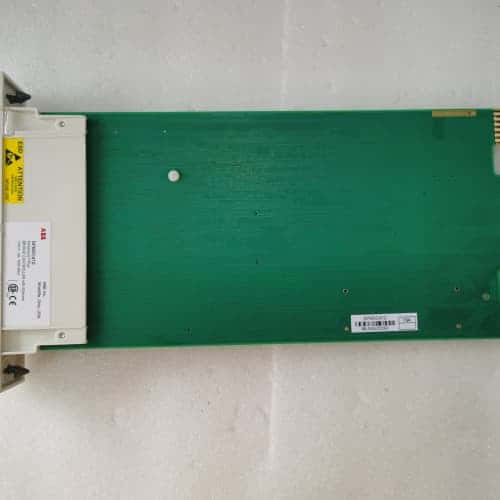
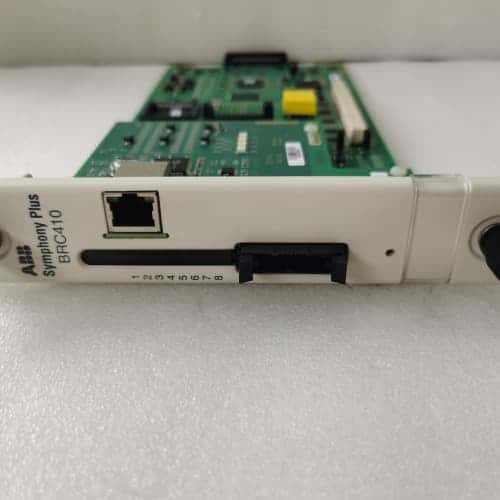
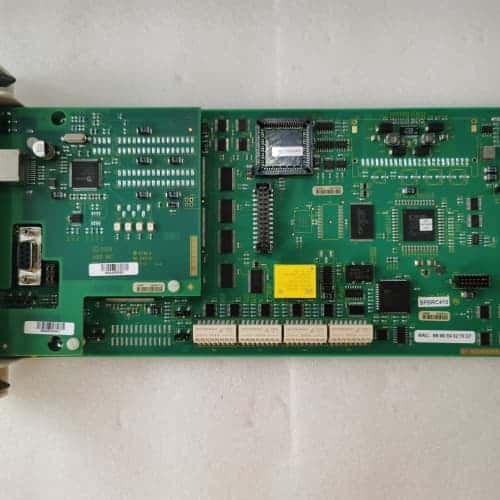
Bus signals don’t travel forever without help — every meter of cable, every connector, every rack boundary degrades the waveform until the receiver can’t tell a one from a zero. The ABB BRC410 sits on that path as a repeater, regenerating the CEX-Bus signal so the next segment sees a clean edge.
It’s a small card doing an unglamorous job, which is exactly why it gets overlooked during a troubleshooting session. A marginal repeater produces bus errors that look like a failing I/O card three racks away.
Key Technical Specifications
| Parameter | Value |
|---|---|
| Part number | BRC410 |
| Function | CEX-Bus repeater card |
| Platform | AC 800M racks — confirm rack configuration per OEM manual |
| Bus | CEX-Bus segment extension |
| Mounting | Card slot, AC 800M chassis — confirm slot per OEM drawing |
| Supply | Rack-supplied — confirm rail voltage against OEM manual |
| Operating temp | Confirm against OEM datasheet for this revision |
| Diagnostics | Verify bus status indicators per OEM manual |
| Termination | Verify termination requirements per OEM drawing |
⚠️ Confirm slot compatibility, segment configuration, and termination requirements against the ABB publication for BRC410 before installation. Repeater placement and termination decide whether the bus works — verify both against the OEM drawing.
Quality Inspection Process
Incoming Verification. Packing slip or channel documentation photographed and filed against the serial number. Serial lookup against ABB records where available — no match, no sale. Visual pass checks the card edge connector for bent pins and wear, the bus connector for corrosion, the board for rework flux residue, and the front panel for cracks. Accessories audited against the box label.
Live Functional Test. Units go into an AC 800M test rack with two bus segments connected through the repeater and reference I/O on both. Power-on self-check logged first — card recognition and status indicators compared against a known-good reference. Then a data pass: verify communication across both segments and confirm bus error counters stay flat under load. Continuous run 24 hours with temperature logging every 10 minutes.
Electrical Parameters. Insulation resistance at 500 V megger where the card allows, pass threshold >10 MΩ. Bus signal integrity checked on the output segment. Ground continuity verified. We use a Fluke 115 for supply rail and continuity checks.
Firmware Verification. Card revision read where applicable and recorded. Any termination settings or switch positions photographed before the card goes back in the bag.
Final QC & Packaging. QC sign-off, anti-static bag, bubble wrap, carton, QC Passed label with date. Test photos and video available on request. Each unit passes all tests above — nobody can honestly promise zero defects.
Field Replacement Pitfalls
Repeater Placement and Segment Count. ❗ The CEX-Bus allows a limited number of repeaters and segments. Add one more repeater than the design permits and the bus runs — intermittently — with errors that look like a bad I/O card. Verify the segment count and repeater placement against the OEM drawing before you install.
Termination on the Extended Segment. The far end of the extended segment needs correct termination. A repeater installed without it, or with termination on the wrong end, produces signal reflections that show up as intermittent bus faults under load.
Slot and Configuration. AC 800M racks assign function by slot and the bus configuration expects the repeater in a specific position. Fit the card in the wrong slot and the segment either doesn’t extend or drops entirely. Follow the system drawing.
Cable Routing and Noise. The bus cable has a routing requirement per the OEM manual. A cable routed alongside a drive output or around a tight panel corner picks up noise, and the repeater regenerates the noise as faithfully as the signal. Check the routing before condemning the card.
ESD and Handling. Wear the wrist strap. The bus connector and card edge are the fragile parts — a dry winter warehouse and a careless hand damage the card before it sees a rack.
Get these five right and you’ll cut rework time by 90%.
New Original vs. Refurbished: Why It Matters
What “New Original (New Surplus)” means here. ABB-manufactured, original packaging (opened only for testing if at all), no wear on the card edge connector or bus connector, no board-level repairs, final-batch or channel stock. The card was never installed in a running rack.
Refurbished risk, plainly. Aging components and reworked solder joints sit hidden under a clean card. Failure rates on refurbished repeater cards typically run 3–5× higher than new, and the failure mode is intermittent bus errors that nobody traces back to the repeater.
The real cost. One marginal repeater on a live process can cost more than the entire price gap — sometimes 10× over. The card is cheap; a bus segment that drops under load isn’t.
What we provide as proof. OEM packing slip photo, serial number traceable to OEM, test report, anti-static bag seal (or a documented reason for opening).
Pricing context. Our price sits 30–50% above refurbished alternatives and 20–40% below current ABB list — the delta covers global sourcing, QC testing, and a 12-month warranty.
Performance Benchmarks & Test Results
Test environment: AC 800M test rack with two bus segments through the repeater, reference I/O on both, ambient 22–24 °C, card revision as recorded per unit.
Bus communication: I/O on the extended segment communicates correctly with the controller across the 24-hour soak
Error counters: no bus errors climbing under full segment load over the run
Signal integrity: output segment waveform holds within the expected band at the far end
Card recognition: recognized by the test rack on every power cycle across the soak
Thermal: stable across the bench ambient range; derating and temperature limits must be verified against the ABB curve for BRC410
MTBF: not published for this revision in available documentation — do not quote a figure without the OEM reliability report
Figures reflect our bench conditions, not a guaranteed field spec. Verify against the ABB datasheet for BRC410 before you size a bus segment around it.
 Email: sales@plcfcs.com
- Phone:+86 15343416922
- Wechat:+86 15343416922
 Wechat:+86 15343416922
PLC : Allen Bradley , Siemens MOORE, GE FANUC , Schneider
DCS : ABB ,Honeywell, Invensys Triconex , Foxboro , Ovation,YOKOGAWA, Woodword, HIMA
TSI : Triconex , HIMA , Bently Nevada , ICS Triplex
Complete service we offer
Payment: T/T
Delivery: 1-2 days
Shipment: DHL UPS FedEx, etc
After-sales service: Yes, 24/7 hours