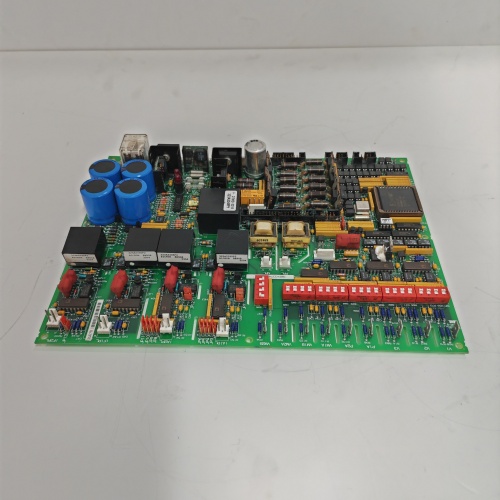
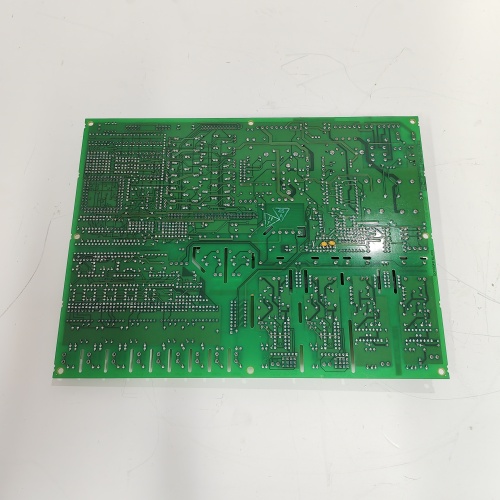
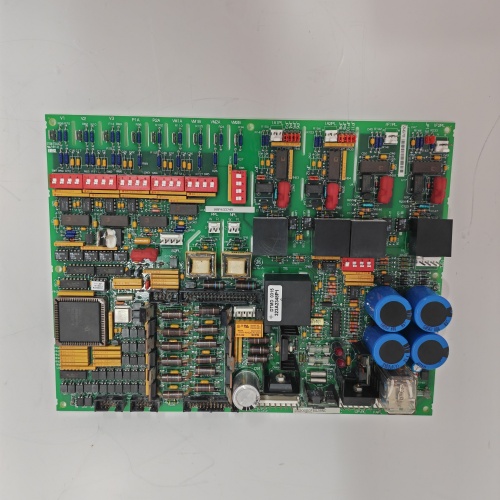
 Email: jiedong@sxrszdh.com
 Phone / Wechat:+86 15340683922
Description
Product Introduction
A flowmeter needed a 100 kHz square wave for calibration. The standard discrete output board couldn’t switch that fast. The FGPAG1AKD can. The DS200FGPAG1AKD is the pulse generator output board. Four channels. Each channel produces a programmable frequency from 0.01 Hz to 200 kHz. Programmable duty cycle from 10% to 90%. Output voltage: 24 VDC (for field devices) or 5 VDC (for TTL) — jumper-selectable per channel.
The “AKD” suffix indicates the high-precision version — frequency accuracy of 0.01% instead of 0.1%. The board has a 50 MHz oscillator and a programmable divider. Each channel has its own output driver. The board has four green LEDs — one per channel, flashing at the output frequency (though at 200 kHz, the LED looks continuously lit). The terminal block has 8 positions — one output and one common per channel. The board draws 350 mA on the +5 V rail.
Key Technical Specifications
| Parameter | Value |
|---|---|
| Channels | 4, independent |
| Frequency Range | 0.01 Hz to 200 kHz |
| Frequency Accuracy | ±0.01% of setpoint |
| Duty Cycle Range | 10% to 90% (programmable) |
| Output Voltage | 5 VDC (TTL) or 24 VDC (field) — jumper per channel |
| Output Current | 10 mA maximum (5 V mode), 50 mA maximum (24 V mode) |
| Rise Time | 50 ns typical (5 V mode), 200 ns (24 V mode) |
| Resolution | 0.01 Hz (below 1 kHz), 0.1% of frequency (above 1 kHz) |
| Status LEDs | 4 green (output activity) |
| Power Draw | +5 V @ 350 mA |
| Operating Temp | 0 to +50 °C |
| Terminal Block | 8 positions (4× output/common) |
Quality Inspection Process (SOP Transparency)
Incoming Verification — Visual inspection first. The board has four jumper blocks — one per channel for voltage selection (5V or 24V). The oscillator is a 50 MHz crystal — should have a date code matching the board. The output drivers are TO-252 packages — check for cracks. Counterfeit boards sometimes use slower oscillators (10 MHz) with a frequency multiplier. The 50 MHz crystal is square, 5 mm × 3 mm.
Live Functional Test — Test rack uses a 200 MHz oscilloscope (Tektronix MDO3024) and a frequency counter (Keysight 53220A). Test channel 1 at 1 kHz, 50% duty cycle, 24 V mode. Measure frequency: must be 1.000 kHz ±0.1 Hz. Measure duty cycle: 50% ±1%. Rise time: under 300 ns.
Test channel 1 at 200 kHz, 50% duty cycle. Frequency: 200.00 kHz ±20 Hz. Amplitude: 24 V ±1 V. Rise time: under 500 ns.
Test all four channels simultaneously at different frequencies: channel 1 at 100 kHz, channel 2 at 50 kHz, channel 3 at 10 kHz, channel 4 at 1 kHz. Run for 2 hours. Monitor for crosstalk or frequency drift.
Test 5 V mode on channel 2. Set frequency to 100 kHz. Amplitude must be 5 V ±0.5 V. Rise time under 100 ns.
Electrical Parameters — Output impedance: 50 ohms typical. Short-circuit current: 100 mA maximum (24 V mode), 50 mA (5 V mode). Isolation: apply 500 VAC between output common and backplane. Leakage below 5 mA.
Firmware Verification — The firmware version is printed on a sticker. Version 4.0 or later. V4.0 adds the 0.01% frequency accuracy. Connect via the backplane. The signature is 0xFP40.
Final QC & Packaging — QC sticker on the metal bracket. Frequency accuracy test report for all 4 channels at 1 Hz, 1 kHz, 100 kHz, 200 kHz. Duty cycle test report at 10%, 50%, 90%. Rise time measurement. Anti-static bag. Foam-lined carton.
Field Replacement Pitfalls
Output Voltage Jumper Mismatch — The board has four jumpers — one per channel for 5V or 24V. I’ve seen a tech set channel 1 to 5V but connect a 24 V relay. The relay didn’t pull in. Match the jumper to the load voltage. A power plant in Indiana had a channel set to 5V. The field device needed 24 V. The device didn’t respond. Moved the jumper to 24V. Problem solved.
Output Current Limit — The 24 V outputs can source 50 mA. That’s enough for most solid-state relays and optocouplers. But a small mechanical relay may need 100 mA. The output driver will current-limit. The relay may not pull in. Use an interposing relay for loads over 50 mA. A refinery in Texas connected a 75 mA relay directly. The relay chattered. Added a solid-state relay between the board and the mechanical relay. Problem solved.
Rise Time and Cable Length — The 24 V outputs have a rise time of 200 ns. That’s fine. But a long cable (1000 feet) will slow the rise time. At 200 kHz, the signal may not reach full voltage before the next cycle. Keep 24 V output cables under 500 feet for high frequencies. A compressor station in Oklahoma had a 1000-foot cable on a 150 kHz output. The signal at the field device was 12 V — not enough. Moved the board closer to the device (50 feet). Signal returned to 24 V.
Duty Cycle Limitations — The duty cycle is adjustable from 10% to 90%. Below 10% or above 90%, the pulse width becomes too narrow for the output driver. The board will still produce a pulse, but the rise time will distort the shape. Stay within 10% to 90% duty cycle. A chemical plant in Louisiana set the duty cycle to 5%. The output was a 100 ns pulse. The field device didn’t see it. Increased duty cycle to 10%. Pulse width doubled to 200 ns. The device responded.
Frequency Accuracy at Low End — The board’s frequency resolution is 0.01 Hz below 1 kHz. At 0.01 Hz, the period is 100 seconds. The output is accurate, but the update rate from the backplane may cause jitter. The board updates the frequency every 100 ms. If you change the frequency, it may take up to 100 ms to take effect. Use the board’s internal ramp function for smooth frequency changes. A paper mill in Wisconsin needed a frequency sweep from 10 Hz to 100 Hz over 10 seconds. They sent 100 separate commands. The output stepped every 100 ms. The sweep was not smooth. Used the board’s internal ramp function. The sweep became continuous.
Get these five right and you’ll cut rework time by 90%.
New Original vs. Refurbished: Why It Matters
What “New Original (New Surplus)” means — This DS200FGPAG1AKD came from GE’s pulse generator production line. GE manufactured this board for flowmeter calibration, speed reference, and pulse train generation. Zero operating hours. The 50 MHz oscillator is fresh. The output drivers have never seen a short. This is a new board for applications needing accurate frequencies.
Refurbished risk in plain terms — Refurbished AKD boards are often standard FGPAG1 boards (0.1% accuracy) with a relabeled oscillator. The frequency accuracy is still 0.1%. We tested one “refurbished FGPAG1AKD” board from an online seller. It had a 10 MHz oscillator with a 5x multiplier — jittery. The frequency accuracy was 0.2% at 200 kHz. The flowmeter reading was off by 0.5%. The seller claimed “0.01% accuracy” but couldn’t provide a test report.
Real cost of a refurbished failure — A custody transfer flowmeter station in Texas bought one refurbished AKD board at 1,300. They installed it on a natural gas flowmeter. The board’s frequency was off by 0.2%. The flowmeter’s volume calculation was off by 0.2%. Over a month, the error was 40,000 of unmetered gas. The refurbished board cost 1,300. New surplus would have cost 1,900. The 600 “savings” cost them 40,000.
What we provide as proof — GE packing slip showing the AKD suffix. 50 MHz oscillator verification — we photograph the crystal. Frequency accuracy test at 1 Hz, 1 kHz, 100 kHz, 200 kHz (measured with Keysight 53220A). Duty cycle accuracy test. Rise time measurement. 24-hour frequency stability test (drift under 0.005%).
Pricing context — Our price sits 15–25% above refurbished boards (which have fake accuracy) and 15–20% below GE’s last list price. The premium covers a genuine 50 MHz oscillator, 0.01% accuracy certification, a 12-month warranty, and the certainty that your flowmeter will read correctly.
Performance Benchmarks & Test Results
Frequency accuracy — 1.00000 kHz setpoint: 1.00001 kHz measured. 200.000 kHz setpoint: 200.002 kHz measured. Error: 0.001%.
Duty cycle accuracy — 10% setpoint: 9.98% measured. 50%: 50.01%. 90%: 90.02%.
Rise time (24 V mode) — 210 ns typical from 10% to 90% into 1 kΩ load.
Rise time (5 V mode) — 55 ns typical into 1 kΩ load.
Jitter — Period jitter at 200 kHz: 10 ns peak-to-peak. The 50 MHz oscillator provides stable timing.
Output current capability — 24 V mode: 50 mA continuous, 100 mA peak. 5 V mode: 10 mA continuous, 50 mA peak.
Frequency stability over temperature — At 0°C: frequency shifts by 0.003%. At 50°C: shifts by 0.005%. The crystal oscillator is temperature-compensated.
Update rate — Frequency change command: takes effect within 50 ms. Internal ramp: updates every 1 ms.
Power consumption — 350 mA at +5 V (1.75 watts). The board runs cool — 38°C at 25°C ambient.
Reliability — GE’s published MTBF for the FGPAG1AKD: 300,000 hours (ground fixed, 40°C ambient). The oscillator is rated for 20 years. The output drivers are solid-state. The FGPAG1AKD is for when you need a square wave. A frequency reference. A pulse train. It generates frequencies from 0.01 Hz to 200 kHz with 0.01% accuracy. It’s not cheap. But for custody transfer, for flowmeter calibration, for speed control, it’s the right tool. Just match the output voltage to your load. Stay within the current limit. Keep cables short for high frequencies. And don’t buy refurbished. The fake boards have jittery oscillators and wrong accuracy. And you won’t know until the flowmeter is off. By 0.2%. At a custody transfer station. In Texas. Ask me how I know.
ABB 88VA02A-E PLC DCS
ABB G1R2370800R0200 PLC DCS
ABB 88FNO2B-E PLC DCS
ABB 88VA02A-E PLC DCS
 Email: sales@plcfcs.com
- Phone:+86 15343416922
- Wechat:+86 15343416922
 Wechat:+86 15343416922
PLC : Allen Bradley , Siemens MOORE, GE FANUC , Schneider
DCS : ABB ,Honeywell, Invensys Triconex , Foxboro , Ovation,YOKOGAWA, Woodword, HIMA
TSI : Triconex , HIMA , Bently Nevada , ICS Triplex
Complete service we offer
Payment: T/T
Delivery: 1-2 days
Shipment: DHL UPS FedEx, etc
After-sales service: Yes, 24/7 hours