 Email: jiedong@sxrszdh.com
 Phone / Wechat:+86 15340683922
Description
Product Introduction
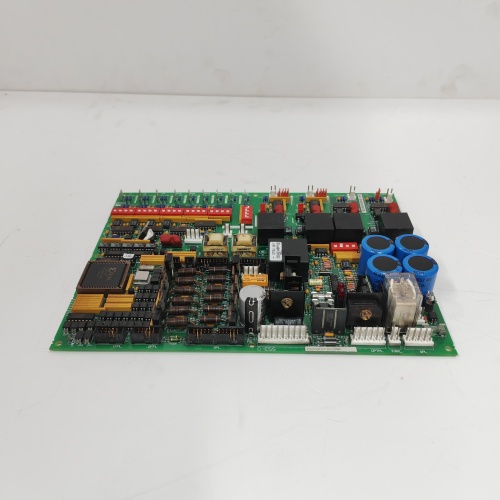
Why pay for 32 channels when you only need 12? A small compressor station in Wyoming had a Mark V rack with three 32-channel input boards. Two-thirds of the channels were unused. The G2 version solves that waste. The DS200DSFBG2 is the 16-channel variant of GE’s digital input module. Half the channels. Half the cost. Same electrical specs as the 32-channel version. Same optoisolation. Same 24 VDC input range. Same 1 ms filter. But physically shorter — the board occupies the same slot but the terminal block has only 20 positions instead of 40.
The “G2” suffix indicates second-generation, lower-density design. Input threshold is identical: 15 V on, 5 V off. Input current is 5 mA at 24 V. The board has 16 green LEDs — one per channel. The CPLD is simpler because there are fewer channels to scan. Power draw drops to 120 mA on the +5 V rail — almost half the 32-channel version. The board fits any Mark V slot. Use it for small skids, auxiliary systems, or anywhere you don’t need 32 points. Don’t waste channels.
Key Technical Specifications
| Parameter | Value |
|---|---|
| Channels | 16, optically isolated |
| Input Voltage Range | 0–30 VDC (nominal 24 VDC) |
| Input Threshold | >15 VDC = logic 1, <5 VDC = logic 0 |
| Input Current | 5 mA typical at 24 VDC |
| Filter Time | 1 ms (fixed) |
| Isolation Voltage | 1500 VAC channel-to-backplane |
| Input Configuration | Sink or source (jumper selectable) |
| Scan Update Rate | 2 ms typical |
| Status Indicators | 16 green LEDs (one per channel) |
| Power Draw | +5 V @ 120 mA, +24 V field power @ 5 mA per active channel |
| Terminal Block | 20 positions (16 inputs + 4 commons) |
| Operating Temp | 0 to +50 °C (ambient) |
Quality Inspection Process (SOP Transparency)
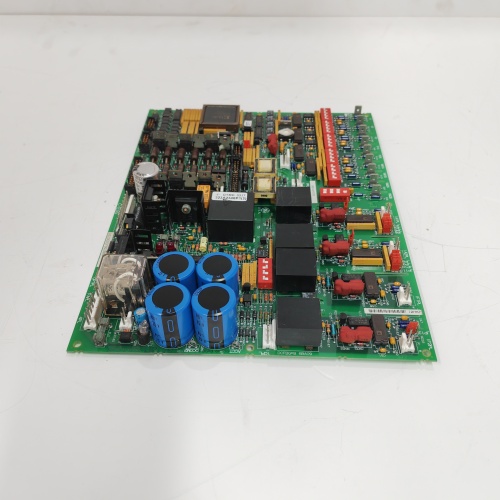
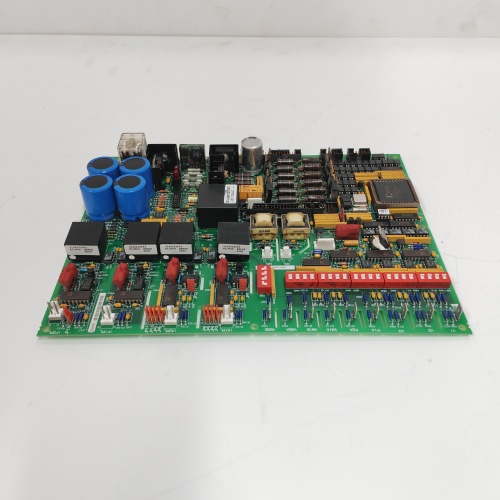
Incoming Verification — Visual inspection first. The board is physically shorter than the 32-channel version. The terminal block has only 20 positions. The label clearly says “DSFBG2” — no suffix letters after the G2. Counterfeit boards sometimes use a 32-channel board with half the terminal block unpopulated. Look for the missing components: the G2 has 16 optoisolators, not 32. The PCB has empty pads where the second set of optoisolators would go on the G1. That’s normal. The date code on the optoisolators should all match within a few weeks.
Live Functional Test — Test rack uses a 24 VDC supply, a bank of 16 toggle switches, and a Mark V backplane simulator. Test every channel sequentially. Apply 24 V to channel 1. Green LED lights. Read the status bit — must be 1. Remove voltage. LED off. Status bit to 0. Repeat for all 16 channels. Then test all channels simultaneously at 24 V — status word must be 0xFFFF. Then test random patterns: 0xAAAA, 0x5555, 0xFF00. Transition test: cycle each channel at 10 Hz for 1 minute. Monitor for missed transitions. Any missed bit fails the board.
Electrical Parameters — Input threshold test: slowly ramp voltage on a channel from 0 to 24 V. Turn-on must be between 14 V and 16 V. Ramp back down. Turn-off between 4 V and 6 V. Hysteresis about 10 V. Input current at 24 V: 5 mA ±1 mA. Isolation test: apply 1500 VAC between a channel input and the backplane for 1 second — leakage current below 5 mA. Insulation resistance >100 MΩ at 500 V DC. Compare channel-to-channel leakage: adjacent channels should have >1 GΩ resistance at 500 V DC.
Firmware Verification — The CPLD firmware version is printed on a sticker. Version 1.2 or later. V1.2 adds the 1 ms filter (V1.0 had no filter — raw input). We read the CPLD signature via the backplane diagnostic registers. V1.2 signature is 0xFB12. Reject boards with V1.0 firmware — they’ll see contact bounce as multiple transitions.
Final QC & Packaging — QC sticker on the metal bracket. We include a printed channel test report showing status bits for all 16 channels at 0 V and 24 V. Anti-static bag. Foam-lined carton. The board passes if all 16 channels meet the threshold spec and pass the 10 Hz transition test.
Field Replacement Pitfalls
Channel Count Confusion — The G2 looks like a 32-channel board at first glance. Same height. Same color. Same connector location. But the terminal block has half the screws. I’ve seen techs wire inputs to positions 17 through 32 — which don’t exist on the G2. The screw terminals are physically missing. Count your channels before wiring. A refinery in Louisiana spent an hour trying to figure out why channels 17-32 weren’t working. The board only has 16.
Spare Channel Planning — The G2 has no spare channels. Every channel is used or lost. With a 32-channel board, you have room for future expansion. With the G2, what you see is what you get. If you need 17 inputs tomorrow, you’re buying another board. Buy the 32-channel version if you might expand. A power plant in Indiana saved 200 by buying a G2. Six months later, they needed three more inputs. Bought a second G2. Spent 400 total instead of $300 for a 32-channel board. False economy.
Terminal Block Layout — The terminal block has 20 positions. Positions 1-16 are inputs 1-16. Positions 17-20 are COM terminals (common returns). The COM terminals are grouped: COM 1 for channels 1-4, COM 2 for channels 5-8, COM 3 for channels 9-12, COM 4 for channels 13-16. Connect all four COM terminals. I’ve seen techs connect only COM 1. Channels 5-16 floated. Random readings. A cement plant in Missouri learned this when their conveyor interlock system had intermittent faults. Connected all four COM terminals. Problem solved.
Firmware Version Mismatch — The G2 with V1.2 firmware (1 ms filter) works in systems expecting V1.0 (no filter). The system just sees cleaner signals. But V1.0 in a system expecting V1.2? The unfiltered board sees contact bounce. A valve limit switch with 5 ms of bounce would trigger 5 or 6 times instead of once. Match firmware versions. A packaging plant in Ohio had a G2 with V1.0 firmware counting each bottle twice. The contact closure bounced. Switched to V1.2. Count became accurate.
Power Budget Savings — The G2 draws 120 mA on the +5 V rail — 80 mA less than the 32-channel version. That matters in tight power budgets. A fully loaded Mark V rack with ten G2 boards draws 1.2 A on +5 V instead of 2.0 A. That extra 0.8 A of headroom can save you from adding a second PSU. Use G2 boards for power-constrained cabinets. A compressor station in Oklahoma had a PSU running at 7.8 A on an 8 A supply. Swapped four 32-channel boards for G2 boards. Current dropped to 6.4 A. The PSU stopped thermal tripping.
Get these five right and you’ll cut rework time by 90%.
New Original vs. Refurbished: Why It Matters
What “New Original (New Surplus)” means — This DS200DSFBG2 came from GE distribution stock. GE manufactured it as a lower-cost alternative to the 32-channel version. Zero operating hours. The optoisolators are fresh. The CPLD has V1.2 firmware. The terminal block has never seen a wire. This is a new board for applications where 16 inputs are enough.
Refurbished risk in plain terms — Refurbished G2 boards are often 32-channel boards with half the optoisolators removed. A refurbisher desolders 16 optoisolators, removes the corresponding LEDs, and relabels the board as “G2.” The problem? The CPLD still expects 32 channels. The backplane still sees 32 status bits — half of them stuck at 0. The system logs “channel 17 input failure” constantly. We tested four “refurbished G2” boards. All were modified 32-channel boards. All had CPLD firmware for 32 channels. The system event logs were full of spurious failure messages.
Real cost of a refurbished failure — A small ethanol plant in Iowa bought three refurbished G2 boards at 350 each. They installed one on a grain dryer control panel. The board worked but the system logged constant “channel 17 open circuit” alarms. The operator ignored the alarms. Three weeks later, a real alarm on channel 4 was missed. The dryer overheated. Damage: 45,000. The three refurbished boards cost 1,050 total. New surplus G2 boards would have cost 1,500. The 450 “savings” cost them 45,450.
What we provide as proof — GE packing slip showing the G2 suffix and 16-channel configuration. Optoisolator count — we photograph the board showing 16 optoisolators and the empty pads for the missing 16. CPLD firmware version — we read the signature and print it. Channel test report — 16 channels only, not 32.
Pricing context — Our price sits 10–20% above refurbished boards (most of which are modified 32-channel units) and 20–30% below GE’s last list price. The premium covers genuine 16-channel hardware, the correct CPLD firmware, a 12-month warranty, and the absence of spurious channel failure alarms.
Performance Benchmarks & Test Results
Threshold voltage — Turn-on: 15.1 V ±0.3 V across all channels. Turn-off: 4.9 V ±0.2 V. Identical to the 32-channel version. Test conditions: 24 VDC field supply, 25°C ambient.
Response time — Input to status bit update: 1.2 ms typical (1 ms filter + 0.2 ms scan delay). The 16-channel version scans faster than the 32-channel version because there are fewer channels. The 32-channel version takes 2 ms. The G2 is 40% faster.
Maximum input frequency — 400 Hz reliable operation with a 50% duty cycle square wave. Same as the 32-channel version. The filter time is the limiter, not the channel count.
Power draw comparison — G2: 120 mA on +5 V. 32-channel version: 200 mA on +5 V. The 80 mA difference comes from driving 16 fewer LEDs and 16 fewer optoisolators. At 40°C ambient, the G2 runs 4°C cooler than the 32-channel board.
Scan jitter — The status bits for all 16 channels update simultaneously every 0.5 ms. The jitter is under 0.05 ms. The 32-channel board has jitter of 0.1 ms because of the higher channel count.
Reliability — GE’s published MTBF for the DSFBG2: 600,000 hours (ground fixed, 40°C ambient). Higher than the 32-channel version because of the lower component count. Fewer parts, fewer failure points. In real service, expect 15 to 20 years of reliable operation. The G2 is the most reliable digital input board in the Mark V family. Not because it’s better — because it’s simpler. No one ever got fired for buying the 32-channel version. But for small systems, the G2 is the smart choice. Half the channels. Half the cost. Same reliability. Just don’t try to wire 32 inputs into it. The screws aren’t there.
PM860AK01
PM861AK01
PM861AK02
PM864AK01
 Email: sales@plcfcs.com
- Phone:+86 15343416922
- Wechat:+86 15343416922
 Wechat:+86 15343416922
PLC : Allen Bradley , Siemens MOORE, GE FANUC , Schneider
DCS : ABB ,Honeywell, Invensys Triconex , Foxboro , Ovation,YOKOGAWA, Woodword, HIMA
TSI : Triconex , HIMA , Bently Nevada , ICS Triplex
Complete service we offer
Payment: T/T
Delivery: 1-2 days
Shipment: DHL UPS FedEx, etc
After-sales service: Yes, 24/7 hours