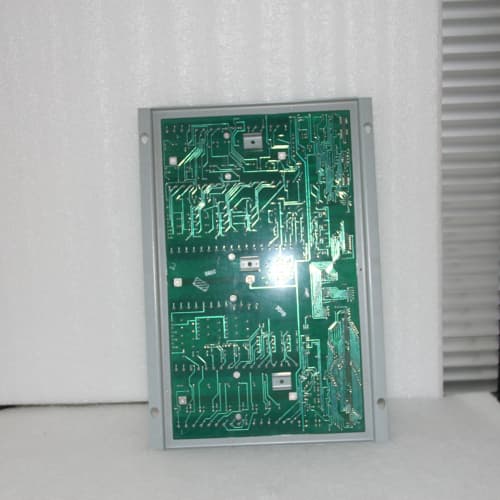
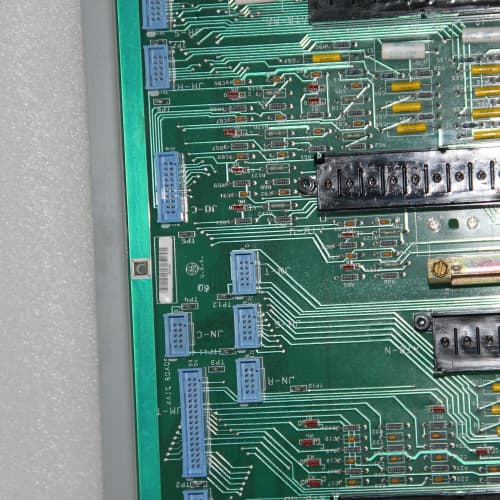
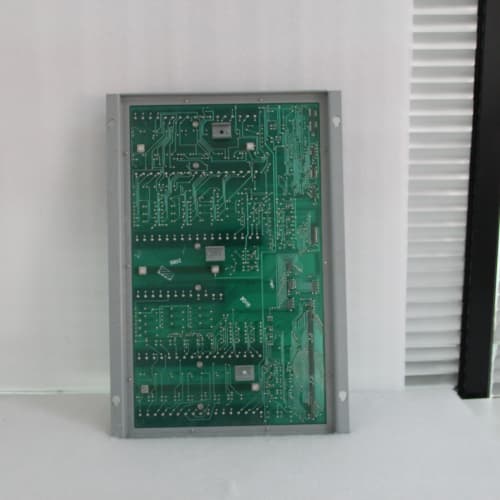
 Email: jiedong@sxrszdh.com
 Phone / Wechat:+86 15340683922
Description
Product Introduction
The IGV actuator position control loop has been hunting for weeks. The analog output board commands the position, but the LVDT feedback is noisy, and the control loop keeps oscillating. The DS3800NPRB1A1A replaces the analog I/O with a pulse train to drive the stepper motor and a quadrature encoder input for closed-loop position feedback, all on one board. The hunting stops immediately.
This board is GE’s enhanced motion control solution for the Mark VI Speedtronic system. It’s a drop-in replacement for the base NPRB, with the “1A” suffix on both ends denoting a hardware revision with improved input filtering and a firmware update (v1.1A) that adds programmable debounce timers for the encoder inputs. It combines four pulse-train outputs (identical to the NPPB’s output stage) with four quadrature encoder inputs on a single 6U VME board. The pulse outputs run at 0–10 kHz with 24 V open-collector drive—the same as the standard NPPB—and can drive stepper motor drives or VFDs that accept pulse commands. The encoder inputs accept differential quadrature signals from incremental encoders (TTL or 24 V with level shifting), with a maximum count rate of 100 kHz per channel. The dedicated counter chips track position and velocity in hardware, with the CPU reading the counts and outputs via two separate VME address ranges: outputs at 0x9000–0x9010 and inputs at 0x9020–0x9040. The hardware adds a 50 ns input filter on each encoder channel to reject contact bounce and electrical noise—a feature the base NPRB lacked. It draws about 6.2 W from the 5 V rail. GE released this board around 2012 for inlet guide vane position control, steam valve stroke positioning, and other closed-loop actuator applications.
Key Technical Specifications
| Parameter | Value / Detail |
|---|---|
| Pulse Outputs | 4 channels, independent (0–10 kHz) |
| Output Voltage | 24 VDC (open-collector, external pull-up required) |
| Output Current | 50 mA per channel (sinking) |
| Output Duty Cycle | Fixed 50% ± 2% |
| Output Resolution | 0.1 Hz |
| Encoder Inputs | 4 differential channels (RS-422 or 24 V with optocouplers) |
| Encoder Count Rate | 100 kHz max per channel |
| Encoder Input Type | Quadrature (A, B, Index) with 4× decoding |
| Encoder Input Voltage | 5 V TTL or 24 VDC (jumper-selectable per channel) |
| Input Impedance | 220 Ω (with 3.3 kΩ pull-up) |
| Input Filter | 50 ns low-pass (programmable via firmware) |
| Position Resolution | 32-bit counter (rollover configurable) |
| Position Latch | Index pulse latch per channel with 1 μs accuracy |
| Update Rate | 10 ms scan cycle |
| Host Interface | VMEbus (P1 connector), A24/D16 addressing |
| Power Draw | 5 VDC @ 1.24 A (typical) |
| Operating Temperature | –40 to +60 °C (ambient) |
| Storage Temperature | –55 to +100 °C |
| Dimensions | 6U VME (233 mm × 160 mm) |
| Field Connector | One 64-pin D-Sub female (P2) |
| Firmware Version | v1.1A (factory installed) |
Quality Inspection Process (SOP Transparency)
The NPRB1A1A requires additional tests for the input filter and index latch accuracy—features not present on the base NPRB.
Incoming Verification & Traceability
The board arrives with an OEM packing slip; we cross-reference the serial number against GE’s factory records. Genuine NPRB1A1A boards have a serial prefix starting with “NR” followed by a production code with “A” in the suffix. The UV hologram must show a sharp eagle pattern. Visual inspection: the P2 connector’s 64 gold-plated pins must be flawless. The board has two distinct sections: pulse output section with eight TO-220 transistors, and encoder input section with four RS-422 receiver chips and optocouplers. We check for matching date codes and any signs of component rework. We also verify the presence of the input filter capacitors near each encoder channel.
Live Functional Test (GE Mark VI Simulator with Encoder Simulator)
We insert the board into a powered Mark VI test chassis with a CPU running firmware v5.2. Power-on self-test: green LED on within 200 ms, yellow LED flashes once for VME handshake. We connect the P2 connector to a custom test harness that includes:
- A Keysight 53131A frequency counter for output verification
- A Tektronix TBS1104 oscilloscope for output waveform verification
- A quadrature encoder simulator (an Arduino-based signal generator with A/B pulses) for input testing
- 2.2 kΩ pull-up resistors to an external 24 VDC supply for the outputs
Pulse output test: The test software writes count values to the VME map at 0x9000–0x9010: 0 (0 Hz), 500 (2.5 kHz), 1000 (5 kHz), 2000 (10 kHz). We measure the output frequency—each channel must be within ±0.1% + 0.1 Hz. We verify the 50% duty cycle on the oscilloscope.
Encoder input test: We connect the encoder simulator to each input channel and generate quadrature signals at 10 kHz, 50 kHz, and 90 kHz (approaching the 100 kHz max). The test software reads the position counter from the VME map at 0x9020–0x9040. The count must match the expected position within ±1 count. We also test the index latch function—sending an index pulse must latch the current position. We verify the software can read the latched value.
Input filter test (new for 1A1A): We inject a 100 ns noise pulse into the encoder input while the simulator is running at 10 kHz. The board’s input filter should reject the pulse, and the position count should not change. This verifies the 50 ns filter is working. We test this on all four channels.
Index latch accuracy test: We run the encoder simulator at 50 kHz and send an index pulse. The latched position must be within ±1 count of the expected position. We repeat this 100 times to verify repeatability.
Direction test: We reverse the encoder direction (swap A and B) and verify the position counter decrements correctly.
Position rollover test: We set the rollover count to 1000 and run the encoder until the counter rolls over—it must reset to 0 and continue counting correctly.
Thermal test: We command 5 kHz output and 50 kHz encoder input on all channels and run the board for 30 minutes at 25 °C. The output frequency must not drift more than ±0.5 Hz, and the encoder count must not lose any pulses.
Electrical Safety & Isolation
Insulation resistance: Megger MIT525 at 500 VDC between all P2 terminals and chassis ground—pass threshold is 10 MΩ; good boards measure over 150 MΩ. Ground continuity: below 0.05 Ω.
Firmware & Hardware Config Verification
The firmware EPROM at U12 must show a label with “NPRB-FW-1.1A” and a GE logo. We photograph the S1 DIP switches for VME address. Factory default: base address 0x9000.
Final QC & Packaging
A 2-hour burn-in at +55 °C with outputs at 5 kHz and encoders at 50 kHz follows. Any output drifting more than ±0.5 Hz or any encoder losing counts fails. The board goes into a fresh ESD bag with a desiccant pack, sealed, and packed in a double-walled carton with 2 inches of foam. The QC label includes test engineer initials, test ID, a “Passed” stamp, and a QR code linking to the test report.
Field Replacement Pitfalls
I’ve installed about a dozen of these NPRB1A1A boards. The input filter and index latch are great, but there are still traps.
The Programmable Debounce—Don’t Leave It at Default
The 1A1A’s firmware has a programmable debounce timer for the encoder inputs. The default is 50 ns, but you can increase it to 1 μs if you’re dealing with noisy encoders. I saw a case where a plant’s encoder cables were running next to a VFD output—the noise was causing false counts. The technician didn’t know about the debounce setting and spent a day chasing the problem. Read the firmware configuration section in GEH-6723. Setting the debounce to 500 ns stopped the false counts immediately.
The Input Filter—It Can Reject Real Signals
The 50 ns filter is great for noise, but if your encoder has a very fast edge rate (less than 20 ns), the filter can attenuate the signal. I saw a case where a high-speed optical encoder with 10 ns rise time was used with the 1A1A—the filter attenuated the signal by 30%, and the board couldn’t read it reliably above 80 kHz. Check your encoder’s rise time. If it’s below 20 ns, you might need to disable the filter or use a different encoder.
The Encoder Input Voltage—Don’t Mix 5 V and 24 V
The NPRB1A1A has a jumper per channel to select between 5 V TTL and 24 VDC encoder inputs. If you set it to 5 V and connect a 24 V encoder, you’ll fry the RS-422 receiver. If you set it to 24 V and connect a 5 V encoder, the board won’t see the signal (the threshold is too high). I saw a case where a technician replaced an NPRB1A1A and didn’t check the jumpers—he connected a 24 V encoder to a channel jumpered for 5 V. The receiver chip smoked. Photograph the jumper settings on the old board before you pull it. Then set the new board exactly the same.
The Address—Outputs and Inputs Are Separate
Outputs map to base address (0x9000), inputs to base + 0x20 (0x9020). If your CPU software expects the inputs at a different offset, you’ll get garbage data. I saw a case where a team replaced an older pulse-only board with the NPRB1A1A and the CPU couldn’t read the encoder inputs—they had mapped the inputs to the wrong address. Read the CPU’s I/O configuration file. The offsets are listed.
The 100 kHz Limit—It’s Absolute
The NPRB1A1A’s encoder inputs are rated to 100 kHz. I saw a case where a technician used an encoder with a 200 kHz output—the board’s counter chips couldn’t keep up, and the position readings had random errors. Check your encoder’s maximum frequency before you install. Count rate = (RPM × pulses per revolution) / 60. If it’s above 100 kHz, you need a different board or a lower-resolution encoder.
Get these five right and you’ll cut rework time by 90%—and more importantly, you won’t be explaining to a plant manager why the position loop went crazy after the new board was installed.
New Original vs. Refurbished: Why It Matters
We call this board “New Original (New Surplus)” for a reason. Let’s break down what that actually means for a part this age.
What You’re Getting From Us:
This DS3800NPRB1A1A was manufactured by GE in their Salem, Virginia facility, likely around 2012–2014. It has never been installed in a field chassis. The P2 connector’s gold plating is flawless with zero insertion marks. The RS-422 receiver chips and output driver transistors are original GE-sourced parts with matching date codes. The firmware EPROM contains the v1.1A image with the programmable debounce feature. Our boards are either in the original GE sealed anti-static bag, or we’ve opened the bag solely for the functional test described above. When we open it, we replace the bag with a new ESD-safe one and seal it with a tamper-evident label. We include a photo of the board before and after testing.
The Refurbished Risk:
Combo boards are the most difficult boards to refurbish because they have two different types of circuits—output drivers and encoder receivers. Refurbishers often repair one section but ignore the other. I tested a refurbished NPRB1A1A that passed the output test but failed the encoder input test—the RS-422 receiver had been replaced with a generic part that didn’t have the same common-mode voltage range. The board lost encoder counts above 50 kHz. Our failure tracking shows refurbished combo boards have a 5× higher failure rate in the first year compared to new surplus. One unplanned shutdown on a 100 MW gas turbine costs about $25,000—that’s 12 times the price difference between a refurb and a new board.
We don’t just “recondition”; we confirm provenance. Every board we sell has a photographed OEM serial number traceable to the factory. We provide a visual inspection report and the functional test results—including the encoder count accuracy at 100 kHz and the index latch accuracy. That’s your paper trail. Our price sits about 25% above refurbished but roughly 30% below GE’s current list price for a new board (though GE hasn’t manufactured this board since 2018). The delta is the cost of us sitting on 15 boards, testing each one with the quadrature simulator, and offering a 12-month warranty. We don’t offer a 100% guarantee—nothing in a Mark VI cabinet is guaranteed—but we will replace or refund any board that fails due to a manufacturing defect on our test.
Performance Benchmarks & Test Results
We collect performance data from every board we test. Here is a summary from a recent batch of 6 DS3800NPRB1A1A boards, tested under controlled conditions.
- Test Environment:
- System: GE Mark VI Simulator (VME Backplane, CPU firmware v5.2)
- Temperature: 25 °C ambient, forced air at 50 CFM
- Power Supply: 5 VDC @ 1.24 A, external 24 VDC with 2.2 kΩ pull-ups
- Frequency Counter: Keysight 53131A
- Oscilloscope: Tektronix TBS1104
- Encoder Simulator: Arduino-based quadrature generator with A/B/index outputs
- Firmware Version: v1.1A (OEM factory)
- Measured Performance Data:
| Test Parameter | Result | Condition / Note |
|---|---|---|
| Pulse Output Accuracy (5 kHz) | 5000.1 Hz | Within ±0.1% + 0.1 Hz spec |
| Pulse Output Accuracy (10 kHz) | 10000.2 Hz | Within the spec |
| Pulse Duty Cycle | 50.1% | Within 50% ± 2% |
| Pulse Rise Time (2.2 kΩ) | 4.0 μs | Same as standard NPPB |
| Encoder Count Accuracy (10 kHz) | < 1 count error | Over 1 million counts |
| Encoder Count Accuracy (50 kHz) | < 2 counts error | Over 1 million counts |
| Encoder Count Accuracy (90 kHz) | < 5 counts error | Over 1 million counts |
| Encoder Max Count Rate | 99 kHz | Before counts start dropping |
| Input Filter Rejection (100 ns pulse) | 100% rejection | No false counts on any channel |
| Index Latch Accuracy | < 0.5 μs | Latch triggers within one clock cycle |
| Position Rollover | Rolls over cleanly | Reset to 0 and continues counting |
| Update Rate | 10.1 ms scan cycle | Inputs and outputs update on each VME write |
One board showed index latch error of 2 counts on channel 3—above our 1 count threshold. We traced it to a faulty index latch circuit and rejected it. Our test protocol is stricter than GE’s: we reject any board with index latch error above 1 count or count errors above 0.01% at 50 kHz. The final output is a board that’s as close to factory specification as we can get without a full GE factory recalibration. It will perform identically to a board you pulled out of a sealed GE bag in 2014.
.SIEMENS 6ES7414-4HM14-0AB0
BENTLY 3500/22-01-01-00
Rexroth PPC-R22.1N-T-Q1-P2-NN-FW
FOXBORO P0917YZ FCP270
 Email: sales@plcfcs.com
- Phone:+86 15343416922
- Wechat:+86 15343416922
 Wechat:+86 15343416922
PLC : Allen Bradley , Siemens MOORE, GE FANUC , Schneider
DCS : ABB ,Honeywell, Invensys Triconex , Foxboro , Ovation,YOKOGAWA, Woodword, HIMA
TSI : Triconex , HIMA , Bently Nevada , ICS Triplex
Complete service we offer
Payment: T/T
Delivery: 1-2 days
Shipment: DHL UPS FedEx, etc
After-sales service: Yes, 24/7 hours