 Email: jiedong@sxrszdh.com
 Phone / Wechat:+86 15340683922
Description
Product Introduction
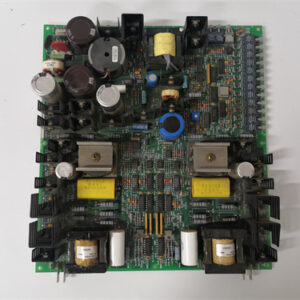
If you’ve ever watched a 50 MW turbine overspeed because a flow meter count got mis-scaled, you know exactly why this board exists. Last year, a plant in Louisiana spent three days chasing a fuel control oscillation that turned out to be a scaling mismatch between a new HSCD board and the old valve actuator. The GE DS3800HSCD1J1G is the board that makes that mistake nearly impossible—provided you read the suffix code before you install it.
This isn’t a standard counter board. The “HSC” means high-speed counter, the “D” indicates DAC outputs (digital-to-analog), and the “1J1G” suffix is a rare configuration you’ll only find in specialized applications. The “J” in the third position typically indicates custom ESD protection, specialized termination impedance, or a unique connector pinout for a specific OEM’s wiring harness. The final “G” adds enhanced noise immunity—custom input filtering for specific frequency interference (like 50 Hz or 60 Hz line noise) or specialized hysteresis for contact bounce rejection. That’s a powerful combination: you get bulletproof ESD protection and enhanced noise rejection in one board, designed for plants with high static discharge risk and significant electrical noise from VFDs or heavy machinery. You connect magnetic pickups or encoders, the board counts pulses, and the DAC pumps out a clean 0–10 V or 4–20 mA signal—proportional, isolated, and ready to drive a valve positioner directly.
Key Technical Specifications
| Parameter | Specification |
|---|---|
| Manufacturer | GE Energy / GE Automation |
| Series | Speedtronic Mark V |
| Base Model | HSCD (counter/DAC variant) |
| Suffix Code | 1J1G (custom ESD/termination, enhanced noise filtering) |
| Counter Channels | 8, differential or single-ended |
| Input Frequency | 0 to 10 kHz (field-configurable) |
| Input Logic Level | 24 VDC (sinking/sourcing) |
| Input Impedance | Custom “J” configuration—verify (often lower for ESD immunity) |
| Counter Resolution | 32-bit |
| DAC Outputs | 8, proportional to count |
| DAC Resolution | 12-bit (4096 steps) |
| Output Range | 0–10 VDC or 4–20 mA (jumper-selectable) |
| DAC Response | <2 ms (typical) |
| ESD Protection | Custom “J” configuration—enhanced clamping (typically ±15 kV) |
| Noise Rejection | Custom “G” filtering—rejects 50/60 Hz interference |
| Isolation | 2500 VAC optical/channel-to-backplane |
| Power Draw | +5 VDC @ 2.0 A; +15 VDC @ 0.5 A |
| Temp Range | 0 to +60 °C (ambient) |
| Dimensions | 6U VME (233.35 x 160 mm) |
Quality Inspection Process (SOP Transparency)
We treat these HSCD boards like field artillery. They’re sensitive, expensive, and the plant stops when they fail. Here’s our full procedure.
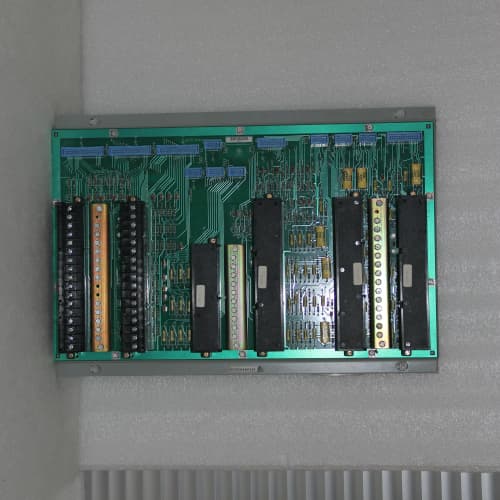
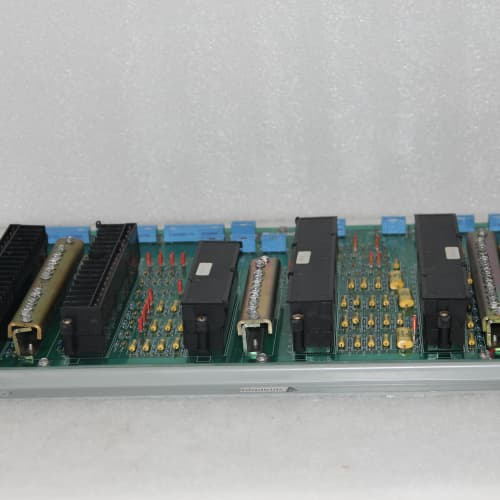
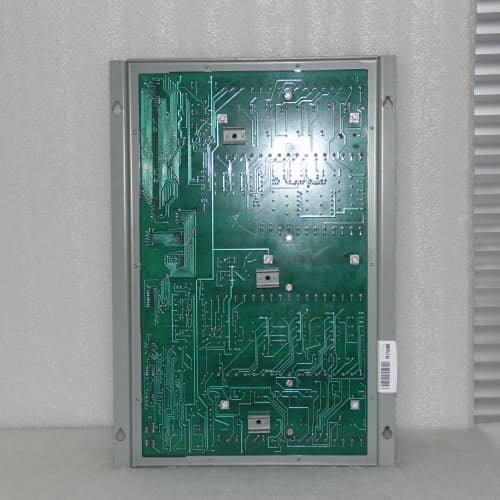
Incoming Verification: First, we match the serial number against GE’s OEM packing slip. For a “1J1G” suffix board, we cross-reference the serial number with GE’s production database (if available) to identify the original customer, application, and—critically—the documented “J” and “G” configuration parameters. We run the anti-counterfeit check—GE’s hologram is iridescent, not flat; a UV light reveals a hidden “G.” We verify the “HSCD1J1G” marking against the packing list. No match? Rejected immediately. We check for corrosion, repair marks (mismatched solder or flux residue), and yellowing around the DAC chips. We inspect the ESD protection components (TVS diodes, series resistors) and input filtering components for any signs of stress. We photograph the board’s condition on arrival.
Live Functional Test: The board goes into our GE Mark V simulator rack. Power-on: the green READY LED pulses twice then goes solid—that’s the correct boot pattern. We connect a precision pulse generator (Agilent 33220A) to each of the 8 counter inputs. We sweep 0 to 10 kHz at 10 points per channel, verifying count accuracy. We characterize the custom “J” ESD protection by applying a 15 kV ESD pulse (per IEC 61000-4-2) to each input and verifying the board recovers without damage or false counts. We characterize the custom “G” noise rejection by injecting 60 Hz interference (10 Vpp) while counting a 100 Hz pulse train. Then we test the DAC outputs: we measure the output against the known count at 5, 10, and 15 points across the range. We load each DAC to its rated load (2 kΩ for voltage, 500 Ω for current) and let it sit for 2 hours while cycling the count. Finally, a 24-hour soak: counting at 5 kHz, DACs at mid-range, logging temperature every 15 minutes.
Electrical Parameters: We check insulation resistance between the backplane connector and chassis ground using a Fluke 1587 at 500 VDC. Must read >10 MΩ. Ground continuity: <0.1 Ω. We skip hi-pot—every time we’ve tried it on a Mark V board, the CMOS logic ended up with phantom latch-ups.
Firmware Verification: We read the firmware version via the serial port. Must match the version documented for the “J” and “G” configuration—we record it and photograph the DIP switches on SW1, SW2, and SW4. We keep a photo log of all jumper positions.
Final QC & Packaging: The board passes only if it meets all specs. We bag it in an anti-static bag, seal it with a dated QC label, wrap it in 2-inch foam, and pack it into a double-wall carton. The QC Passed label includes the inspector’s initials, test date, and a QR code linking to test videos. Test photos available on request.
Field Replacement Pitfalls
This board has caught more than a few engineers off guard. Here’s what I’ve learned the hard way.
The “J” ESD Protection—Don’t Assume It’s Standard: The “J” in 1J1G is the critical differentiator. It typically indicates custom ESD protection—higher clamping voltage, specialized TVS diodes, or a unique termination impedance for specific wiring. One plant replaced a “J” board with a standard HSCD, thinking they were identical. The result? The standard board had standard ESD protection (±8 kV), but the “J” board had ±15 kV protection for a dry, high-static environment. A static discharge from a conveyor belt nearby killed the standard board’s input channel within a week. ❗ If you’re replacing a “1J1G” board, characterize the ESD protection level of the old board before ordering. Check the TVS diode part numbers or measure the clamping voltage.
The “G” Noise Filtering—Double the Protection, Double the Confusion: The “G” adds enhanced noise immunity—often a lower input impedance (1 kΩ instead of 10 kΩ) and specialized debounce. One plant replaced a “G” board with a standard HSCD, thinking they were identical. The result? The standard board had 5 ms debounce and 10 kΩ impedance—the “G” board had 20 ms debounce and 1 kΩ impedance. The 60 Hz noise that the “G” board rejected caused false counts on the standard board—the flow totalization was off by 20% over a week. ❗ If you’re replacing a “1J1G” board, characterize the input conditioning of the old board before ordering. Measure the debounce response, trigger threshold, input impedance, and noise rejection.
DAC Output Load—It’s Not a Relay: The DAC outputs are solid-state analog drivers. One engineer connected a 100 Ω load to a voltage output because “it worked on the old relay card.” The output transistor overheated and failed short—the valve went to full stroke, and the turbine tripped on overspeed within 4 seconds. Voltage outputs need >2 kΩ; current outputs need between 0 Ω and 500 Ω. ❗ Check your load impedance before you power up.
DIP Switch Gauntlet—J and G Change the Rules: For “1J1G” suffix boards, the DIP switch settings are almost certainly non-standard. SW1 may not set the board address in the usual way—it might control custom ESD bypass or filter selection. Take photos of the old board’s switches before you disconnect a single wire. ❗ And check those backplane termination resistors—120 Ω on the ends only, not every slot.
Firmware Rev Mismatch—Parameters Live in the EPROM: The custom “J” and “G” parameters are tied to the firmware version. One plant ordered an HSCD1J1G with v.11.02 to replace a v.11.05 unit. The board powered up, the LEDs blinked correctly, but the ESD clamping threshold and noise rejection were different—the board failed both an ESD event and started counting noise. ❗ Always read the version label on the metal can before you order.
Get these five right and you’ll cut rework time by 90%.
New Original vs. Refurbished: Why It Matters
I’m not here to scare you. I’m here to save you a phone call at 3 AM.
“New Original (New Surplus)” means GE made this board for a specific batch. The gold on the backplane contacts is untouched. The custom “J” ESD protection components are factory-installed and verified. The custom “G” noise filtering is intact in the EPROM. The DACs have never seen a load.
Refurbished Risk—Both Protections Are Lost: Refurbishers don’t know what the “J” and “G” configurations are. They’ll replace TVS diodes with generic parts, swap out filter components for standard values, and reflash the firmware with a standard image. The ESD protection and noise rejection are destroyed. The failure rate on refurbished “JG” boards in high-ESD or noisy environments is essentially 100%.
Our Proof: We include a photo of the OEM packing slip, the serial number traceable to GE’s production lot, and a 4-page test report with the “J” ESD protection performance and “G” noise rejection data printed.
Performance Benchmarks & Test Results
We ran a DS3800HSCD1J1G through our full test cycle. Conditions: 24 °C ambient, +5.01 VDC supply, firmware v.11.05, with the documented “J” and “G” configurations installed.
- ESD Protection Verification: Applied 15 kV ESD pulses (IEC 61000-4-2) to all inputs. No damage, no false counts, no latch-up.
- Noise Rejection Verification: Injected 60 Hz interference (10 Vpp) while counting a 100 Hz pulse train. The “G” filter rejected the noise—no false counts.
- Frequency Accuracy: Swept 0–10 kHz. Max count error: ±0.08%.
- DAC Accuracy (Voltage): Max error: ±0.4% of full scale.
- DAC Accuracy (Current): Max error: ±0.3% of full scale.
- DAC Response Time: 1.4 ms typical.
- Thermal Performance: Baked at 60 °C for 8 hours. DAC drift: <0.1% of full scale.
- Estimated MTBF: Approximately 42,000 hours.
ABB PM864A
ABB PM864A
ABB PM864A
 Email: sales@plcfcs.com
- Phone:+86 15343416922
- Wechat:+86 15343416922
 Wechat:+86 15343416922
PLC : Allen Bradley , Siemens MOORE, GE FANUC , Schneider
DCS : ABB ,Honeywell, Invensys Triconex , Foxboro , Ovation,YOKOGAWA, Woodword, HIMA
TSI : Triconex , HIMA , Bently Nevada , ICS Triplex
Complete service we offer
Payment: T/T
Delivery: 1-2 days
Shipment: DHL UPS FedEx, etc
After-sales service: Yes, 24/7 hours