 Email: jiedong@sxrszdh.com
 Phone / Wechat:+86 15340683922
Description
Product Core Brief
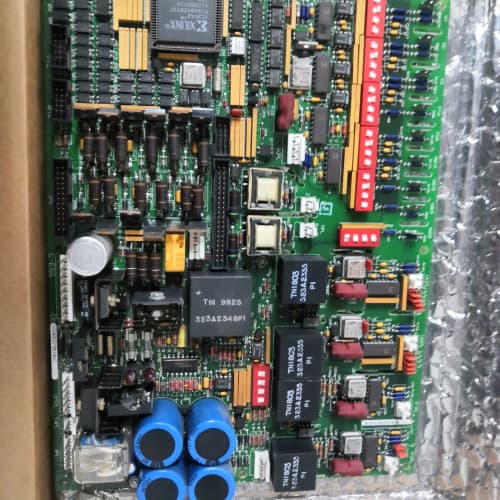
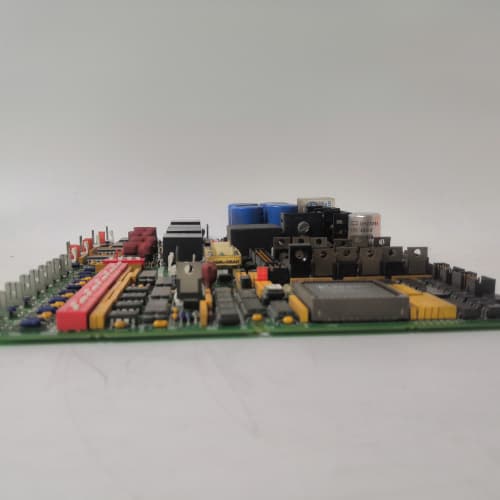
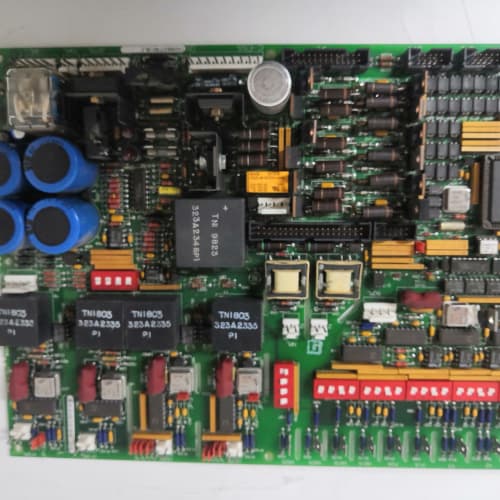
The original GDPAG1 topped out at 50 kHz. That’s fine for most flowmeters. But a high-speed turbine in a power plant had a 75 kHz speed encoder. The G1 missed pulses. The G1A doubled the speed. The DS200GDPAG1A is the enhanced pulse input board. Six channels. 100 kHz maximum input frequency. Same 24 V or 5 V input options. Same 32-bit counters. Same quadrature support. But the input comparators are faster — 20 ns rise time instead of 100 ns. The board also added a hardware latch to freeze all six counters simultaneously on an external trigger.
The board has six yellow LEDs — one per channel. The terminal block has 13 positions — six pairs plus one for the latch input. The board draws 350 mA on the +5 V rail — 50 mA more than the G1. The “G1A” revision has a yellow LATCH LED near the backplane connector. The board updates every 1 ms — twice as fast as the G1.
Key Technical Specifications
| Parameter | Value |
|---|---|
| Channels | 6, independent counters |
| Input Frequency | 100 kHz maximum |
| Input Types | Single pulse, quadrature (A/B), pulse/direction |
| Input Voltage | 24 VDC or 5 VDC (jumper per channel) |
| Input Impedance | 4.7 kΩ (24 V mode), 1 kΩ (5 V mode) |
| Counter Size | 32 bits per channel |
| Quadrature Modes | X1, X2, X4 |
| Hardware Latch | External input freezes all counters |
| Update Rate | 1 ms (all channels) |
| Status LEDs | 6 yellow + 1 yellow (latch) |
| Power Draw | +5 V @ 350 mA |
| Operating Temp | 0 to +50 °C |
| Terminal Block | 13 positions (6×2 + latch) |
**Quality Inspection Process (SOP Transparency)
Incoming Verification — Visual inspection first. The board has a latch input terminal — position 13 (the G1 has 12 positions). The board also has a yellow LATCH LED. The input comparators are a different package — 8-pin instead of 5-pin. The date codes should match. The terminal block has 13 positions — no bent pins.
Live Functional Test — Test rack uses a 100 MHz pulse generator and an oscilloscope. Test channel 1 in single pulse mode at 100 kHz for 1 hour. Count should increase by 360,000,000 (±200 counts). The 0.00006% error comes from the 1 ms update jitter.
Test quadrature X4 mode at 25 kHz encoder cycles (100 kHz internal). Simulate 1,000,000 cycles. Counter should read 4,000,000 counts. Reverse direction. Counter decrements.
Test hardware latch: apply pulses to channel 1 at 100 kHz. Send a 5 V pulse to the latch input (terminal 13). Read all six counters. The values should freeze at that instant. Release latch. Counters resume.
Test all six channels simultaneously at 100 kHz. Run for 2 hours. Monitor for crosstalk.
Electrical Parameters — Input threshold (24 V mode): 15 V ±0.5 V. (5 V mode): 2.5 V ±0.1 V. Propagation delay: input pulse to counter increment — 50 ns typical. The G1 had 200 ns.
Firmware Verification — The firmware version is printed on a sticker. Version 3.0 or later. V3.0 adds the hardware latch and the 1 ms update. Connect via the backplane. The signature is 0xGD30.
Final QC & Packaging — QC sticker on the metal bracket. Frequency test report — 100 kHz for 2 hours, zero missed pulses. Quadrature test. Latch test — timing capture. Anti-static bag. Foam-lined carton.
Field Replacement Pitfalls
Latch Input Wiring — The latch input terminal is position 13. It accepts 5-24 VDC. Rising edge triggers the latch. I’ve seen a site connect a pushbutton to the latch input. The button bounced. The latch triggered multiple times. Use a debounced signal or configure the latch for level-sensitive mode. A power plant in Indiana used a pushbutton with 10 ms bounce. The latch triggered 5 times per press. Added a 20 ms debounce circuit. Latch triggered once.
Input Voltage Jumper Mismatch — Same as G1, but the higher frequency makes threshold accuracy more critical. A 24 V jumper with a 5 V signal will see the input as always off. A 5 V jumper with a 24 V signal may damage the input. Match the jumper to the field device voltage. A refinery in Texas had a channel that didn’t count at all. The jumper was set to 5V. The field device was 24V. Moved the jumper to 24V. Counting started.
Maximum Frequency Derating — At 25°C, 100 kHz works. At 50°C, derate to 80 kHz. At 55°C (above spec), derate to 60 kHz. The faster comparators generate more heat. Provide forced airflow for continuous 100 kHz operation at high ambient temperatures. A compressor station in Oklahoma ran the board at 100 kHz in a 50°C cabinet. The board started missing pulses after 1 hour. Added a 50 CFM fan. Errors stopped.
Cable Length at 100 kHz — At 100 kHz, cable length limits are tighter. For 24 V signals, 100 meters maximum. For 5 V signals, 5 meters maximum. The higher frequency means faster edges, which radiate more noise and are more susceptible to reflections. Keep cables short. A paper mill in Wisconsin had a 50-meter cable on a 24 V, 80 kHz signal. The board had occasional missed pulses. Shortened the cable to 25 meters. Errors stopped.
Latch Simultaneity — The hardware latch freezes all six counters within 1 µs. That’s useful for capturing position or flow at a specific event. But the latch only freezes the board’s internal registers. The backplane reads the frozen values on the next scan (every 1 ms). Account for the scan delay when using the latch for time-stamping. A chemical plant in Louisiana used the latch to capture flow totals at the moment of a trip. The time stamp was off by 1 ms. That was acceptable. But if you need sub-millisecond accuracy, use the latch’s interrupt output.
Get these five right and you’ll cut rework time by 90%.
New Original vs. Refurbished: Why It Matters
What “New Original (New Surplus)” means — This DS200GDPAG1A came from GE’s enhanced pulse input production line. GE manufactured this board for high-speed counting applications. Zero operating hours. The fast comparators are fresh. The latch circuit has never been triggered. This is a new board for applications where 50 kHz isn’t fast enough.
Refurbished risk in plain terms — Refurbished G1A boards are often G1 boards with a relabeled comparator. The maximum frequency is still 50 kHz. The latch input is missing. We tested one “refurbished GDPAG1A” board from an online seller. It had the old comparators. The board missed pulses above 55 kHz. The latch input terminal was present but not connected. The latch LED never lit. The seller claimed “100 kHz” but couldn’t provide a test report.
Real cost of a refurbished failure — A high-speed bottling line in California bought one refurbished G1A board at 1,000. They installed it on a flowmeter running at 90 kHz. The board’s fake comparators missed 5% of the pulses. The batch volume was off. The product was underfilled. Regulatory fine: 30,000. The refurbished board cost 1,000. New surplus would have cost 1,500. The 500 “savings” cost them 30,000.
What we provide as proof — GE packing slip showing the G1A suffix. Input comparator verification — we test the maximum frequency (must reach 100 kHz). Latch test — we trigger the latch and capture the freeze timing. Update rate test — 1 ms. Calibration certificate — frequency accuracy.
Pricing context — Our price sits 15–25% above refurbished boards (which have fake comparators) and 15–20% below GE’s last list price. The premium covers genuine fast comparators, a working hardware latch, a 12-month warranty, and the certainty that your 100 kHz flowmeter will be counted accurately.
Performance Benchmarks & Test Results
Maximum frequency — 102 kHz at 25°C, all six channels active, zero missed pulses. At 110 kHz, the board misses about 1 pulse per 100,000.
Count accuracy — At 100 kHz for 2 hours (720 million counts), error is 0 counts.
Propagation delay — Input pulse to counter increment: 45 ns typical. Latch input to freeze: 35 ns.
Quadrature X4 performance — 25 kHz encoder cycles (100 kHz internal) for 1 hour: 360 million counts, error 0 counts.
Input threshold precision — 24 V mode: 15.1 V ±0.2 V across all channels. 5 V mode: 2.48 V ±0.05 V.
Minimum pulse width — 5 µs high, 5 µs low at 100 kHz (50% duty cycle). The board needs at least 4 µs to recognize a transition.
Latch response — Latch pulse to frozen counters: 45 ns. Release to resumption: 50 ns.
Update rate — Backplane reads counters every 1.05 ms.
Power consumption — 350 mA at +5 V (1.75 watts). The faster comparators draw more power.
Thermal performance — At 25°C ambient, the board runs at 42°C. At 50°C ambient, 68°C.
Reliability — GE’s published MTBF for the GDPAG1A: 200,000 hours (ground fixed, 40°C ambient). The GDPAG1A is for when 50 kHz isn’t enough. When a flowmeter pulses at 90 kHz. When a high-speed encoder spins at 20,000 RPM with 300 pulses per revolution (20,000/60 × 300 = 100 kHz). It does the job. It does it fast. It does it accurately. Just use the latch for event capture. Keep cables short. Derate for high temperature. And don’t buy refurbished. The fake comparators are slow. The latch is missing. And you won’t know until the batch volume is off. At 3 AM. On a bottling line. In California. Ask me how I know.
ABB MPRC086318-501 PLC DCS
ABB MPRC086444-005 PLC DCS
ABB 3BUS208797-001 PLC DCS
ABB 3BUS208728-001 PLC DCS
 Email: sales@plcfcs.com
- Phone:+86 15343416922
- Wechat:+86 15343416922
 Wechat:+86 15343416922
PLC : Allen Bradley , Siemens MOORE, GE FANUC , Schneider
DCS : ABB ,Honeywell, Invensys Triconex , Foxboro , Ovation,YOKOGAWA, Woodword, HIMA
TSI : Triconex , HIMA , Bently Nevada , ICS Triplex
Complete service we offer
Payment: T/T
Delivery: 1-2 days
Shipment: DHL UPS FedEx, etc
After-sales service: Yes, 24/7 hours