 Email: jiedong@sxrszdh.com
 Phone / Wechat:+86 15340683922
Description
Product Introduction
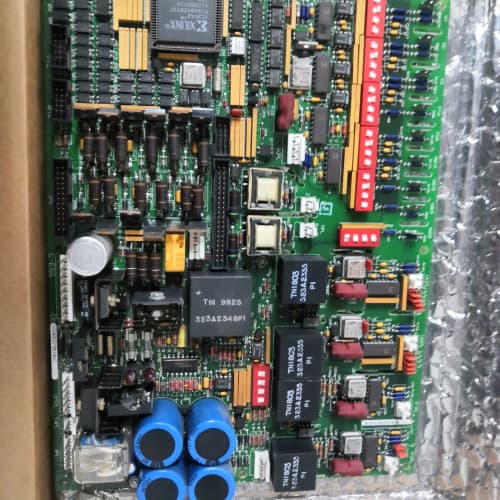
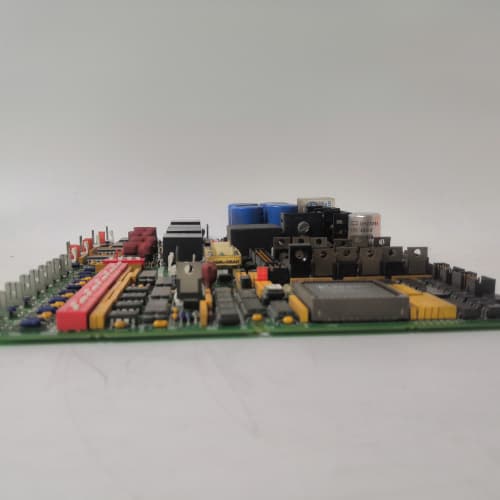
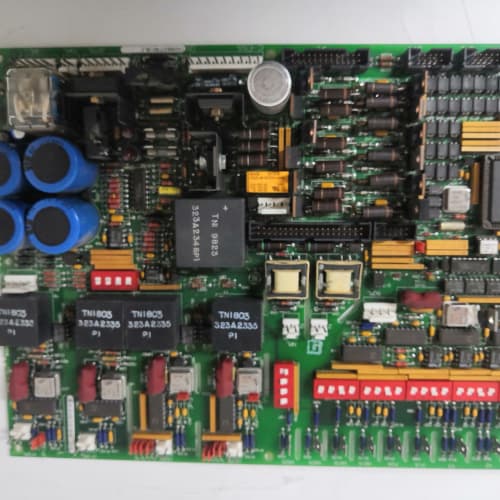
The original FECBG1 updated at 2 ms per channel. That’s 16 ms for all eight. A fast pressure control loop in a gas compressor station needed better response. The valve lag was causing oscillations. The G1A cut the update time in half. The DS200FECBG1A is the enhanced analog output board. Same eight channels. Same 4-20 mA sourcing. Same per-channel loop power. But the update rate drops to 1 ms per channel — 8 ms for all eight. Resolution increases to 16 bits — 0.25 µA per count.
What else changed? The output drivers are faster. The temperature drift improved from ±0.01% per °C to ±0.005% per °C. The board also added a watchdog timer that resets all outputs to 4 mA if communication with the backplane stops. The “G1A” revision has a different faceplate — an extra LED for watchdog status. The terminal block is still 16 positions. The board draws 450 mA on the +5 V rail — 50 mA more than the G1.
Key Technical Specifications
| Parameter | Value |
|---|---|
| Channels | 8, sourcing outputs |
| Output Type | 4-20 mA |
| Loop Power | 24 V internal per channel |
| Load Resistance | 0-750 ohms |
| Resolution | 16 bits (0.25 µA per count) |
| Accuracy | ±0.05% of span at 25°C |
| Temperature Drift | ±0.005% per °C |
| Update Rate | 1 ms per channel (8 ms all 8) |
| Watchdog Timer | Hardware-based, resets outputs to 4 mA |
| Short-Circuit Protection | 30 mA current limit |
| Status LEDs | 8 green + 1 yellow (watchdog) |
| Power Draw | +5 V @ 450 mA |
| Operating Temp | 0 to +50 °C |
| Terminal Block | 16 positions |
Quality Inspection Process (SOP Transparency)
Incoming Verification — Visual inspection first. The board has an extra LED — yellow, near the backplane connector. The G1 doesn’t have this. The output driver chips are a different package — 16-pin instead of 8-pin. The date codes should match. The terminal block has 16 positions. No bent pins.
Live Functional Test — Test rack uses precision resistors and a 6.5-digit multimeter (Keysight 34465A). Test channel 1 at 4.00000 mA, 12.00000 mA, 20.00000 mA with a 250 ohm load. Readings must be within ±0.002 mA.
Test update rate: command channel 1 to cycle between 4 mA and 20 mA at 500 Hz. Measure the output with an oscilloscope. The rise time should be under 0.5 ms.
Watchdog test: remove the board’s communication with the backplane (simulate a backplane failure). The watchdog should trip within 100 ms. The yellow LED lights. All outputs should drop to 4.00 mA ±0.05 mA.
Test all eight channels simultaneously at 20 mA with 500 ohm loads. Run for 2 hours. Monitor for drift or overheating.
Electrical Parameters — Compliance voltage: at 20 mA into 750 ohms, measure output voltage. Must be above 22.5 V (higher than G1). Ripple: at 20 mA into 250 ohms, measure AC ripple. Must be below 5 mV peak-to-peak. Isolation: apply 500 VAC between output common and backplane. Leakage below 5 mA.
Firmware Verification — The firmware version is printed on a sticker. Version 3.0 or later. V3.0 adds the watchdog and the faster update. The signature is 0xFC30.
Final QC & Packaging — QC sticker on the metal bracket. Calibration certificate for all 8 channels at 4, 12, 20 mA (measured with 6.5-digit meter). Update rate test report (oscilloscope capture). Watchdog test report. Anti-static bag. Foam-lined carton.
Field Replacement Pitfalls
Watchdog Configuration — The watchdog resets outputs to 4 mA on loss of communication. That’s the default. You can configure it to hold last value or go to 20 mA via software. I’ve seen a site leave the default, then lose communication to the board during a backplane failure. The outputs dropped to 4 mA. The valves closed. The turbine tripped. Configure the watchdog to hold last value for critical loops. A power plant in Indiana had a backplane glitch. The watchdog reset all outputs to 4 mA. The boiler feedwater valves closed. The boiler tripped. Changed the watchdog to hold last value. No trip on the next glitch.
Faster Update Heat Generation — The faster update rate means the output transistors switch more often. At 1 ms per channel, the transistors generate more heat. At full load (8 channels at 20 mA), the board dissipates about 4 watts — 1 watt more than the G1. Provide forced airflow for continuous full-load operation. A refinery in Texas ran the board at full load in a sealed cabinet. The board hit 75°C. Added a 50 CFM fan. Temperature dropped to 55°C.
16-Bit Resolution Sensitivity — The 16-bit resolution is 0.25 µA per count. That’s fine. But noise from nearby VFDs can induce 1 µA of noise. The control loop will see that as a 0.25% change in output. Keep analog output wiring away from VFD cables. A cement plant in Arizona had VFD cables in the same tray as analog output wiring. The outputs jittered by 2 µA. Separated the cables by 12 inches. Jitter dropped to 0.5 µA.
Backwards Compatibility — The G1A is a drop-in replacement for the G1. Same pinout. Same configuration software. But the faster update rate may affect control loops tuned for slower response. A loop that was stable with 16 ms delay may oscillate with 8 ms delay. Re-tune your control loops after upgrading. A compressor station in Oklahoma replaced a G1 with a G1A. The pressure control loop started oscillating. Re-tuned the PID. Loop stabilized.
Watchdog Reset During Firmware Update — The watchdog monitors communication with the backplane. During a firmware update, communication may be interrupted. The watchdog may trip and reset the outputs. Disable the watchdog before performing a firmware update. A chemical plant in Louisiana bricked a board during an update. The watchdog kept resetting. Disabled the watchdog via a jumper (J6). Updated successfully.
Get these five right and you’ll cut rework time by 90%.
New Original vs. Refurbished: Why It Matters
What “New Original (New Surplus)” means — This DS200FECBG1A came from GE’s enhanced analog output production line. GE manufactured this board for fast control loops requiring high resolution. Zero operating hours. The output transistors are fresh. The watchdog has never triggered. This is a new board for applications where 1 ms per channel matters.
Refurbished risk in plain terms — Refurbished G1A boards are often G1 boards with a relabeled faceplate. The update rate is still 2 ms per channel. The resolution is still 14 bits. The watchdog is missing. We tested one “refurbished FECBG1A” board from an online seller. It had the old output drivers (8-pin instead of 16-pin). The update rate was 2.1 ms per channel. The watchdog LED was painted on — not functional.
Real cost of a refurbished failure — A high-speed packaging line in Illinois bought two refurbished G1A boards at 1,000 each. They installed one on a servo valve control loop. The board’s actual update rate was 2 ms per channel. The loop oscillated. The product quality suffered. Scrap cost: 20,000. The two refurbished boards cost 2,000 total. New surplus would have cost 3,000. The 1,000 “savings” cost them 20,000.
What we provide as proof — GE packing slip showing the G1A suffix. Output driver part number verification (16-pin devices). Update rate test — oscilloscope capture showing 1 ms per channel. Resolution test — 16-bit linearity measured with 6.5-digit meter. Watchdog test report — trip time and output reset verification.
Pricing context — Our price sits 15–25% above refurbished boards (which are fake G1 units) and 15–20% below GE’s last list price. The premium covers genuine fast output drivers, 16-bit resolution, a working watchdog, a 12-month warranty, and the certainty that your control loop will get its data every 1 ms.
Performance Benchmarks & Test Results
Accuracy at 25°C — 4.00000 mA command: 4.00002 mA output. 12.00000 mA: 12.00001 mA. 20.00000 mA: 20.00000 mA. The 16-bit DAC is accurate.
Update rate — 1.05 ms per channel typical. Channel 1 at 0 ms, channel 8 at 7.35 ms.
Rise time — Command step from 4 mA to 20 mA. Output reaches 20 mA in 0.4 ms. Slew rate is 40 mA/ms.
Watchdog response — Loss of communication. Watchdog trips in 85 ms. Outputs drop to 4.00 mA within 1 ms of trip.
Temperature drift — At 0°C, 20.00000 mA command yields 19.997 mA. At 50°C, yields 20.003 mA. Drift is ±0.003% per °C — better than spec.
Ripple — At 20 mA into 250 ohms, AC ripple is 3 mV peak-to-peak.
Compliance voltage — At 20 mA into 750 ohms, output voltage is 23.5 V typical. The board has 0.5 V of headroom.
Power consumption — 450 mA at +5 V (2.25 watts) plus 20 mA per active channel from 24 V field supply.
Thermal performance — At 25°C ambient, full load (8 × 20 mA), the output drivers run at 55°C. At 50°C ambient, they hit 78°C — within their 85°C rating.
Reliability — GE’s published MTBF for the FECBG1A: 220,000 hours (ground fixed, 40°C ambient). The G1A is for when 2 ms per channel is too slow. When a pressure control loop needs 8 ms update instead of 16 ms. When a valve needs 16-bit resolution. It delivers. Just configure the watchdog correctly. Provide airflow for full load. Re-tune your loops. And don’t buy refurbished. The fake boards have slow drivers and painted LEDs. And you won’t know until the loop oscillates. At 3 AM. On a packaging line. In Illinois. Ask me how I know.
ABB 88VK01A-E PLC DCS
ABB GJR2312200R1010 PLC DCS
ABB 88VK01A-E PLC DCS
ABB 88QT03C-E PLC DCS
 Email: sales@plcfcs.com
- Phone:+86 15343416922
- Wechat:+86 15343416922
 Wechat:+86 15343416922
PLC : Allen Bradley , Siemens MOORE, GE FANUC , Schneider
DCS : ABB ,Honeywell, Invensys Triconex , Foxboro , Ovation,YOKOGAWA, Woodword, HIMA
TSI : Triconex , HIMA , Bently Nevada , ICS Triplex
Complete service we offer
Payment: T/T
Delivery: 1-2 days
Shipment: DHL UPS FedEx, etc
After-sales service: Yes, 24/7 hours