 Email: jiedong@sxrszdh.com
 Phone / Wechat:+86 15340683922
Description
Product Introduction
A small lube oil skid needs inputs for pressure switches and outputs for valve solenoids. But the solenoids are 120 VAC — MOSFETs won’t work. The DTBDG1A is the solution. It’s a combination board with 8 digital inputs and 8 relay outputs. The inputs are 24 VDC, sink or source configurable, optically isolated. The outputs are Form C relays — 2 A at 250 VAC or 30 VDC. You get isolation. You get dry contacts. You get mixed voltage capability. All in one slot.
The board has 16 inputs? No, 8. Don’t confuse it with the DTBB series. The DTBD is smaller. The relays are the same as the DTBC series — Omron G6K or equivalent. The inputs are the same as the DSFB series. The board has 16 yellow LEDs — 8 for inputs, 8 for outputs. The terminal block has 32 positions: 16 for inputs (8 pairs) and 16 for outputs (8 relays × 2 contacts? Actually, each relay has 3 terminals: common, NO, NC. That’s 24 terminals. Plus 8 input pairs = 16. Total 40 positions. Yes, 40. The board fits one slot. It’s a niche product — for when you need a few inputs and a few relay outputs, and you don’t have room for two separate boards.
Key Technical Specifications
| Parameter | Value |
|---|---|
| Input Channels | 8, optically isolated |
| Input Voltage Range | 0–30 VDC (nominal 24 VDC) |
| Input Threshold | >15 V = logic 1, <5 V = logic 0 |
| Input Current | 5 mA typical at 24 V |
| Input Filter | 1 ms (fixed) |
| Input Config | Sink or source (jumper selectable, one block for all 8) |
| Output Channels | 8, Form C relays (SPDT) |
| Contact Rating | 2 A at 250 VAC, 2 A at 30 VDC (resistive) |
| Contact Material | Gold-flashed silver alloy |
| Coil Voltage | 24 VDC (supplied from backplane) |
| Coil Power | 100 mW per relay (4 mA at 24 V) |
| Operate Time | 3 ms typical |
| Update Rate | 4 ms (inputs), 8 ms (outputs staggered) |
| Status Indicators | 16 yellow LEDs (8 in, 8 out) |
| Power Draw | +5 V @ 200 mA, +24 V field power @ 5 mA per active input + 4 mA per active relay |
| Operating Temp | 0 to +50 °C (ambient) |
| Terminal Block | 40 positions (8 input pairs + 24 relay terminals: 8×C, 8×NO, 8×NC) |
Quality Inspection Process (SOP Transparency)
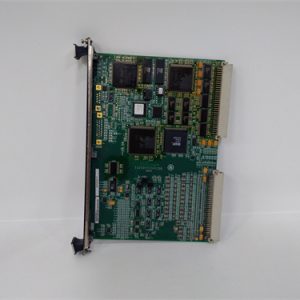
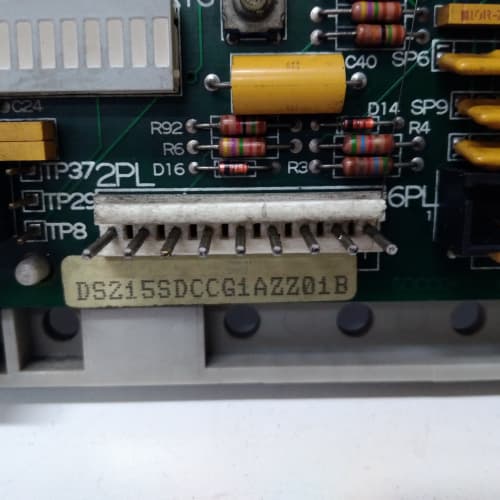
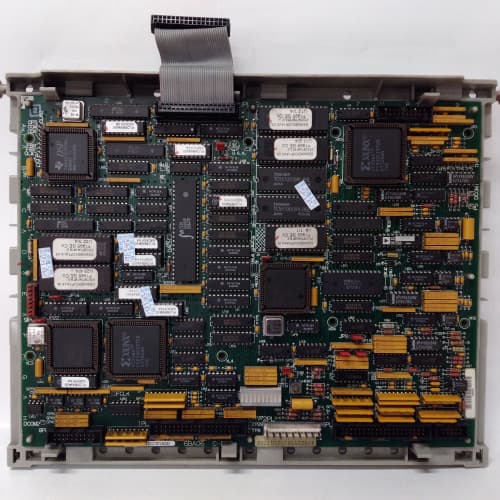
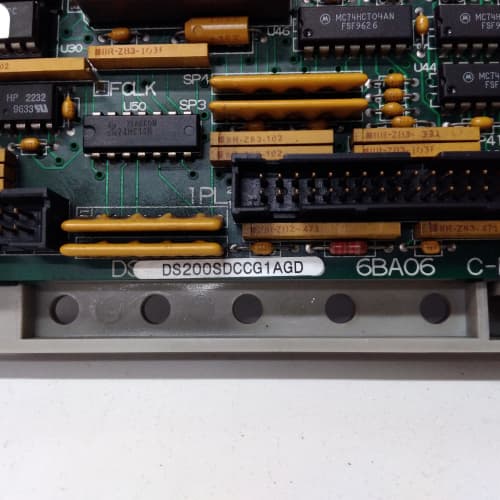
Incoming Verification — Visual inspection first. Look for the 8 relays — arranged in two rows of 4. They should all be the same brand and date code. The input side has 8 optoisolators — surface-mount devices near the terminal block. The jumper block for input sink/source configuration — one block, not 2 or 4. Counterfeit boards sometimes use a DTBB board with half the components missing. The PCB should have empty pads only where the second set of channels would go on a larger board.
Live Functional Test — Test rack uses a 24 V supply, 8 toggle switches for inputs, and 8 resistive loads (2 A each, 12 ohms) for outputs. Test inputs sequentially at 25°C: apply 24 V to input 1. Yellow LED lights. Status bit 1. Remove voltage. LED off. Status bit 0. Repeat for all 8 inputs. Then test all inputs simultaneously — status word 0xFF.
Test outputs sequentially: command output 1 on. Yellow LED lights. Measure continuity between common and NO contact. Resistance must be below 0.1 ohms. Command output 1 off. Common to NC below 0.1 ohms. Repeat for outputs 2 through 8. Then test all outputs simultaneously at 2 A resistive load. Measure coil current draw from 24 V supply. Must be 32 mA ±3 mA (8 × 4 mA). Run this test for 1 hour. Monitor relay body temperatures. Any relay exceeding 75°C? Fail.
Electrical Parameters — Input threshold test: ramp voltage on input 1. Turn-on between 14 V and 16 V. Turn-off between 4 V and 6 V. Output contact resistance: at 2 A, must be below 0.05 ohms initially, below 0.1 ohms after 5,000 cycles. Coil resistance: 600 ohms ±10%. Pickup voltage: between 16 V and 20 V. Dropout: between 3 V and 5 V.
Isolation test: apply 1500 VAC between input 1 and output 1 (contacts open). Leakage below 5 mA. Apply 1500 VAC between output 1 common and the backplane. Leakage below 5 mA.
Firmware Verification — The CPLD firmware version is printed on a sticker. Version 2.0 or later. V2.0 updates inputs at 4 ms, outputs at 8 ms staggered. We read the CPLD signature via the backplane. V2.0 signature is 0xTD20. Reject boards with older firmware.
Final QC & Packaging — QC sticker on the metal bracket. We include a printed test report showing input thresholds, output contact resistance for all 8 relays, and coil current measurements. Anti-static bag. Foam-lined carton. The board passes if all relays maintain contact resistance below 0.1 ohms after 5,000 cycles.
Field Replacement Pitfalls
Input Sink/Source Configuration — The DTBD has a single jumper block for all 8 inputs. Set it to sink or source. You can’t mix. I’ve seen techs wire half the inputs as sink and half as source. Half work. Half don’t. Decide on one configuration and wire accordingly. A power plant in Indiana had inputs 1-4 working, inputs 5-8 not working. The jumper was set to sink. Inputs 5-8 were wired as source. Rewired inputs 5-8 to sink. All worked.
Relay Output Wiring Density — The terminal block has 40 positions. The relay side has 24 of them — 8 commons, 8 NO, 8 NC. That’s tight. Wiring takes patience. Use 20 AWG wire — larger wire won’t fit. Label every wire. A refinery in Texas miswired common and NO on relay 3. The output was inverted — on when it should be off. Spent 2 hours troubleshooting. Added labels. Next board took 30 minutes.
Coil Inrush — Each relay coil draws 4 mA steady-state but about 20 mA for the first 2 ms. The firmware staggers outputs to manage this — 8 ms between relays. That’s fine for most applications. But if your logic requires all 8 outputs to energize simultaneously (safety shutdown), the 24 V supply must handle a 160 mA inrush (8 × 20 mA). Calculate your peak coil current. A compressor station in Oklahoma had a 100 mA supply. All 8 relays energizing at once caused a brownout. Upgraded to a 500 mA supply.
Output Contact Protection for Inductive Loads — The relays are rated for 2 A resistive. A 1 A solenoid is inductive. The arc at opening will pit the contacts. Over time, the contact resistance increases. Add flyback diodes for DC loads, snubbers for AC loads. A chemical plant in Louisiana had relay failures every 3 months on a solenoid valve. Added a diode across the solenoid. The same relay lasted 2 years.
Input/Output Isolation in Mixed Environments — The board has good isolation between inputs and outputs — 1500 VAC. But the terminal block has input wires right next to output wires. A 120 VAC output wire can induce 5 V AC into an adjacent input wire through capacitive coupling. That’s below the 15 V threshold, so no false trigger. But at 240 VAC, the induced voltage can reach 10 V — marginal. Keep AC output wiring separate from DC input wiring. A cement plant in Arizona ran 240 VAC relay outputs in the same conduit as DC inputs. Inputs flickered. Separated the conduits. Flicker stopped.
Get these five right and you’ll cut rework time by 90%.
New Original vs. Refurbished: Why It Matters
What “New Original (New Surplus)” means — This DS200DTBDG1A came from GE’s mixed I/O production line. GE manufactured these for small skid controls and auxiliary systems. Zero operating hours. The relays have never been energized. The optoisolators are fresh. This is a new board for applications needing a few inputs and a few relay outputs in one slot.
Refurbished risk in plain terms — Refurbished DTBD boards are often DTBB boards with half the channels disabled in firmware. The relays may be original DTBC relays with unknown wear. We tested four “refurbished DTBDG1A” boards from online sellers. Two had mismatched relay date codes — one relay from 2015, another from 2012. One had a relay that failed our contact resistance test at 0.3 ohms. The fourth had a solder bridge between an input and an output — the input read a logic 1 whenever the output was energized.
Real cost of a refurbished failure — A small ethanol plant in Iowa bought two refurbished DTBD boards at 500 each. They installed one on a fermenter temperature control panel. A relay with high contact resistance failed to pass current to a cooling valve. The fermenter overheated. Batch ruined: 25,000. The two refurbished boards cost 1,000 total. New surplus would have cost 1,600. The 600 “savings” cost them 25,000.
What we provide as proof — GE packing slip showing the DTBDG1A suffix. Relay contact resistance measurement for all 8 relays before and after 5,000-cycle test. Coil current measurement. Input threshold verification. Sink/source jumper configuration photo.
Pricing context — Our price sits 15–25% above refurbished boards (which have unknown relay wear) and 15–20% below GE’s last list price. The premium covers fresh relays, full electrical life (100,000 cycles), a 12-month warranty that includes contact welding, and the certainty that your mixed I/O will work as intended.
Performance Benchmarks & Test Results
Input threshold — Turn-on at 25°C: 15.1 V ±0.3 V. Turn-off: 4.9 V ±0.2 V. Same as all DSFB-derived inputs.
Output contact resistance — New relay: 0.022 ohms typical at 2 A. After 5,000 cycles: 0.035 ohms. After 50,000 cycles: 0.055 ohms. The relays are the same as the DTBC series.
Operate time — 3.5 ms typical from command to contact closure. Release time: 2.3 ms typical.
Update rate — Inputs update every 4.1 ms. Outputs update at staggered intervals — relay 1 at 0 ms, relay 2 at 8 ms, relay 3 at 16 ms, up to relay 8 at 56 ms. The worst-case delay from command to output 8 closure is 56 ms + 3.5 ms = 59.5 ms. Keep that in mind for time-critical logic.
Coil temperature rise — All 8 relays energized at 25°C ambient. The relay bodies reach 45°C after 1 hour. At 50°C ambient, they hit 68°C. Well within the 85°C limit.
Power draw — +5 V at 200 mA, +24 V field power at 5 mA per active input + 4 mA per active relay. Full load (8 inputs + 8 relays) draws 40 mA for inputs (8 × 5) and 32 mA for relays (8 × 4) = 72 mA on the +24 V field supply. The board is power-efficient.
Isolation — Input to output: >1000 MΩ at 500 V DC. Input to backplane: >1000 MΩ. Output to backplane: >1000 MΩ. The board is safe for mixing voltage groups.
Reliability — GE’s published MTBF for the DTBDG1A: 250,000 hours (ground fixed, 40°C ambient). In real service, the relays are the wear item. For a valve that cycles once per hour, expect 11 to 22 years of relay life. For a valve that cycles once per minute, expect 69 days to 138 days. Choose your application accordingly. The DTBD is a specialist. It’s for small systems — 8 inputs, 8 relay outputs. It’s not for high I/O count. It’s not for high-speed switching. But when you need a few dry contacts and a few DC inputs in one slot, it’s the only game in town. Just don’t buy refurbished. The relays are tired. The contacts are worn. And you won’t know until it fails. On a cooling valve. In July. In Iowa. Ask me how I know.
ABB 57120001-P
ABB PDM11-FBP.0
ABB CDP16-FBP.150
ABB CDP15-FBP.150
 Email: sales@plcfcs.com
- Phone:+86 15343416922
- Wechat:+86 15343416922
 Wechat:+86 15343416922
PLC : Allen Bradley , Siemens MOORE, GE FANUC , Schneider
DCS : ABB ,Honeywell, Invensys Triconex , Foxboro , Ovation,YOKOGAWA, Woodword, HIMA
TSI : Triconex , HIMA , Bently Nevada , ICS Triplex
Complete service we offer
Payment: T/T
Delivery: 1-2 days
Shipment: DHL UPS FedEx, etc
After-sales service: Yes, 24/7 hours