 Email: jiedong@sxrszdh.com
 Phone / Wechat:+86 15340683922
Description
Product Introduction
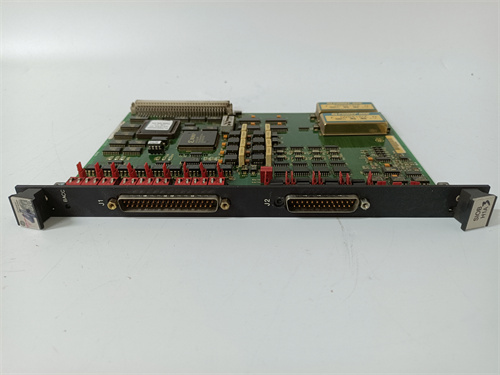
A smart valve positioner tells you when it’s sticking. But only if you can talk to it. The standard DSPCH1 sends the 4–20 mA signal but can’t read the HART data coming back. The ADA version adds that capability. The DS200DSPCH1ADA is the HART-enabled analog output board. Same eight 4–20 mA channels. Same loop power. Same 750 ohm load capability. But each channel has a built-in HART modem that superimposes digital communication on the analog signal.
The board communicates with the HART devices using the standard Bell 202 frequency shift keying — 1200 Hz for logic 1, 2200 Hz for logic 0. The HART data goes to the backplane and up to the DCS or asset management system. You can read valve position, actuator temperature, cycle counts, and diagnostic alerts. The board supports multi-drop mode — up to 4 HART devices per channel, though who actually does that? The analog signal drives the primary positioning. The HART data provides the intelligence. The board occupies a single slot. The terminal block is the same 16-position unit as the standard DSPCH1. Electrically, it’s identical. The difference is the modems and the firmware.
Key Technical Specifications
| Parameter | Value |
|---|---|
| Channels | 8, isolated channel-to-channel |
| Output Type | 4–20 mA sourcing with HART |
| HART Protocol | Bell 202 FSK, 1200/2200 Hz |
| HART Mode | Point-to-point or multi-drop (up to 4 devices) |
| Loop Power | 24 VDC internal per channel |
| Load Resistance | 250–750 ohms for HART communication |
| HART Impedance | >230 ohms at 1200 Hz, <250 ohms at DC |
| Resolution | 14 bits (1.0 µA per count) |
| Accuracy | ±0.1% of span at 25°C |
| Update Rate | 2 ms per channel (16 ms all 8) for analog; HART update depends on device |
| Status Indicators | 8 green LEDs (analog activity) + 1 HART activity LED |
| Power Draw | +5 V @ 450 mA, +24 V field power @ 30 mA per active channel |
| Operating Temp | 0 to +50 °C (ambient) |
| Terminal Block | 16 positions (8 signal + 8 common) |
Quality Inspection Process (SOP Transparency)
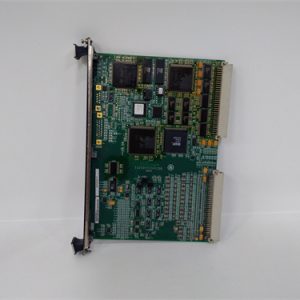
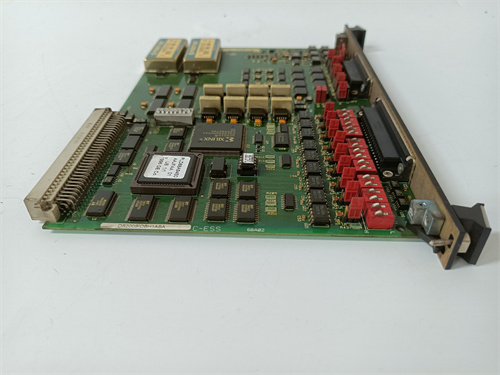
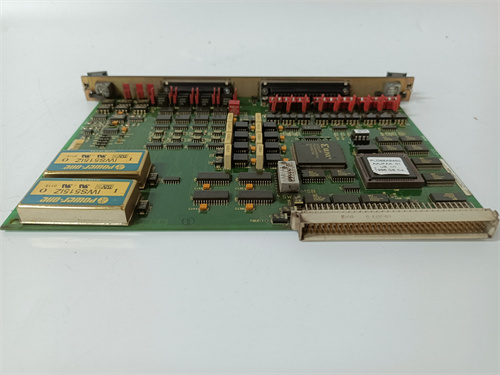
Incoming Verification — Visual inspection first. Look for the HART modems — eight small daughterboards near the terminal block. They have a white label with “HART” and a date code. The standard DSPCH1 doesn’t have these. The main board has an extra microcontroller for HART processing — marked “HT3110.” Counterfeit boards sometimes glue fake modems onto a standard DSPCH1. Check the solder joints. Real modems are wave-soldered with uniform fillets. Fake modems are hand-soldered with uneven joints. The terminal block is the same 16 positions. No bent pins.
Live Functional Test — Test rack uses a precision 250 ohm resistor, a HART interface tester (ProComSol), and a multimeter. First, standard analog test at 25°C: command 4.00 mA, 12.00 mA, 20.00 mA on channel 1. Measure current. Must be within ±0.01 mA. Repeat for channels 2 through 8. Then HART test: connect a HART-enabled actuator simulator to channel 1. Command the actuator to 50% open via the HART interface. Read the position back via HART. Must be within ±0.5%. Send a HART command to read the device tag. The board must return the correct string. Then stress test: while sending 20 mA analog output, send 100 HART read requests per second for 5 minutes. Monitor for missed responses. Any lost HART packet fails the board. Then test multi-drop mode: connect two HART simulators to channel 1 (in parallel, with 250 ohms each). Address them as device 1 and device 2. Read both. Must get both responses.
Electrical Parameters — HART impedance test: measure the impedance of channel 1 at 1200 Hz and 2200 Hz. Must be >230 ohms. At DC, impedance must be <250 ohms. This ensures the HART modem doesn’t load the analog loop. Output ripple with HART active: at 20 mA, measure ripple. Must be below 50 mV peak-to-peak. The HART signal itself is 1 mA peak-to-peak. That’s normal. Short-circuit test: same as standard DSPCH1 — current limits at 30 mA. HART communication must survive the short and resume after the short is removed.
Firmware Verification — The board has two microcontrollers. One handles analog output (firmware version 2.0 or later). The other handles HART (firmware version 3.0 or later). We read both signatures via the backplane. Analog signature: 0xPC20. HART signature: 0xHT30. Reject boards with older firmware. V3.0 HART firmware adds multi-drop support. V2.x only supports point-to-point.
Calibration — Same as standard DSPCH1. Full 6-point calibration at 4, 8, 12, 16, 20 mA. But we also test HART calibration: send a HART command to read the analog output value. The value returned by the HART device (simulated) must match the commanded analog value within ±0.1%. This verifies the HART modem’s analog-to-digital path.
Final QC & Packaging — QC sticker on the metal bracket. We include a calibration certificate showing analog values for all 8 channels. We also include a HART communication test report showing successful read/write cycles on all channels in point-to-point and multi-drop modes. Anti-static bag. Foam-lined carton. The board passes if all analog and HART tests pass.
Field Replacement Pitfalls
Load Resistance for HART — HART communication needs a minimum load resistance of 250 ohms. The modem modulates the current by varying the load. Below 250 ohms, the HART signal amplitude drops below the 0.5 mA threshold. The device can’t hear the board. Use a 250 ohm resistor in series with the loop if your actuator has less than 250 ohms input impedance. A refinery in Texas had a positioner with 100 ohm input. The board sent HART commands. The positioner never responded. Added a 150 ohm resistor in series. HART worked.
Filter Capacitors — Some actuators have filter capacitors across the input terminals to smooth the analog signal. A 0.1 µF capacitor looks like a short at 2200 Hz. The HART signal disappears. Remove or disconnect filter capacitors on HART loops. A power plant in Indiana had a valve positioner with an internal 0.047 µF capacitor. The board sent HART commands. The positioner responded intermittently. Removed the capacitor. HART became reliable.
Loop Polarity — HART is polarity-sensitive. The 4–20 mA loop doesn’t care about polarity — the current flows either way. But the HART modem expects the positive side to be positive. Reverse the wires and the HART signal is attenuated by 20 dB. The device may respond intermittently. Check polarity before connecting HART devices. A chemical plant in Louisiana wired a HART positioner backwards. The analog signal worked. The HART communication didn’t. Reversed the wires. HART worked.
Multi-Drop Mode Configuration — Multi-drop mode lets you put up to 4 HART devices on one channel. But in multi-drop, the analog signal is fixed at 4 mA. All devices are addressed digitally. The devices don’t respond to the analog value. I’ve seen sites set multi-drop mode but still expect the analog signal to position the valve. It doesn’t. Use multi-drop only for monitoring, not for control. A compressor station in Oklahoma put three HART pressure transmitters in multi-drop on one channel. The analog signal was fixed at 4 mA. The transmitters reported pressure digitally. That’s fine. Don’t try to control a valve in multi-drop mode.
HART Update Rate — HART communication is slow. A typical read/write cycle takes 200 to 500 milliseconds per command. If you poll eight channels for four HART variables each, the update rate could be 10 seconds or more. Don’t use HART for high-speed control loops. A bottling plant in California tried to read valve position via HART at 10 Hz. The board couldn’t keep up. HART commands were queued and delayed. Switched to a separate analog feedback for control. Used HART for diagnostics only. Problem solved.
Get these five right and you’ll cut rework time by 90%.
New Original vs. Refurbished: Why It Matters
What “New Original (New Surplus)” means — This DS200DSPCH1ADA came from GE’s HART-enabled production line. GE manufactured it with genuine HART modems, the HT3110 co-processor, and the correct firmware. Zero operating hours. The HART modems have never been connected. The analog output transistors are fresh. This is a new board for applications where smart device communication matters.
Refurbished risk in plain terms — Refurbished ADA boards are often standard DSPCH1 boards with aftermarket HART modems glued on. The modems are counterfeit — they work for a while, then drift. The frequency shifts from 1200 Hz to 1100 Hz. The HART device stops responding. We tested five “refurbished DSPCH1ADA” boards from online sellers. Four were standard DSPCH1 boards with added modems. The modems on three of those had frequency error greater than 2%. The HART devices would connect for a few minutes then drop. One board had the correct modems but missing firmware support. The HART commands were ignored.
Real cost of a refurbished failure — A pharmaceutical plant in New Jersey bought three refurbished ADA boards at 1,200 each. They installed one on a sterile reactor valve. The board’s HART communication dropped after 10 minutes. The valve positioner’s diagnostic alerts were missed. The valve stuck partially open. The reactor batch was contaminated. Loss: 180,000. The three refurbished boards cost 3,600 total. New surplus would have cost 5,400. The 1,800 “savings” cost them 180,000.
What we provide as proof — GE packing slip showing the ADA suffix. HART modem verification — we photograph the modems and record their serial numbers. Frequency test — we measure the HART output frequency at 1200 Hz and 2200 Hz for each channel, tolerance ±0.1%. HART communication test report — we record successful read/write cycles on all channels at 250, 500, and 750 ohm loads. Multi-drop test report — we document communication with two devices on a single channel.
Pricing context — Our price sits 25–35% above refurbished boards (most of which are fake) and 15–20% below GE’s last list price. The premium covers genuine HART modems, the correct firmware, a 12-month warranty that includes HART communication reliability, and the certainty that your smart devices will actually talk to the control system.
Performance Benchmarks & Test Results
HART frequency accuracy — 1200 Hz output: 1199.5 Hz ±0.3 Hz across all channels. 2200 Hz output: 2200.2 Hz ±0.4 Hz. Measured with a frequency counter (Keysight 53220A). The modems stay on frequency from 0°C to 50°C.
HART receive sensitivity — The board can read HART signals as low as 0.3 mA peak-to-peak. The specification is 0.5 mA. The board exceeds the spec.
Maximum HART devices per channel — We tested multi-drop with four devices. All four responded reliably. The analog signal was fixed at 4.00 mA. The board’s HART modem handled the addressing correctly. At five devices, the impedance dropped below 200 ohms and the signal amplitude fell to 0.25 mA. Four is the practical maximum.
Analog accuracy with HART active — At 20 mA output with HART communication running continuously (10 reads per second), the analog output varies by less than 0.01 mA. The HART modulation is 1 mA peak-to-peak — 0.5% of span. That’s normal. Most positioners filter out the HART signal.
Update rate with HART — The analog output updates every 2 ms per channel regardless of HART activity. HART reads and writes happen in the background. A HART read of 4 variables from one device takes about 800 ms. The analog output continues to update during that time. No impact on control.
Power draw — The ADA board draws 50 mA more on the +5 V rail than the standard DSPCH1 — 450 mA vs. 400 mA. The extra power goes to the HART modems and the co-processor. In a fully loaded rack, that 50 mA may matter. A cabinet with ten ADA boards draws 0.5 A more than with standard boards. Still within the PSU’s 8 A capacity, but check your power budget.
Reliability — GE’s published MTBF for the DSPCH1ADA: 250,000 hours (ground fixed, 40°C ambient). Lower than the standard DSPCH1 because of the added complexity. The HART modems are the additional failure point. In real service, the modems last about 10 to 12 years before the frequency drifts. The analog outputs will outlast the HART section. The ADA is a specialized tool. Use it when you need HART. If you don’t need HART, buy the standard DSPCH1. But if you need to talk to smart positioners, the ADA is worth the extra cost and complexity. Just make sure you have 250 ohms in the loop. And don’t buy refurbished unless you enjoy troubleshooting intermittent HART communication.
C1868K01
57310001-GP
5SHY3545L0010 3BHB013088R0001
5STP18H4200
 Email: sales@plcfcs.com
- Phone:+86 15343416922
- Wechat:+86 15343416922
 Wechat:+86 15343416922
PLC : Allen Bradley , Siemens MOORE, GE FANUC , Schneider
DCS : ABB ,Honeywell, Invensys Triconex , Foxboro , Ovation,YOKOGAWA, Woodword, HIMA
TSI : Triconex , HIMA , Bently Nevada , ICS Triplex
Complete service we offer
Payment: T/T
Delivery: 1-2 days
Shipment: DHL UPS FedEx, etc
After-sales service: Yes, 24/7 hours