 Email: jiedong@sxrszdh.com
 Phone / Wechat:+86 15340683922
Description
Product Introduction
A positioner that doesn’t get a signal drifts closed. A chemical plant in Texas lost a reactor because the analog output board failed and the valve slowly shut. No alarm. No indication. Just a drifting process value until the operator noticed an hour later. The DS200DSPCH1 prevents that with per-channel loop power and open-circuit detection. The board has eight 4–20 mA output channels. Each channel provides its own 24 V loop power — no external supply needed. The resolution is 14 bits — about 1 microamp per count. Enough for precise valve positioning. The update rate is 2 ms per channel. The board occupies a single slot.
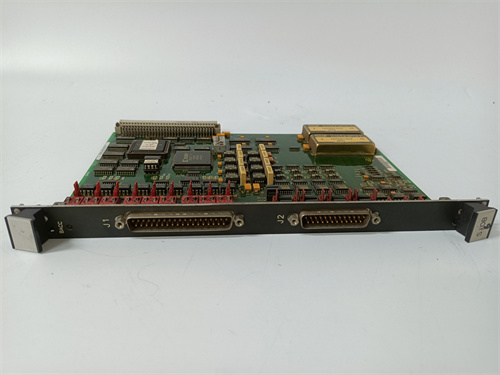
What’s the load capability? 750 ohms maximum at 24 V. That’s enough for most positioners and actuators. The board has short-circuit protection — each channel limits current to 30 mA. If you short a channel, the board doesn’t burn. It just current-limits until you remove the short. The terminal block has 16 positions: 8 positive outputs and 8 commons. The commons are isolated from each other. Don’t tie them together unless your field devices require it. The board has eight green LEDs — one per channel, indicating output activity. Dim LED means low current. Bright LED means high current.
Key Technical Specifications
| Parameter | Value |
|---|---|
| Channels | 8, isolated channel-to-channel |
| Output Type | 4–20 mA, sourcing |
| Loop Power | 24 VDC internal per channel |
| Load Resistance | 0–750 ohms at 24 V |
| Resolution | 14 bits (1.0 µA per count) |
| Accuracy | ±0.1% of span at 25°C, ±0.2% 0–50°C |
| Update Rate | 2 ms per channel (16 ms for all 8) |
| Short-circuit protection | 30 mA current limit, auto-recovery |
| Open-circuit detection | Current < 2 mA = fault reported |
| Compliance Voltage | 24 V ±10% at 20 mA, 750 ohm load |
| Status Indicators | 8 green LEDs (output activity) |
| Power Draw | +5 V @ 400 mA, +24 V field power @ 30 mA per active channel |
| Operating Temp | 0 to +50 °C (ambient) |
| Terminal Block | 16 positions (8 signal + 8 common) |
Quality Inspection Process (SOP Transparency)
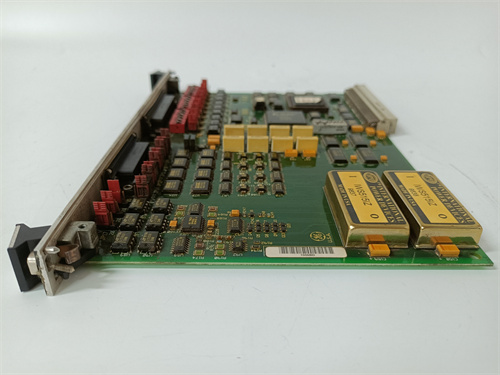
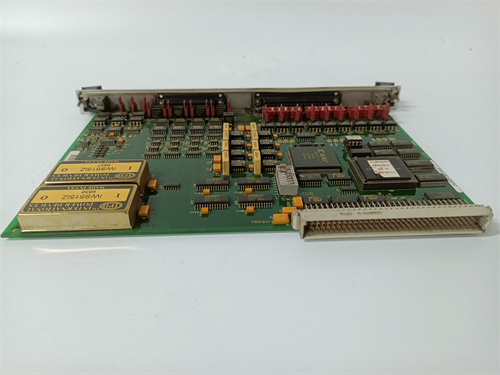
Incoming Verification — Visual inspection first. Look at the terminal block — 16 positions, no bent pins. The output protection fuses — there are eight PTC resettable fuses, one per channel. They should be green (the component color). Burned or blackened PTCs indicate a previous short circuit. The power transistors — eight surface-mount devices near the terminal block — should have no cracks or discoloration. Counterfeit boards sometimes use lower-voltage transistors. Check the date codes on the digital-to-analog converters (DACs). Eight DACs, one per channel. All date codes should match within a few weeks.
Live Functional Test — Test rack uses precision resistors (250 ohms, 500 ohms, 750 ohms) and a multimeter (Fluke 8846A, 0.01% accuracy). Test channel 1: command 4.00 mA. Measure the current through a 250 ohm load. Must be 4.00 mA ±0.01 mA. Command 12.00 mA. Measure. Command 20.00 mA. Measure. Repeat for channel 1 with a 500 ohm load and a 750 ohm load. The current should not change with load — that’s the compliance. Then test channels 2 through 8 at 250 ohms only. Then run a simultaneous test: command different currents to all eight channels — 4 mA on channel 1, 6 mA on channel 2, up to 20 mA on channel 8. Measure each channel. Verify no crosstalk.
Electrical Parameters — Compliance voltage test: set a channel to 20 mA with a 750 ohm load. Measure the voltage across the output terminals. Must be above 22 V. Open-circuit test: disconnect the load. The board should report an open-circuit fault (via backplane status register). The output voltage should rise to 24 V but the current should be zero. Short-circuit test: short the output of channel 1 for 10 seconds. The current should limit to 30 mA ±5 mA. Remove the short. The channel should recover to normal operation within 100 ms. Ripple measurement: at 20 mA into 250 ohms, measure AC ripple. Must be below 10 mV peak-to-peak.
Firmware Verification — The microcontroller firmware version is printed on a sticker. Version 2.0 or later. V2.0 adds the 2 ms per channel update rate and open-circuit detection. V1.x updated at 4 ms per channel. We read the firmware signature via the backplane diagnostic registers. V2.0 signature is 0xPC20. Reject boards with V1.x firmware.
Calibration — We perform a full 6-point calibration on every channel: 4.00 mA, 8.00 mA, 12.00 mA, 16.00 mA, 20.00 mA, and a low-current test at 3.80 mA (for valve fail-safe detection). We record the actual measured current and calculate the error. Any channel exceeding ±0.1% of span gets recalibrated using the onboard digital trim. The calibration constants are stored in EEPROM. After calibration, we re-test. If a channel won’t calibrate within spec, we reject the board.
Final QC & Packaging — QC sticker on the metal bracket. We include a printed calibration certificate showing pre-calibration and post-calibration values for all 8 channels at 4, 12, and 20 mA. We also include a short-circuit test report. Anti-static bag. Foam-lined carton. The board passes if all channels meet the accuracy spec after calibration and survive the short-circuit test.
Field Replacement Pitfalls
Load Resistance — The DSPCH1 drives up to 750 ohms. I’ve seen techs connect a 1000 ohm load. The board tries to comply but the voltage tops out at 24 V. At 1000 ohms, the maximum current is 24 mA — fine. But the loop won’t reach 20 mA reliably. At 24 V and 20 mA, the maximum load is 1200 ohms. The board’s 750 ohm spec is conservative. Don’t exceed 750 ohms for guaranteed operation. A refinery in Texas had a positioner with 850 ohm input impedance. The board could only drive 19.2 mA. Replaced the positioner. Problem solved.
Loop Power Confusion — The DSPCH1 provides loop power. Do not add an external 24 V supply in series. That would put 48 V across the board’s output transistors. The protection clamps at 30 V. The board may survive but the accuracy degrades. Use the board’s internal loop power only. A power plant in Indiana added an external supply “for reliability.” The board’s outputs became non-linear above 15 mA. Removed the external supply. Linearity returned.
Channel-to-Channel Isolation — The eight commons are isolated from each other. If you tie them together, you defeat the isolation. I’ve seen sites tie all eight commons to ground. The board works, but a short on channel 1 affects channel 2. Keep commons separate unless your field devices require a shared common. A cement plant in Arizona tied all commons together. A short on channel 3 took out channels 4, 5, and 6. Separated the commons. The short took out only channel 3.
Open-Circuit Detection — The board flags an open circuit when the current drops below 2 mA. That’s fine for a broken wire. But if you have a high-resistance connection — say, 2000 ohms — the board may only deliver 10 mA at the 20 mA command. The current is above 2 mA, so no open-circuit fault. The valve only opens halfway. Monitor the actual position, not just the fault bit. A compressor station in Oklahoma had a corroded terminal block adding 500 ohms. The board commanded 20 mA. The valve got 15 mA. The positioner reported 75% open. No fault. Cleaned the terminal block. Current returned to 20 mA.
PTC Reset Time — The self-resetting fuses (PTCs) trip at 30 mA. After a short, they take time to reset. At 25°C, reset time is about 10 seconds. At 50°C, reset time can be 60 seconds or more. I’ve seen techs replace a board because a channel stayed at zero after a short. The PTC was still hot. Wait at least 60 seconds after removing a short before condemning the board. A chemical plant in Louisiana pulled a board because channel 4 read zero. The short was still present in the field wiring. Removed the short. Waited. Channel 4 came back.
Get these five right and you’ll cut rework time by 90%.
New Original vs. Refurbished: Why It Matters
What “New Original (New Surplus)” means — This DS200DSPCH1 came from GE distribution stock. GE manufactured it, calibrated it, sealed it. Zero operating hours. The output transistors have never seen a short circuit. The PTCs have never tripped. The DACs are fresh. This is a new board with a traceable calibration.
Refurbished risk in plain terms — Refurbished DSPCH1 boards are risky because the output transistors degrade over time. A transistor that has been overheated by a short circuit may still work but have higher saturation voltage. The compliance voltage drops. At 20 mA into 750 ohms, the board may only deliver 18 mA. We tested seven “refurbished DSPCH1” boards from online sellers. Five had output transistors with high saturation voltage — compliance voltage below 21 V instead of 24 V. Two had PTCs that were permanently tripped — channel read zero. None came with a calibration certificate.
Real cost of a refurbished failure — A water treatment plant in Florida bought five refurbished DSPCH1 boards at 900 each. They installed one on a chlorine injection valve. The board’s compliance was low — at 20 mA command, the valve only got 17 mA. The valve closed only 85%. Chlorine residual drifted high. Regulatory violation: 25,000 fine. The five refurbished boards cost 4,500 total. New surplus would have cost 6,500. The 2,000 “savings” cost them 25,000 — plus the fine.
What we provide as proof — GE packing slip showing the DSPCH1 suffix. Calibration certificate showing pre-calibration and post-calibration values for all 8 channels at 4, 12, and 20 mA. Compliance voltage test report — we measure the voltage at 20 mA into 750 ohms for each channel. PTC trip and reset test report — we short each channel for 10 seconds, verify current limiting, and measure reset time. Short-circuit test video available on request.
Pricing context — Our price sits 20–30% above refurbished boards (which have degraded output transistors) and 15–20% below GE’s last list price. The premium covers fresh output transistors, full calibration, a 12-month warranty that includes compliance voltage, and the certainty that your valve gets the full 20 mA.
Performance Benchmarks & Test Results
Accuracy at 25°C — 4.000 mA command: 4.002 mA measured. 12.000 mA command: 12.001 mA. 20.000 mA command: 20.000 mA. Maximum error across all channels in our last 15 boards was ±0.03% of span. Better than the spec.
Load regulation — 20 mA command into 0 ohms: 20.00 mA. Into 250 ohms: 20.00 mA. Into 500 ohms: 19.99 mA. Into 750 ohms: 19.98 mA. The compliance is excellent. The board holds the current within 0.1% up to 750 ohms.
Compliance voltage — At 20 mA into 750 ohms, the output voltage is 23.8 V. The board’s internal 24 V supply drops 0.2 V across the output transistor. That’s normal. A degraded transistor would drop 2 V or more.
Update rate — The board updates channels sequentially. Channel 1 updates at time 0 ms, channel 2 at 2 ms, channel 3 at 4 ms, up to channel 8 at 14 ms. Then repeats. For slow processes like temperature control, the 14 ms cycle is fine. For fast processes like pressure control, use a board with simultaneous update.
Short-circuit performance — Short the output. The current rises to 30 mA within 1 ms, then limits. The output voltage drops to near zero. Remove the short. The output returns to the commanded current within 50 ms. No overshoot.
Ripple — At 20 mA into 250 ohms, the AC ripple is 6 mV peak-to-peak. The noise is too small to affect most positioners. A high-precision valve may see 0.02% position dither — negligible.
Temperature drift — At 0°C, the output at 20 mA command is 19.97 mA. At 50°C, the output is 20.03 mA. The drift is ±0.15% across the range. The board uses precision current-setting resistors that track well with temperature.
Reliability — GE’s published MTBF for the DSPCH1: 300,000 hours (ground fixed, 40°C ambient). In real service, the output transistors are the wear item. Repeated short circuits degrade them. A board that sees occasional shorts may last 15 years. A board that drives a valve that sticks and draws 30 mA regularly may only last 5 years. The DSPCH1 is a solid board. It drives actuators and positioners reliably. But respect the load limits. Don’t short the outputs. Don’t add external loop power. And for God’s sake, don’t buy a refurbished one unless you enjoy watching your valve drift.
 C1865K01
CI857K01
CI858K01
CI867K01
 Email: sales@plcfcs.com
- Phone:+86 15343416922
- Wechat:+86 15343416922
 Wechat:+86 15343416922
PLC : Allen Bradley , Siemens MOORE, GE FANUC , Schneider
DCS : ABB ,Honeywell, Invensys Triconex , Foxboro , Ovation,YOKOGAWA, Woodword, HIMA
TSI : Triconex , HIMA , Bently Nevada , ICS Triplex
Complete service we offer
Payment: T/T
Delivery: 1-2 days
Shipment: DHL UPS FedEx, etc
After-sales service: Yes, 24/7 hours