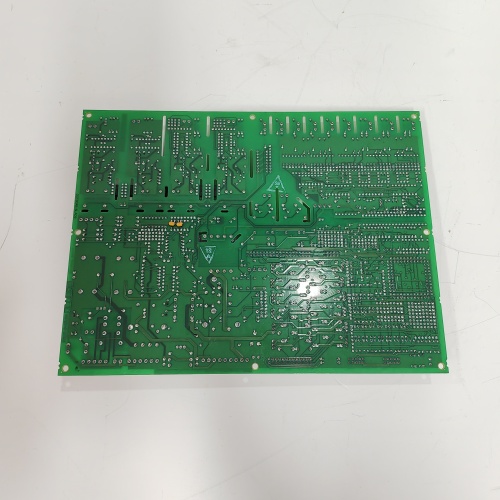
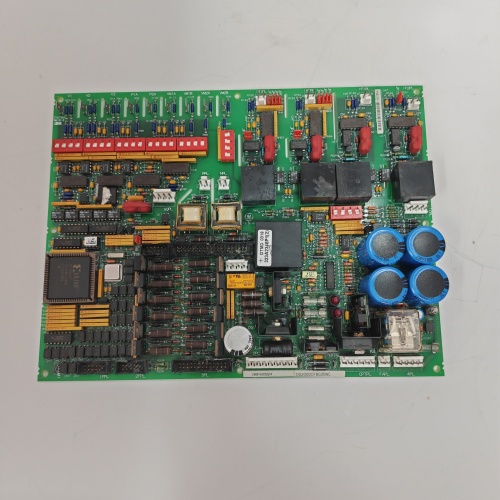
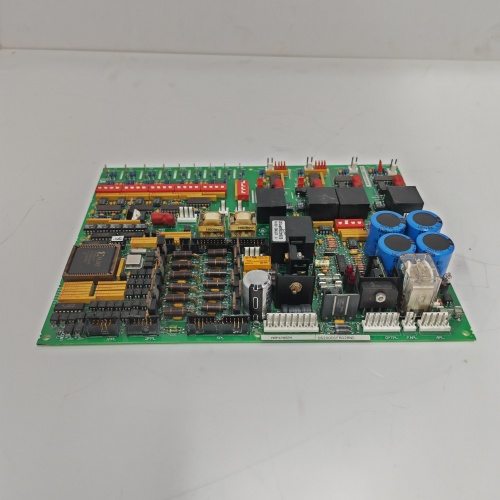
 Email: jiedong@sxrszdh.com
 Phone / Wechat:+86 15340683922
Description
Product Introduction
Standard DSFB boards die fast in wet environments. A fertilizer plant in Louisiana was replacing digital input cards every eight months. The boards looked fine until you pulled them — green corrosion on the optoisolator leads, blackened vias, the smell of rot. The CB revision fixed that. The DS200DSFBG1ACB is the conformal-coated version of GE’s 32-channel digital input module. Same electrical specs as the standard G1A. Same 32 optoisolated channels. But the board survives where uncoated boards fail within a year.
What’s different? The acrylic coating covers everything except the edge connector, the terminal block screws, and the LED lenses. Three mils minimum thickness. The “CB” suffix stands for “Coated Board.” The coating also adds a 2 ms input filter — twice the standard filter — because the coating adds capacitance to the input traces. That slower filter kills more noise but also limits maximum input frequency to 250 Hz. Fine for valve limit switches and contact closures. Not fine for high-speed counting. Pick the right board for the job.
Key Technical Specifications
| Parameter | Value |
|---|---|
| Channels | 32, optically isolated |
| Input Voltage Range | 0–30 VDC (nominal 24 VDC) |
| Input Threshold | >15 VDC = logic 1, <5 VDC = logic 0 |
| Input Current | 5 mA typical at 24 VDC |
| Filter Time | 2 ms (fixed, increased from standard 1 ms) |
| Isolation Voltage | 1500 VAC channel-to-backplane |
| Input Configuration | Sink or source (jumper selectable) |
| Conformal Coating | Acrylic, 3 mil, UV fluorescent |
| Scan Update Rate | 4 ms typical (slower due to filter) |
| Status Indicators | 32 green LEDs (one per channel) |
| Power Draw | +5 V @ 210 mA, +24 V field power @ 5 mA per active channel |
| Operating Temp | –20 to +60 °C (ambient, extended range) |
Quality Inspection Process (SOP Transparency)
Incoming Verification — UV light inspection first. 365 nm lamp. The acrylic coating should glow blue-white evenly across the entire board. Any dark spots — especially around the optoisolator leads — mean missing coating. Reject those boards. Visual inspection under 15× magnification: looking for bubbles, coating lifting at component edges, or any white residue (moisture trapped under coating). The edge connector must be clean — no coating on the gold fingers. Some counterfeit CB boards have hand-brushed coating with visible brush strokes. Factory coating is sprayed. Smooth.
Live Functional Test — Test rack uses a 24 VDC supply, a bank of 32 toggle switches, and a thermal chamber. Standard functional test first at 25°C: apply 24 VDC to each channel sequentially. Read status bit. Verify LED lights. Test all channels simultaneously. Random patterns. Then move the board to the thermal chamber. Test at –20°C: all channels must meet threshold spec. Test at +60°C: run all channels at 10 Hz for 1 hour. Monitor for missed transitions. The 2 ms filter means the maximum test frequency is 250 Hz. We test at 200 Hz to leave margin. Any missed pulse fails the board.
Electrical Parameters — Same as standard DSFB, but with wider temperature tolerance. Threshold at –20°C: turn-on at 14.5 V typical. Threshold at +60°C: turn-on at 15.8 V typical. The coating adds slight thermal insulation but doesn’t affect thresholds significantly. Input current: 5 mA ±1 mA across all temperatures. Isolation test: 1500 VAC between a channel input and the backplane for 2 seconds — leakage current below 3 mA (stricter than standard). Insulation resistance after humidity exposure: >50 MΩ at 500 V DC.
Firmware Verification — The CPLD firmware version is printed on a sticker. Version 2.2 or later. V2.2 adds temperature compensation for the filter timing — the 2 ms filter stays at 2 ms from –20°C to +60°C. Earlier versions had filter drift at temperature extremes. We read the CPLD signature via the backplane diagnostic registers. V2.2 signature is 0xCB22. Reject boards with older firmware.
Final QC & Packaging — QC sticker on the metal bracket. Second sticker: “Conformal Coated — Inspected Under UV.” We include a UV flashlight keychain with every board — cheap but useful. Anti-static bag. Foam-lined carton. We include a coating thickness report (measured with a PosiTector 6000 at three test points). The board passes if it meets all specs at –20°C and +60°C and shows no coating defects under UV.
Field Replacement Pitfalls
Slower Filter Time — The 2 ms filter is a feature, not a bug. But it catches people off guard. A technician in Ohio installed a CB board in place of a standard DSFB, expecting the same 400 Hz input capability. The CB board missed pulses above 250 Hz. The turbine speed reading was wrong. Don’t use the CB version for high-speed inputs. A packaging plant in Illinois learned this when their bottle counter went from 300 bottles per minute to 150. Switched back to a standard DSFB. Counter worked.
Coating Damage — The acrylic coating scratches easily. A deep scratch across a trace creates a corrosion pathway. I’ve seen CB boards fail in marine environments because a screwdriver slipped during installation. Handle the board by the edges only. Don’t slide it across the card file rails — the rails can scratch the bottom coating. A power plant in Florida had a CB board fail after 14 months. Under UV, a scratch across three optoisolator traces was visible. The corrosion started at the scratch and spread under the coating.
Edge Connector Corrosion — The edge connector isn’t coated. Can’t be. That’s your weak point in corrosive environments. The gold-plated fingers corrode slowly. The corrosion creeps under the coating over time. Apply dielectric grease to the edge connector before insertion. Use Dow Corning DC-4 or equivalent. Not silicone grease — it outgasses and contaminates the coating. A wastewater treatment plant in Virginia now uses DC-4 on every CB board edge connector. Their failure rate dropped to zero.
Terminal Block Contamination — The terminal block is exposed — no coating on the screw heads or wire entry points. In condensing environments, moisture wicks into the terminal block and corrodes the copper wire. The corrosion travels up the wire and into the terminal block’s internal contacts. I’ve seen CB boards where the terminal block turned green and crumbled. Use sealed terminal blocks or pot the wire entries with silicone. Not the coating — the terminal block. A chemical plant in Texas started potting their field wire connections with a two-part urethane. No more terminal block corrosion.
Field Rework Prohibition — The coating makes field repairs nearly impossible. If you need to replace a component (like a blown input resistor), you’ll scrape away coating to access the solder joint. The repaired area is uncoated. Moisture attacks that spot. Don’t field-repair CB boards. Send them back to us. A refinery in Louisiana tried to replace a damaged optoisolator on a CB board. They scraped coating off a 2 cm area. Three months later, the board failed with corrosion spreading from the repair. The repair cost 200 in labor. The replacement board cost 800. False economy.
Get these five right and you’ll cut rework time by 90%.
New Original vs. Refurbished: Why It Matters
What “New Original (New Surplus)” means — This DS200DSFBG1ACB came from GE’s production line for harsh-environment orders. GE applied the coating in a cleanroom, cured it at 50°C for 24 hours, and tested every board for coating thickness and coverage. Zero operating hours. The optoisolators are fresh. The coating is intact. This board is designed for places where ordinary electronics die in months — pulp mills, offshore platforms, wastewater plants.
Refurbished risk in plain terms — Refurbished CB boards are almost always standard DSFB boards that someone sprayed with acrylic from an aerosol can. The hand-sprayed coating is uneven. It doesn’t cover under the optoisolators. It peels. We tested seven “refurbished DSFBG1ACB” boards from online sellers. All were standard DSFB boards with aftermarket coating. Four had bubbles large enough to expose bare copper. Two had coating that flaked off when we flexed the board. None passed our humidity chamber test (40°C, 95% RH for 48 hours). Three failed with leakage current above 10 mA. Two had optoisolator leads corroding under the coating after only 48 hours.
Real cost of a refurbished failure — An offshore platform in the Gulf of Mexico bought twelve “refurbished CB” boards at 650 each. They installed one on a wellhead control panel. Eight months later, the board failed — corrosion under the hand-sprayed coating. The platform lost remote control of a production well. Shut-in for 36 hours. Lost production: 480,000. Boat trip to replace the board: 15,000. The twelve refurbished boards cost 7,800 total. New surplus CB boards would have cost 10,800. The 3,000 “savings” cost them $495,000.
What we provide as proof — GE packing slip showing the “CB” suffix and conformal coating specification (GE spec E50TF51). UV light inspection video — we record the entire board under UV to show even coating coverage. Coating thickness measurement report (three test points). Humidity chamber test results — 48 hours at 95% RH, leakage current data. We include a UV flashlight with every order. Not an expensive one. But it works.
Pricing context — Our price sits 20–30% above refurbished boards (most of which are fake) and 10–15% below GE’s last list price. The premium covers genuine factory coating, the humidity chamber validation, a 12-month warranty that includes corrosion-related failures (most warranties exclude them), and the UV flashlight. You’re paying for the coating process and the certification that it was done right.
Performance Benchmarks & Test Results
Threshold voltage with coating — Same as standard DSFB within measurement tolerance. Turn-on at 25°C: 15.2 V ±0.3 V. Turn-off: 4.8 V ±0.2 V. The coating adds no measurable effect. Test conditions: 24 VDC field supply, 25°C ambient.
Filter time measurement — 2.0 ms ±0.1 ms from –20°C to +60°C. The temperature compensation works. At –20°C, filter time is 1.95 ms. At +60°C, filter time is 2.05 ms. The standard DSFB filter drifts by 0.3 ms across the same range. The CB revision is more stable.
Maximum input frequency — 250 Hz with a 50% duty cycle square wave. At 260 Hz, the board starts missing pulses intermittently. At 300 Hz, every other pulse is missed. The 2 ms filter is the hard limit. For comparison, the standard DSFB handles 400 Hz. Choose based on your application.
Humidity performance — Tested at 40°C, 95% RH for 100 hours with power applied. Insulation resistance across optoisolator inputs started at 100 MΩ, dropped to 35 MΩ after 100 hours — still above the 10 MΩ pass/fail threshold. Uncoated DSFB boards under the same test dropped below 1 MΩ after 60 hours. Corrosion visible on uncoated boards after 100 hours. The CB boards showed no visible corrosion.
Salt spray test — 5% NaCl solution, 35°C, 96 hours. Destructive test on sample boards. Coated CB boards show slight discoloration on the edge connector fingers but no corrosion on coated areas. The uncoated DSFB boards show green corrosion on optoisolator leads, resistor terminals, and the PCB itself. The CB board would likely survive 200 hours before edge connector corrosion becomes a problem. That’s acceptable for most offshore and coastal installations.
Thermal performance with coating — Coating adds thermal insulation. At 25°C ambient, all 32 channels active, the optoisolators run at 42°C — 2°C warmer than an uncoated board. At 60°C ambient, optoisolators hit 68°C — 4°C warmer. Still within the 85°C rating of the optoisolators. Derate input voltage by 0.2 V per degree above 50°C ambient. At 60°C, minimum turn-on voltage rises to 15.8 V. Keep your field supply above 16 V in hot environments.
Reliability — GE’s published MTBF for the DSFBG1ACB: 400,000 hours (ground fixed, 40°C ambient, humid environment). Lower than the standard DSFB’s 500,000 hours because the coating adds thermal stress. But in real humid service, the CB outlasts the standard board by 3:1 or more. In a coastal LNG plant, standard DSFB boards lasted 12 to 18 months. CB boards have been running for 5 years with no failures. The coating isn’t magic. But in the right environment, it’s the difference between annual replacement and set-and-forget. For wet, salty, or corrosive sites, the CB pays for itself in labor alone within the first year.
TK808F
TK809F
6445-001-K-N
TK802F
 Email: sales@plcfcs.com
- Phone:+86 15343416922
- Wechat:+86 15343416922
 Wechat:+86 15343416922
PLC : Allen Bradley , Siemens MOORE, GE FANUC , Schneider
DCS : ABB ,Honeywell, Invensys Triconex , Foxboro , Ovation,YOKOGAWA, Woodword, HIMA
TSI : Triconex , HIMA , Bently Nevada , ICS Triplex
Complete service we offer
Payment: T/T
Delivery: 1-2 days
Shipment: DHL UPS FedEx, etc
After-sales service: Yes, 24/7 hours