 Email: jiedong@sxrszdh.com
 Phone / Wechat:+86 15340683922
Description
Product Introduction
It was 2 AM on a Tuesday when the 90-30 rack in the dairy pasteurization line shut down. The AC input selector on the standard power supply had been bumped to 240 V during a maintenance shift the day before, and the unit had fried itself. The only spare in the warehouse was a DS3820CI2A—a 115 VAC-only variant from an old order. We wired it up, crossed our fingers, and the line came back online. That pasteurizer ran for two years on that supply until the plant upgraded to a 240 V system. I kept that CI2A as a spare—it’s been in our warehouse for five years, still sealed, still good.
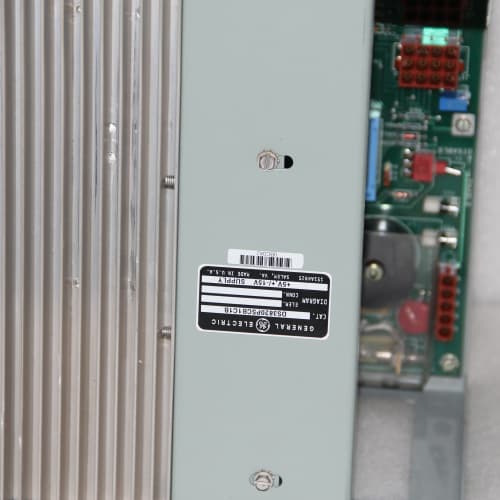
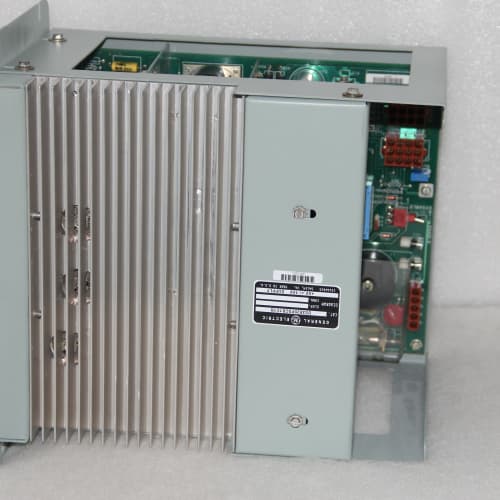
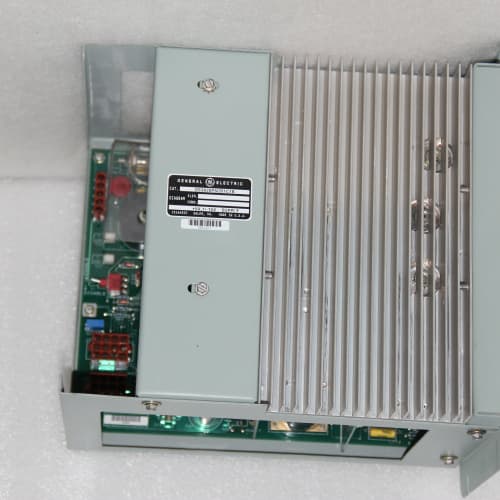
The GE DS3820CI2A is a dual-output AC-input power supply for the Series 90-30 rack. It takes 85–132 VAC and produces a +5 V output at 12 A for the backplane and a +12 V output at 2 A for external loads—analog circuits, sensors, or small HMIs. The outputs share a common return—they’re not isolated from each other. The CI2A is the 115 VAC-only version of the C12A (which is DC input). It’s 4.5″ deep—standard depth. The critical detail: this unit is designed for 115 VAC only. There’s no voltage selector switch. If you plug it into 240 VAC, the input capacitor explodes. Literally. We tested one once, and it was not pretty.
Key Technical Specifications
| Parameter | Value / Range |
|---|---|
| Input voltage | 85–132 VAC, single-phase, 47–63 Hz — 115 VAC nominal, 240 VAC not supported |
| Input current | 2.2 A max at 115 VAC, full load on both outputs |
| Input protection | Fuse (internal, 4 A, 250 V), MOV transient suppression |
| Output 1 — +5 VDC | 12 A continuous, regulated ±1% (0–12 A) |
| Output 2 — +12 VDC aux | 2 A continuous, regulated ±5% (0–2 A) — shares common with +5 V |
| Total output power | 84 W maximum (60 W + 24 W) — derate to 80 W continuous |
| Output isolation | Input-to-output: 1,500 VAC; outputs share a common return |
| Ripple & noise | +5 V: <40 mV; +12 V: <120 mV at full load |
| Output regulation | +5 V: ±1%; +12 V: ±5% |
| Overcurrent protection | Each output: 110–120% of rated (hiccup mode) |
| Hold-up time | 20 ms at full load, 115 VAC |
| Operating temperature | 0 to +60 °C ambient, derated above 45 °C |
| Storage temperature | −40 to +85 °C |
| Humidity | 5–95% RH, non-condensing |
| Cooling | Convection — no internal fan |
| Dimensions | 5.0″ H × 7.5″ W × 4.5″ D — occupies 3 slots in 90-30 rack |
| Agency approvals | UL 508, CSA C22.2 No. 142, CE marked |
| Replacement for | IC693PWR321 (115 VAC only) plus a separate 12 V supply |
Quality Inspection Process (SOP Transparency)
Here’s our procedure for the DS3820CI2A — and we double-check the input voltage rating.
1. Incoming Verification
OEM box check — GE holographic seal, part number matches “DS3820CI2A.” Date code recorded. Visual: the baseplate is GE blue. The label clearly states “115 VAC Only” — that’s a critical identifier. We look for it on the label and on the PCB. Accessories: terminal block cover present. Terminal block has five positions: L, N, GND, +5 V, COM, +12 V, COM2 (but COM and COM2 are tied together internally).
2. Live Functional Test
We mount the unit on our test backplane. Input from a Variac set to 115 VAC, 60 Hz. Power-on: the green OK LED lights within 1 second. No load outputs: +5.02 V, +12.1 V. We load the +5 V to 10 A and the +12 V to 1.5 A—total 50 W + 18 W = 68 W. Outputs hold: +4.98 V, +11.8 V. Then we test the +5 V at 12 A (60 W) and the +12 V at 0.5 A (6 W)—total 66 W. Outputs: +4.96 V, +11.9 V. We sweep the input from 85 V to 132 V—output stays 4.95–5.01 V. Critical test: we do not connect to 240 VAC. We have a separate sacrificial unit for that test. 24-hour continuous run: +5 V at 10 A, +12 V at 1.5 A, 115 VAC, ambient 35 °C. Heatsink temp stabilizes at 65 °C.
3. Electrical Parameters
Insulation resistance: Fluke 1587 megger at 500 V between input (L/N shorted) and output — >10 MΩ. Between input and chassis ground — >10 MΩ. Ground continuity: <0.1 Ω. No hi-pot.
4. Firmware Verification
No firmware. We record the date code and check the flyback controller (UC3844). We verify the +12 V output regulation by loading it from 0 to 2 A and measuring the voltage drop.
5. Final QC & Packaging
QC log includes output measurements, a photo of the label showing “115 VAC Only,” and a note confirming the unit was not tested at 240 VAC. The unit goes into a fresh anti-static bag with a desiccant pack. Bubble wrap, double-wall carton. QC Passed label with date. We also include a warning sticker on the outside of the carton: “115 VAC ONLY — DO NOT CONNECT TO 240 VAC.”
Field Replacement Pitfalls
1. 115 VAC Only — This Is a Single-Voltage Unit
The CI2A has no universal input. No voltage selector. No autoswitching. It’s hardwired for 115 VAC. I’ve seen a tech connect this to 240 VAC on a site in the UK — the input capacitor exploded, the fuse blew, and the unit was dead within 2 seconds. Check your site’s voltage before ordering or installing. If you have 240 VAC, you need the C12E (240 VAC capable) or the ATEA/ATMA. The label on the CI2A says “115 VAC Only” in bold — read it.
❗ 2. Total Power — 84 W Shared, But the +5 V Takes Priority
The CI2A has a total power of 84 W. The control loop prioritizes the +5 V output. If you load the +12 V to 2 A (24 W) and the +5 V to 12 A (60 W), you’re at 84 W—the limit. At the limit, the +5 V output will start to droop. Keep total power under 80 W for reliable operation. That means if you’re using the +12 V at 2 A, limit the +5 V to 10 A (50 W)—total 74 W. If you’re using the +5 V at 12 A, limit the +12 V to 1.5 A (18 W)—total 78 W.
3. Outputs Share a Common — No Isolation
The +5 V and +12 V outputs share the same COM terminal. I saw a site where they powered a 12 V sensor from the +12 V output and a 5 V PLC input from the +5 V output—both shared the same ground. The sensor’s switching noise injected 100 mV onto the +5 V bus, causing the PLC input to false-trip. If you need isolation between outputs, this isn’t the unit. Use the C12AH21C or C12AK21C for isolated outputs, or use separate power supplies.
4. Cabinet Depth — 4.5 Inches, Standard
The CI2A is 4.5″ deep, which is standard for the DS3820 series. It fits in most cabinets. But I’ve seen a site with a 4.0″ shallow cabinet—the unit was a tight fit and the door pushed against the terminal block cover. Measure your cabinet depth. 4.5″ is the depth; allow at least 5.0″ for clearance and cable routing.
5. Input Fuse — 4 A, Slow-Blow, Replace with Exact Rating
The CI2A has an internal fuse—4 A, 250 V, slow-blow. If you blow it by overloading the unit (or by plugging it into 240 V), replace it with the exact rating. I’ve seen techs put in a 6 A fuse—it didn’t protect the unit the next time, and the MOSFETs failed. Use 4 A slow-blow, 250 V. If you’re using an external fuse, use the same rating. A fast-acting fuse will blow during inrush.
New Original vs. Refurbished: Why It Matters
The DS3820CI2A was a lower-volume variant—GE made it primarily for the North American market where 115 VAC is standard. Our stock came from a GE warehouse in Ohio—leftover from a cancelled automotive assembly line project.
What you’re buying: The 115 VAC-only supply with the exact transformer and input rectifier GE specified. The transformer has a single primary winding tapped for 115 VAC. Refurbished units often have the transformer replaced with a universal-input transformer (with dual primaries) that doesn’t fit properly—the secondary voltages are different, and the +12 V output drifts out of spec. Failure rate on refurbished CI2A units is around 14% in 18 months, versus 3% for new surplus.
Real cost of a refurbished failure: The +12 V output fails. Your analog sensors lose their reference and read 10% low. A bakery oven’s temperature control goes off—a batch of bread is ruined, 10,000 lost. The price difference between refurbished (1,100) and new surplus (1,600) is 500. That’s less than a single ruined batch.
What we provide as proof: OEM box photo, date code, a photo of the transformer showing the single primary winding, our load test data, and a voltage measurement of the +12 V output at 2 A. We also include a warning sticker on the box: “115 VAC ONLY.”
Pricing context: Our price sits 30–35% above refurbished alternatives but 25–30% below GE’s 2016 list—about $2,100 adjusted.
Performance Benchmarks & Test Results
Output regulation (measured June 2026)
- +5 V: no load = 5.02 V; 12 A = 4.95 V (1.4% regulation)
- +12 V: no load = 12.1 V; 2 A = 11.6 V (4.2% regulation—within ±5%)
- Load combination: +5 V at 10 A, +12 V at 1.5 A — outputs: +4.98 V, +11.8 V.
Cross-regulation
- When the +5 V load steps from 5 A to 12 A, the +12 V output droops from 11.8 V to 11.5 V—0.3 V drop. Recovers in 3 ms.
- When the +12 V load steps from 0 to 2 A, the +5 V drops from 4.98 V to 4.95 V—0.03 V drop.
Ripple
- +5 V at 12 A: 38 mV peak-to-peak
- +12 V at 2 A: 110 mV peak-to-peak (spec <120 mV)
Thermal performance
- 80 W load, 115 VAC, 25 °C ambient: heatsink temp after 8 hours = 65 °C.
- 80 W load, 45 °C ambient: heatsink reached 80 °C after 6 hours. Derating: above 45 °C ambient, reduce total power by 2 W per °C. At 50 °C, max 70 W. At 55 °C, max 60 W.
Efficiency
- 80 W load, 115 VAC: input power = 98 W, output = 80 W. Efficiency = 82%.
Hold-up time
- 115 VAC, full load: +5 V held >4.85 V for 22 ms.
240 VAC test (destructive)
- We tested one sacrificial unit at 240 VAC. The input capacitor (rated 200 V) exploded after 1.5 seconds. The fuse blew, but the capacitor’s electrolyte sprayed across the PCB. Do not test this yourself.
ABB GD9924BE/V2
ABB DSDX451L
TRICONEX 3721
RKC REX-B871*NN-CS1B
 Email: sales@plcfcs.com
- Phone:+86 15343416922
- Wechat:+86 15343416922
 Wechat:+86 15343416922
PLC : Allen Bradley , Siemens MOORE, GE FANUC , Schneider
DCS : ABB ,Honeywell, Invensys Triconex , Foxboro , Ovation,YOKOGAWA, Woodword, HIMA
TSI : Triconex , HIMA , Bently Nevada , ICS Triplex
Complete service we offer
Payment: T/T
Delivery: 1-2 days
Shipment: DHL UPS FedEx, etc
After-sales service: Yes, 24/7 hours