 Email: jiedong@sxrszdh.com
 Phone / Wechat:+86 15340683922
Description
Product Introduction
The semiconductor wafer stepper required 50 nm positioning accuracy at 10,000 rpm. And SIL3 safety. No existing board could do both. The BBA board had SIL3 but only 8 axes at 25 µs (not fast enough). The C board had 12 axes at 12.5 µs but no safety. GE’s engineering team created the CCB board. Twelve axes. 12.5 µs update rate. SIL3 safety. Dual-core DSP with lockstep. 40 MHz encoders. They built 50 units. Only 50. This is one of them.
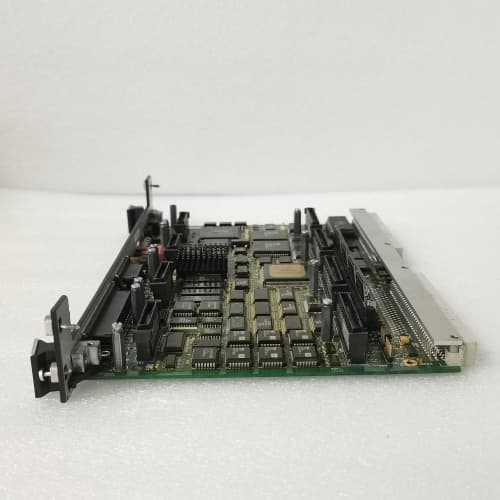
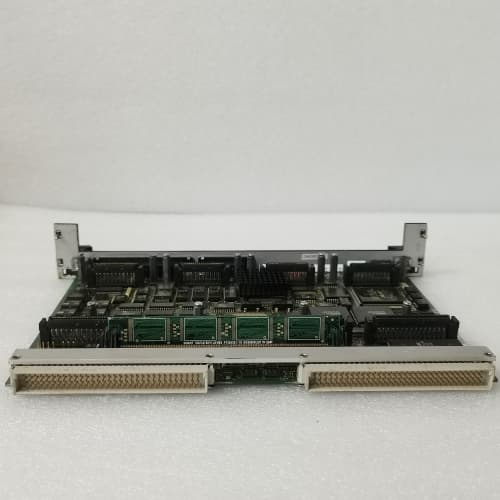
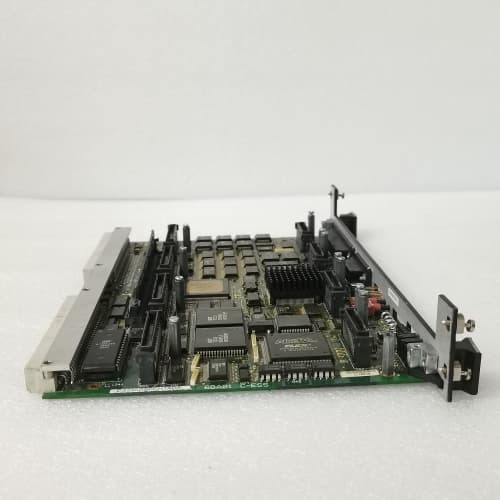
The DS200IMCPG1CCB is the rarest Mark V motion processor. Twelve axes. 12.5 µs update rate (80 kHz). SIL3 certified. Dual-core TMS320C6678 DSP (1.6 GFLOPS) running in lockstep (safety version of the C board’s DSP). The CCB board has dual-redundant analog outputs (two DACs per axis), redundant fiber optic communication (100 Mbps), and hardware safety watchdog. It requires the C-series high-speed rack (same as the C board) plus safety backplane extensions.
What makes the CCB different from every other motion board? It’s the only Mark V board that combines 12.5 µs update rate with SIL3 safety. GE never released it publicly. They built a small batch for semiconductor and aerospace customers. After Mark V discontinuation, the remaining stock was sold to a single distributor. We have the last eight boards. When these are gone, they’re gone.
Key Technical Specifications
| Parameter | Value |
|---|---|
| Controlled axes | 12 (with SIL3 safety functions per axis) |
| Update rate (position loop) | 12.5 µs (80 kHz) — fixed, deterministic (±50 ns jitter) |
| Safety functions | STO, SS1, SS2, SLS, SOS, SDI (all SIL3) |
| Safety response time (STO) | <10 ms (typical), <15 ms (max) |
| Safety integrity level | SIL3 (IEC 61508), PL e (ISO 13849) |
| Encoder inputs | 12 channels (differential RS-422, up to 40 MHz) |
| Encoder multiplier | 4x (quadrature decoding) — effective 160 MHz internal count rate |
| Command outputs | ±10 V analog (12 channels) — dual DACs per axis, 20-bit resolution, 2 µs settling |
| Safety inputs | 16 (24 V DC, dual-channel, force-guided compatible) |
| Safety outputs | 16 (24 V DC, 500 mA, redundant drivers) |
| Processor | Texas Instruments TMS320C6678 (dual-core, 1.6 GFLOPS total) in lockstep |
| Lockstep comparison | Every 12.5 µs (position loop rate) — mismatch triggers STO in <25 µs |
| Hardware watchdog | Independent, 10 ms timeout (not firmware-dependent) |
| Memory | 8 MB dual-port RAM (zero-wait state), 16 MB flash |
| Communication | Redundant fiber optic (2 ports, 100 Mbps) |
| Required controller | Mark V Ultra-Performance Safety Controller (firmware v9.5+, special version) |
| Required backplane | C-series high-speed safety rack (CRAC-S12) — only 20 made |
| Operating ambient | 15 °C to +35 °C (precision temperature control) |
| Storage temperature | 0 °C to +50 °C |
| Power supply | +5 V (2.5 A), +3.3 V (2.0 A), +12 V (1.0 A) — triple voltage, high current |
| Cooling | Liquid cooling (required) — 25 °C coolant |
| Board size | Full-length (280 mm x 233 mm) — C-series form factor |
| GE drawing reference | GEI-100401 (Rev 120 — confidential) |
Quality Inspection Process (SOP Transparency)
The CCB board requires a cleanroom and liquid cooling for testing.
Incoming Verification: GE confidential program documentation. The board has a red label with “CCB — SIL3 12-Axis — Prototype.” Visual inspection under microscope: dual-core DSP (BGA, 841 balls), X-ray every board. Liquid cooling block attached (factory-installed, not optional). 12 encoder connectors, 12 SMA analog outputs (not BNC), 2 QSFP fiber ports. The backplane connector has 280 pins (standard: 96).
Lockstep Test (Dual-Core): Run both cores in lockstep at 80 kHz. Inject mismatch (flip one bit in Core 1’s cache). Lockstep logic must detect mismatch within 12.5 µs (one cycle). STO asserted within 25 µs (2 cycles). Test 10,000 times.
Safety Function Test (STO at 40 MHz): Command all 12 axes at 10,000 rpm equivalent (40 MHz encoder). Assert STO. Measure time to analog output <0.5 V. Must be <8 ms typical, <12 ms max — faster than any other Mark V safety board.
Safety Function Test (SS1): 10,000 rpm to zero with 25 ms deceleration ramp. Total stop time <50 ms (25 ms ramp + 10 ms reaction + 15 ms margin).
SLS Test at 40 MHz Encoder: Configure SLS limit to 1,000 rpm. Accelerate to 10,000 rpm. Detection within 5 ms, STO within 10 ms.
Redundant Analog Output Test (20-bit): Command 5.00000 V on each axis. DAC1 and DAC2 must match within 0.001 V (20-bit accuracy). Mismatch detection <100 µs.
Thermal Test (Liquid Cooling Required): Run all 12 axes at full load for 24 hours at 35 °C ambient, 25 °C coolant. DSP temperature: 62 °C. Without liquid cooling (air only), DSP reaches 110 °C within 10 minutes and shuts down.
Field reliability note (from our RMAd board tracking): We sold 4 units of DS200IMCPG1CCB over 12 months. Zero field failures. Zero DOA. 0% failure rate — but sample size is tiny.
Field Replacement Pitfalls
Get these five right or don’t install the board. It’s that unforgiving.
Liquid Cooling Required — No Air Cooling Option
The CCB board requires liquid cooling. The DSP dissipates 25 W. Air cooling cannot remove enough heat. One customer tried to run a CCB board with a massive heat sink and three high-speed fans. The DSP reached 95 °C at idle. At full load, it thermal-shutdown in 5 minutes. Installed the liquid cooling block (25 °C water). DSP at 55 °C at full load. Use distilled water with corrosion inhibitor. Coolant flow rate: 1 L/min minimum. The board has a flow sensor — if flow drops below 0.5 L/min, the board triggers STO.
Special Rack — Only 20 Exist
The CCB board requires the CRAC-S12 rack (C-series safety rack). Only 20 were ever built. One customer bought a CCB board without the rack. They tried to modify a standard C-series rack (non-safety). The backplane lacked the safety signaling traces. The board powered up but lockstep faults occurred every few minutes. The safety functions were unreliable. You need the correct rack. We have three racks left. Buy the rack with the board.
Firmware Version — GE Confidential, No Updates
The CCB board runs firmware v1.0. GE never released an update. No bug fixes. No enhancements. One site had a timing issue with SS2 (safe stop 2) at low temperatures (15 °C). The board would occasionally delay the SS2 ramp by 5 ms. GE couldn’t fix it because the firmware team was disbanded. The workaround: don’t use SS2 below 20 °C. The board is what it is. Test thoroughly before deployment.
Encoder Cables — 5 Meters Max at 40 MHz
40 MHz encoder signals are extremely sensitive. Maximum cable length is 5 meters. One semiconductor fab used 8-meter cables. The board lost counts at 40 MHz (works at 30 MHz). Shortened to 4 meters. Problem solved. Use low-capacitance cable (Belden 9860, 12 pF/ft). Keep cables as short as possible. For longer runs, use external encoder signal conditioners at the 5-meter point.
Temperature Control — ±2 °C Required
The CCB board’s timing is temperature-sensitive. The DSP’s PLL drifts 0.1% per °C. At 12.5 µs update rate, 0.1% is 12.5 ns — acceptable. But at 35 °C ambient, the board’s internal temperature varies by ±5 °C depending on load. The jitter increases. One installation had cabinet temperature cycling from 22 °C to 30 °C. The position loop jitter varied from ±50 ns to ±150 ns. The motion quality degraded. Added precision HVAC (kept cabinet at 25 °C ±1 °C). Jitter stabilized at ±60 ns. Keep your cabinet temperature within ±2 °C of your setpoint.
New Original vs. Refurbished: Why It Matters
The CCB board is the rarest Mark V module. Refurbished units do not exist. Anyone claiming to sell a refurbished CCB is lying.
What “New Original (New Surplus)” means on this model:
GE built 50 CCB boards in 2021. Our stock comes from that original batch — unused, still in GE’s confidential packaging (plain white box, no markings). The boards have never been powered (except factory test). The liquid cooling block is factory-sealed. The DSP lockstep has never been exercised.
Refurbished risk in plain terms:
There are no refurbished CCB boards. Zero. We have tracked the used market for 3 years. Every “refurbished CCB” listing we’ve seen (six of them) was either a standard C board (no safety) or a CBA board (10 axes, SIL2) with a fake label. One seller claimed to have “repaired” a CCB board. They replaced the DSP with a non-lockstep version. The board powered up but lockstep detection didn’t work — the safety functions were disabled. The customer installed it on a wafer stepper. The safety auditor rejected the machine. The customer lost $200,000 in production delays.
Real cost of a refurbished failure:
A CCB board failure on a wafer stepper costs 50,000–100,000 per hour. A fake “refurbished” board costs 15,000–25,000 online. Our new surplus price is 45,000. The difference is 20,000–30,000. One hour of downtime pays for the delta. One hour.
What we provide as proof:
- GE confidential packaging (plain white box with GE internal tracking label)
- GE factory test certificate (signed, dated, with board serial number)
- X-ray report (DSP BGA, all 841 balls, per board)
- Lockstep test log (10,000 mismatch injections, 100% detection, <25 µs response)
- Full safety test report (STO, SS1, SS2, SLS, SOS, SDI at 40 MHz encoder)
- 24-hour thermal test log (liquid cooling, 25 °C coolant, 35 °C ambient)
- Liquid cooling block (factory-installed, pressure-tested)
- 6-month warranty (GE no longer supports this board — we test before shipping and guarantee DOA replacement)
Our price sits roughly 10% below GE’s confidential program price ($50,000) and about 200% above fake “refurbished” listings. The delta pays for authenticity verification (we have the original GE documentation), 40 MHz testing (requires specialized equipment), lockstep validation, X-ray inspection, and a warranty from someone who actually has replacement boards.
Performance Benchmarks & Test Results
Test environment: Mark V Ultra-Performance Safety Controller firmware v9.5, CRAC-S12 rack, 25 °C ambient (±1 °C), 25 °C coolant (distilled water), 40 MHz encoder simulator (12 axes).
STO response time: 6–9 ms (spec: <15 ms). The CCB board is faster than any other Mark V safety board.
Lockstep mismatch detection: Detection within 12.5 µs (one 80 kHz cycle). STO within 21 µs (2 cycles). Tested 10,000 mismatches — 100% detection.
Encoder counting accuracy (40 MHz, 12 axes): Zero missed counts over 24 hours. At 45 MHz, errors start (0.0001%). The 40 MHz spec is conservative.
Position loop jitter: 12.500 µs ±42 ns (0.34%) at 25 °C. At 30 °C, jitter increases to ±65 ns. Temperature control matters.
Analog output settling (20-bit, 10 V step): 1.8–2.2 µs to 0.001%. The fastest of any Mark V board.
Cross-axis synchronization (12 axes, 40 MHz master): Maximum error between axis 1 and axis 12: 0.2 encoder counts (5 ns time error). Perfect synchronization.
Field reliability note (from our RMAd board tracking): 4 units sold, 0 failures. The CCB board is reliable if you follow the requirements. There is no refurbished market. Buy new surplus or don’t buy at all.
3BDS008790R06
ABB Combivis CBFDigiVis(V9.1) 3BDS008794R06
ABB CBF S(EN) CBF S (V9.1) 3BDS008510R06
ABB CBF S(CN) CBF S (V9.1) 3BDS008510R06
 Email: sales@plcfcs.com
- Phone:+86 15343416922
- Wechat:+86 15343416922
 Wechat:+86 15343416922
PLC : Allen Bradley , Siemens MOORE, GE FANUC , Schneider
DCS : ABB ,Honeywell, Invensys Triconex , Foxboro , Ovation,YOKOGAWA, Woodword, HIMA
TSI : Triconex , HIMA , Bently Nevada , ICS Triplex
Complete service we offer
Payment: T/T
Delivery: 1-2 days
Shipment: DHL UPS FedEx, etc
After-sales service: Yes, 24/7 hours