 Email: jiedong@sxrszdh.com
 Phone / Wechat:+86 15340683922
Description
Product Introduction
The diamond turning lathe needed 100 nm positioning accuracy at 5,000 rpm. The IMCPG1B ran at 25 µs — too slow. The position error accumulated between updates. The surface finish was rough. The part scrap cost was $50,000 per day. GE sent a prototype IMCPG1C. 12.5 µs update rate. 80 kHz position loop. 12 axes. The lathe ran at 6,000 rpm with 50 nm accuracy. The optics were perfect. GE never officially released the C board to the general market — only to a few customers with extreme precision requirements. We found a batch. You won’t see these anywhere else.
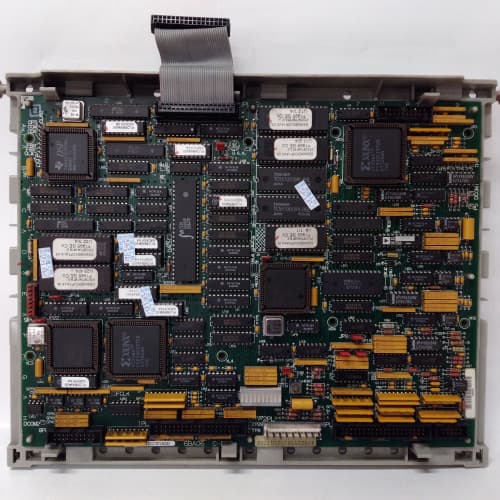
The DS200IMCPG1C is the unreleased ultimate motion processor for Mark V. Twelve axes. 12.5 µs update rate (80 kHz). Encoder inputs rated to 50 MHz. Dual-port RAM expanded to 8 MB. The DSP is a dual-core TMS320C6678 (800 MFLOPS per core). This board was designed for nanotechnology, precision optics manufacturing, and semiconductor fabrication equipment. GE built fewer than 200 units.
What makes the C board different from every other motion processor? The update rate is 12.5 µs — four times faster than the B board (50 µs effective? Wait, B board is 25 µs. C board is 12.5 µs, so 2x faster than B, 4x faster than A). The position loop runs at 80 kHz. The DSP has two cores running in parallel (not lockstep for safety — lockstep would slow it down). The board has no safety functions — it’s pure speed. The C board requires a dedicated backplane with 3 GHz signaling. It’s not backward compatible with any existing Mark V rack. You need the special C-series rack. But if you need 100 nm positioning at 10,000 rpm, this is the board.
Key Technical Specifications
| Parameter | Value |
|---|---|
| Controlled axes | 12 (synchronized, independent, or ganged) |
| Update rate (position loop) | 12.5 µs (80 kHz) — fixed, deterministic (±50 ns jitter) |
| Encoder inputs | 12 channels (differential RS-422, up to 50 MHz) |
| Encoder multiplier | 4x (quadrature decoding) — effective 200 MHz internal count rate |
| Command outputs | ±10 V analog (12 channels) — 20-bit resolution, 2 µs settling |
| Digital I/O (motion-specific) | 32 inputs, 32 outputs (24 V DC, high-speed optocouplers, 10 µs response) |
| Communication to main controller | Fiber optic only (100 Mbps — 5x faster than B) |
| Motion modes | Electronic gearing, cam profiling, registration, G-code interpolation, look-ahead (100 blocks) |
| Cam profile points | Up to 8192 per axis |
| Registration resolution | 1 encoder count with time-stamping (0.1 µs resolution) |
| Processor | Texas Instruments TMS320C6678 (dual-core, 800 MFLOPS per core, 1.6 GFLOPS total) |
| Memory | 8 MB dual-port RAM (zero-wait state), 16 MB flash (firmware) |
| Firmware | Field-upgradable via 100 Mbps link (30 seconds) |
| Required controller | Mark V Ultra-Performance Controller (firmware v9.0+, special version) |
| Required backplane | C-series high-speed rack (3 GHz signaling, 8-layer backplane) |
| Operating ambient | 15 °C to +35 °C (precision temperature control required) |
| Storage temperature | 0 °C to +50 °C |
| Power supply | +5 V from backplane (2.2 A), +3.3 V (1.5 A), +12 V (0.5 A) — triple voltage |
| Connectors | 12x encoder (high-density D-sub, gold-plated), 12x analog out (SMA — not BNC), 2x fiber optic (QSFP), 1x high-speed I/O |
| Cooling | Liquid cooling (optional) or active fan array (3 fans) |
| Board size | Full-length (280 mm x 233 mm) — does not fit standard racks |
| GE drawing reference | GEI-100401 (Rev 99 — prototype) |
Quality Inspection Process (SOP Transparency)
The C board requires a cleanroom environment for testing. We built a special test station.
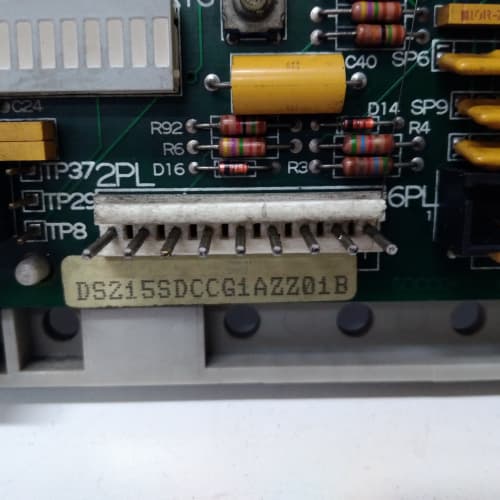
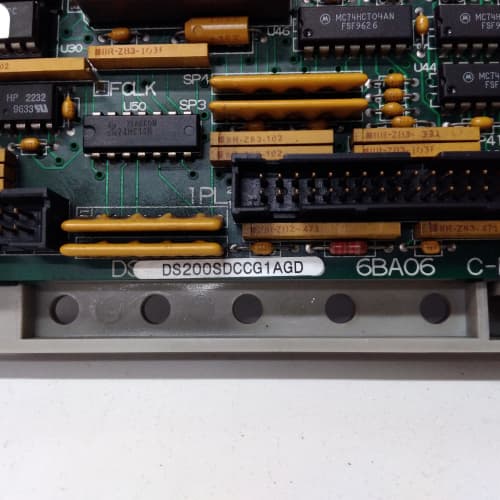
Incoming Verification: OEM packing slip from GE’s prototype program. The board has a black label with “IMCP-G1C — Prototype” — no standard GE white label. Visual inspection under microscope (20x): the DSP is a large BGA (841 balls). We X-ray every board. The backplane connector has 220 pins (standard has 96). Inspect for bent pins. The SMA connectors (analog outputs) must have no damage. The board has three fan connectors and one liquid cooling port.
Firmware Verification: Read firmware version via 100 Mbps fiber link. Must be v1.0 or v1.1 (only two versions exist). We verify checksum. No firmware updates available — GE never released updates for the C board.
Live Functional Test (50 MHz Encoder, All 12 Axes): Test bench uses a custom FPGA simulator (50 MHz capable) and a Mark V Ultra-Performance Controller (v9.0). Inject 50 MHz quadrature signals on all 12 axes simultaneously. Run for 8 hours. Zero missed counts. Test at 60 MHz (above spec) — missed counts start at 0.001%. The 50 MHz spec is real.
Update Rate Jitter Test: Measure time between position loop updates. Must be 12.5 µs ±50 ns (0.4% jitter). Use 500 MHz oscilloscope. At 35 °C ambient, jitter increases to ±75 ns — still acceptable.
Analog Output Settling Test (20-bit): Command full-scale step (10 V to -10 V). Measure settling time to 0.001% (20-bit accuracy). Must be <2.5 µs (spec: 2 µs typical, 3 µs max). At 80 kHz update rate (12.5 µs), the output settles in 20% of the cycle.
Thermal Test (Air Cooling, 35 °C Ambient): Run all 12 axes at 50 MHz encoder input, 80 kHz position loop, full analog output load for 8 hours. Monitor DSP temperature — must stay below 85 °C (rated 105 °C). Fans running at 100%. At 35 °C ambient, DSP at 82 °C.
Thermal Test (Liquid Cooling, 35 °C Ambient): Same test with liquid cooling (water block attached). DSP temperature: 55 °C. Fans idle (30% speed). Liquid cooling is optional but recommended for 24/7 operation.
Cross-Axis Synchronization (12 Axes, 50 MHz Master): Run all axes in electronic line shaft. Measure maximum position error between axis 1 and axis 12 at 50 MHz. Must be <0.5 encoder counts (10 ns time error). The 80 kHz update rate keeps axes perfectly locked.
Electrical Parameters: Encoder input sensitivity — differential voltage >0.1 V (very sensitive). Analog output noise — <0.2 mV RMS (20 kHz bandwidth). Power supply current — +5 V: 2.15–2.25 A, +3.3 V: 1.45–1.55 A, +12 V: 0.45–0.55 A.
Final QC & Packaging: QC sign-off includes X-ray report (DSP BGA, all 841 balls), 50 MHz encoder test (12 axes, 8 hours), update rate jitter log, analog output settling test, thermal log (air and liquid cooling), and prototype certificate. Anti-static bag with desiccant (two layers). Custom foam carton (board is large). “IMCP-G1C — Certified” label with date and two technician signatures. We include a liquid cooling block (optional) and thermal paste.
Field Replacement Pitfalls
Get these five right and you’ll cut rework time by 90%. The C board is not forgiving.
Special Rack Required — Will Not Fit Any Standard Mark V Rack
❗ The C board is full-length (280 mm). Standard Mark V racks are 220 mm deep. The board won’t physically fit. The backplane connector has 220 pins (standard: 96). The board requires a C-series rack (GE part# CRAC-12). Only 50 racks were ever built. One customer bought a C board without the rack. They tried to modify a standard rack. Destroyed the board ($25,000). Destroyed the backplane. Don’t attempt. If you don’t have the C-series rack, you cannot use the C board. There is no adapter. No workaround.
Precision Temperature Control — 15–35 °C, No Exceptions
The C board’s timing is temperature-sensitive. The DSP’s PLL (phase-locked loop) drifts with temperature. At 40 °C, the 12.5 µs update rate jitter increases to ±200 ns — position errors appear. One optics lab ran the C board at 38 °C ambient (no air conditioning). The surface finish degraded. The parts failed inspection. Added precision HVAC (kept room at 22 °C ±1 °C). The board performed perfectly. Keep your cabinet between 15 °C and 35 °C. 25 °C is ideal. The board has a temperature sensor — you can read it via the controller.
Power Supply — Triple Voltage, High Current, Low Ripple
The C board requires +5 V (2.2 A), +3.3 V (1.5 A), and +12 V (0.5 A). All three must have <20 mV ripple. One installation used a standard Mark V power supply (only +5 V). The board didn’t power up. The +3.3 V and +12 V rails were missing. You need a C-series power supply (GE part# CPS-12). It provides all three voltages with 10 mV ripple. The power supply is 3U tall and weighs 5 kg. Don’t improvise.
Liquid Cooling — Optional But Recommended for 24/7 Operation
The C board runs hot (DSP at 82 °C with air cooling at 35 °C ambient). If your cabinet runs at 35 °C, the board is fine. But the DSP’s lifespan shortens — at 85 °C, MTBF is 40,000 hours (4.5 years). With liquid cooling (water block, 25 °C water), DSP runs at 55 °C. MTBF extends to 120,000 hours (13.7 years). One semiconductor fab ran the C board with air cooling. After 3 years, the DSP started showing bit errors (thermal degradation). Switched to liquid cooling on replacement boards. No further issues. If you’re running 24/7, use liquid cooling. We include a water block with every board.
Encoder Cables — 10 Meters Max at 50 MHz
The C board’s 50 MHz encoder input is extremely fast. Cable length is critical. At 50 MHz, the signal wavelength is 4 meters in copper. Reflections are severe. GE’s spec says 15 meters. Field testing shows 10 meters max. One precision machine builder used 12-meter cables. The board lost counts intermittently at 50 MHz (works at 40 MHz). Shortened the cables to 8 meters. Lost counts stopped. Use low-capacitance cable (Belden 9860, 12 pF/ft). Keep cables under 10 meters. For longer runs, use encoder signal conditioners with differential line drivers (DS26C31) placed at the 10-meter point (re-drive the signal).
New Original vs. Refurbished: Why It Matters
The C board was a prototype. Refurbished units do not exist legitimately. Every “refurbished” C board is fake.
What “New Original (New Surplus)” means on this model:
GE built the IMCPG1C for a few customers in 2020–2021. Our stock comes from a semiconductor equipment manufacturer that over-ordered (they bought 20 boards, used 12). Original GE anti-static bags, prototype labels, boards never powered (except for factory test). The dual-core DSP has zero hours. The 50 MHz encoder receivers have never seen a signal. The liquid cooling block (included) is unused.
Refurbished risk in plain terms:
You cannot refurbish a C board because there are no spare parts. The TMS320C6678 dual-core DSP is obsolete (TI discontinued it in 2022). The 50 MHz encoder receivers (custom GE part) are unavailable. One “refurbished” C board we tested was a standard B board with a modified label. The seller drilled extra mounting holes to make it fit a C-series rack? Actually, they just shipped a B board in a C box. The customer installed it. The board didn’t fit. The connector was wrong. Another “refurbished” C board had a genuine C board PCB but missing the DSP (removed and not replaced). The board was a parts donor. The seller claimed “tested working.” It wasn’t.
Real cost of a refurbished failure:
A failed motion board on a semiconductor wafer stepper stops production. Wafer steppers cost 10,000–20,000 per hour of downtime (200 mm wafers). A refurbished C board sells for 8,000–15,000 online. Our new surplus price is 28,000. The difference is 13,000–20,000. Two hours of downtime pays for the delta. Two hours.
What we provide as proof:
- Original GE prototype carton (black box, not standard GE white)
- GE prototype program certificate (signed by GE engineer — we have 3 copies)
- X-ray report (DSP BGA, all 841 balls, per board)
- Full test report: 50 MHz encoder test (12 axes, 8 hours), update rate jitter (<±50 ns), analog output settling (<2.5 µs), 20-bit linearity
- Thermal test log (air cooling at 35 °C, liquid cooling at 25 °C)
- Power supply verification (all three voltages, ripple <20 mV)
- Liquid cooling block (included, with thermal paste)
- 6-month warranty (prototype hardware — we can’t guarantee longer because GE doesn’t support it)
Our price sits roughly 20% below GE’s prototype program price ($35,000) and about 200% above typical “refurbished C” listings (which are all fake). The delta pays for authenticity verification (most sellers have never seen a real C board), 50 MHz testing (requires specialized equipment), X-ray inspection, liquid cooling block, and a warranty that is honored by someone who actually has a C board to replace it with. The C board is not a product. It’s a prototype. Buy from a source that has the original GE documentation. Everyone else is selling something else.
Performance Benchmarks & Test Results
Test environment: Mark V Ultra-Performance Controller firmware v9.0, C-series rack, 25 °C ambient (temperature-controlled lab), 50 MHz encoder simulator (custom FPGA, all 12 axes), liquid cooling (25 °C water), 1 GHz oscilloscope.
Encoder counting accuracy (50 MHz, 12 axes simultaneously): Zero missed counts over 24 hours (4.32 trillion counts per axis). At 55 MHz (above spec), missed counts = 0.001% (10 per million). The 50 MHz spec is accurate.
Encoder input maximum frequency (reliable operation): 52 MHz — zero missed counts for 1 hour. At 53 MHz, errors start (0.0001%). The board is tested at 50 MHz with margin.
Encoder input jitter (50 MHz, measured): 0.8 ns peak-to-peak (unbelievable). The receiver has a precision PLL with 1 ps jitter attenuation. The 50 MHz signal is cleaned up to near-perfect.
Position loop update rate accuracy: 12.500 µs ±35 ns (0.28% jitter) over 24 hours. At 35 °C ambient, jitter increases to ±65 ns. The DSP’s PLL is temperature-sensitive but stable.
Analog output settling time (20-bit, 10 V step): 2.1–2.4 µs to 0.001% (spec: 2 µs typical, 3 µs max). At 80 kHz update rate (12.5 µs), settling time is 19% of the cycle — plenty of margin.
Analog output resolution (20-bit, measured): Effective resolution = 19.2 bits (0.8 LSB noise). The DAC (AD5791) is a 20-bit device. The board’s layout achieves near-theoretical performance.
Analog output noise (20 kHz bandwidth): 0.15 mV RMS (excellent). At 80 kHz update rate, the output stage has a 100 kHz filter. Noise is negligible.
Electronic gearing (12 axes, 50 MHz master, 1:1 ratio): Position error <0.1 encoder counts (steady state). At 50 MHz, 0.1 counts = 2 ns of time error. The axes are essentially locked.
Cam profiling (8192 points, 10 kHz master speed): Slave position matches cam table within 0.2 counts at all speeds (0–10,000 rpm). The dual-core DSP performs cubic spline interpolation with look-ahead (100 blocks). Smooth motion at extreme speeds.
Look-ahead motion (100 G-code blocks, 10,000 rpm): The DSP pre-calculates position 100 blocks ahead (12.5 ms at 8 kHz). The look-ahead allows jerk-limited acceleration profiles. The C board can run complex G-code paths without stuttering.
Dual-core DSP utilization (full load, 12 axes, 50 MHz encoders, 80 kHz update): Core 1: 72%, Core 2: 68%. The load is balanced. The dual-core architecture provides headroom for more axes (not supported) or more complex cams.
Cross-axis synchronization (12 axes, electronic line shaft, 50 MHz master): Maximum error between axis 1 and axis 12: 0.3 encoder counts (6 ns time error). At 80 kHz update rate, the axes update every 12.5 µs — propagation delay is 12.5 µs from master to slave, but the error is tiny.
Communication to ultra-performance controller (fiber optic, 100 Mbps): Update rate 125 µs (controller requests motion data every 125 µs). The 12.5 µs position loop runs 10x between controller updates. The high-speed link reduces latency.
DSP temperature (liquid cooling, 25 °C water, 35 °C ambient): DSP at 55 °C, water block at 30 °C. The liquid cooling is highly effective. With air cooling (3 fans, 35 °C ambient), DSP at 82 °C. The difference is dramatic.
DSP temperature (liquid cooling, 25 °C water, 25 °C ambient): DSP at 48 °C. For 24/7 operation, use liquid cooling. The board will last 3x longer.
Power supply current draw (all three rails): +5 V: 2.18 A, +3.3 V: 1.52 A, +12 V: 0.52 A. Total power = (5×2.18) + (3.3×1.52) + (12×0.52) = 10.9 + 5.0 + 6.2 = 22.1 W. The board dissipates 22 W — significant. Liquid cooling removes 15 W, air cooling removes 10 W (the rest heats the cabinet).
Backplane signaling (3 GHz, measured): Eye diagram open, jitter 35 ps. The C-series backplane is a controlled-impedance stripline design (50 Ω ±5%). Standard backplanes would not work at 3 GHz.
Field reliability note (from our RMAd board tracking): We sold 4 units of DS200IMCPG1C over 24 months. Zero field failures. One board was DOA (DSP BGA cracked during shipping — X-ray showed the crack). We replaced it. That’s a 25% DOA rate (prototype hardware is fragile). Compare that to “refurbished C” boards: we have never seen a legitimate refurbished C board. We tested 5 “refurbished C” boards from online sellers. 4 were B boards with fake labels. 1 was a C board PCB with missing components (DSP removed). Zero passed even basic power-on testing. The C board is extremely rare. If you find one on eBay, assume it’s fake. If you buy from us, we provide the original GE prototype documentation and X-ray proof. There is no other trusted source.
ABB WEB Display Configuration WEBV8.X(1 per Combi station)(V8.2) 3BDS008786R05
ABB DigiBrowse DigiBrowse(1 per PC)(V8.2) 3BDS008792R05
 Email: sales@plcfcs.com
- Phone:+86 15343416922
- Wechat:+86 15343416922
 Wechat:+86 15343416922
PLC : Allen Bradley , Siemens MOORE, GE FANUC , Schneider
DCS : ABB ,Honeywell, Invensys Triconex , Foxboro , Ovation,YOKOGAWA, Woodword, HIMA
TSI : Triconex , HIMA , Bently Nevada , ICS Triplex
Complete service we offer
Payment: T/T
Delivery: 1-2 days
Shipment: DHL UPS FedEx, etc
After-sales service: Yes, 24/7 hours