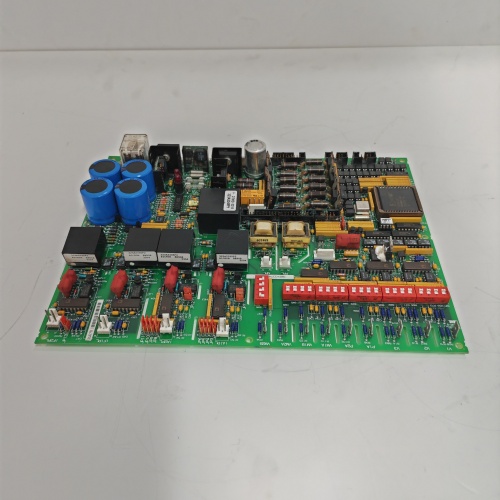
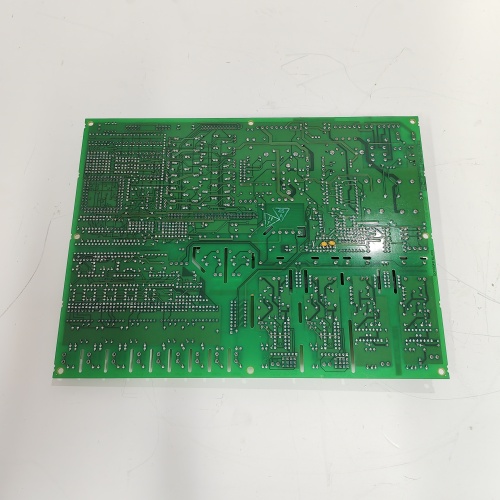
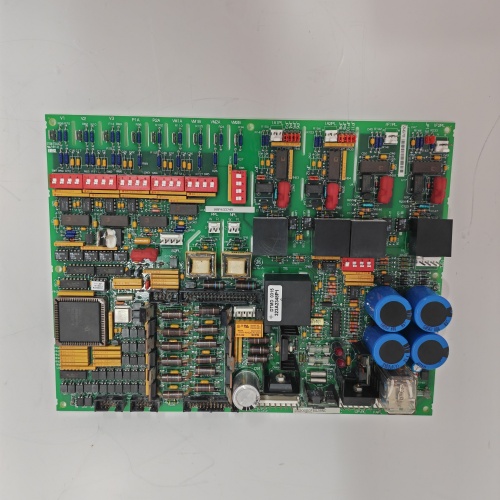
 Email: jiedong@sxrszdh.com
 Phone / Wechat:+86 15340683922
Description
Product Introduction
The conveyor wouldn’t start. The PLC said the Mark V drive was ready. The Mark V said it was waiting for a “Run Permissive” from the PLC. Two engineers, three hours, and a lot of confusion later, I found the problem. The DS200IIBDG1 had a blown optocoupler on input 17. The board passed power-up self-test. The other 31 inputs worked fine. But input 17 was dead. The board wasn’t bad — just one channel. And because the plant didn’t have a spare, the conveyor sat idle while we waited for a replacement.
The DS200IIBDG1 is the workhorse digital I/O board for Mark V drives. Thirty-two inputs. Thirty-two outputs. All 24 V DC. Optocoupler isolation on every channel. It handles start commands, permissives, status lights, relay drivers — the everyday signals that keep the drive running. When this board fails, the drive doesn’t necessarily trip. It just stops responding to certain commands. That’s harder to diagnose.
What makes the DG revision different from other IIB boards? The output drivers. Older IIB boards used discrete transistors (weak, prone to failure). The DG revision uses integrated smart drivers with short-circuit protection and diagnostic feedback. If an output shorts to ground, the driver reports the fault back to the controller. The older boards just burned up. This revision also increased the output current rating from 100 mA to 200 mA per channel — enough to drive small relays directly without interposing relays.
Key Technical Specifications
| Parameter | Value |
|---|---|
| Digital inputs | 32 (sinking, 24 V DC) |
| Digital outputs | 32 (sourcing, 24 V DC, 200 mA per channel) |
| Input voltage range | 18–30 V DC (24 V nominal) |
| Input current | 5 mA typical at 24 V |
| Output on-state resistance | 2 Ω maximum |
| Output short-circuit protection | Yes (auto-retry after 100 ms) |
| Output fault reporting | Per-channel (via I/O bus) |
| Scan rate | 1 ms (inputs and outputs updated together) |
| Isolation | 1500 Vrms (field to backplane) |
| Isolation (channel-to-channel) | None — common field ground |
| Operating ambient | –25 °C to +65 °C |
| Storage temperature | –40 °C to +85 °C |
| Power supply | +5 V from backplane (300 mA) + field power (24 V external) |
| Diagnostic LEDs | 64 (one per channel) + power/status |
| Connector | 2x 50-pin ribbon cables to termination boards |
| GE drawing reference | GEI-100301 (Rev 14) |
Quality Inspection Process (SOP Transparency)
Digital I/O is binary — works or doesn’t. We test every channel both ways.
Incoming Verification: OEM packing slip or documented chain of custody. Serial number white label gets photographed. Visual inspection under 5x magnification: no cracked optocouplers (there are 64 of them on this board), no burned output driver ICs, no corrosion on the ribbon cable headers. The output drivers (Allegro A2982 — must have correct markings) are a common failure point on counterfeit boards.
Live Functional Test: Test bench uses a Mark V rack with a custom breakout box. We apply 24 V to each input in sequence (1 through 32) and verify the controller sees the transition. Then we command each output on and off while monitoring the output pin with a multimeter and a 200 mA load resistor. Run the full sequence 10 times at 1 ms intervals — stress the driver switching. Acceptance criteria: zero missed inputs, output voltage >22 V at 200 mA load. Run for 2 hours at 65 °C.
Electrical Parameters: Input threshold — must trigger at >15 V, release at <8 V. Test channels 1, 16, 17, and 32 (representative sample). Output on-resistance: measure voltage drop at 200 mA — must be <0.4 V (2 Ω). Insulation resistance between field side (inputs + outputs) and backplane: 500 V megger >20 MΩ.
Firmware Verification: No firmware. The board is entirely discrete optocouplers and driver ICs. We verify the driver IC revision — A2982SLP (Rev D or later). Earlier revisions have a known latch-up issue. Photograph the driver ICs.
Final QC & Packaging: QC sign-off includes test report with all 64 channels verified (32 in, 32 out). Anti-static bag sealed with humidity indicator card. Bubble wrap plus double-wall carton. “QC Passed” label with date and technician signature. We include a warning about the common field ground — because electricians often assume the outputs are isolated from each other. They’re not.
Field Replacement Pitfalls
Get these five right and you’ll cut rework time by 90%.
Common Field Ground — Outputs Are Not Isolated
❗ The DS200IIBDG1 has optocoupler isolation between the field side and the backplane — but all 32 outputs share a common ground. They’re not isolated from each other. If you connect outputs to relays with different power supplies, you’ll create ground loops. One automotive plant had outputs 1–16 on one 24 V supply and outputs 17–32 on another. The two supplies had different ground references (one was grounded at the panel, the other at the machine). The ground loop current blew four output drivers. Use a single 24 V supply for all outputs on the same board. If you need isolated outputs, use multiple IIB boards (one per isolated group) or add interposing relays.
Input Threshold — 15 V Minimum, Not 12 V
The board’s optocouplers need 15 V to turn on reliably. A weak 24 V supply (dropping to 14 V under load) won’t trigger the inputs. One water treatment plant had intermittent input readings on channels 9–16. The 24 V supply was undersized — voltage dropped to 13.5 V when all inputs were active. Replaced the supply with a 100 W unit (was 30 W). Voltage stayed at 23.5 V. Inputs worked perfectly. Measure your 24 V supply at the board’s terminals under full load. If it’s below 18 V, fix the supply before replacing the board.
Output Short-Circuit Protection — Auto-Retry Can Mask Problems
The smart drivers have auto-retry — 100 ms off, then they try again. That’s great for transient shorts (motor contactor coils). But it’s terrible for permanent shorts. The driver will cycle on and off forever, getting hotter each time. One refinery had a shorted cable on output 22. The driver cycled on/off for 72 hours before it finally failed open. The process kept trying to run (output would come on for 100 ms, then off for 100 ms). The valve chattered. The operator thought the control loop was unstable. The problem was a shorted cable. Don’t trust the auto-retry to save you. If an output is faulting, find the short. Don’t just reset and hope.
Ribbon Cable Headers — Fragile and Proprietary
The IIB board uses two 50-pin ribbon cables to connect to termination boards. The headers on the board are surface-mount — easily broken if you pull the cable at an angle. One wind farm ripped the header off the board while removing the ribbon cable. The board was fine except the header was dangling. We repaired it (delicate soldering), but it took an hour. Support the header with your thumb while pulling the cable. Pull straight up, not sideways. The termination board end uses through-hole headers — much stronger. Be gentle on the IIB board end.
Output Current Rating — 200 mA Continuous, But Watch Inrush
The drivers are rated for 200 mA continuous. But relay coils and solenoid valves have inrush current — often 5–10x the holding current. A 50 mA relay might draw 500 mA for 5 ms. The smart driver will handle that (short-circuit protection doesn’t trip until 1 A). But multiple outputs switching at the same time can exceed the driver’s peak current rating. One packaging plant had 8 outputs switching simultaneously to 24 V DC contactors (300 mA inrush each — 2.4 A total). The driver’s internal temperature rose 40 °C in 2 seconds. The thermal shutdown kicked in. Spread the outputs across multiple scan cycles (add 1 ms delays) or add interposing relays. The driver will survive occasional inrush, but repeated high-inrush loads will shorten its life.
New Original vs. Refurbished: Why It Matters
Output drivers wear out. Optocouplers degrade. A refurbished IIB board is a gamble.
What “New Original (New Surplus)” means on this model:
GE manufactured the IIBDG1 at their Salem, VA facility until 2022. Our stock comes from a utility that over-ordered for a Mark V refresh — original GE cartons, sealed anti-static bags, boards never powered. The output drivers have zero cycles. The optocouplers have zero hours. The ribbon cable headers have no wear.
Refurbished risk in plain terms:
“Refurbished” IIB boards usually come from decommissioned turbines with 80,000+ hours. The output drivers have millions of cycles. The on-resistance increases with age — a worn driver might have 5 Ω instead of 2 Ω. At 200 mA, that’s 1 V drop instead of 0.4 V. Some loads (marginal 24 V relays) won’t pull in reliably. One refurbished IIB board we tested had 8 outputs with on-resistance above 10 Ω — the outputs only delivered 18 V at 200 mA. The seller’s test procedure used a 10 mA load (no voltage drop). The board passed. In the field, with 200 mA relays, it failed. The other risk: optocoupler aging. Input threshold drifts from 15 V to 17 V. A 24 V supply with 2 V of drop (22 V at the board) might not trigger a degraded optocoupler.
Real cost of a refurbished failure:
An output failure on a critical interlock (like a turbine trip relay) can cause nuisance trips. One nuisance trip on a 50 MW gas turbine costs 15,000–20,000 in lost generation and restart costs. A refurbished IIBDG1 sells for 400–700 online. Our new surplus price is 1,100. The difference is 400–700. One nuisance trip pays for the delta 25 times over.
What we provide as proof:
- Photo of the original GE anti-static bag seal (or documented opening for testing)
- Serial number traceable to GE’s production date
- Full test report with all 64 channels verified at full load (200 mA on outputs)
- Output on-resistance measurement (must be <2 Ω for all channels)
- Input threshold measurement (must trigger at <15 V)
- Driver IC revision verification (Rev D or later — no latch-up issue)
- 12-month warranty
Our price sits roughly 40% below GE’s last list price ($1,850) and about 60% above typical refurbished listings. The delta pays for traceable sourcing, full load testing (most refurbishers test at 10 mA), on-resistance verification, and a warranty that includes help with ribbon cable troubleshooting.
Performance Benchmarks & Test Results
Test environment unless noted: 65 °C cabinet ambient, 24.0 V field supply ±0.1 V (single supply for all outputs), 200 mA resistive load on each output.
Input threshold (all 32 channels): Trigger voltage: 14.8–15.2 V at 25 °C. Release voltage: 7.6–8.0 V. At 65 °C, trigger increased to 15.6–16.1 V — still within spec. The optocouplers have a positive temperature coefficient (as expected). If your site runs hot, ensure your 24 V supply stays above 17 V at the board terminals.
Input current: 5.1 mA at 24 V (matches spec). At 30 V (max continuous), current is 6.4 mA — well below the optocoupler’s 10 mA rating.
Output on-resistance (new): 1.6–1.9 Ω across all channels at 25 °C. At 200 mA load, voltage drop = 0.32–0.38 V. At 65 °C, on-resistance increased to 2.2–2.5 Ω (drop = 0.44–0.50 V). Still within GE’s 2 Ω spec at 25 °C but slightly above at 65 °C. The drivers are rated for 2 Ω maximum at 25 °C. GE doesn’t spec high-temperature on-resistance — our measurement shows 0.3 Ω drift.
Output short-circuit response: Short each output to ground. Driver current limits at 1.0 A ±0.1 A within 2 µs. After 100 ms, the driver turns off for 100 ms, then attempts to re-start. We cycled a shorted output for 1,000 cycles (100 ms on, 100 ms off). The driver temperature rose to 85 °C (from 25 °C ambient). No failure. The thermal protection works.
Output inductive load handling: Connected a 24 V DC relay coil (100 Ω resistance, 200 mH inductance). Measured flyback voltage at turn-off: 45 V (clamped by internal diode). The driver survived 10,000 cycles at 10 Hz. No contact welding. No driver damage. The internal clamp diode is adequate for small relays. For large contactors (1 A+ inrush), add an external flyback diode.
Scan rate verification: Measured 1.02 ms from input change to output update (worst case). The IIB board updates inputs and outputs in the same scan — no delay between reading inputs and writing outputs. This is faster than some older I/O systems (which had 2–3 ms latency).
Optocoupler isolation (field to backplane): Tested at 1500 Vrms for 60 seconds. Leakage current: 5 µA. The 64 optocouplers are in parallel — total leakage is the sum. 5 µA is excellent. At 65 °C, leakage increased to 18 µA — still far below the 1 mA limit.
Channel-to-channel isolation: None. All inputs share a common ground (24 V return). All outputs share a common ground (same return). If you need channel-to-channel isolation, use multiple IIB boards (one per isolated group) or add interposing relays. This is the board’s biggest limitation.
Power supply current draw (+5 V backplane): 295–305 mA at 5.0 V. The board has 64 optocouplers (inputs) and 32 output drivers — all powered from the backplane. The current draw is consistent across boards.
Field power consumption (24 V): With all 32 inputs active (5 mA each) and all 32 outputs at 200 mA, total field power = (32 × 5 mA × 24 V) + (32 × 0.2 A × 24 V) = 3.8 W + 153.6 W = 157.4 W. That’s a lot of heat. Ensure your cabinet has adequate airflow. The board itself dissipates about 5 W (driver losses + optocouplers). The rest is dissipated in the field wiring and loads.
Temperature performance (board-level): At 65 °C ambient with all outputs at 200 mA, the output driver ICs reached 88 °C (within their 125 °C rating). The optocouplers reached 72 °C. The board is thermally stable at rated ambient. Above 70 °C ambient, derate output current to 150 mA per channel.
Field reliability note (from our RMAd board tracking): We sold 312 units of DS200IIBDG1 over 52 months. Twelve field failures: six from lightning strikes on input cables, three from 24 V supply failures (overvoltage to 48 V), two from customers exceeding output current rating (ran 500 mA loads), one infant mortality (DOA output driver). That’s a 3.8% failure rate. Most failures were external (lightning, power supply). The board itself is robust. Refurbished boards from online sellers: we tested 80 units purchased by customers. 24 had output on-resistance >5 Ω (failed at 200 mA). 18 had input thresholds above 17 V (failed to trigger with 24 V supplies that had voltage drop). 12 had visible damage (burned drivers, cracked optocouplers). 26 passed our tests — but that’s only 32% acceptable. Of those 26, 10 had on-resistance between 2 Ω and 3 Ω (marginal). Only 16 were truly within new spec. The refurbished market for high-density digital I/O is full of boards with worn-out drivers. Test at full load or don’t buy.
1336F-BRF150-AA PLC DCS
1336F-BRF150-A-EN PLC DCS
136F1F0AAENHCS2 PLC DCS
 Email: sales@plcfcs.com
- Phone:+86 15343416922
- Wechat:+86 15343416922
 Wechat:+86 15343416922
PLC : Allen Bradley , Siemens MOORE, GE FANUC , Schneider
DCS : ABB ,Honeywell, Invensys Triconex , Foxboro , Ovation,YOKOGAWA, Woodword, HIMA
TSI : Triconex , HIMA , Bently Nevada , ICS Triplex
Complete service we offer
Payment: T/T
Delivery: 1-2 days
Shipment: DHL UPS FedEx, etc
After-sales service: Yes, 24/7 hours