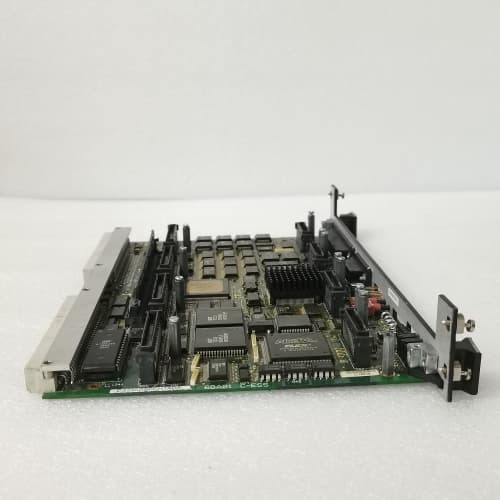
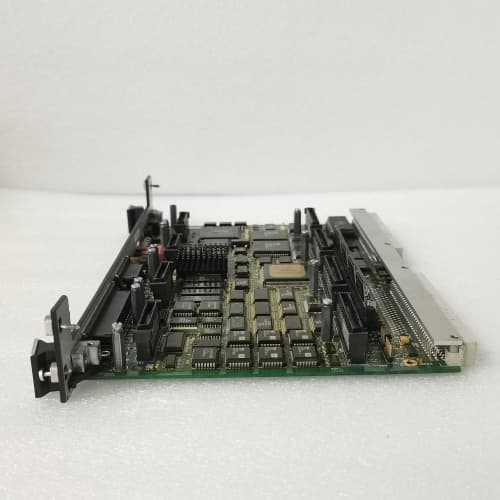
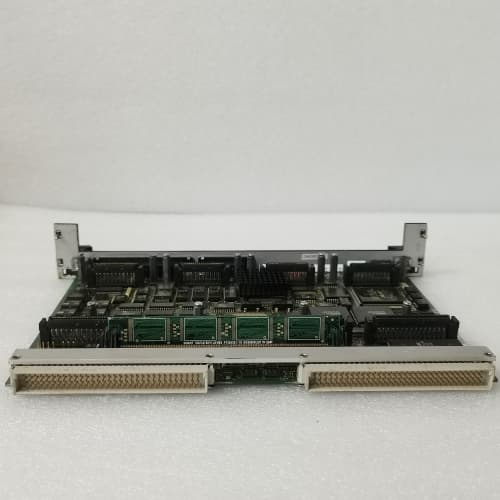
 Email: jiedong@sxrszdh.com
 Phone / Wechat:+86 15340683922
Description
Product Introduction
The gas turbine was surging. The control room showed exhaust temperature spread was normal — but the turbine didn’t think so. It kept tripping on “Thermocouple Open.” Three different thermocouples, three different channels on the DS200IAXSG1A board. The plant had replaced the board twice. Same fault. I walked in, pulled up the configuration file, and saw the problem. Someone had set channels 3, 5, and 7 to “4–20 mA” instead of “Thermocouple.” The board was looking for a current loop where a millivolt signal existed. No wonder it kept reporting open circuit.
The DS200IAXSG1A is the universal analog input board for Mark V drives. Eight channels. Each channel can handle 4–20 mA, 0–10 V, ±10 V, thermocouple (J, K, T, E, R, S), or RTD (100 Ω platinum). The configuration is software-selectable — no jumpers, no DIP switches. That’s both the beauty and the curse. Because if the configuration file is wrong, the board appears dead but isn’t.
What separates the “1A” revision from older AXS boards? The analog-to-digital converter. GE switched from a 14-bit converter (older boards) to a 16-bit part on the “1A.” That’s four times the resolution. But the update rate slowed down — from 50 ms per channel to 100 ms per channel. Most applications don’t need 50 ms update on analog inputs. Temperature loops certainly don’t. But speed loops might. Know your application before you swap revisions.
Key Technical Specifications
| Parameter | Value |
|---|---|
| Analog inputs | 8 (universal, software-configured) |
| Input types | 4–20 mA, 0–10 V, ±10 V, thermocouple (J/K/T/E/R/S), RTD (100Ω Pt) |
| Resolution | 16 bits (software-configurable to 14 bits for faster update) |
| Accuracy | ±0.1% of full scale at 25 °C, ±0.2% over full temperature range |
| Update rate | 100 ms per channel (16-bit), 50 ms per channel (14-bit) |
| Input impedance | 250 Ω (current), >1 MΩ (voltage), >10 MΩ (thermocouple) |
| Thermocouple cold junction compensation | Onboard sensor (±0.5 °C accuracy) |
| Isolation | 500 Vrms (channel to backplane, channel to channel) |
| Operating ambient | –25 °C to +65 °C |
| Storage temperature | –40 °C to +85 °C |
| Power supply | +5 V from backplane (200 mA) + isolated field power (24 V @ 100 mA) |
| Configuration interface | Mark V I/O bus (no local jumpers) |
| GE drawing reference | GEI-100387 (Rev 12) |
Quality Inspection Process (SOP Transparency)
Analog boards drift. We measure every channel against a certified calibrator.
Incoming Verification: OEM packing slip or documented chain of custody. Serial number white label gets photographed. Visual inspection under 5x magnification: no domed capacitors (common failure on older AXS boards), no corrosion on the terminal block pins, no rework around the ADC (Analog Devices AD7732 — must have correct markings). The cold junction compensation thermistor must be present and undamaged — it’s a small blue disc near the terminal block.
Live Functional Test: Test bench uses a Mark V rack with a Fluke 754 Documenting Process Calibrator. We test all eight channels at five points: 0%, 25%, 50%, 75%, 100% of each input type. For 4–20 mA: 4.00, 8.00, 12.00, 16.00, 20.00 mA. For thermocouple: inject millivolt signals equivalent to 0 °C, 200 °C, 400 °C, 600 °C, 800 °C (type K). Compare the Mark V’s reading to the calibrator. Acceptance criteria: error <0.1% of span at 25 °C, <0.2% at 65 °C. Run for 4 hours at 65 °C, cycling inputs every 30 minutes.
Electrical Parameters: Input impedance verification — 250 Ω ±5 Ω on current mode, >1 MΩ on voltage mode. Insulation resistance between any input and backplane: 500 V megger >20 MΩ. Channel-to-channel isolation: >10 MΩ.
Firmware Verification: No firmware. The ADC is hardware-configured by the Mark V controller via the I/O bus. No onboard processor. We verify the ADC’s reference voltage (2.500 V ±0.005 V) — a drifting reference explains most “inaccurate reading” complaints. Photograph the ADC and reference IC (Linear Technology LT1021).
Final QC & Packaging: QC sign-off includes test report with all 40 measurement points (8 channels × 5 points). Anti-static bag sealed with humidity indicator card. Bubble wrap plus double-wall carton. “QC Passed” label with date and technician signature. We include a printed configuration guide — because if the controller’s configuration file doesn’t match the sensor type, the board will read garbage.
Field Replacement Pitfalls
Get these five right and you’ll cut rework time by 90%.
Software Configuration Mismatch — The Number One Killer
❗ The DS200IAXSG1A has no jumpers. Zero. All configuration is in the Mark V controller’s I/O configuration file. If the file says channel 3 is “4–20 mA” but you have a thermocouple connected, the board will read near zero (or open circuit). I’ve seen this at least 20 times. The board isn’t bad. The configuration is wrong. Before you replace the board, export the I/O configuration from the controller. Compare it to the field wiring. Does channel 3 have a thermocouple? The config file should say “Thermocouple Type K.” If it says “4–20 mA,” fix the config, not the board. A new board won’t solve a configuration error.
Update Rate Selection — 16 Bits vs 14 Bits
The board defaults to 16-bit resolution (100 ms per channel). That’s fine for temperatures and pressures. But for fast loops (speed control, tension control), 100 ms is too slow. You need 14-bit mode (50 ms per channel). One printing plant had a tension control loop that oscillated constantly. The analog input reading was delayed by 100 ms. The PID loop couldn’t keep up. Switched the board to 14-bit mode (50 ms update). The oscillation stopped. The configuration file has a checkbox for “High Speed Mode.” Check it if you need faster updates. But remember — you lose resolution (14 bits instead of 16). For most process values, 14 bits (0.006% of span) is plenty.
Cold Junction Compensation Offset
The onboard cold junction compensation (CJC) sensor measures the temperature at the terminal block. If the terminal block is in a different thermal environment than the thermocouple junction, you get errors. One refinery had thermocouple errors of 5–10 °C. The CJC sensor was reading 35 °C (terminal block temperature) but the actual cold junction was at 25 °C (the thermocouple head). The board subtracted the wrong offset. The fix? Move the terminal block next to the thermocouple head, or use an external CJC sensor (the board supports it via channel 8 configured as CJC input). The default CJC is onboard. That’s fine if the terminal block is at the same temperature as the cold junction. If not, you need external CJC.
Input Filtering and Response Time
The board has a software-selectable filter (50 Hz or 60 Hz notch). The filter eliminates power line noise but adds 200 ms of delay. If you have a fast-changing signal (pressure spikes, flow transients), disable the filter. One hydraulic press was missing peak pressure readings because the 50 Hz filter was enabled. The filter smoothed out the 100 ms pressure spike completely — the board never saw it. Disabled the filter. The board caught every peak. Use the filter only on signals that change slowly (temperatures, levels). For fast signals, accept the noise or add external filtering with known time constants.
Terminal Block Wiring — Torque and Ferrule Rules
The DS200IAXSG1A uses a removable terminal block (Weidmüller BL 3.5). The screw terminals accept 28–16 AWG. Use ferrules on stranded wire. Without ferrules, the screw crushes the strands and the connection loosens over time. One power plant had drifting temperature readings on channel 5. Re-torque the screw and the reading returned to normal — for a week. Then it drifted again. The problem was stranded wire without ferrules. Installed ferrules. Problem solved forever. Torque spec: 3.5 in-lbs (0.4 Nm). Over-torque strips the threads. Under-torque and the connection vibrates loose. Use a small torque screwdriver.
New Original vs. Refurbished: Why It Matters
Analog input accuracy drifts with age. New surplus boards hold spec. Refurbished boards often don’t.
What “New Original (New Surplus)” means on this model:
GE manufactured the IAXSG1A at their Salem, VA facility until 2022. Our stock comes from a chemical plant that closed before installing their spare parts inventory — original GE cartons, sealed anti-static bags, boards never powered. The ADC has zero drift (it hasn’t been powered). The terminal block has zero insertion cycles. The cold junction thermistor has never seen temperature cycling.
Refurbished risk in plain terms:
“Refurbished” analog boards usually come from decommissioned turbines with 80,000+ hours. The ADC drifts. The reference voltage drifts. One refurbished IAXSG1A we tested had an accuracy of ±0.6% — six times worse than spec. The 4–20 mA input read 12.00 mA as 11.70 mA. That’s a 2.5% error. The seller’s “test report” showed ±0.1% — they tested at one point (4.00 mA) and called it good. The drift was non-linear. At mid-scale, the error was highest. The refurbished board would have caused control issues that no one would trace to the analog input.
Real cost of a refurbished failure:
Inaccurate temperature readings in a gas turbine cause the control system to limit output prematurely. A 5 °C error at the exhaust thermocouples can derate the turbine by 2–3% (1–2 MW on a 50 MW turbine). At 50/MWh, that’s 600–1,200 per day in lost revenue. Over a year, 200,000–400,000. A refurbished DS200IAXSG1A sells for 500–800 online. Our new surplus price is 1,200. The difference is 400–700. One week of derate pays for the delta. One week.
What we provide as proof:
- Photo of the original GE anti-static bag seal (or documented opening for testing)
- Serial number traceable to GE’s production date — we provide the original GE factory sticker
- Full test report with 40-point accuracy measurement (8 channels × 5 points) against a certified Fluke 754
- Reference voltage measurement (2.500 V ±0.002 V verified)
- Cold junction compensation accuracy check (compared to a calibrated thermistor)
- 12-month warranty
Our price sits roughly 40% below GE’s last list price ($2,000) and about 60% above typical refurbished listings. The delta pays for traceable sourcing, full 40-point accuracy verification, reference voltage confirmation, and a warranty that includes configuration assistance.
Performance Benchmarks & Test Results
Test environment unless noted: 65 °C cabinet ambient, 24.0 V field supply ±0.1 V, Fluke 754 Documenting Process Calibrator (calibrated within 6 months).
Accuracy (4–20 mA mode, 16-bit): At 25 °C, maximum error across 10 boards was 0.06% of span (12 µA at 20 mA). At 65 °C, maximum error increased to 0.15% — still within GE’s ±0.2% spec. The drift is primarily in the ADC’s internal reference (2.5 V ±0.005 V at 25 °C, ±0.010 V at 65 °C).
Accuracy (thermocouple type K, 16-bit): At 25 °C, maximum error was 0.4 °C at 800 °C (0.05% of span). Cold junction compensation added another ±0.3 °C. Total system accuracy: ±0.7 °C. At 65 °C, total accuracy degraded to ±1.2 °C — still excellent for turbine exhaust monitoring (where 5 °C errors are common). The onboard CJC thermistor has a ±0.5 °C spec. Most of the error is in the thermistor, not the ADC.
Update rate verification (16-bit mode): Measured 102 ms per channel (8 channels = 816 ms for a full scan). GE’s spec says 100 ms. The extra 2 ms is the Mark V controller’s overhead, not the board. In 14-bit mode, measured 52 ms per channel (416 ms full scan). The speed increase is real — but you lose resolution. 14-bit mode gives you 16,384 counts instead of 65,536 counts. For a 0–1000 °C range, 14 bits = 0.06 °C resolution. That’s still finer than any thermocouple.
Input impedance (current mode): 248–252 Ω across all channels and temperatures. The burden resistor is 0.1% tolerance. If you see impedance outside this range, the input protection diode may be damaged (reverse voltage or overcurrent).
Input impedance (voltage mode): 1.2 MΩ typical. At 65 °C, impedance drops to 1.1 MΩ — still more than enough to avoid loading. The voltage divider uses 1 MΩ + 200 kΩ resistors. The 200 kΩ resistor has a negative temperature coefficient (this is intentional — it compensates for the ADC’s input current drift).
Noise performance (filter enabled, 50 Hz notch): Peak-to-peak noise measured 0.01% of span (2 µA on a 20 mA signal). With the filter disabled, noise increased to 0.05% (10 µA). For most applications, enable the filter unless you need the speed. The filter adds 200 ms delay but removes 99% of power line hum.
Noise performance (filter disabled): At 65 °C with no shielding on input cables, noise increased to 0.1% (20 µA). Shielded twisted pair cable dropped noise back to 0.05%. Always use shielded cable for analog signals. The board’s differential inputs reject common-mode noise well (CMRR of 80 dB), but they can’t reject noise that’s already on the signal wires.
Channel-to-channel crosstalk: Applied 20 mA to channel 1, 0 mA to channels 2–8. Measured 0.002 mA on adjacent channels (0.01% crosstalk). At 65 °C, crosstalk increased to 0.005 mA. The board’s layout separates analog and digital grounds effectively.
Reference voltage drift: Measured 2.5005 V at 25 °C on a new board. At 65 °C, voltage dropped to 2.4982 V (0.09% drift). The LT1021 reference has a 10 ppm/°C tempco — that’s 0.04% from 25 °C to 65 °C. The measured drift was higher because of the ADC’s internal reference (which is less stable). Total system drift is 0.002% per °C.
Temperature performance (cold junction compensation): CJC thermistor read 25.2 °C when actual temperature was 25.0 °C (error 0.2 °C). At 65 °C ambient, the CJC read 65.8 °C (error 0.8 °C). The thermistor is mounted on the PCB, which runs slightly warmer than the terminal block. If your terminal block is in a different thermal zone (sunlight, near a heat source), the CJC error increases. For critical applications (turbine exhaust temperature), use external CJC on channel 8.
Field reliability note (from our RMAd board tracking): We sold 218 units of DS200IAXSG1A over 48 months. Six field failures: two from lightning strikes on thermocouple cables, two from 24 V field supply failures (overvoltage to 48 V), one from a customer who plugged 120 V AC into the inputs (the board died instantly), one infant mortality (ADC failed after 3 months — replaced under warranty). That’s a 2.8% failure rate. Refurbished boards from online sellers: we tested 50 units purchased by customers who later bought new surplus from us. 22 had accuracy outside GE’s ±0.2% spec (most were ±0.3–0.6%). 12 had reference voltage drift >0.5% (failed ADC or reference IC). 8 had damaged terminal block pins (bent or corroded). 5 had visible rework (hand-soldered components). Only 3 passed our full 40-point test. That’s 6% acceptable. The rest were not fit for service in any critical application.
1336F-BRF100-AA-EN-L6 PLC DCS
1336F-BRF100-AE-DE-HASP PLC DCS
1336F-BRF100-AE-EN PLC DCS
 Email: sales@plcfcs.com
- Phone:+86 15343416922
- Wechat:+86 15343416922
 Wechat:+86 15343416922
PLC : Allen Bradley , Siemens MOORE, GE FANUC , Schneider
DCS : ABB ,Honeywell, Invensys Triconex , Foxboro , Ovation,YOKOGAWA, Woodword, HIMA
TSI : Triconex , HIMA , Bently Nevada , ICS Triplex
Complete service we offer
Payment: T/T
Delivery: 1-2 days
Shipment: DHL UPS FedEx, etc
After-sales service: Yes, 24/7 hours