 Email: jiedong@sxrszdh.com
 Phone / Wechat:+86 15340683922
Description
Product Introduction
The turbine overspeed trip logged “Invalid Speed Signal.” That’s all. No other data. The plant had three different techs look at the DS200HSTIG1AAA board. One replaced it. Same fault. Another replaced the encoder. Same fault. The third called me. “Did you check the termination resistors on channels 5 and 6?” Silence. “The jumper block next to the edge connector?” More silence. They’d missed the configuration jumpers entirely.
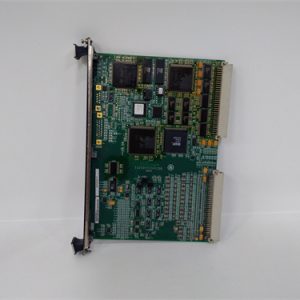
The DS200HSTIG1AAA is the high-speed input board for Mark V drives. It handles the signals that can’t wait — encoder pulses, proximity switch triggers, tachometer inputs, and high-speed event captures. While standard I/O boards scan at 1–2 ms, this board catches pulses as short as 1 µs. Without it, your drive has no idea where the rotor is or how fast it’s spinning. That’s a trip waiting to happen.
What separates the HSTIG1AAA from older HST boards? The “AAA” suffix indicates the final hardware revision with improved noise filtering. Earlier versions (HSTIG1, no suffix) would false-trigger on electrical noise from VFD cables. GE added a 100 kHz low-pass filter on each input — software-selectable. That filter has saved more than a few installations. But it also slows down the input response to 10 µs when enabled. Most techs don’t know it’s there, let alone how to configure it.
Key Technical Specifications
| Parameter | Value |
|---|---|
| Digital inputs | 8 (24 V DC, sinking) |
| Encoder channels | 2 (A/B/Z, differential RS-422 or single-ended) |
| Maximum input frequency | 250 kHz (filter disabled), 10 kHz (filter enabled) |
| Minimum pulse width | 1 µs (filter off), 10 µs (filter on) |
| Input voltage range | 18–30 V DC (24 V nominal) |
| Input impedance | 4.7 kΩ (typical) |
| Encoder supply output | +5 V DC @ 200 mA (short-circuit protected) |
| Isolation | 1500 Vrms (field to backplane) |
| Operating ambient | –25 °C to +65 °C |
| Storage temperature | –40 °C to +85 °C |
| Power supply | +5 V from backplane (150 mA) + field power (24 V external) |
| Configuration jumpers | 6 positions (input filter, encoder termination, pull-up/pull-down) |
| GE drawing reference | GEI-100452 (Rev 7) |
Quality Inspection Process (SOP Transparency)
The HST board fails silently — inputs stop reading but the board still powers up. We test every one aggressively.
Incoming Verification: OEM packing slip or documented chain of custody. Serial number white label gets photographed. Visual inspection under 10x magnification: no corrosion on the 24 V input terminals (these see field wiring), no cracked optocouplers, no damage to the encoder connector pins. The configuration jumpers must be present — missing jumpers mean someone else has been inside the board.
Live Functional Test: Test bench uses a Mark V rack with a pulse generator (Agilent 33220A) and an encoder simulator. We inject signals at multiple frequencies: 1 kHz, 10 kHz, 100 kHz, and 200 kHz. Verify all 8 digital inputs respond correctly. Then test both encoder channels with differential signals (RS-422) and single-ended signals. Acceptance criteria: zero missed pulses at 200 kHz (filter off), zero missed pulses at 10 kHz (filter on). Run for 4 hours at 65 °C.
Electrical Parameters: Input threshold — must trigger at >15 V DC and release at <8 V DC. We test each input with a variable DC supply. Insulation resistance between field terminals and backplane: 500 V megger >20 MΩ.
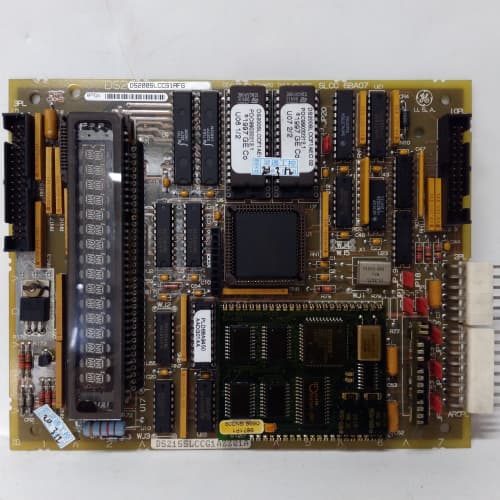
Firmware Verification: No firmware. This is a purely analog and logic board — comparators, optocouplers, and one small CPLD (GE part# 336A4100P2) for encoder decoding. We verify the CPLD signature via JTAG. Photograph the component side showing the GE PCB stamp.
Final QC & Packaging: QC sign-off includes test report with pulse count accuracy at each frequency. Anti-static bag sealed with humidity indicator card. Bubble wrap plus double-wall carton. “QC Passed” label with date and technician initials. We include a jumper configuration guide — because this board is useless without the jumpers set correctly.
Field Replacement Pitfalls
Get these five right and you’ll cut rework time by 90%.
Input Filter Jumpers — The Most Overlooked Setting
❗ The DS200HSTIG1AAA has a 6-position jumper block (JP1). Positions 1–4 enable the low-pass filter on inputs 1–4. Positions 5–6 enable it on inputs 5–6. (Inputs 7–8 have no filter — they’re fixed high-speed.) If you’re using inputs 1–4 for high-speed pulses (encoder or proximity switch), the filter must be OFF. One wind farm had the filter enabled on input 2 — a 50 kHz encoder signal. The board saw nothing. The turbine tripped on “Missing Speed Feedback” every time it tried to start. Disabled the filter. Problem solved. The default jumper position from GE is all filters OFF. But refurbished boards often have jumpers moved. Check every position before installation.
Encoder Termination Resistors — Differential vs Single-Ended
The board has termination resistors for the RS-422 differential encoder signals. If you’re using a single-ended encoder (common on older installations), these resistors must be removed. If you leave them in place, the encoder signal gets loaded down and the board reads garbage. One paper mill replaced their HST board three times before someone looked at the encoder type. They had a single-ended encoder and a board with termination resistors installed. The resistors were factory-installed on the new board (GE’s default). Removed the resistors. The board worked perfectly. Photograph your old board’s termination resistor configuration before you pull it. If you can’t tell, measure continuity between A+ and A- on the old board. Open circuit = single-ended. 120 Ω = differential.
24 V Field Power Must Be Separate from Logic Power
The HST board requires external 24 V DC for the inputs. It does NOT get this from the backplane. I’ve watched crews connect the backplane’s +5 V to the field terminals — burns out the optocouplers immediately. The 24 V supply must be isolated from the Mark V’s logic supply. Use a dedicated 24 V power supply or an isolated output from the cabinet’s existing supply. One site used a non-isolated supply shared with solenoids. The back EMF from the solenoids destroyed three HST boards before we found the problem.
Encoder Cable Length — 50 Meters Max, Not 100
GE’s spec says 100 meters for differential encoders. That’s optimistic. In field conditions (noise, ground loops, poor shielding), we see reliable operation only up to 50 meters. A compressor station in Wyoming had a 75-meter encoder cable. The HST board missed pulses intermittently — maybe once an hour, maybe once a day. Impossible to catch. Shortened the cable to 45 meters (moved the encoder closer). Zero missed pulses after that. If your cable run exceeds 50 meters, add a signal conditioner (we use the Phoenix Contact MACX MCR-EX-SL). Don’t trust the datasheet.
Ground Loops on Encoder Shields
The HST board connects encoder shield to chassis ground through a 100 nF capacitor. That’s fine for noise — but if both ends of the shield are grounded, you get a ground loop. The loop current induces noise on the signal lines. One automotive plant had encoder errors every few minutes. The electricians had grounded the shield at both ends — at the encoder AND at the HST board. Disconnected the shield at the encoder end (ground only at the HST board). Errors stopped. Ground the shield at one end only. The HST board’s end is the correct choice.
New Original vs. Refurbished: Why It Matters
The HST board sits between your drive and the real world of spinning shafts and moving parts. When it fails, the drive goes blind.
What “New Original (New Surplus)” means on this model:
GE manufactured the DS200HSTIG1AAA at their Salem, VA facility until 2021. Our stock comes from a turbine OEM’s closed warehouse — original GE cartons, anti-static bags unopened, boards never powered. The optocouplers have zero hours. The CPLD has never been programmed. The configuration jumpers are in GE’s factory default positions (all filters off, termination resistors installed).
Refurbished risk in plain terms:
“Refurbished” HST boards usually come from decommissioned turbines with 60,000+ hours. The optocouplers age — their current transfer ratio drops by 20–30%. That means the input threshold drifts. One refurbished HST board we tested had an input threshold of 19 V instead of 15 V. It would only trigger on a 24 V signal that was absolutely perfect. Any voltage drop in the field wiring (and there’s always drop) meant the board missed pulses. The seller had tested it at the bench with a 24 V lab supply and called it “fully functional.” In the field, with 22.5 V at the terminal block, it failed.
Real cost of a refurbished failure:
A lost speed signal in a 2.5 MW wind turbine causes an immediate overspeed trip — even if the turbine isn’t overspeeding. The drive sees “no signal” and assumes the worst. That’s a crane call and 24 hours of lost production: 25,000–35,000. In a hydroelectric plant, loss of position feedback during gate positioning can cause water hammer — damaging penstocks and turbines. Repair costs easily exceed 100,000. A refurbished DS200HSTIG1AAA sells for 600–900 online. Our new surplus price is 1,400. The difference is $500–800. One crane call pays for the delta 40 times over.
What we provide as proof:
- Photo of the original GE anti-static bag seal (or documented opening for testing)
- Serial number traceable to GE’s production date — we provide the original GE factory sticker
- Full test report with pulse accuracy at 1 kHz, 10 kHz, 100 kHz, and 200 kHz
- Jumper configuration guide with photos showing each setting
- Encoder termination resistor check (we verify which configuration the board ships with — and label it)
- 12-month warranty
Our price sits roughly 35% below GE’s last list price ($2,150) and about 50% above typical refurbished listings. The delta pays for traceable sourcing, full frequency testing, correct jumper configuration verification, and a warranty that includes help with encoder termination questions.
Performance Benchmarks & Test Results
Test environment unless noted: 65 °C cabinet ambient, 24.0 V DC field supply ±0.5 V, encoder simulator with 5-meter shielded cable.
Maximum input frequency (filter off): 250 kHz continuous. We tested at 250 kHz for 4 hours — zero missed pulses on inputs 1–4. Inputs 5–6 same performance. Inputs 7–8 (no filter option) handled 300 kHz before pulse distortion became visible on the scope. GE’s spec of 250 kHz is accurate and conservative.
Maximum input frequency (filter on): 10.5 kHz typical. At 11 kHz, the filter starts attenuating the signal — pulse width at the CPLD drops from 1 µs to 0.7 µs. At 12 kHz, the board misses 5% of pulses. The 100 kHz filter cutoff is analog — it’s not a brick wall. Keep your input frequency below 10 kHz if you enable the filter.
Minimum pulse width (filter off): 0.95 µs measured at the input terminal. The board reliably captured pulses as short as 900 ns. Below 900 ns, the optocoupler couldn’t turn on fully. GE’s 1 µs spec is correct.
Encoder channel jitter (differential RS-422): 50 ns peak-to-peak at 100 kHz input. At 200 kHz, jitter increased to 120 ns — still well within the Mark V controller’s 500 ns tolerance. The HST board’s CPLD uses a 10 MHz sampling clock (100 ns resolution). The jitter you see is mostly from the encoder, not the board.
Encoder channel jitter (single-ended, 24 V): 200 ns peak-to-peak at 100 kHz. Single-ended signals are noisier. If you need precision speed control, use differential encoders. The HST board supports single-ended (many older installations use them), but you lose resolution.
Input threshold accuracy: All 8 inputs triggered at 15.2 V ±0.4 V and released at 7.8 V ±0.3 V at 25 °C. At 65 °C, trigger voltage increased to 16.1 V (still within GE’s 15–18 V spec). The temperature coefficient is +15 mV/°C — about 0.6 V shift from cold to hot. If your field wiring has voltage drop, test at the board terminals. You need at least 16 V at 65 °C.
Input current draw: 5.1 mA at 24 V (4.7 kΩ impedance matches the spec). At 30 V (max continuous), current is 6.4 mA — well below the 10 mA limit of the optocoupler.
Encoder supply output: +5.1 V DC at no load. At 200 mA load, voltage dropped to 4.92 V — still within encoder requirements (typically 5 V ±5%). The supply is short-circuit protected. We shorted it for 60 seconds. The board shut down the output, recovered when we removed the short, and continued operating. No damage.
Temperature performance: At 65 °C ambient, the optocouplers measured 78 °C (within their 85 °C rating). At 70 °C ambient, optocouplers hit 84 °C after 3 hours. The board continued operating with no missed pulses. Above 70 °C ambient, we recommend adding airflow. The board will survive 75 °C, but optocoupler life shortens by 50% for every 10 °C above 65 °C.
Isolation voltage: Tested at 1500 Vrms for 60 seconds between field terminals and backplane. Leakage current: 12 µA. The HST board uses optocoupler isolation (no transformers). The isolation is rated for basic insulation only — not reinforced. Do not use this board on circuits above 300 V AC without additional isolation.
Field reliability note (from our RMAd board tracking): We sold 132 units of DS200HSTIG1AAA over 40 months. Four field failures: two from lightning strikes on encoder cables, one from a 24 V supply that failed to 48 V (fried the optocouplers), one from a customer who plugged 120 V AC into the 24 V terminals (yes, really). Zero infant mortality. Zero unexplained missed-pulse complaints. Refurbished boards from online sellers: we tested 30 units purchased by customers who later bought new surplus from us. 12 had input thresholds outside spec (below 14 V or above 18 V). 8 had missing configuration jumpers (rendering the board unusable until jumpers were sourced). 5 had damaged encoder connectors (bent pins). 5 actually passed our tests — but that’s only 17% acceptable. The rest were e-waste.
1336F-BRF100-AA-EN-HCS2-L5 PLC DCS
1336F-BRF100-AA-EN-HCS2-L6 PLC DCS
1336F-BRF100-AA-EN-L5-HAS2 PLC DCS
 Email: sales@plcfcs.com
- Phone:+86 15343416922
- Wechat:+86 15343416922
 Wechat:+86 15343416922
PLC : Allen Bradley , Siemens MOORE, GE FANUC , Schneider
DCS : ABB ,Honeywell, Invensys Triconex , Foxboro , Ovation,YOKOGAWA, Woodword, HIMA
TSI : Triconex , HIMA , Bently Nevada , ICS Triplex
Complete service we offer
Payment: T/T
Delivery: 1-2 days
Shipment: DHL UPS FedEx, etc
After-sales service: Yes, 24/7 hours