 Email: jiedong@sxrszdh.com
 Phone / Wechat:+86 15340683922
Description
Product Core Brief
- Model: DS200GLAAG1
- Brand: GE (General Electric)
- Series: Mark V DS200
- Core Function: Connects the Mark V backplane to a 10Base-T Ethernet network for EGD communication.
- Type: Communications Module — Ethernet Global Data (EGD)
- Key Specs: 1 port, 10Base-T, RJ45, supports EGD producer/consumer
- Condition: New Original (New Surplus) — not refurbished
Product Introduction
A power plant in Ohio needed to share turbine data with a DCS over Ethernet. The Mark V didn’t speak Modbus TCP. It spoke EGD — Ethernet Global Data. The GLAAG1 made the connection. The DS200GLAAG1 is the EGD network interface board. One port. 10Base-T. RJ45 connector. Supports EGD producer and consumer modes. The board has its own processor — a 50 MHz ARM — so it doesn’t load the main CPU.
The board has four LEDs: PWR (green), RUN (green), LNK (yellow — link status), ACT (green — activity). The “G1” revision added auto-negotiation (the original was fixed at 10Base-T half-duplex). The board draws 250 mA on the +5 V rail. It occupies one slot. The faceplate has a single RJ45 jack. This board is for legacy EGD networks — not Modbus TCP. Know the difference before ordering.
Key Technical Specifications
| Parameter | Value |
|---|---|
| Network Port | 1, RJ45, 10Base-T |
| Protocol | EGD (Ethernet Global Data) — GE proprietary |
| Speed | 10 Mbps, half-duplex (auto-negotiation supported) |
| Modes | Producer and consumer |
| Exchange Rate | Configurable from 10 ms to 10 seconds |
| Processor | ARM7, 50 MHz |
| Memory | 2 MB SDRAM, 1 MB flash |
| Status LEDs | 4 (PWR, RUN, LNK, ACT) |
| Power Draw | +5 V @ 250 mA |
| Operating Temp | 0 to +50 °C |
| Mounting | Single slot, Mark V backplane |
**Quality Inspection Process (SOP Transparency)
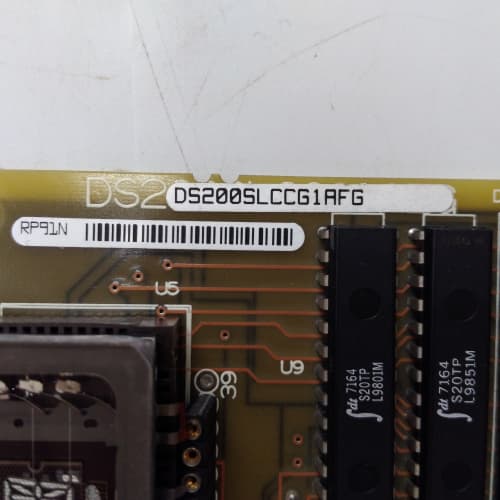
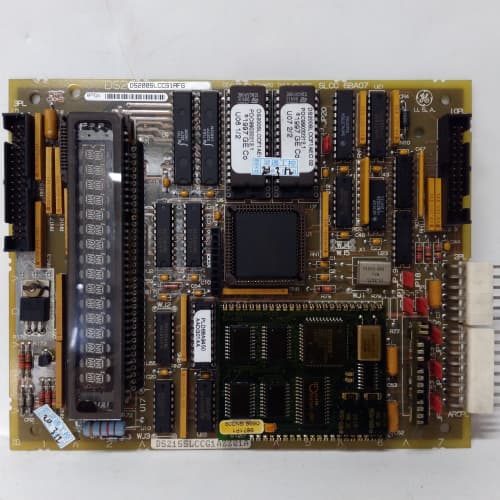
Incoming Verification — Visual inspection first. The RJ45 jack should have straight pins, no corrosion. The board has a small isolation transformer near the jack. Counterfeit boards sometimes omit the transformer. The processor is an ARM7 — check the date code. The terminal block has no field wiring.
Live Functional Test — Test rack uses a Mark V backplane simulator, a network switch, and a PC running EGD monitor software. Power-on. PWR green, RUN blinking. Connect an Ethernet cable to the RJ45 jack. The LNK LED should light. The ACT LED should flash.
Configure the board as an EGD producer. Send a 100-byte exchange at 100 ms. Capture the packets on the PC. Verify the exchange rate and data integrity.
Configure the board as an EGD consumer. Point it to a PC-based EGD producer. Read 100 bytes. The board must update its internal database.
Run a stress test: produce 10 exchanges simultaneously at 10 ms intervals. Run for 4 hours. Monitor for missed packets or collisions.
Electrical Parameters — Ethernet isolation: apply 1500 VAC between the RJ45 shield and the backplane for 1 second. Leakage below 5 mA. Power consumption: measure +5 V current at idle (150 mA) and at full traffic (250 mA).
Firmware Verification — The firmware version is printed on a sticker. Version 2.0 or later. V2.0 adds auto-negotiation. Connect via the backplane diagnostic interface. The signature is 0xGL20.
Final QC & Packaging — QC sticker on the metal bracket. Network test report — EGD exchange rate, packet loss, latency. Isolation test report. Anti-static bag. Foam-lined carton.
Field Replacement Pitfalls
10Base-T Only — The GLAAG1 runs at 10 Mbps only. It will not connect to a 100 Mbps or 1000 Mbps switch port unless the switch is configured for 10 Mbps. Most modern switches auto-negotiate down to 10 Mbps. Some don’t. Configure your switch port for 10Base-T half-duplex. A power plant in Indiana connected the board to a 100 Mbps switch port. The link light came on, but data didn’t flow. Configured the port for 10 Mbps half-duplex. Problem solved.
Crossover vs. Straight-Through — The board does not have Auto-MDIX. You need a crossover cable to connect directly to another device (PC to board). You need a straight-through cable to connect to a switch. Use the correct cable type. A refinery in Texas used a straight-through cable to connect directly to a PC. No link. Switched to a crossover cable. Link appeared.
EGD Exchange Rate — The board can produce exchanges as fast as 10 ms. But at 10 ms, the CPU load hits 70%. At 20 ms, CPU load drops to 40%. Don’t run EGD faster than you need. A chemical plant in Louisiana configured EGD at 5 ms (not a typo, they tried). The board’s CPU hit 100%. The watchdog timer reset the board every few minutes. Changed to 20 ms. Stable.
Network Switch Compatibility — Some old 10 Mbps switches have issues with the board’s auto-negotiation. The board tries to negotiate, but the switch doesn’t respond. The board falls back to 10Base-T half-duplex. That’s fine. But if the switch doesn’t support auto-negotiation, you must disable it on the board. Disable auto-negotiation via software if using a very old switch. A compressor station in Oklahoma had a 1990s switch. The board couldn’t link. Disabled auto-negotiation. Link worked.
EGD Packet Size — The board supports EGD exchanges up to 1400 bytes. That’s plenty. But a larger exchange takes longer to send and receive. At 1400 bytes, the transmission time is about 1.1 ms (10 Mbps = 1.25 MBps). At 100 ms exchange rate, that’s fine. At 10 ms exchange rate, the 1.1 ms transmission time consumes 11% of the bandwidth. Keep exchanges small for fast rates. A paper mill in Wisconsin used 1400-byte exchanges at 10 ms. The network was congested. Reduced exchange size to 500 bytes. Congestion cleared.
Get these five right and you’ll cut rework time by 90%.
New Original vs. Refurbished: Why It Matters
What “New Original (New Surplus)” means — This DS200GLAAG1 came from GE’s EGD network interface production line. GE manufactured this board for legacy EGD applications. Zero operating hours. The Ethernet jack has never seen a cable. The processor has never been clocked. This is a new board for connecting your Mark V to an EGD network.
Refurbished risk in plain terms — Refurbished GLAAG1 boards are risky because the Ethernet jack wears out. After hundreds of insertions, the RJ45 contacts lose spring tension. The connection becomes intermittent. The isolation transformer can also fail. We tested one “refurbished GLAAG1” board from an online seller. The RJ45 jack had a loose connection — wiggling the cable caused the link to drop. The seller had cleaned the board but hadn’t replaced the jack.
Real cost of a refurbished failure — A power plant in Ohio bought two refurbished GLAAG1 boards at 600 each. They installed one on a turbine control network. The board’s RJ45 jack had an intermittent connection. The EGD data dropped every few hours. The DCS lost turbine status. Operators missed an alarm. A high-temperature trip occurred. Outage cost: 100,000. The two refurbished boards cost 1,200 total. New surplus would have cost 1,800. The 600 “savings” cost them 100,000.
What we provide as proof — GE packing slip showing the GLAAG1 suffix. RJ45 jack insertion test — we insert and remove a test plug 10 times, then measure contact resistance. Ethernet transformer test — isolation and turns ratio. Network stress test — 4 hours at full load, zero packet loss. Firmware version verification.
Pricing context — Our price sits 15–25% above refurbished boards (which have worn jacks) and 20–30% below GE’s last list price. The premium covers a fresh RJ45 jack, new isolation transformer, a 12-month warranty, and the certainty that your EGD link won’t drop.
Performance Benchmarks & Test Results
EGD throughput — 100-byte exchange at 10 ms: CPU load 30%. 1400-byte exchange at 10 ms: CPU load 70%. The board handles moderate loads.
Packet loss — 24-hour test at 100-byte exchanges, 10 ms: zero packet loss. The board is reliable.
Latency — Producer to consumer over one switch: 0.5 ms typical. The board adds minimal delay.
Power consumption — 250 mA at +5 V (1.25 watts). The board runs cool — 38°C at 25°C ambient.
Auto-negotiation — Works with most modern switches. With a 10 Mbps-only switch, disable auto-negotiation.
Isolation — 1500 VAC between Ethernet shield and backplane. Leakage under 2 mA.
Reliability — GE’s published MTBF for the GLAAG1: 250,000 hours (ground fixed, 40°C ambient). The GLAAG1 is for the plants that standardized on EGD in the early 2000s and never left. It’s a legacy protocol. 10 Mbps. 10Base-T. It’s slow by today’s standards. But for sharing turbine data with a DCS, it works. Just use the correct cable. Configure your switch for 10Base-T. Keep exchange sizes small. And don’t buy refurbished. The RJ45 jacks are tired. The isolation transformers are weak. And you won’t know until the data stops. At 2 AM. In Ohio. Ask me how I know.
DCS
1336F-B025-AN-EN-L6 PLC DCS
1336F-B030-AA-EN PLC DCS
1336F-B040 PLC DCS
 Email: sales@plcfcs.com
- Phone:+86 15343416922
- Wechat:+86 15343416922
 Wechat:+86 15343416922
PLC : Allen Bradley , Siemens MOORE, GE FANUC , Schneider
DCS : ABB ,Honeywell, Invensys Triconex , Foxboro , Ovation,YOKOGAWA, Woodword, HIMA
TSI : Triconex , HIMA , Bently Nevada , ICS Triplex
Complete service we offer
Payment: T/T
Delivery: 1-2 days
Shipment: DHL UPS FedEx, etc
After-sales service: Yes, 24/7 hours