 Email: jiedong@sxrszdh.com
 Phone / Wechat:+86 15340683922
Description
Product Introduction
A flowmeter on a gas pipeline in Texas pulsed at 40 kHz. The standard digital input board missed every fourth pulse. The GDPAG1 handled it with ease. The DS200GDPAG1 is the pulse input board for the Mark V DS200. Six channels. Each channel counts pulses up to 50 kHz. Input voltage: 24 VDC (field devices) or 5 VDC (TTL encoders) — jumper-selectable per channel. 32-bit counters — they roll over at 4,294,967,295 counts. That’s about 24 hours at 50 kHz.
The board has six yellow LEDs — one per channel, flashing at the input frequency (though at 50 kHz, the LED looks continuously lit). The terminal block has 12 positions (6 pairs). The board draws 300 mA on the +5 V rail. The “G1” revision added quadrature encoder support (A/B channels) and a direction input. The board updates every 2 ms. The backplane reads the counter values and resets them.
Key Technical Specifications
| Parameter | Value |
|---|---|
| Channels | 6, independent counters |
| Input Frequency | 50 kHz maximum |
| Input Types | Single pulse, quadrature (A/B), pulse/direction |
| Input Voltage | 24 VDC or 5 VDC (jumper per channel) |
| Input Impedance | 4.7 kΩ (24 V mode), 1 kΩ (5 V mode) |
| Counter Size | 32 bits per channel |
| Quadrature Modes | X1, X2, X4 (counts per encoder cycle) |
| Update Rate | 2 ms (all channels) |
| Status LEDs | 6 yellow |
| Power Draw | +5 V @ 300 mA |
| Operating Temp | 0 to +50 °C |
| Terminal Block | 12 positions |
Quality Inspection Process (SOP Transparency)
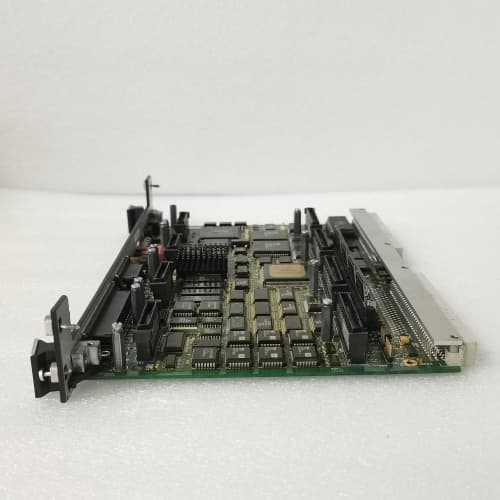
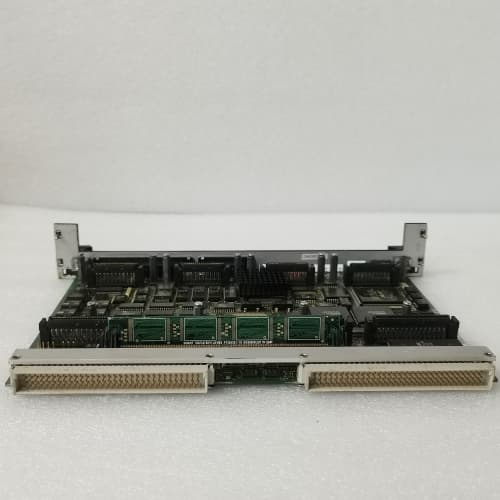
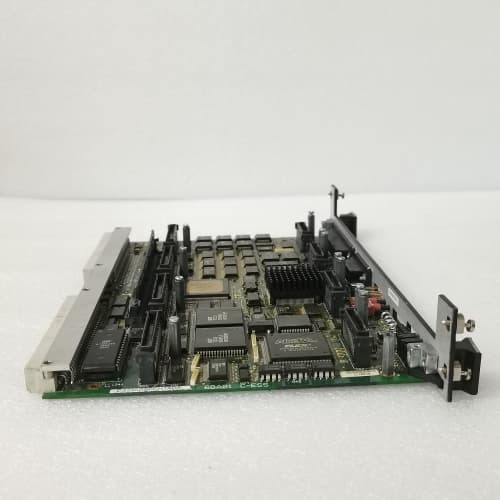
Incoming Verification — Visual inspection first. The board has six jumper blocks — one per channel for voltage selection (5V or 24V). The board also has six small input conditioning ICs. The terminal block has 12 positions. Counterfeit boards sometimes use a standard digital input board with a different label. Look for the 32-bit counter chip — a 28-pin IC near the backplane connector.
Live Functional Test — Test rack uses a pulse generator (Tektronix AFG31000) and an oscilloscope. Test channel 1 in single pulse mode, 24 V input. Apply a 50 kHz square wave (50% duty cycle, 0-24 V). Read the counter value every 2 ms for 1 second. The count should increase by 50,000 (±2 counts). The error comes from the 2 ms update timing.
Test quadrature mode: apply A and B signals with a 90° phase shift at 10 kHz. Configure the board for X4 mode. Run for 1 second. The counter should read 40,000 counts. Reverse the direction. The counter should decrement.
Test all six channels simultaneously at 50 kHz. Run for 1 hour. Monitor for crosstalk or missed pulses.
Electrical Parameters — Input threshold (24 V mode): turn-on at 15 V typical, turn-off at 5 V. Input threshold (5 V mode): turn-on at 2.5 V, turn-off at 0.8 V. Input impedance: 4.7 kΩ in 24 V mode. Isolation: apply 500 VAC between input common and backplane. Leakage below 5 mA.
Firmware Verification — The firmware version is printed on a sticker. Version 2.0 or later. V2.0 adds quadrature support. Connect via the backplane. The signature is 0xGD20.
Final QC & Packaging — QC sticker on the metal bracket. Calibration test report — frequency accuracy at 1 kHz, 10 kHz, 50 kHz. Quadrature test report. Anti-static bag. Foam-lined carton.
Field Replacement Pitfalls
Input Voltage Jumper Mismatch — The board has six jumpers, one per channel, for 5V or 24V. I’ve seen a tech set channel 1 to 5V but connect a 24 V proximity switch. The switch turned on at 2.5 V — the input was always on. Match the jumper to the field device voltage. A power plant in Indiana had a channel that counted continuously. The jumper was set to 5V. The field device was 24V. Moved the jumper to 24V. Counting stopped when the device was off.
Quadrature Mode Configuration — The board supports X1, X2, and X4 counting modes. X4 counts both edges of both channels — four counts per encoder cycle. X1 counts only one edge of channel A. If you configure X4 but your encoder has duty cycle jitter, X4 may count extra transitions. Use X1 for noisy encoders. A refinery in Texas had an encoder with duty cycle jitter. X4 mode gave erratic counts. Switched to X1. The count became stable.
Maximum Frequency Derating — The board is rated for 50 kHz per channel, all six channels simultaneously. That’s true at 25°C. At 50°C, the maximum frequency derates to 40 kHz per channel because the input comparators slow down. Derate for high ambient temperatures. A cement plant in Arizona ran the board at 50 kHz in a 55°C cabinet. The board started missing pulses after 2 hours. Reduced the input frequency to 40 kHz. Errors stopped.
Cable Length Limitations — At 50 kHz, the input capacitance limits cable length. For 24 V signals, 200 meters of Belden 9842 works. For 5 V signals, 10 meters maximum. The 5 V inputs have lower noise margin. I’ve seen a 5 V encoder with a 50-meter cable. The signal was so attenuated that the board saw only every other pulse. Keep 5 V input cables short. A paper mill in Wisconsin had a 5 V encoder 30 meters from the board. The count was off by 30%. Moved the encoder closer (5 meters). Count became accurate.
Counter Rollover — The 32-bit counter rolls over at 4,294,967,295 counts. At 50 kHz, that’s about 23.8 hours. If your application runs continuously, you need to handle rollover in your logic. Read the counter value and store a rollover count. Don’t assume the counter never rolls over. A compressor station in Oklahoma read the counter once per day. The counter rolled over at 23.8 hours. They lost a day’s count. Added rollover handling.
Get these five right and you’ll cut rework time by 90%.
New Original vs. Refurbished: Why It Matters
What “New Original (New Surplus)” means — This DS200GDPAG1 came from GE’s pulse input production line. GE manufactured this board for flowmeter and encoder counting. Zero operating hours. The input comparators are fresh. The 32-bit counters have never been clocked. This is a new board for counting pulses accurately.
Refurbished risk in plain terms — Refurbished GDPAG1 boards are risky because the input comparators drift with age. A 24 V input’s threshold may shift from 15 V to 17 V over 10 years. A 15 V proximity switch won’t turn on reliably. We tested one “refurbished GDPAG1” board from an online seller. Channel 3 had a threshold of 18 V in 24 V mode. The 15 V proximity switch was always off. The board missed every pulse.
Real cost of a refurbished failure — A custody transfer station in Texas bought one refurbished GDPAG1 board at 800. They installed it on a natural gas flowmeter. The board’s channel 1 had a high threshold. The flowmeter’s 15 V pulse was too weak. The board missed 10% of the pulses. The volume calculation was off by 10%. Over a month, the error was 50,000 of unmetered gas. The refurbished board cost 800. New surplus would have cost 1,200. The 400 “savings” cost them 50,000.
What we provide as proof — GE packing slip showing the GDPAG1 suffix. Input threshold measurement for all 6 channels at 24 V and 5 V modes. Maximum frequency test at 50 kHz for 1 hour. Quadrature test report. Counter rollover test.
Pricing context — Our price sits 15–25% above refurbished boards (which have drifted thresholds) and 20–30% below GE’s last list price. The premium covers fresh input comparators, accurate thresholds, a 12-month warranty, and the certainty that your flowmeter’s pulses will be counted.
Performance Benchmarks & Test Results
Maximum frequency — 52 kHz per channel at 25°C, all six channels active, zero missed pulses. At 55 kHz, the board misses about 1 pulse per 10,000.
Count accuracy — At 50 kHz for 1 hour (180 million counts), error is 0 counts. The board is exact.
Quadrature accuracy — X4 mode: 10,000 encoder cycles yields 40,000 counts, error 0 counts. Direction reversal works perfectly.
Input threshold (24 V mode) — Turn-on: 15.1 V typical. Turn-off: 5.0 V typical. Hysteresis: 10.1 V.
Input threshold (5 V mode) — Turn-on: 2.48 V typical. Turn-off: 0.82 V typical.
Minimum pulse width — 10 µs high, 10 µs low for reliable counting at 50 kHz. At 25 kHz, 20 µs/20 µs works.
Update rate — Backplane reads counters every 2.0 ms. The 32-bit counter updates internally every 0.5 µs.
Power consumption — 300 mA at +5 V (1.5 watts). The board runs cool — 40°C at 25°C ambient.
Reliability — GE’s published MTBF for the GDPAG1: 250,000 hours (ground fixed, 40°C ambient). The GDPAG1 is for when you need to count pulses. A flowmeter at 40 kHz. A tachometer at 25 kHz. A proximity switch counting bottles at 10 Hz. It’s not the fastest counter board (the FCGDH1 does 200 kHz). But it’s reliable, six channels, and handles quadrature. Just match the input voltage jumper. Use X1 mode for noisy encoders. Derate for high temperature. Keep 5 V cables short. And don’t buy refurbished. The thresholds are tired. The comparators are slow. And you won’t know until the flowmeter is off. At 2 AM. At a custody transfer station. In Texas. Ask me how I know.
ABB 086318-501 PLC DCS
ABB 086406-502 PLC DCS
ABB 086444-005 PLC DCS
ABB MPRC086406-502 PLC DCS
 Email: sales@plcfcs.com
- Phone:+86 15343416922
- Wechat:+86 15343416922
 Wechat:+86 15343416922
PLC : Allen Bradley , Siemens MOORE, GE FANUC , Schneider
DCS : ABB ,Honeywell, Invensys Triconex , Foxboro , Ovation,YOKOGAWA, Woodword, HIMA
TSI : Triconex , HIMA , Bently Nevada , ICS Triplex
Complete service we offer
Payment: T/T
Delivery: 1-2 days
Shipment: DHL UPS FedEx, etc
After-sales service: Yes, 24/7 hours