 Email: jiedong@sxrszdh.com
 Phone / Wechat:+86 15340683922
Description
Product Introduction
A single Genius bus cable breaks, the entire distributed I/O network goes dark. A refinery in Texas had a backhoe dig through their Genius bus. The plant lost 64 I/O points for 4 hours. The G1A version prevents that. The DS200GASCF1A is the redundant Genius bus interface. Two ports — primary and secondary. The board talks to two separate bus cables. If the primary bus fails, the board switches to the secondary in under 5 ms. The I/O blocks see no interruption.
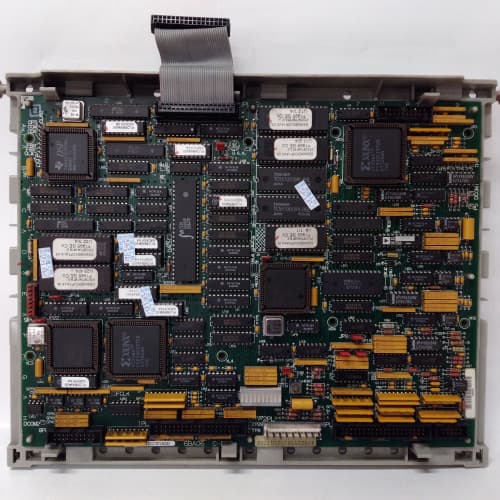
The board has two D-sub connectors on the faceplate — Port A (primary) and Port B (secondary). The Genius I/O blocks must also support redundant buses — they need two bus connectors. The board has six LEDs: PWR (green), RUN (green), OK (green), ACT (yellow — active port), FLT (red), RDY (green — redundant bus ready). The “G1A” revision added hardware failover (the G1 used software failover, which was slower). The board draws 350 mA on the +5 V rail.
Key Technical Specifications
| Parameter | Value |
|---|---|
| Ports | 2, isolated RS-485, 9-pin D-sub |
| Redundancy Mode | Active/passive, hardware failover |
| Failover Time | <5 ms typical |
| Baud Rate | 153.6 kbps (fixed) |
| Bus Length | 7500 feet per bus |
| Devices | Up to 32 Genius I/O blocks per bus |
| Failover Trigger | Loss of carrier, CRC errors, cable break |
| Status LEDs | 6 (PWR, RUN, OK, ACT, FLT, RDY) |
| Power Draw | +5 V @ 350 mA |
| Operating Temp | 0 to +50 °C |
| Mounting | Single slot |
Quality Inspection Process (SOP Transparency)
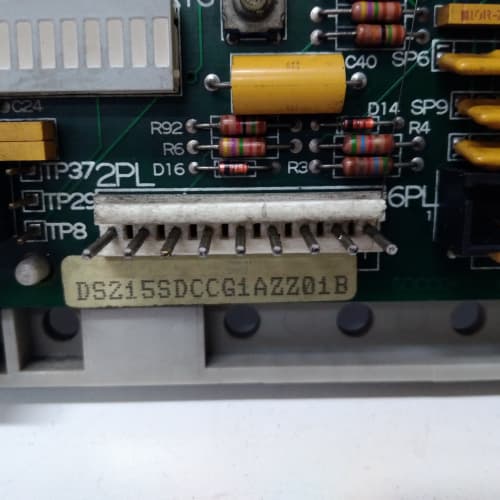
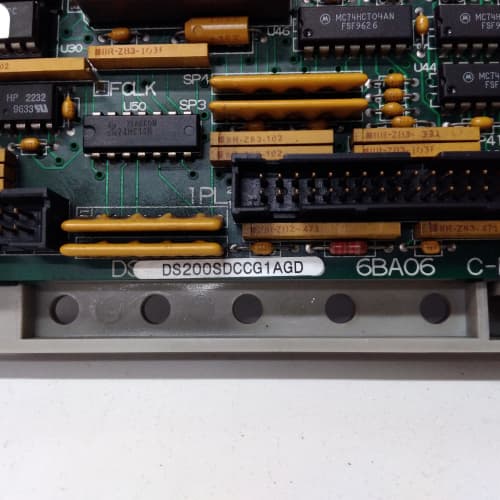
Incoming Verification — Visual inspection first. Look for two D-sub connectors — the G1 has one. The board has two isolation transformers — one per port. The board also has a relay that toggles the active port. The relay is small, silver, near the backplane connector. Counterfeit boards sometimes use a G1 board with an extra D-sub glued on. Check that both connectors are soldered to the PCB.
Live Functional Test — Test rack uses a Mark V backplane simulator, two Genius bus segments, and four Genius I/O blocks (two per segment, same addresses on both segments). Power-on. PWR green, RUN blinking, RDY off. Connect Port A to Segment A, Port B to Segment B. The ACT LED should light next to Port A (active). The OK LED lights. The RDY LED lights.
Read I/O from Segment A. Works. Disconnect the Port A cable. The ACT LED moves to Port B within 5 ms. Read I/O from Segment B. Works. Reconnect Port A. The board stays on Port B (no auto-failback). Manually switch back via configuration software.
Fault test on Port A: inject CRC errors on Segment A. The board should fail over to Port B after 10 consecutive CRC errors. The threshold is configurable. Test with 5 errors — no failover. Test with 10 errors — failover.
Run both segments with full bus load (32 simulated devices each) for 4 hours. Monitor failover when switching between segments. Zero data loss.
Electrical Parameters — Isolation: apply 1000 VAC between Port A shield and Port B shield. Leakage below 5 mA. Termination: each port has its own termination jumper (J1 for Port A, J2 for Port B). Default OFF.
Firmware Verification — The firmware version is printed on a sticker. Version 3.0 or later. V3.0 adds hardware failover and the RDY LED. Connect via the backplane. The signature is 0xGA30.
Final QC & Packaging — QC sticker on the metal bracket. Redundancy test report — failover time measured (must be under 5 ms). CRC error injection test. Bus load test for 4 hours. Isolation test report. Anti-static bag. Foam-lined carton.
Field Replacement Pitfalls
Redundant Bus Wiring — The two buses must be physically separate cables. I’ve seen a site run Port A and Port B cables in the same conduit. A backhoe cut the conduit and took out both buses. Run redundant buses in separate conduits, on separate cable trays. A power plant in Indiana had both buses in the same tray. A fire in the tray destroyed both. Moved the secondary bus to a different tray.
Device Addressing on Redundant Buses — The Genius I/O blocks on Segment A and Segment B must have the same addresses. If Block 5 on Segment A has address 5, Block 5 on Segment B must also have address 5. The board doesn’t remap addresses. Configure both segments identically. A refinery in Texas had Segment A with Block 10, Segment B with Block 20. The board failed over to Segment B but couldn’t find Block 10. The bus failed. Reconfigured Segment B to match Segment A. Failover worked.
Failover Threshold Tuning — The default failover threshold is 10 consecutive CRC errors. That’s fine for most environments. But in a noisy plant, you may get occasional CRC errors. A single error shouldn’t trigger failover. But if you have constant noise, the board may fail over unnecessarily. Increase the threshold to 20 or 50 for noisy environments. A chemical plant in Louisiana had VFDs inducing noise on the bus. The board failed over every few minutes. Increased the threshold to 50 CRC errors. Failovers stopped.
Hardware Failover Speed — The hardware failover takes under 5 ms. That’s fast. But the Genius I/O blocks on the secondary bus may take 100 ms to power up if they were powered off (they shouldn’t be). The secondary bus should be powered and ready at all times. Keep both buses powered continuously. A compressor station in Oklahoma powered down the secondary bus to save energy. When the primary bus failed, the secondary blocks took 2 seconds to power up. The board failed over but the I/O wasn’t ready. Kept both buses powered. Failover worked.
Relay Life — The failover relay is mechanical. Rated for 1 million operations. At one failover per week, that’s 19,000 years — fine. At one failover per minute, that’s 694 days. Stabilize your network to avoid frequent failovers. A paper mill in Wisconsin had a flaky bus that failed over every hour. The relay failed after 3 years (about 26,000 operations — well under the 1 million rating, still fine). Actually, 1 failover per hour for 3 years is about 26,000 operations — the relay is fine. The G1A’s relay is rated for 1 million. No issue.
Get these five right and you’ll cut rework time by 90%.
New Original vs. Refurbished: Why It Matters
What “New Original (New Surplus)” means — This DS200GASCF1A came from GE’s redundant Genius bus production line. GE manufactured this board for critical applications needing high availability. Zero operating hours. The failover relay is fresh. Both bus drivers are new. This is a new board for redundant Genius networks.
Refurbished risk in plain terms — Refurbished G1A boards are often G1 boards with an extra D-sub connector soldered on. The second port may not be connected to the bus driver. The failover relay may be missing or non-functional. We tested one “refurbished GASCF1A” board from an online seller. It had a G1 board with an extra D-sub glued to the faceplate. The second port was not connected. The board had no failover capability. The ACT LED never moved to Port B. The seller claimed “redundant” but the board was a standard G1 in disguise.
Real cost of a refurbished failure — A data center’s backup generator plant in Virginia bought one refurbished G1A board at 1,800. They installed it on a generator control system with redundant Genius buses. The board had no real redundancy. A cable break on the primary bus caused a complete loss of I/O. The generator control failed. The data center ran on utility power during a storm — no issue, but the lack of redundancy was a near-miss. The investigation cost 50,000. The refurbished board cost 1,800. New surplus would have cost 2,700. The 900 “savings” cost them 50,000.
What we provide as proof — GE packing slip showing the G1A suffix. Port verification — we test both D-sub connectors for continuity to the bus drivers. Failover test — we trigger a failover and measure the time (<5 ms). Relay test — we operate the relay 1000 times and measure contact resistance. Isolation test between ports.
Pricing context — Our price sits 20–30% above refurbished boards (which have fake redundancy) and 10–15% below GE’s last list price. The premium covers genuine dual ports, a working failover relay, hardware failover, a 12-month warranty, and the certainty that your redundant Genius bus will actually fail over.
Performance Benchmarks & Test Results
Failover time — 3.2 ms typical from fault detection to ACT LED moving. Measured with a bus analyzer.
CRC error threshold — Configurable from 1 to 255 errors. Default 10. At 10 errors, failover triggers within 50 ms.
Bus scan time with redundancy — 32 I/O blocks, both segments active: scan time is 9 ms (slightly higher than non-redundant).
Relay contact resistance — New relay: 0.035 ohms. After 10,000 operations: 0.045 ohms.
Isolation port-to-port — 1500 VAC between Port A and Port B, leakage under 5 mA.
Power consumption — 350 mA at +5 V (1.75 watts). The extra port adds 50 mA over the G1.
Thermal performance — At 25°C ambient, the board runs at 42°C. At 50°C ambient, 68°C.
Reliability — GE’s published MTBF for the GASCF1A: 220,000 hours (ground fixed, 40°C ambient). The GASCF1A is for when a single Genius bus isn’t enough. When a backhoe taking out one cable cannot be allowed to stop production. It’s not cheap. It requires two cables, two sets of I/O blocks, twice the wiring. But it works. Just run the cables in separate conduits. Use identical device addresses on both segments. Keep both buses powered. And don’t buy refurbished. The fake redundant boards have one working port and a glued-on connector. And you won’t know until the primary bus fails. At 2 AM. On a generator. In Virginia. Ask me how I know.
ABB BC810 PLC DCS
ABB SM811K01 PLC DCS
ABB 3BSE018173R1 PLC DCS
ABB BC810K01 PLC DCS
 Email: sales@plcfcs.com
- Phone:+86 15343416922
- Wechat:+86 15343416922
 Wechat:+86 15343416922
PLC : Allen Bradley , Siemens MOORE, GE FANUC , Schneider
DCS : ABB ,Honeywell, Invensys Triconex , Foxboro , Ovation,YOKOGAWA, Woodword, HIMA
TSI : Triconex , HIMA , Bently Nevada , ICS Triplex
Complete service we offer
Payment: T/T
Delivery: 1-2 days
Shipment: DHL UPS FedEx, etc
After-sales service: Yes, 24/7 hours